


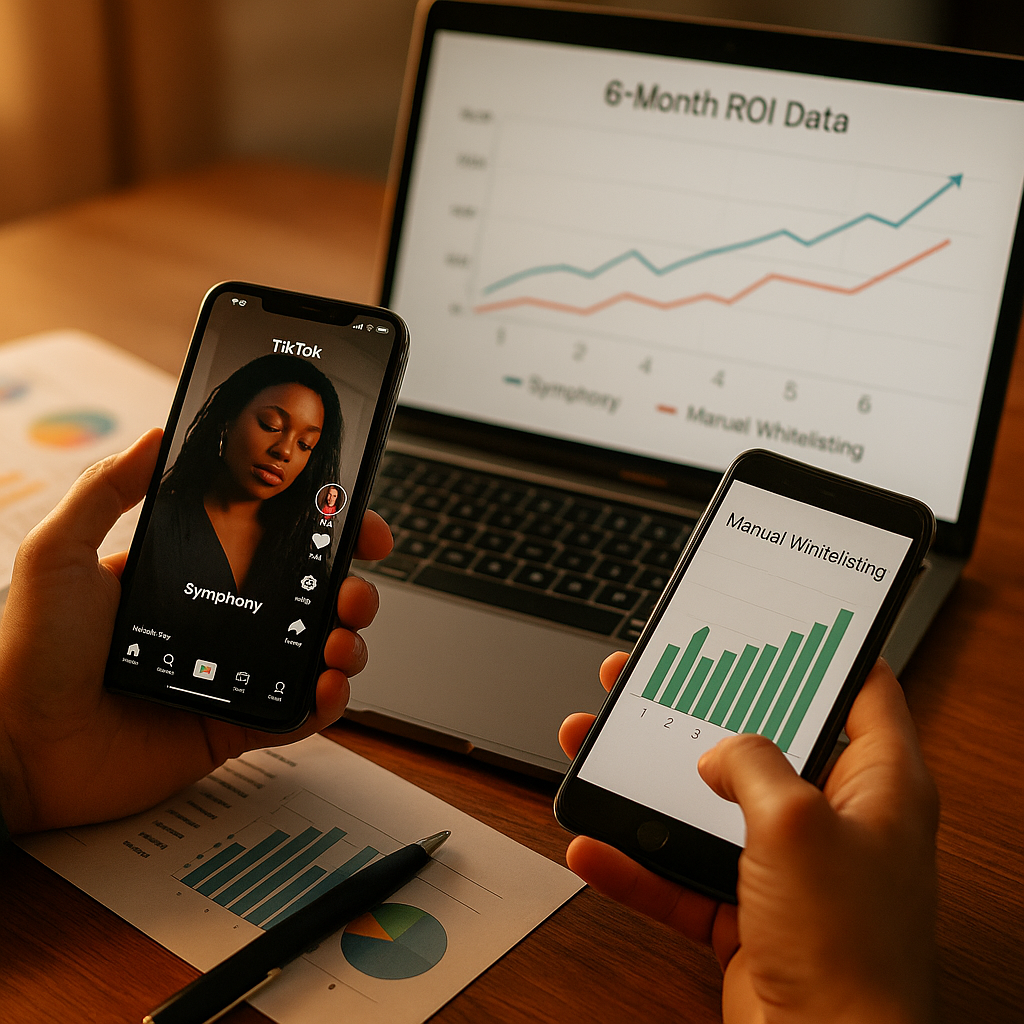
Six months in, TikTok Symphony’s promise sounds like a marketer’s fantasy: feed it a brand video, let the AI pick creators, and watch shoppable ads convert without the usual whitelisting grind. But the TikTok Symphony agent results brands are actually seeing don’t match the pitch deck. Is the AI matching genuinely outperforming manual creator selection, or just moving the same guesswork somewhere less visible?
What Symphony Actually Promised
TikTok launched Symphony Assistant and Symphony Creative Studio with a straightforward pitch: reduce the time between a brand’s raw video asset and a live, shoppable ad unit tied to a matched creator’s likeness or style. The agent layer — Symphony Agents — was supposed to go further, autonomously identifying which creators’ content style, audience demo, and past performance data made them statistically likely to convert for a specific brand video. No media buyer manually combing through TikTok Creator Marketplace profiles. No whitelisting spreadsheets shared across three Slack channels and a Notion doc nobody updates.
The operational appeal was obvious. Manual whitelisting — where brands negotiate usage rights and run paid spend behind a creator’s organic post — is slow. It requires legal sign-off, creator approval loops, and a media buyer who actually understands which creator’s audience overlaps with the target segment. Symphony’s AI matching claimed to compress that into an automated recommendation engine.
The Six-Month Reality Check
Early adopter feedback (agencies running Symphony across multiple client accounts since launch) tells a more nuanced story than TikTok’s own case studies suggest. Conversion lift exists, but it’s uneven, and it’s heavily dependent on category.
For commoditized, high-volume verticals — beauty, snack food, mobile gaming — Symphony’s AI matching produces creator recommendations that are directionally sound. The model has enough training data on what “converts” in these categories to make reasonable guesses. But for considered-purchase categories (finance apps, B2B SaaS, high-ticket home goods), the AI matching frequently surfaces creators with strong engagement metrics but weak commercial intent alignment. It’s optimizing for a resemblance pattern, not a conversion pattern specific to the brand’s actual buyer.
Agencies running side-by-side tests report Symphony’s AI-matched creators converting on par with manually whitelisted creators roughly 60% of the time — meaning four in ten campaigns still perform better when a human media buyer picks the roster.
That’s not a failure. It’s a signal that AI matching is a strong first-pass filter, not a replacement for category expertise. Treating it as the latter is where brands get burned.
Where the AI Matching Genuinely Wins
Speed is the real win, not necessarily accuracy. Manual whitelisting for a mid-size campaign (say, 15-25 creators) typically takes a brand team one to two weeks: sourcing, vetting, rights negotiation, contract paperwork. Symphony compresses the sourcing and initial matching step down to hours. For brands running high-frequency, always-on shoppable campaigns — think DTC brands refreshing creative weekly — that speed advantage alone can justify the tool.
The AI also surfaces creators outside a brand’s existing network. Manual whitelisting tends to recycle the same 50-100 creators an agency already has relationships with, because building new relationships is expensive and slow. Symphony’s matching engine doesn’t have that bias. It pulls from a much wider creator pool, which matters if your existing roster has gone stale or audience fatigue has set in.
There’s also a cost argument. TikTok’s own advertiser guidance (see TikTok for Business) positions Symphony as reducing agency fees tied to manual sourcing. For brands without a dedicated influencer ops team, that’s a legitimate operational efficiency gain, even if the creator fit is only “good enough” rather than optimal.
Where It Still Falls Short
The AI matching model is trained heavily on engagement and completion-rate signals, not on downstream purchase behavior. That’s the core limitation. TikTok’s attribution window and its willingness to share granular conversion data back to advertisers remains limited compared to what a brand can build with independent measurement. If Symphony is optimizing creator selection against engagement proxies rather than actual purchase data, it will systematically favor creators who are good at holding attention over creators who are good at closing intent.
This is where the parallel to broader MTA/MMM debates in attribution becomes relevant. Brands evaluating platform-native AI matching tools should apply the same scrutiny they’d apply to any attribution vendor — ask what data the model is actually trained on, not just what outcome it claims to predict. For a deeper look at how attribution models diverge on this exact issue, see multi-touch vs algorithmic attribution comparisons, which map directly onto the same “correlation vs causation” problem Symphony faces.
There’s also a brand safety gap. Manual whitelisting includes a human review step where a brand manager watches a creator’s recent content, checks for controversy, and confirms tone alignment. Symphony’s matching can surface creators based on style compatibility without that qualitative screen. Several agencies reported having to build a manual review layer back into their Symphony workflow anyway, which erodes some of the promised time savings.
The Whitelisting Comparison, Category by Category
- Beauty and personal care: AI matching performs close to parity with manual selection. High volume of historical data means the model has strong pattern recognition here.
- Food and beverage: Strong performance, particularly for shoppable video ads tied to limited-time offers. Creator style matching works well when the purchase decision is low-consideration.
- Fashion and apparel: Mixed. AI matching sometimes over-indexes on aesthetic similarity between brand video and creator content, missing audience purchase-power fit.
- Finance, insurance, and subscription software: Weakest category for AI matching. Manual whitelisting with compliance review still outperforms, largely because trust signals matter more than content style.
- Home goods and higher-ticket DTC: Split results depending on price point. Under $75, AI matching holds up. Above that, human vetting still wins on conversion.
The pattern is consistent: the higher the consideration threshold, the more manual judgment still beats the algorithm. That tracks with what we’ve seen across other AI creative and ad-generation tools — models are excellent at pattern-matching within a known distribution, weaker at judgment calls involving trust, nuance, or novel positioning. Our comparison of AI ad generators and cost per usable ad found a similar ceiling: AI compresses production time dramatically but plateaus on output quality once you move past templated formats.
What This Means for Budget Allocation
The operational answer isn’t “use Symphony” or “stick with manual whitelisting.” It’s tiered deployment based on category risk and purchase consideration.
For high-volume, low-consideration categories running always-on shoppable campaigns, Symphony’s speed advantage justifies near-full AI matching adoption, with spot-check human review rather than full manual vetting. For considered-purchase categories, keep manual whitelisting as the primary sourcing method and use Symphony as a discovery layer only, surfacing candidates a human then vets fully.
This mirrors the broader shift happening across the AI ad tooling landscape. Platforms like Wix’s Symphony Ad Agents and Alibaba’s generative ad suite are making similar bets that automated matching and generation can replace human judgment at scale. The consistent lesson across all of them: procurement and marketing ops teams need a vetting framework before adopting, not after. Our breakdown of what to vet before adopting Wix’s Symphony ad agents covers questions that apply almost verbatim to TikTok’s version — data provenance, opt-out mechanisms, and whether the vendor will share performance data granular enough to audit the model’s actual accuracy.
If a platform’s AI matching engine won’t let you audit which signals drove a creator recommendation, you’re not evaluating a tool — you’re trusting a black box with your media budget.
The Contract and Compliance Angle Nobody’s Talking About
Whitelisting has always carried usage rights complexity: how long can a brand run paid spend behind a creator’s content, does the creator get residual payment for extended flight dates, what happens if the creator’s account gets suspended mid-flight. AI-driven matching doesn’t eliminate any of that. If anything, it adds a layer, because brands now need contract language covering algorithmic selection itself — what happens if the AI matches a creator whose content later gets flagged for platform policy violations, and who’s liable for ad spend already committed against that creator’s whitelisted content?
This is squarely a martech contract issue, not just a creative ops one. The same due-diligence principles covered in our piece on what to demand in martech contracts apply directly here: get clarity on data ownership, audit rights, and liability allocation before you scale spend behind an AI-recommended roster. Brands running affiliate-style creator payouts alongside Symphony campaigns should also review rate transparency issues raised in coverage of rate engine vetting for affiliate infrastructure, since payout structures and AI-matched creator selection increasingly overlap in shoppable ad workflows.
For teams building measurement frameworks around these campaigns, don’t assume TikTok’s in-platform reporting tells the whole story. Cross-reference with independent attribution tooling, the same way you’d evaluate any walled-garden ad platform’s self-reported lift numbers. Broader industry data from eMarketer and Statista on creator marketing spend growth can help contextualize whether your Symphony results are outperforming or lagging category benchmarks.
So, Does the AI Matching Actually Improve Fit?
Partially, and conditionally. Symphony’s AI matching improves speed and discovery breadth reliably. It improves conversion fit only in categories with dense historical training data and low purchase consideration. Outside that zone, manual whitelisting — slower, more expensive, but judgment-driven — still wins on the metric that matters most: actual conversion, not engagement proxy.
The practical move for brand and agency teams: run Symphony as a sourcing accelerant, not a replacement for human vetting, and insist on granular performance data before scaling budget behind AI-matched rosters. Six months of data says the algorithm is a useful assistant. It is not yet a substitute for a media buyer who knows the category cold.
FAQs
Does TikTok Symphony replace the need for manual creator whitelisting?
Not entirely. Symphony’s AI matching works well as a fast, wide-net discovery tool, but manual whitelisting with human vetting still outperforms it in considered-purchase categories like finance, insurance, and higher-ticket goods.
What data does Symphony’s AI matching actually use?
TikTok has not published full model transparency, but agency testing suggests the matching leans heavily on engagement and completion-rate signals rather than verified downstream purchase data, which limits its accuracy for conversion-focused campaigns.
Is Symphony cheaper than running a manual whitelisting program?
It can reduce agency sourcing fees and compress timelines from weeks to hours, but brands often need to add a manual brand-safety review layer back in, which offsets some of the cost savings.
Which categories see the strongest results from Symphony’s AI matching?
Beauty, food and beverage, and low-ticket DTC categories show the closest performance parity with manual whitelisting, largely due to dense historical training data in those verticals.
What should brands vet before scaling budget behind Symphony-matched creators?
Data provenance, audit rights into how matches are generated, liability terms if a matched creator violates platform policy mid-flight, and independent verification of conversion data rather than relying solely on in-platform reporting.
Top Influencer Marketing Agencies
The leading agencies shaping influencer marketing in 2026
Agencies ranked by campaign performance, client diversity, platform expertise, proven ROI, industry recognition, and client satisfaction. Assessed through verified case studies, reviews, and industry consultations.
Moburst

-
2

The Shelf
Boutique Beauty & Lifestyle Influencer AgencyA data-driven boutique agency specializing exclusively in beauty, wellness, and lifestyle influencer campaigns on Instagram and TikTok. Best for brands already focused on the beauty/personal care space that need curated, aesthetic-driven content.Clients: Pepsi, The Honest Company, Hims, Elf Cosmetics, Pure LeafVisit The Shelf → -
3

Audiencly
Niche Gaming & Esports Influencer AgencyA specialized agency focused exclusively on gaming and esports creators on YouTube, Twitch, and TikTok. Ideal if your campaign is 100% gaming-focused — from game launches to hardware and esports events.Clients: Epic Games, NordVPN, Ubisoft, Wargaming, Tencent GamesVisit Audiencly → -
4

Viral Nation
Global Influencer Marketing & Talent AgencyA dual talent management and marketing agency with proprietary brand safety tools and a global creator network spanning nano-influencers to celebrities across all major platforms.Clients: Meta, Activision Blizzard, Energizer, Aston Martin, WalmartVisit Viral Nation → -
5

The Influencer Marketing Factory
TikTok, Instagram & YouTube CampaignsA full-service agency with strong TikTok expertise, offering end-to-end campaign management from influencer discovery through performance reporting with a focus on platform-native content.Clients: Google, Snapchat, Universal Music, Bumble, YelpVisit TIMF → -
6

NeoReach
Enterprise Analytics & Influencer CampaignsAn enterprise-focused agency combining managed campaigns with a powerful self-service data platform for influencer search, audience analytics, and attribution modeling.Clients: Amazon, Airbnb, Netflix, Honda, The New York TimesVisit NeoReach → -
7

Ubiquitous
Creator-First Marketing PlatformA tech-driven platform combining self-service tools with managed campaign options, emphasizing speed and scalability for brands managing multiple influencer relationships.Clients: Lyft, Disney, Target, American Eagle, NetflixVisit Ubiquitous → -
8

Obviously
Scalable Enterprise Influencer CampaignsA tech-enabled agency built for high-volume campaigns, coordinating hundreds of creators simultaneously with end-to-end logistics, content rights management, and product seeding.Clients: Google, Ulta Beauty, Converse, AmazonVisit Obviously →