


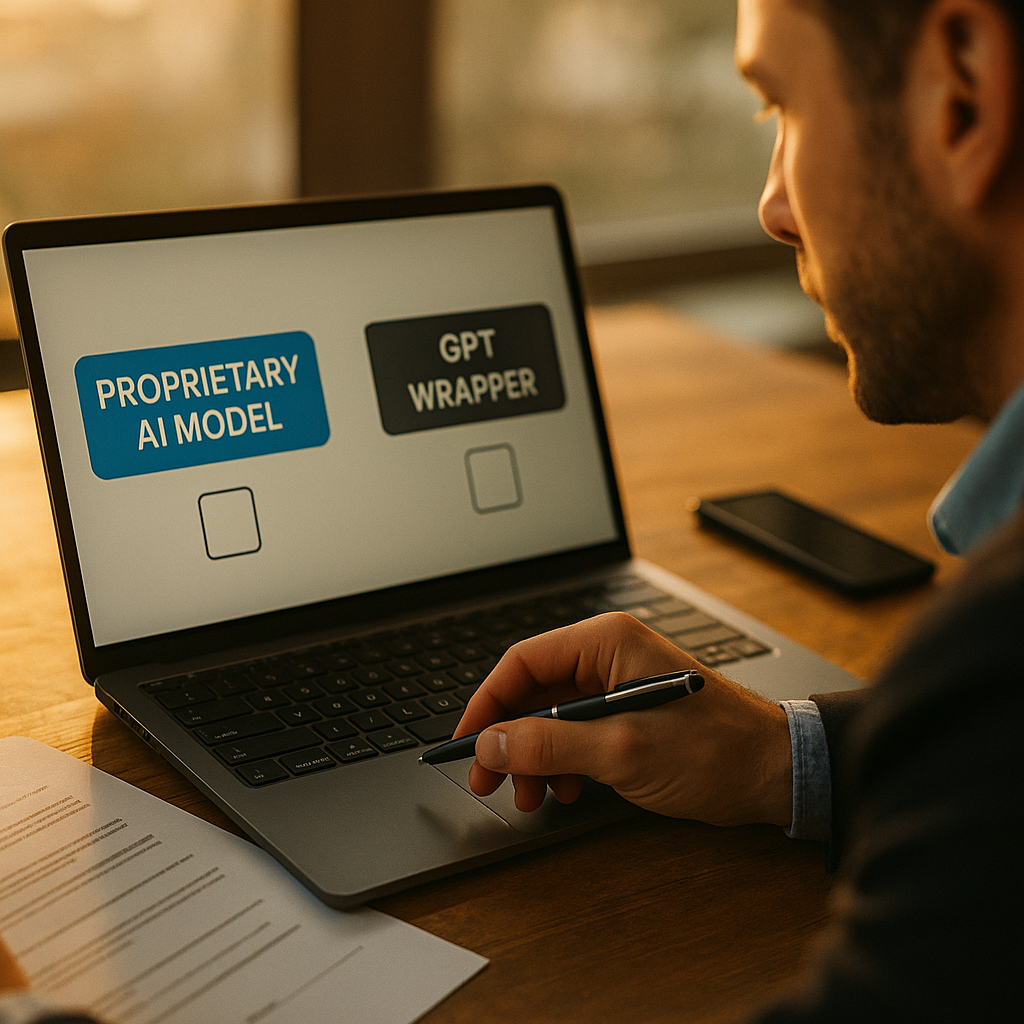
Ask any AI vendor if their model is “proprietary” and watch what happens. Nine times out of ten, you’ll get a confident yes and a vague answer about “custom fine-tuning.” AI vendor claims of proprietary technology have become the marketing equivalent of “clean beauty,” a phrase that sounds meaningful and means almost nothing until someone forces a definition. If your renewal is coming up, that definition matters more than ever.
Marketing teams are now running dozens of AI tools inside their stack: content generation, campaign optimization, social listening, creative testing. Budgets for these tools have ballooned, and renewal season is when the real accounting happens. The uncomfortable question every CMO should be asking: are we paying a premium for genuine proprietary infrastructure, or are we paying markup on a GPT wrapper with a nice UI?
Why This Distinction Actually Matters for Your Budget
A wrapper isn’t inherently bad. Plenty of useful tools are thin interfaces on top of OpenAI, Anthropic, or Google models, and there’s nothing dishonest about that if the vendor is upfront about it. The problem is pricing and risk. If you’re paying $8,000 a month for something that’s functionally a prompt template calling GPT-4o through an API, you’re paying for convenience and workflow, not for model IP. That’s a fine trade if you know that’s what you’re buying. It’s a terrible one if you were sold “proprietary AI” and priced accordingly.
There’s also a resilience issue. Wrapper tools live and die by their underlying model provider’s roadmap, pricing changes, and rate limits. When OpenAI adjusts API pricing or deprecates a model version, every wrapper built on it either absorbs the cost or passes it to you. A team that audited AI marketing agents found that a huge share of failures traced back to exactly this kind of brittle, dependency-heavy architecture rather than any flaw in the marketing logic itself.
If a vendor can’t explain, in plain language, what happens to your product when their upstream model provider changes terms, you don’t have a vendor relationship. You have a dependency you didn’t know you signed up for.
The Questions Vendors Hope You Won’t Ask
Most procurement conversations stay comfortably surface level. Renewal season is the time to get uncomfortable. Here’s what actually separates a proprietary model claim from marketing fluff:
- Which foundation model powers this, and is it disclosed anywhere in your terms of service or technical documentation? If the answer is buried or absent, that’s informative on its own.
- What specifically was fine-tuned, and on what data? Fine-tuning a base model on your industry’s data is a legitimate value-add. Calling that “proprietary AI” without disclosing the base model is a stretch.
- Can you show us model weights, training infrastructure, or at minimum a technical whitepaper? Real proprietary model shops, even small ones, usually have documentation because investors and enterprise buyers ask for it constantly.
- What happens if [OpenAI/Anthropic/Google] changes API pricing or access tomorrow? Watch for hesitation here. It tells you how exposed their margins, and your service continuity, really are.
- Do you retrain or only prompt-engineer? Prompt engineering on a general model is not the same as training a domain-specific model, even if outputs look similar on a demo call.
Vendors who built something real tend to answer these fast, because they’ve answered them before for investors and enterprise security reviews. Vendors selling a wrapper tend to pivot to outcomes: “look at the results we drive,” “our clients see 3x engagement.” Results matter, sure, but they’re not evidence of proprietary architecture. A well-crafted prompt chain can produce great results too.
Reading the Contract, Not Just the Pitch Deck
The sales deck is theater. The contract and technical documentation are where the truth lives. Three things to check before you sign a renewal:
- Data processing addendums. If your vendor routes prompts through a third-party model API, your data (including customer PII if you’re not careful) may be transiting through OpenAI or Anthropic’s infrastructure too. Check whether that’s disclosed and whether it complies with your existing data governance policy.
- Uptime and dependency clauses. Does the SLA account for upstream model provider outages? A wrapper vendor has zero control over an OpenAI outage, so their SLA should reflect that honestly.
- IP ownership language. If the vendor claims proprietary model IP but the contract’s IP section is silent on model architecture, that’s a red flag worth raising with legal before renewal, not after.
This isn’t paranoia, it’s the same rigor teams are already applying to agentic AI media buying governance, where roughly one in six autonomous bids fail compliance checks because nobody validated the underlying decision logic. Model provenance deserves the same scrutiny as bid logic. Both are black boxes until someone opens them.
A Simple Test: The Model Swap Question
Here’s a practical diagnostic. Ask your vendor: “If OpenAI raised API prices 40% tomorrow, what would change for us?” A genuine proprietary model company might shrug, because they own their infrastructure and aren’t exposed to that pricing swing. A wrapper company will either dodge the question or admit pricing would need to shift. Neither answer is disqualifying on its own, wrapper businesses can be perfectly good vendors, but the answer tells you what you’re actually buying and whether the price reflects it.
Run this test alongside a broader capability audit. Teams that have done speed claim verification on AI briefing tools found that vendor-reported benchmarks rarely survive independent replication. The same skepticism applies here. Ask for a live demo where you control the inputs, not a curated case study.
What “Proprietary” Should Actually Mean
To be fair to vendors, proprietary doesn’t have to mean “we built a foundation model from scratch.” That’s an unrealistic bar for almost everyone outside the handful of companies with billion-dollar compute budgets. Legitimate proprietary claims usually fall into one of these categories:
- A fine-tuned model trained on a genuinely unique, licensed, or proprietary dataset (customer behavior data, industry-specific corpora, first-party creative performance data)
- Proprietary orchestration layers that combine multiple models, retrieval systems, and business logic in ways that materially outperform a naive single-model approach
- Custom evaluation and guardrail systems that reduce hallucination or bias in ways generic APIs don’t
None of that requires owning a foundation model. But it does require the vendor to be specific about what’s custom and what’s off-the-shelf. Vague language like “our advanced AI engine” without any of the above specifics should trigger scrutiny, especially at renewal when leverage shifts back to you.
This same discipline shows up in how serious teams evaluate autonomous AI marketing tools before handing over budget authority. The checklist isn’t just “does it work,” it’s “do we understand why it works, and what breaks it.”
What Happens If You Skip This Audit
Skipping this step doesn’t just risk overpaying, it risks compliance exposure too. The Federal Trade Commission has increasingly scrutinized AI-washing, where companies overstate their AI capabilities to investors, customers, or partners. If your vendor’s marketing claims don’t match their actual architecture and that surfaces in an audit or a client-facing dispute, your brand’s name is attached to that vendor relationship. Marketing leaders signing off on AI tool renewals are effectively vouching for those vendors’ claims internally.
There’s also a data monitoring angle worth flagging. Research on AI training data monitoring found that most marketing teams aren’t tracking what data feeds their AI tools’ outputs at all. If you don’t know whether your vendor’s “proprietary model” was trained on your data, competitor data, or scraped web content, you’re carrying legal exposure you haven’t priced in.
Renewal negotiations are the one moment in the vendor relationship where you have real leverage. Use it to demand technical transparency, not just a discount.
Building the Audit Into Your Renewal Cycle
Don’t treat this as a one-time investigation. Bake it into procurement process permanently. A few operational moves that make this sustainable:
- Require a technical disclosure form as part of every AI vendor contract, renewed annually, not just at initial onboarding.
- Loop in IT or data governance teams before marketing signs any AI tool renewal above a set spend threshold.
- Benchmark vendor performance claims independently rather than trusting vendor-supplied case studies, the same way you’d fact-check any other B2B sales claim.
- Ask for a model change notification clause, so you’re alerted if the vendor swaps their underlying model (a common and often undisclosed practice).
According to industry analysts tracking enterprise AI spend, marketing technology budgets allocated to AI tools have grown sharply, and vendor consolidation is accelerating as buyers get pickier about what they’re actually paying for. That consolidation trend favors teams who ask hard questions now, before renewal locks them in for another cycle.
FAQs
Frequently Asked Questions
What’s the difference between a proprietary AI model and a GPT wrapper?
A proprietary model is trained or substantially fine-tuned on unique data and infrastructure the vendor owns or controls. A GPT wrapper is a product built on top of a third-party model like GPT-4o or Claude, adding a user interface, prompt engineering, and workflow features without owning the underlying model itself.
Is it bad to use a GPT wrapper tool for marketing?
Not inherently. Many wrapper tools deliver real value through workflow design and integration, not model ownership. The issue arises when pricing or marketing implies proprietary model IP that doesn’t exist, which can lead to overpaying or misjudging vendor risk exposure.
How can I verify a vendor’s proprietary model claims before renewal?
Ask directly which foundation model powers the product, request technical documentation or a whitepaper, and test how the vendor answers questions about upstream pricing changes or outages. Genuine proprietary model companies typically have documentation ready because enterprise buyers ask for it regularly.
What contract terms should marketing teams check for AI vendor renewals?
Review data processing addendums for third-party model routing, SLA language covering upstream provider outages, and IP ownership clauses. Also request a model change notification clause so you’re informed if the vendor swaps the underlying model without notice.
Why does this distinction matter for compliance and risk?
Regulators including the FTC have scrutinized AI-washing, where vendors overstate AI capabilities. If a vendor’s claims don’t match its actual architecture and that becomes public through a dispute or audit, the brands using that vendor share reputational and legal exposure.
Before you sign that renewal, put the model-swap question and the technical disclosure request in writing, and make the vendor answer both before the invoice goes through. If they can’t, that’s your answer about what you’ve really been paying for.
Top Influencer Marketing Agencies
The leading agencies shaping influencer marketing in 2026
Agencies ranked by campaign performance, client diversity, platform expertise, proven ROI, industry recognition, and client satisfaction. Assessed through verified case studies, reviews, and industry consultations.
Moburst

-
2

The Shelf
Boutique Beauty & Lifestyle Influencer AgencyA data-driven boutique agency specializing exclusively in beauty, wellness, and lifestyle influencer campaigns on Instagram and TikTok. Best for brands already focused on the beauty/personal care space that need curated, aesthetic-driven content.Clients: Pepsi, The Honest Company, Hims, Elf Cosmetics, Pure LeafVisit The Shelf → -
3

Audiencly
Niche Gaming & Esports Influencer AgencyA specialized agency focused exclusively on gaming and esports creators on YouTube, Twitch, and TikTok. Ideal if your campaign is 100% gaming-focused — from game launches to hardware and esports events.Clients: Epic Games, NordVPN, Ubisoft, Wargaming, Tencent GamesVisit Audiencly → -
4

Viral Nation
Global Influencer Marketing & Talent AgencyA dual talent management and marketing agency with proprietary brand safety tools and a global creator network spanning nano-influencers to celebrities across all major platforms.Clients: Meta, Activision Blizzard, Energizer, Aston Martin, WalmartVisit Viral Nation → -
5

The Influencer Marketing Factory
TikTok, Instagram & YouTube CampaignsA full-service agency with strong TikTok expertise, offering end-to-end campaign management from influencer discovery through performance reporting with a focus on platform-native content.Clients: Google, Snapchat, Universal Music, Bumble, YelpVisit TIMF → -
6

NeoReach
Enterprise Analytics & Influencer CampaignsAn enterprise-focused agency combining managed campaigns with a powerful self-service data platform for influencer search, audience analytics, and attribution modeling.Clients: Amazon, Airbnb, Netflix, Honda, The New York TimesVisit NeoReach → -
7

Ubiquitous
Creator-First Marketing PlatformA tech-driven platform combining self-service tools with managed campaign options, emphasizing speed and scalability for brands managing multiple influencer relationships.Clients: Lyft, Disney, Target, American Eagle, NetflixVisit Ubiquitous → -
8

Obviously
Scalable Enterprise Influencer CampaignsA tech-enabled agency built for high-volume campaigns, coordinating hundreds of creators simultaneously with end-to-end logistics, content rights management, and product seeding.Clients: Google, Ulta Beauty, Converse, AmazonVisit Obviously →