


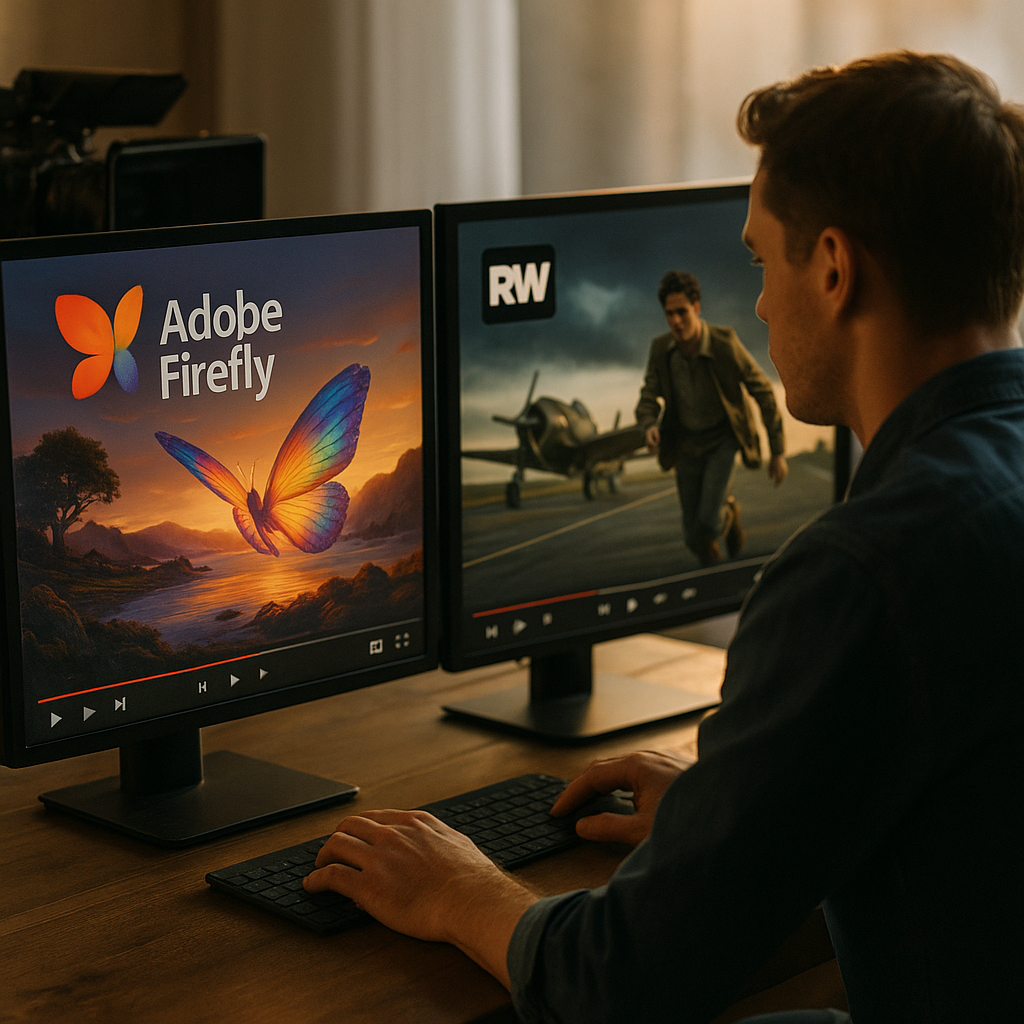
Seventy percent of enterprise marketers say they’ll produce more video this year with the same headcount, according to recent industry surveys. That math only works with generative video, which is why the Adobe Firefly Services vs Runway Gen-4 decision has landed on every VP of marketing’s desk. One vendor sells you compliance. The other sells you cinematography. Picking wrong costs you either legal exposure or creative mediocrity.
This isn’t a hobbyist comparison. Both tools now ship enterprise tiers with SLAs, dedicated support, and API access built for brands running hundreds of creative variants a month. The differences that matter aren’t about which tool makes prettier b-roll. They’re about indemnification, unit economics, and whether your engineering team can actually wire this into a production pipeline without six months of custom integration work.
What Each Platform Actually Optimizes For
Adobe Firefly Services was built from day one as an enterprise content engine, not a creative toy. It sits inside the Creative Cloud and Experience Cloud ecosystem, which means it was designed to talk to Workfront, Adobe Experience Manager, and asset libraries your brand already governs. The generative models themselves are trained exclusively on licensed Adobe Stock content and public domain material, a detail Adobe repeats constantly because it’s the entire value proposition. You’re not getting the flashiest video model on the market. You’re getting one Adobe will legally stand behind.
Runway Gen-4 takes the opposite bet. It’s optimized for visual fidelity, motion consistency, and creative control, the kind of tool a production studio reaches for when the brief calls for something that looks expensive. Character consistency across shots, camera control, and stylistic range are genuinely ahead of most competitors. Runway has been chasing the “AI that thinks like a filmmaker” positioning, and for brand films, hero content, and social-first video, that shows.
The core trade-off: Adobe sells indemnified, pipeline-native generation built for scale and compliance. Runway sells output quality and creative flexibility, with brand safety and integration depth still catching up to enterprise expectations.
Brand Safety Controls: Not a Feature, a Requirement
Ask your legal team what “brand safety” means for generative video and you’ll get a list: no copyright contamination, no unlicensed likeness usage, no outputs that could trigger a takedown after a campaign has already spent media dollars against it. This is where the two platforms diverge hardest.
Adobe’s IP indemnification for Firefly-generated content, tied to its curated training data, is the single biggest reason risk-averse enterprises default to it. If a Fortune 500 legal department is in the room, this usually ends the conversation. Runway has improved its content moderation and enterprise terms significantly, but it doesn’t offer the same blanket indemnification structure, and its training data provenance has drawn more scrutiny historically.
That doesn’t mean Runway is reckless. It means the burden of proof shifts to your team’s own review workflows. If you’re running Runway outputs through a legal or compliance gate before publishing (which you should be doing anyway), the practical risk narrows. But if your organization is regulated (financial services, healthcare, pharma), the paperwork alone tends to favor Adobe. Brands already navigating this tension in adjacent tools should look at how Firefly performs against Gemini Enterprise for regulated marketing, since the compliance logic is nearly identical.
There’s also the increasingly unavoidable question of content provenance. As platforms and regulators push toward mandatory disclosure of AI-generated media, brands need workflows that can attach credentials automatically rather than bolt them on after the fact. If your approval process isn’t already accounting for this, it’s worth reviewing how C2PA content credentials are reshaping approval workflows before you scale either tool into production.
Cost-Per-Variant: The Number Finance Actually Cares About
Here’s where the spreadsheet gets uncomfortable. Neither vendor publishes a simple per-video rate card for enterprise tiers, because pricing is negotiated based on volume, resolution, and API call frequency. But directionally, the pattern is consistent across teams running both in parallel.
- Adobe Firefly Services: Priced through generative credits bundled into Creative Cloud Enterprise or Firefly API contracts. Cost-per-variant drops meaningfully at scale because credits pool across image, video, and vector generation. A brand running 500 short-form variants a month for a paid social campaign typically sees costs stabilize once volume crosses a threshold, since Adobe’s incentive is ecosystem lock-in, not per-clip margin.
- Runway Gen-4: Priced through credit consumption tied to generation length, resolution, and re-render iterations. Because Gen-4’s outputs often require more prompt iteration to nail character consistency or camera movement, the effective cost-per-usable-variant can run higher than the sticker price suggests. Teams report needing two to four generations per final usable clip on complex prompts.
That iteration tax matters more than the headline credit price. A tool that’s cheaper per generation but requires triple the attempts to get a brand-safe, on-brief output isn’t actually cheaper. This is the same lesson brands have learned the hard way with AI copy tools, where true cost-per-variant for localization often diverges sharply from advertised pricing once revision cycles get counted.
If your team is producing high volumes of near-identical ad variants (localized versions, aspect ratio swaps, minor copy changes), Adobe’s pipeline efficiency tends to win the unit economics argument. If you’re producing a smaller number of high-stakes hero assets where visual quality is the whole point, Runway’s higher per-clip cost is easier to justify against the media spend it will support.
API Integration Depth: Where the Real Work Happens
Marketing leaders love to talk about “API-first” tools, but the depth of that integration is what separates a proof-of-concept from a production system. Adobe Firefly Services’ API was purpose-built to plug into existing enterprise DAM and workflow tools. It integrates natively with Adobe Experience Manager, Workfront, and Frame.io, meaning a generated video variant can move from prompt to approval queue to publish without leaving governed systems. For brands already running localization or approval workflows through Adobe’s ecosystem, this is a genuine operational advantage, not just a marketing claim. It echoes the same pipeline logic covered in Workfront’s AI collaborator features for localization.
Runway’s API is developer-friendly and well-documented, with strong support for programmatic generation, batch requests, and third-party orchestration tools. It’s a favorite among agencies and production tech teams building custom tools on top of it. But it’s a generation API, not a workflow platform. It doesn’t natively route outputs through brand approval gates, asset tagging, or rights management. You’ll need to build (or buy) that layer yourself, likely stitching together the kind of orchestration tools discussed in AI agent interoperability, since generative video tools rarely operate in isolation from your broader martech stack.
Integration depth isn’t about how easy the API is to call. It’s about how much custom glue code your team has to write to make the output governable at scale.
Where This Plays Out in Real Campaigns
Picture a CPG brand running 40 localized product ad variants across five markets for a quarterly push. Speed and consistency matter more than visual bravado, and legal needs sign-off on every asset before it touches paid media. Firefly Services’ credit pooling, indemnification, and native Workfront routing make it the practical choice, even if the video quality is a notch below what a boutique production house could deliver.
Now picture a DTC fashion brand launching a hero campaign film for a single seasonal drop. Budget is concentrated on fewer, higher-impact assets, and creative directors want camera moves and stylistic control that feel closer to a real production shoot. Runway Gen-4 fits that brief. The iteration cost is worth it because the volume is low and the creative bar is high.
Most enterprise brands, honestly, need both. The mistake is assuming one tool has to win outright. The smarter operational model treats Firefly as the volume engine for programmatic and localized content, and Runway as the specialist tool for flagship creative, with clear internal rules about which briefs route to which platform. That routing logic should live in the same governance framework you’re already using for auditing AI tool overlap across the broader stack, so you’re not paying for redundant capability twice.
The Governance Layer Nobody Budgets For
Whichever tool (or combination) you choose, the actual bottleneck isn’t generation speed. It’s review speed. Legal, brand, and compliance teams need a standardized way to evaluate AI-generated video before it goes to media buying, and most organizations still route this through ad hoc Slack threads and email chains. That’s a scaling failure waiting to happen.
Build a lightweight scoring rubric before you scale either tool: rights clearance, brand voice alignment, disclosure requirements, and platform-specific ad policy compliance (Meta and TikTok both have evolving rules on synthetic media, and it’s worth checking Meta’s business policies and TikTok’s advertising guidelines directly rather than assuming last quarter’s rules still apply). Pair that with the disclosure expectations increasingly enforced by the FTC, and you have a repeatable gate that scales regardless of which generative tool produced the asset.
Data on generative AI adoption in marketing, tracked by firms like eMarketer and Statista, consistently shows the gap isn’t tool capability anymore. It’s governance maturity. The brands winning with generative video aren’t the ones with the fanciest model. They’re the ones with the tightest review loop.
FAQs
Frequently Asked Questions
Is Adobe Firefly Services actually safer for brand use than Runway Gen-4?
Adobe offers broader IP indemnification because Firefly is trained exclusively on licensed Adobe Stock and public domain content, which makes it the lower-risk default for regulated industries. Runway has strengthened its enterprise terms and moderation, but it doesn’t provide the same blanket indemnification, so brands using it typically need stronger internal legal review gates.
Which tool has a lower cost-per-variant at scale?
Adobe Firefly Services generally wins on cost-per-variant for high-volume, repetitive content like localized ad sets, because its credit system pools across formats and stabilizes at scale. Runway Gen-4 often costs more per usable clip once you factor in the extra generation attempts needed to nail complex camera moves or character consistency.
Can Runway Gen-4 integrate with enterprise approval workflows?
Runway’s API supports programmatic and batch generation well, but it doesn’t natively include brand approval routing, asset tagging, or rights management like Adobe’s ecosystem does. Most enterprise teams need to build or buy a separate governance layer to make Runway outputs auditable at scale.
Should a brand pick one platform or run both?
Most enterprise marketing teams get better results running both: Firefly for high-volume, compliance-heavy content and Runway for a smaller number of high-impact hero assets. The key is defining clear routing rules upfront so budget and creative briefs don’t overlap unnecessarily.
Do these tools handle disclosure requirements for AI-generated video automatically?
Neither platform fully automates regulatory disclosure on its own. Brands need to layer in content credential standards and platform-specific ad policies manually, since FTC guidance and platform rules on synthetic media continue to evolve.
Run a two-week pilot with both platforms against the same brief, score outputs on your compliance rubric, and let the real cost-per-usable-variant (not the credit price) decide your routing rules before you commit budget at scale.
Top Influencer Marketing Agencies
The leading agencies shaping influencer marketing in 2026
Agencies ranked by campaign performance, client diversity, platform expertise, proven ROI, industry recognition, and client satisfaction. Assessed through verified case studies, reviews, and industry consultations.
Moburst

-
2

The Shelf
Boutique Beauty & Lifestyle Influencer AgencyA data-driven boutique agency specializing exclusively in beauty, wellness, and lifestyle influencer campaigns on Instagram and TikTok. Best for brands already focused on the beauty/personal care space that need curated, aesthetic-driven content.Clients: Pepsi, The Honest Company, Hims, Elf Cosmetics, Pure LeafVisit The Shelf → -
3

Audiencly
Niche Gaming & Esports Influencer AgencyA specialized agency focused exclusively on gaming and esports creators on YouTube, Twitch, and TikTok. Ideal if your campaign is 100% gaming-focused — from game launches to hardware and esports events.Clients: Epic Games, NordVPN, Ubisoft, Wargaming, Tencent GamesVisit Audiencly → -
4

Viral Nation
Global Influencer Marketing & Talent AgencyA dual talent management and marketing agency with proprietary brand safety tools and a global creator network spanning nano-influencers to celebrities across all major platforms.Clients: Meta, Activision Blizzard, Energizer, Aston Martin, WalmartVisit Viral Nation → -
5

The Influencer Marketing Factory
TikTok, Instagram & YouTube CampaignsA full-service agency with strong TikTok expertise, offering end-to-end campaign management from influencer discovery through performance reporting with a focus on platform-native content.Clients: Google, Snapchat, Universal Music, Bumble, YelpVisit TIMF → -
6

NeoReach
Enterprise Analytics & Influencer CampaignsAn enterprise-focused agency combining managed campaigns with a powerful self-service data platform for influencer search, audience analytics, and attribution modeling.Clients: Amazon, Airbnb, Netflix, Honda, The New York TimesVisit NeoReach → -
7

Ubiquitous
Creator-First Marketing PlatformA tech-driven platform combining self-service tools with managed campaign options, emphasizing speed and scalability for brands managing multiple influencer relationships.Clients: Lyft, Disney, Target, American Eagle, NetflixVisit Ubiquitous → -
8

Obviously
Scalable Enterprise Influencer CampaignsA tech-enabled agency built for high-volume campaigns, coordinating hundreds of creators simultaneously with end-to-end logistics, content rights management, and product seeding.Clients: Google, Ulta Beauty, Converse, AmazonVisit Obviously →