


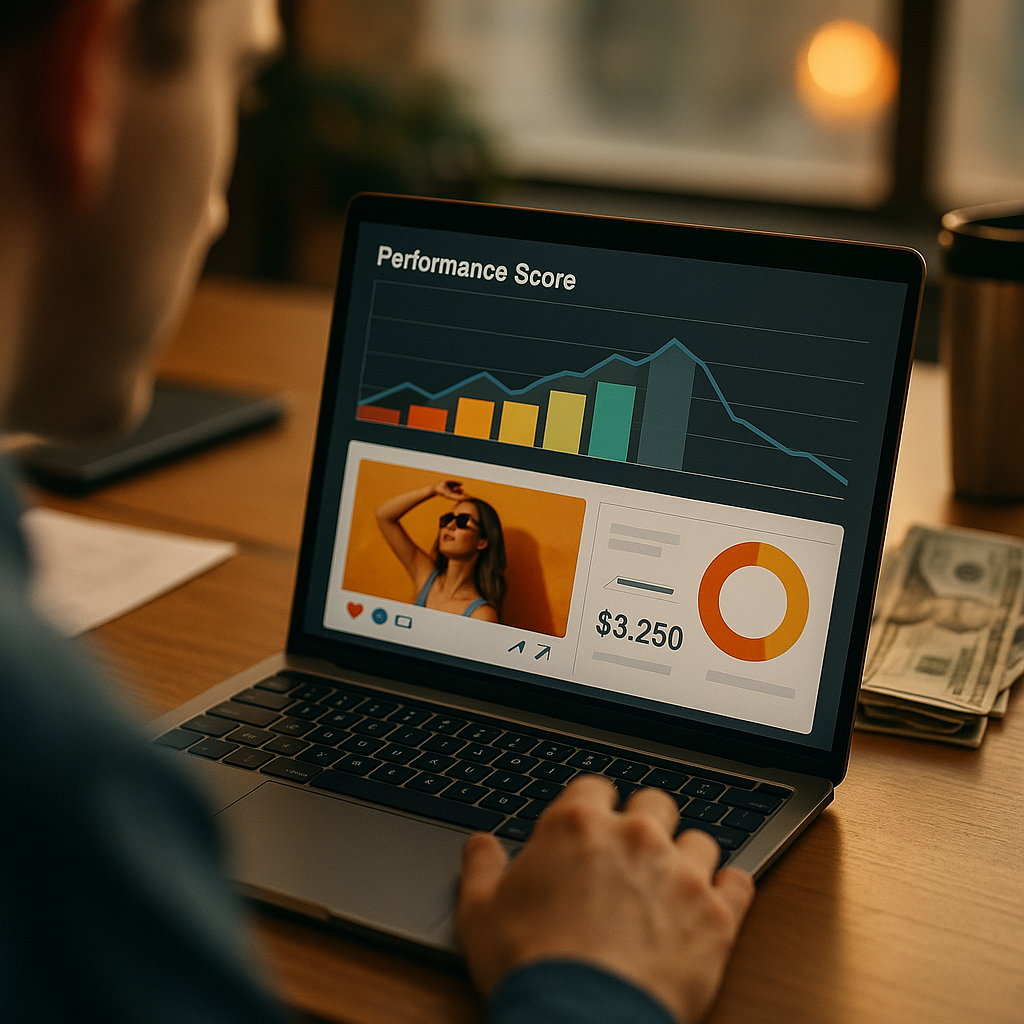
Roughly 60% of paid social creative never earns back its media budget. That’s not a hunch, it’s the pattern brand teams keep rediscovering every quarter when they audit spend against conversion data. Predictive creative performance scoring exists to fix that math problem before it happens, using AI models trained on historical ad and creator data to forecast which pieces of content will actually convert, ranked and scored before a single dollar hits an ad account.
For marketing leaders tired of “spray and pray” whitelisting budgets, this is the shift from gut-feel creative approval to something closer to underwriting. You’re not guessing anymore. You’re pricing risk.
What Predictive Creative Scoring Actually Does
Strip away the vendor decks and the concept is simple. A predictive scoring model ingests a piece of creator content, whether that’s a TikTok, a UGC-style video ad, or a static carousel, and outputs a probability score tied to a specific outcome: click-through rate, conversion rate, cost per acquisition, or watch-through completion. The model doesn’t know if the content will perform. It estimates the odds based on patterns learned from thousands (sometimes millions) of prior assets with known outcomes.
These systems typically pull from three data layers:
- Visual and audio signals: pacing, hook structure in the first three seconds, on-screen text density, color contrast, face presence and expression, music tempo.
- Historical performance data: how similar creative structures performed across past campaigns, by platform, by audience segment, by product category.
- Creator-level metadata: engagement consistency, audience overlap with the target segment, past brand-safety flags, and format-specific track record (a creator who crushes it in unboxing videos may flop in testimonial-style ads).
The output isn’t a binary pass or fail. It’s usually a percentile ranking or a predicted performance band, which is exactly what makes it useful for budget allocation instead of just creative approval.
Predictive scoring doesn’t replace creative judgment. It replaces the expensive habit of finding out which creative works only after the media budget is already spent.
Why This Matters More Now Than It Did Two Years Ago
Creator-led ad formats have exploded across every major platform, and platform-side AI has moved faster than most brand teams’ internal processes. Meta’s Andromeda recommendation system and TikTok’s Smart+ suite are already making automated creative and delivery decisions at the platform level, which means brands that aren’t scoring creative before it enters the auction are effectively letting the platform’s black box make that call for them. If you’ve read our breakdown of how Andromeda changes creative brief requirements, you already know the platforms expect more creative variants, faster, with less manual review time per asset. Predictive scoring is the only realistic way to keep quality control intact at that volume.
There’s also a budget-discipline argument. Agencies managing six or seven-figure influencer programs can’t afford to greenlight fifteen creator videos, boost them all, and see what sticks. That model worked when CPMs were cheap and testing budgets were forgiving. Neither is true anymore.
The Cost of Not Scoring: A Simple Example
Say a brand runs 40 pieces of creator content through paid amplification without pre-scoring. Industry benchmarks from eMarketer and Sprout Social suggest that in an unscreened batch like this, only a small minority, often under a quarter, will outperform the account average. The rest burn budget at break-even or worse before anyone pulls the plug. Predictive scoring lets teams cut that dead weight at the review stage, reallocating the saved spend toward the creative most likely to convert.
How the Models Are Actually Trained
This is where practitioners need to get a little technical, because “AI predicts performance” is doing a lot of hand-waving unless you understand the training loop underneath it.
Most predictive creative models are built as supervised learning systems. You feed the model a labeled dataset: creative asset in, known outcome out (CTR, ROAS, conversion rate, whatever the target metric is). The model learns which features correlate with strong outcomes and builds a scoring function it can apply to new, unseen creative. Some platforms layer in computer vision models to parse the actual footage frame by frame, identifying things like hook pacing or product visibility duration, then feed those extracted features into the prediction layer alongside historical account data.
The accuracy of any of this hinges entirely on data quality and volume. A model trained on 200 assets from one vertical will not generalize well to a different product category or platform. This is the same failure mode we’ve covered in the context of AI marketing agents failing on broken data foundations: the model is only as good as what it was trained on, and a lot of vendors are quietly training on thinner datasets than their sales pitch implies.
A few things worth asking any vendor pitching predictive creative scoring:
- What’s the minimum sample size the model needs before it produces a reliable score for a new vertical or product category?
- Is the scoring model retrained on a rolling basis, or was it trained once and frozen?
- Does the vendor disclose a confidence interval alongside the score, or just a single number?
- How does the model handle creator content that doesn’t fit historical patterns, genuinely novel formats or trends?
That last question matters because prediction models are inherently backward-looking. They’re excellent at spotting proven patterns and weaker at recognizing breakout creative that doesn’t resemble anything in the training set. This is a real limitation, not a footnote. Brands that lean too hard on predictive scores risk systematically filtering out the exact kind of novel, culturally-timed content that tends to outperform everything else. We’ve covered this tension before in the context of fast-moving trend response, where speed and cultural fit sometimes beat historical pattern-matching entirely.
Where This Fits in the Actual Workflow
Predictive scoring isn’t a standalone step, it slots into the pipeline between creator delivery and paid amplification. A typical operational flow looks like this:
- Creator delivers raw or edited content ahead of the whitelisting or spark ads decision.
- Content runs through the scoring model, generating a predicted performance percentile per platform and objective.
- Assets above a set threshold move into paid testing with a small initial budget allocation.
- Live performance data feeds back into the model, refining future predictions (this is the retraining loop that separates a serious system from a static scorecard).
- Underperforming assets, even ones with strong predicted scores, get pulled or reallocated based on real spend data within the first 48 to 72 hours.
Step five matters more than most teams admit. Prediction is a filter, not a guarantee. Treating a high predicted score as a green light to stop monitoring is how brands end up defending bad spend decisions with a chart that was accurate on average but wrong for this specific asset.
A predictive score should lower your testing budget, not eliminate your testing budget. The model narrows the field, live spend data still makes the final call.
Governance, Bias, and the Questions Legal Will Ask
Any scoring system that influences which creators and content get amplified needs a governance layer, full stop. This isn’t just a compliance nicety, it’s how brands avoid quietly baking bias into their creator programs. If historical training data skews toward creators who’ve historically gotten more paid support (a self-reinforcing loop), the model can systematically underscore newer or more diverse creators who simply haven’t had the same volume of paid exposure to generate performance data.
This is the same governance conversation that’s already playing out around agentic media buying. Our checklist on auto-bidding governance and the broader piece on why 1 in 6 agentic bids fail governance checks both apply here almost directly: any AI system making allocation decisions with real budget consequences needs a human review checkpoint, an audit trail, and a documented process for challenging a score.
Practical governance steps worth putting in place before rolling out predictive scoring at scale:
- Require the vendor to disclose training data sources and any known demographic skew.
- Set a manual override process for creators or content flagged low that a brand team believes has strategic or cultural value beyond the score.
- Audit score-to-outcome accuracy quarterly, not just at contract renewal.
- Keep FTC endorsement and disclosure compliance separate from performance scoring entirely. The FTC’s endorsement guidelines apply regardless of how well content is predicted to convert.
Picking a Tool Without Getting Sold a Wrapper
Predictive creative scoring is having its moment, which means the market is flooded with tools claiming proprietary AI that are, on closer inspection, a thin layer over a general-purpose model with some prompt engineering attached. This exact problem shows up across the AI marketing stack right now, and we’ve written a full framework on how to check whether a tool is a real proprietary model or a GPT wrapper before renewal. The same due diligence applies to creative scoring vendors specifically.
Ask for a validation study. A legitimate vendor should be able to show backtested accuracy on assets you can independently verify, not just a case study slide with a single client’s ROAS lift. If they can’t produce that, treat the score as a nicely packaged opinion, not a prediction.
The Bottom Line for Budget Owners
Predictive creative performance scoring won’t make bad creative good. What it does is stop brands from discovering which creative is bad using live media budget as the test instrument. For teams running high-volume creator programs, that shift alone justifies the tooling investment, provided the model is validated, retrained, and governed with the same rigor applied to any other AI system making spend-adjacent decisions.
Start small: score your next batch of creator deliverables before boosting, compare predicted rank against actual 72-hour performance, and use that gap to decide whether the vendor’s model earns a bigger role in your workflow.
Frequently Asked Questions
What is predictive creative performance scoring?
It’s the use of AI models to forecast how well a piece of creator or ad content will perform, such as click-through rate or conversion rate, before any paid media budget is spent on it.
How accurate are these predictive models?
Accuracy varies significantly by vendor and data volume. Models trained on large, category-specific datasets with regular retraining tend to outperform static, one-time-trained systems, but no model should be treated as a guarantee rather than a probability estimate.
Can predictive scoring replace human creative review?
No. It’s best used as a filtering and prioritization layer that narrows which assets get tested with paid spend, while human reviewers still assess brand fit, cultural relevance, and compliance.
Does predictive scoring introduce bias against newer creators?
It can, if the training data overrepresents creators who’ve historically received more paid support. Brands should audit for this and build in manual override options for promising creators without extensive performance history.
How does predictive scoring fit with platform-side AI like Meta Andromeda or TikTok Smart+?
Predictive scoring happens before content enters the auction, acting as a pre-screen. Platform-side systems like Andromeda then handle delivery and optimization once the creative is live, so the two work at different stages of the same pipeline.
What should brands ask vendors before adopting a scoring tool?
Ask about training data sources, retraining frequency, confidence intervals on scores, and whether they can provide an independently verifiable backtest rather than a single client case study.
Top Influencer Marketing Agencies
The leading agencies shaping influencer marketing in 2026
Agencies ranked by campaign performance, client diversity, platform expertise, proven ROI, industry recognition, and client satisfaction. Assessed through verified case studies, reviews, and industry consultations.
Moburst

-
2

The Shelf
Boutique Beauty & Lifestyle Influencer AgencyA data-driven boutique agency specializing exclusively in beauty, wellness, and lifestyle influencer campaigns on Instagram and TikTok. Best for brands already focused on the beauty/personal care space that need curated, aesthetic-driven content.Clients: Pepsi, The Honest Company, Hims, Elf Cosmetics, Pure LeafVisit The Shelf → -
3

Audiencly
Niche Gaming & Esports Influencer AgencyA specialized agency focused exclusively on gaming and esports creators on YouTube, Twitch, and TikTok. Ideal if your campaign is 100% gaming-focused — from game launches to hardware and esports events.Clients: Epic Games, NordVPN, Ubisoft, Wargaming, Tencent GamesVisit Audiencly → -
4

Viral Nation
Global Influencer Marketing & Talent AgencyA dual talent management and marketing agency with proprietary brand safety tools and a global creator network spanning nano-influencers to celebrities across all major platforms.Clients: Meta, Activision Blizzard, Energizer, Aston Martin, WalmartVisit Viral Nation → -
5

The Influencer Marketing Factory
TikTok, Instagram & YouTube CampaignsA full-service agency with strong TikTok expertise, offering end-to-end campaign management from influencer discovery through performance reporting with a focus on platform-native content.Clients: Google, Snapchat, Universal Music, Bumble, YelpVisit TIMF → -
6

NeoReach
Enterprise Analytics & Influencer CampaignsAn enterprise-focused agency combining managed campaigns with a powerful self-service data platform for influencer search, audience analytics, and attribution modeling.Clients: Amazon, Airbnb, Netflix, Honda, The New York TimesVisit NeoReach → -
7

Ubiquitous
Creator-First Marketing PlatformA tech-driven platform combining self-service tools with managed campaign options, emphasizing speed and scalability for brands managing multiple influencer relationships.Clients: Lyft, Disney, Target, American Eagle, NetflixVisit Ubiquitous → -
8

Obviously
Scalable Enterprise Influencer CampaignsA tech-enabled agency built for high-volume campaigns, coordinating hundreds of creators simultaneously with end-to-end logistics, content rights management, and product seeding.Clients: Google, Ulta Beauty, Converse, AmazonVisit Obviously →