


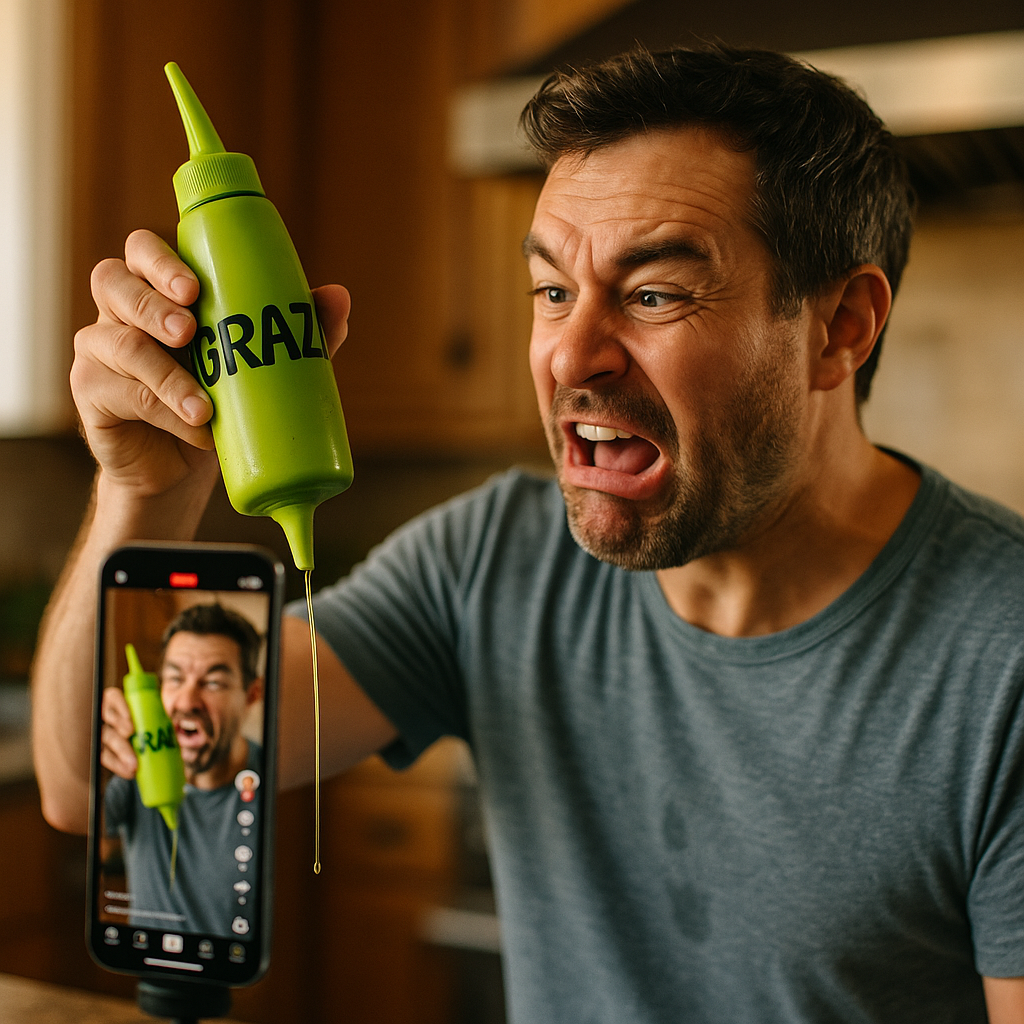
A single olive oil founder built a comedy bit so sticky that “Zhoozh” became a verb in the comments section. Graza’s squeeze bottle isn’t just packaging anymore, it’s a recurring character in a founder-led squeeze-bottle comedy format that has quietly outperformed most influencer campaigns on cost per impression. If you’re still briefing static product shots, you’re leaving a proven distribution mechanic on the table.
The Bit That Built a Category
Andrew Benin, Graza’s founder, didn’t set out to become a comedian. He set out to sell squeezable olive oil in a category dominated by dusty glass bottles and Mediterranean cliché. What he found instead was that TikTok rewards repetition with a twist. The green squeeze bottle, nicknamed for its “sizzle” and “drizzle” varieties, became the anchor prop in dozens of short sketches: deadpan cameos, exaggerated kitchen chaos, absurdist product demos that never quite finish the sentence “and that’s why you need Graza.”
The format works because it’s cheap to produce and expensive to replicate emotionally. Competitors can copy a bottle shape. They can’t copy two years of inside jokes with an audience that now recognizes the founder’s face as fast as the packaging.
Recurring comedic formats built around a founder and a hero product don’t just generate views, they compound audience familiarity in a way one-off influencer drops never do.
Why a Squeeze Bottle, Specifically?
Squeeze bottles are physically funny. There’s a slapstick quality to squirting, spraying, and over-squeezing that static pump bottles or jars simply can’t deliver. Graza leaned into that physical comedy the way a prop comic leans into a rubber chicken. The bottle’s design, bright, cartoonish, condiment-adjacent, already primed audiences to treat it as a toy rather than a premium good. That’s a deliberate product redesign decision paying dividends on the content side, not just the shelf side.
Founder-Led Content Outperforms Because It Skips the Trust Tax
Every influencer partnership carries a hidden cost: the audience has to decide whether to trust a stranger talking about a product they were paid to mention. Founder content skips that negotiation. Viewers already assume a founder has skin in the game, so the comedy reads as confidence rather than salesmanship. That’s the same psychology behind founder story video briefs that convert better than polished brand films, except Graza stretched it into an ongoing bit rather than a one-time origin story.
According to eMarketer, creator-led and founder-led short-form video continues to post higher engagement rates than traditional branded content across nearly every consumer packaged goods vertical. The gap isn’t marginal. It’s the difference between a campaign that needs paid amplification to survive and one that gets organic reach because people actually want to watch it twice.
How the Recurring Format Actually Works
Strip away the jokes and you’ll find a repeatable production structure. It’s not improvised chaos, even though it looks that way.
- Fixed prop, variable gag: The bottle appears in every video, but the joke around it changes weekly. This keeps the format recognizable without becoming repetitive.
- Low production floor: Most clips look shot on a phone in a real kitchen. That’s intentional. Polish would kill the bit, echoing the shift toward messy, unpolished creator content that now outperforms studio setups on watch time.
- Founder as recurring character: Benin shows up often enough that the audience treats him like a sitcom regular, not a guest spot.
- Cameo economy: Other creators, chefs, and even customers get pulled into the bit, extending reach without diluting the format’s identity.
This is essentially a serialized content engine dressed up as a joke. One shoot day can generate a week’s worth of drops, similar in spirit to the efficiency gains covered in turning one creator shoot into six placements.
What This Costs Versus What It Replaces
A single day of founder-led filming, using existing staff, a phone, and no agency, can replace what would otherwise be a five-figure influencer retainer. That’s the operational case brand leads actually care about. Graza doesn’t need to pay a roster of mid-tier creators to say nice things about olive oil when the founder himself generates comparable reach for a fraction of the media spend. Sprout Social’s research on short-form video consistently shows that recurring, recognizable formats retain viewers longer than one-off branded posts, which directly affects TikTok’s distribution algorithm.
The Compliance Question Nobody Asks Until It’s Too Late
Founder content still counts as brand speech under FTC guidance, and it’s easy to assume a CEO joking around doesn’t need a disclosure. That assumption gets brands into trouble. If a founder features other creators in the bit, or if the content runs as a paid ad after organic testing, disclosure rules still apply. The FTC’s endorsement guidance doesn’t carve out an exception for humor. Brands scaling this format should borrow the same review discipline outlined in short-form sales briefs that pass legal review fast, because a viral bit that trips a compliance flag stops being funny very quickly.
There’s also a subtler risk: founder fatigue. If every video centers the same person, the format can start to feel like a personal brand vehicle rather than a product story. Graza manages this by rotating cameo appearances and letting the bottle, not just the founder, carry recognizable comedic weight.
Can Your Brand Actually Replicate This?
Not every category has a prop this visually funny, and not every founder is comfortable on camera. Be honest about that before you greenlight a copycat strategy. But the underlying mechanics, recurring visual anchor, low-fi production, founder as recognizable character, translate across categories more easily than people assume. Beverage brands, supplement companies, and even B2B SaaS founders have started testing lighter versions of this format, often pairing it with nano-influencer repeat-purchase content to extend reach beyond the founder’s own following.
The mistake most brands make is treating this as a one-off stunt instead of a format. A single funny video is a fluke. A recurring bit, refreshed weekly with a consistent visual hook, is a distribution system. That distinction matters when you’re pitching budget to a CFO who wants to know why TikTok production costs keep recurring on the line item.
If you’re testing this internally, start small: pick one product feature that’s inherently visual, assign a recognizable face (ideally the founder, but a long-tenured team member works too), and commit to a cadence, not a campaign. Review the TikTok Ads platform data after four to six weeks before deciding whether to formalize it as an always-on content line rather than a marketing experiment.
Frequently Asked Questions
What is the founder-led squeeze-bottle comedy format?
It’s a recurring short-form video style pioneered by Graza, where a founder uses a distinctive product (in this case, a squeeze bottle) as a recurring comedic prop across weekly TikTok content, building audience familiarity over time instead of relying on one-off viral hits.
Why does founder-led content outperform traditional influencer marketing for some brands?
Audiences already assume a founder has a stake in the product, which removes the trust negotiation that comes with paid influencer endorsements. This often results in higher engagement rates and lower cost per impression compared to standard influencer retainers.
Does founder comedy content still require FTC disclosure?
Yes. Founder-led content is still brand speech under FTC endorsement guidance, especially when other creators are featured or when organic content is later boosted as a paid ad. Brands should apply the same disclosure review used for any paid or brand-affiliated content.
Can smaller brands without a charismatic founder use this format?
Yes, though it requires substituting a recognizable team member or a consistently branded visual prop for the founder. The core mechanic, a fixed visual anchor with a variable comedic angle, matters more than celebrity status.
How often should a brand post to sustain a recurring comedy format?
Weekly cadence tends to work best. Posting too infrequently breaks audience recognition, while overposting without fresh gags risks format fatigue and declining engagement.
Frequently Asked Questions
Graza’s real lesson isn’t the bottle or the bit, it’s the cadence. Pick one visual anchor, commit a founder or team face to it weekly, and treat compliance review as part of production, not an afterthought.
Top Influencer Marketing Agencies
The leading agencies shaping influencer marketing in 2026
Agencies ranked by campaign performance, client diversity, platform expertise, proven ROI, industry recognition, and client satisfaction. Assessed through verified case studies, reviews, and industry consultations.
Moburst

-
2

The Shelf
Boutique Beauty & Lifestyle Influencer AgencyA data-driven boutique agency specializing exclusively in beauty, wellness, and lifestyle influencer campaigns on Instagram and TikTok. Best for brands already focused on the beauty/personal care space that need curated, aesthetic-driven content.Clients: Pepsi, The Honest Company, Hims, Elf Cosmetics, Pure LeafVisit The Shelf → -
3

Audiencly
Niche Gaming & Esports Influencer AgencyA specialized agency focused exclusively on gaming and esports creators on YouTube, Twitch, and TikTok. Ideal if your campaign is 100% gaming-focused — from game launches to hardware and esports events.Clients: Epic Games, NordVPN, Ubisoft, Wargaming, Tencent GamesVisit Audiencly → -
4

Viral Nation
Global Influencer Marketing & Talent AgencyA dual talent management and marketing agency with proprietary brand safety tools and a global creator network spanning nano-influencers to celebrities across all major platforms.Clients: Meta, Activision Blizzard, Energizer, Aston Martin, WalmartVisit Viral Nation → -
5

The Influencer Marketing Factory
TikTok, Instagram & YouTube CampaignsA full-service agency with strong TikTok expertise, offering end-to-end campaign management from influencer discovery through performance reporting with a focus on platform-native content.Clients: Google, Snapchat, Universal Music, Bumble, YelpVisit TIMF → -
6

NeoReach
Enterprise Analytics & Influencer CampaignsAn enterprise-focused agency combining managed campaigns with a powerful self-service data platform for influencer search, audience analytics, and attribution modeling.Clients: Amazon, Airbnb, Netflix, Honda, The New York TimesVisit NeoReach → -
7

Ubiquitous
Creator-First Marketing PlatformA tech-driven platform combining self-service tools with managed campaign options, emphasizing speed and scalability for brands managing multiple influencer relationships.Clients: Lyft, Disney, Target, American Eagle, NetflixVisit Ubiquitous → -
8

Obviously
Scalable Enterprise Influencer CampaignsA tech-enabled agency built for high-volume campaigns, coordinating hundreds of creators simultaneously with end-to-end logistics, content rights management, and product seeding.Clients: Google, Ulta Beauty, Converse, AmazonVisit Obviously →