


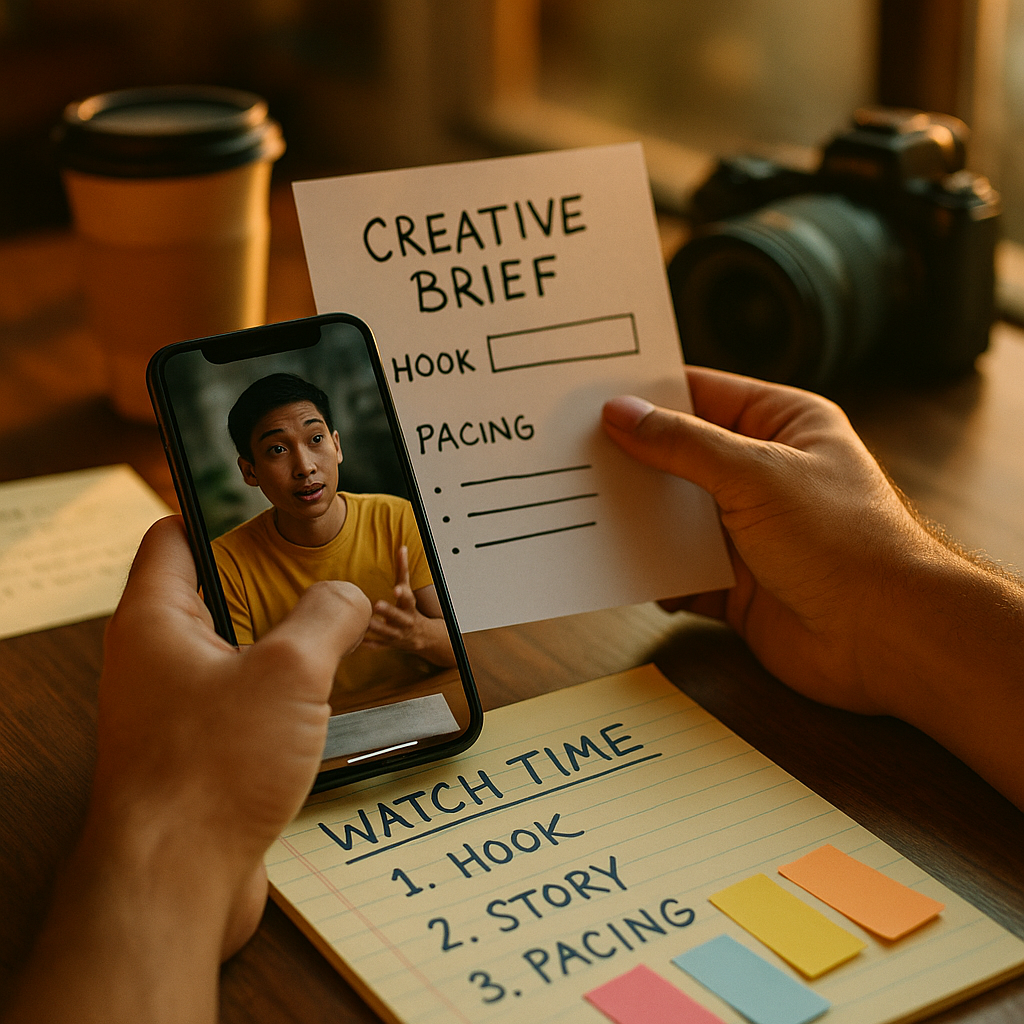
TikTok’s own creators will tell you: if a video doesn’t hold attention past the first two seconds, it’s dead on arrival. No amount of production polish saves it. That’s why the watch-time-first creative brief is replacing the old “message and mandatories” template at agencies and in-house teams that actually care about distribution, not just delivery.
The Algorithm Doesn’t Care About Your Brand Story
Brand teams love a narrative arc. Set up, tension, resolution, call to action. It reads beautifully in a deck. It performs terribly in a feed.
Recommendation systems on TikTok, Instagram Reels, and YouTube Shorts don’t reward storytelling structure. They reward retention curves. A video that loses forty percent of viewers in the first three seconds gets throttled before your carefully written CTA ever loads. The platform’s job is to keep people scrolling less and watching more, and it allocates distribution accordingly. Your job, if you want reach, is to make the content itself the ranking signal.
Watch time isn’t a vanity metric anymore. It’s the primary input the algorithm uses to decide whether your content deserves a second look, and creators who understand that outperform creators who just have better lighting.
This is a hard pivot for brands used to briefing on tone, key messages, and “must include” product shots. Those things still matter, but they’re secondary to a structural question: does this video’s pacing match what the algorithm is optimizing for right now?
What Is a Watch-Time-First Creative Brief?
A watch-time-first creative brief is a directive document that prioritizes retention mechanics (hook timing, pattern interrupts, pacing cadence, loop potential) above brand messaging hierarchy. It still includes your key talking points and compliance notes, but it opens with structural requirements, not creative concepts.
Think of it as briefing the shape of attention, then filling that shape with your product story. Instead of telling a creator “show the product benefits in a fun way,” you tell them: “Open with a visual contradiction or unexpected statement within the first 1.5 seconds. Introduce the product by second 4. Create a pattern break (cut, zoom, text overlay, sound shift) every 2 to 3 seconds through the first fifteen seconds. Deliver the payoff or twist before second 20.”
That’s a brief a creator can actually execute against, because it’s measurable. Compare that to “make it feel authentic,” which is the kind of feedback that gets creators nowhere and brand managers three rounds of unusable revisions.
This approach borrows heavily from direct-response video advertising, where every second is treated as a drop-off risk. If you’ve read our micro-drama brief guide, the retention logic is the same: structure first, polish second.
Engineering the Hook: The First 3 Seconds Decide Everything
Here’s the uncomfortable truth most brand briefs ignore: the hook is not a creative flourish, it’s a survival mechanism. TikTok’s creator resources have repeatedly pointed to the opening seconds as the single biggest lever for video performance, and internal creator data shared across the industry suggests videos that fail to establish a hook within the first two to three seconds see completion rates fall off a cliff.
So what actually works? A few patterns show up again and again across high-performing branded content:
- The contradiction hook. State something that seems wrong, then resolve it. “This $8 serum outperformed the one that costs $80” stops a thumb faster than any product beauty shot.
- The visual interruption. A jump cut, an unexpected object entering frame, or a sudden zoom in the first frame breaks the scroll pattern viewers have trained themselves into.
- The direct question. “Why does nobody talk about this?” works because it creates an open loop the brain wants closed.
- The in-media-res drop. Start mid-action, not at setup. Skip the “hey guys” intro entirely.
None of these require a bigger budget. They require a brief that specifies them explicitly, because creators left to their own instincts will often default to a warm, friendly intro that feels natural on camera but dies on the algorithm.
Pacing Patterns That Keep the Algorithm Feeding Your Video
Hooks get the click. Pacing keeps the watch. This is where most briefs go quiet, leaving pacing entirely up to the editor’s instinct. That’s a mistake, because pacing is just as engineerable as the opening line.
The pattern that consistently shows up in high-retention short-form content is a “cut every 2 to 4 seconds” cadence through the first half of the video, tapering to slightly longer holds once the viewer is invested. This isn’t about frantic editing for its own sake. It’s about giving the algorithm’s completion-rate model fresh reasons to keep the viewer engaged at regular intervals.
Specific tactics worth putting directly into your brief:
- Text overlays that update every 3 to 5 seconds to reinforce the audio without requiring sound on.
- A mid-video “re-hook” around the 7 to 10 second mark, a second pattern interrupt for viewers whose attention is drifting.
- Looping structures where the final frame visually or narratively connects back to the first, encouraging rewatches (which platforms weight heavily).
- Native captions synced tightly to speech, since silent-scroll viewing is now the default for a huge share of feed traffic.
If you’re briefing creators on demo-style content specifically, pacing matters even more because product demonstrations are naturally slower. Our breakdown on why demo videos beat lifestyle content covers how to structure functional footage without losing the retention curve.
Building the Brief: A Practical Template
Stop sending creators a paragraph of adjectives. Send them a structure they can shoot against. A watch-time-first brief should include:
- Hook requirement. Specify the hook type (contradiction, question, visual interrupt) and the exact second it must land.
- Pattern interrupt schedule. List where cuts, zooms, or overlay changes should occur through the first 15 seconds.
- Product integration window. Define when the product must appear, not how it must be framed creatively.
- Loop or re-hook instruction. Ask for a mid-video attention reset and, where relevant, a closing frame that echoes the opener.
- Caption and sound-off viewing notes. Require synced native captions given how much feed traffic happens muted.
- Compliance and disclosure placement. Build in FTC-safe disclosure timing so legal doesn’t become a bottleneck later. Our guide on short-form sales briefs that pass legal review fast is a useful companion here.
Notice what’s missing: tone of voice paragraphs, mood boards, and “brand feel” language. Those aren’t irrelevant, they just belong in a secondary creative reference doc, not the primary structural brief. Creators need the retention mechanics up front, because that’s what determines whether their video gets seen at all.
A brief that leads with brand tone and buries pacing requirements on page three is optimizing for internal approval, not for algorithmic distribution.
If you’re producing content designed to be cut into multiple formats across platforms, this structural approach also pays off downstream. Teams using modular storyboard design already build hook variants into a single shoot, which makes A/B testing pacing far cheaper than reshooting.
Where Brands Get This Wrong
The most common failure mode isn’t a bad brief, it’s a brief that’s technically correct but never gets tested. Teams write the perfect hook-and-pacing document, hand it to a creator, get one video back, and call it done. That’s not how algorithmic distribution works.
Watch time benchmarks shift by platform, by vertical, and by season. What held attention on Reels in Q1 may underperform by Q3. Brands need to treat the brief as a living document, updated based on actual retention data pulled from the platform’s own analytics (TikTok’s Creator Center and Meta’s business tools both surface completion-rate breakdowns down to the second).
The second failure is over-scripting. Creators know their audience’s attention patterns better than a brand manager staring at a spreadsheet. Give them the structural requirements, not word-for-word dialogue. The best watch-time-first briefs specify the “when” and let the creator own the “how.”
Third, brands underestimate how much rewatch value matters. Platforms increasingly weight loop completion and rewatches as strong positive signals, according to data cited by outlets like eMarketer and Sprout Social’s platform research. A video that gets watched twice by a smaller audience can outperform a video watched once by a larger one. Briefing for loopability, not just initial hook strength, is where more advanced teams are now focusing.
Measuring Whether Your Brief Actually Worked
Don’t just track views. Track average watch time, completion rate, and rewatch percentage as your primary creative KPIs, with engagement and conversion as secondary layers. If a creator’s video hits your hook and pacing specs but still underperforms, the issue usually traces back to audience mismatch, not execution. That’s a targeting problem, not a brief problem.
Run every campaign as a mini experiment. Brief two or three creators with the same structural requirements but different hook types, then compare retention curves in the platform’s native analytics. Over a few cycles, you’ll build an internal benchmark for what actually works in your category, which beats any generic best-practices list, including this one. HubSpot’s content benchmarking resources are a solid starting point if you need external retention data to calibrate against.
Next step: Rewrite your next creative brief so the first section is hook and pacing mechanics, not brand messaging. Test it against your current template on identical spend and compare retention curves after one cycle. The data will make the case for you.
Frequently Asked Questions
What makes a watch-time-first creative brief different from a standard influencer brief?
A standard brief leads with brand messaging, tone, and mandatory talking points. A watch-time-first brief leads with retention mechanics: hook timing, pattern interrupts, and pacing cadence, treating those as the primary structural requirements the creator must build around.
How long should a hook be in short-form video content?
Most high-performing short-form content establishes its hook within the first 1.5 to 3 seconds. Anything longer risks losing viewers before the algorithm registers meaningful engagement signals.
Does a watch-time-first approach work for demo or educational content, not just entertainment?
Yes, though pacing needs adjustment. Demo content can hold attention with slightly longer segments if it includes clear pattern interrupts and delivers value signals early, rather than relying purely on rapid cuts.
How do I brief creators on pacing without over-scripting their content?
Specify timing windows and structural beats (when a cut, overlay, or re-hook should happen) rather than dictating exact dialogue or shots. This gives creators room to execute in their own voice while hitting the retention mechanics your brief requires.
What metrics should replace views as the main success measure?
Average watch time, completion rate, and rewatch or loop percentage are stronger indicators of algorithmic favor than raw view counts, since platforms weight retention signals heavily when deciding further distribution.
FAQs
What makes a watch-time-first creative brief different from a standard influencer brief?
A standard brief leads with brand messaging, tone, and mandatory talking points. A watch-time-first brief leads with retention mechanics: hook timing, pattern interrupts, and pacing cadence, treating those as the primary structural requirements the creator must build around.
How long should a hook be in short-form video content?
Most high-performing short-form content establishes its hook within the first 1.5 to 3 seconds. Anything longer risks losing viewers before the algorithm registers meaningful engagement signals.
Does a watch-time-first approach work for demo or educational content, not just entertainment?
Yes, though pacing needs adjustment. Demo content can hold attention with slightly longer segments if it includes clear pattern interrupts and delivers value signals early, rather than relying purely on rapid cuts.
How do I brief creators on pacing without over-scripting their content?
Specify timing windows and structural beats (when a cut, overlay, or re-hook should happen) rather than dictating exact dialogue or shots. This gives creators room to execute in their own voice while hitting the retention mechanics your brief requires.
What metrics should replace views as the main success measure?
Average watch time, completion rate, and rewatch or loop percentage are stronger indicators of algorithmic favor than raw view counts, since platforms weight retention signals heavily when deciding further distribution.
Top Influencer Marketing Agencies
The leading agencies shaping influencer marketing in 2026
Agencies ranked by campaign performance, client diversity, platform expertise, proven ROI, industry recognition, and client satisfaction. Assessed through verified case studies, reviews, and industry consultations.
Moburst

-
2

The Shelf
Boutique Beauty & Lifestyle Influencer AgencyA data-driven boutique agency specializing exclusively in beauty, wellness, and lifestyle influencer campaigns on Instagram and TikTok. Best for brands already focused on the beauty/personal care space that need curated, aesthetic-driven content.Clients: Pepsi, The Honest Company, Hims, Elf Cosmetics, Pure LeafVisit The Shelf → -
3

Audiencly
Niche Gaming & Esports Influencer AgencyA specialized agency focused exclusively on gaming and esports creators on YouTube, Twitch, and TikTok. Ideal if your campaign is 100% gaming-focused — from game launches to hardware and esports events.Clients: Epic Games, NordVPN, Ubisoft, Wargaming, Tencent GamesVisit Audiencly → -
4

Viral Nation
Global Influencer Marketing & Talent AgencyA dual talent management and marketing agency with proprietary brand safety tools and a global creator network spanning nano-influencers to celebrities across all major platforms.Clients: Meta, Activision Blizzard, Energizer, Aston Martin, WalmartVisit Viral Nation → -
5

The Influencer Marketing Factory
TikTok, Instagram & YouTube CampaignsA full-service agency with strong TikTok expertise, offering end-to-end campaign management from influencer discovery through performance reporting with a focus on platform-native content.Clients: Google, Snapchat, Universal Music, Bumble, YelpVisit TIMF → -
6

NeoReach
Enterprise Analytics & Influencer CampaignsAn enterprise-focused agency combining managed campaigns with a powerful self-service data platform for influencer search, audience analytics, and attribution modeling.Clients: Amazon, Airbnb, Netflix, Honda, The New York TimesVisit NeoReach → -
7

Ubiquitous
Creator-First Marketing PlatformA tech-driven platform combining self-service tools with managed campaign options, emphasizing speed and scalability for brands managing multiple influencer relationships.Clients: Lyft, Disney, Target, American Eagle, NetflixVisit Ubiquitous → -
8

Obviously
Scalable Enterprise Influencer CampaignsA tech-enabled agency built for high-volume campaigns, coordinating hundreds of creators simultaneously with end-to-end logistics, content rights management, and product seeding.Clients: Google, Ulta Beauty, Converse, AmazonVisit Obviously →