


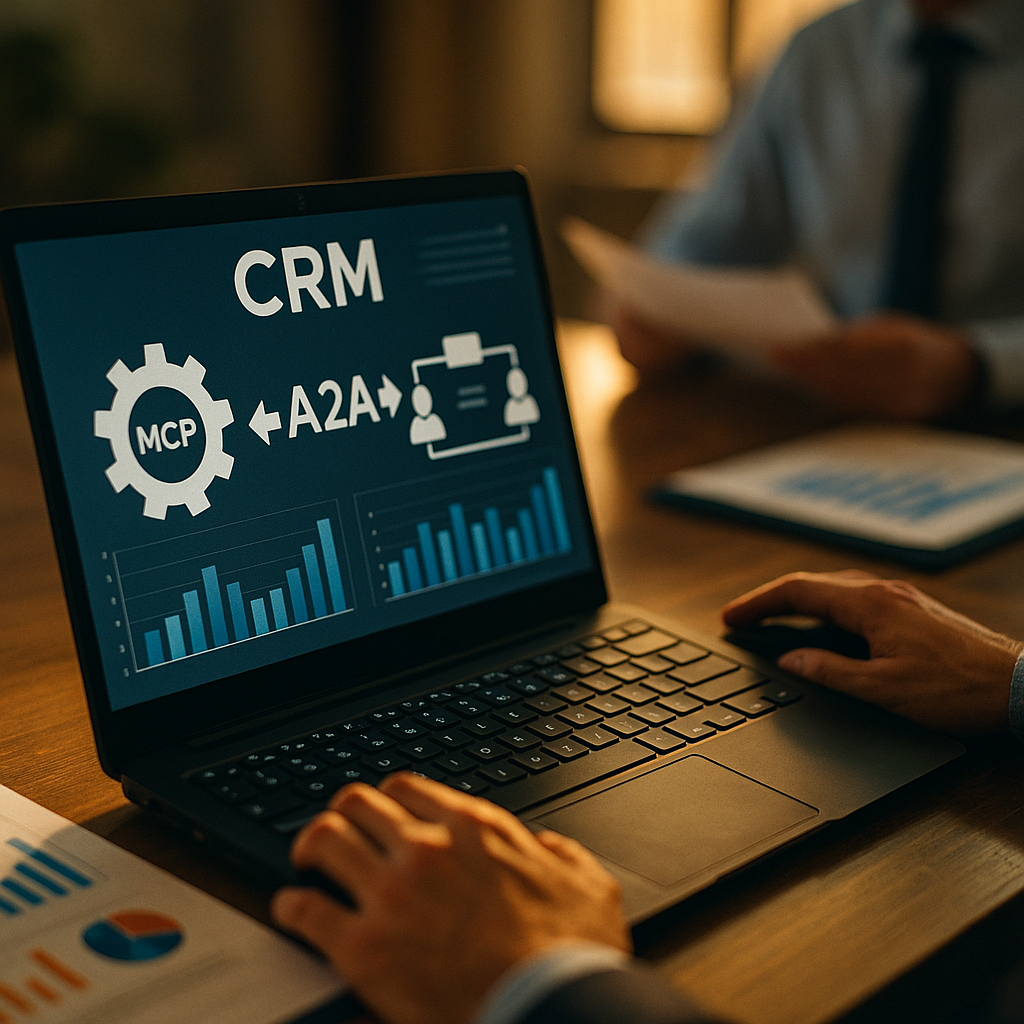
Only a fraction of CRM and attribution vendors can explain, in plain language, how their platform will talk to autonomous AI agents next year. That’s not a hypothetical risk anymore. As agentic workflows move from pilot to production, MCP and A2A protocol support is quietly becoming the single most consequential line item in your next renewal negotiation, and most procurement teams haven’t even added it to the checklist.
What MCP and A2A Actually Mean for Your Stack
Model Context Protocol (MCP) and Agent2Agent (A2A) aren’t marketing buzzwords cooked up by a vendor’s positioning team. MCP, originally pushed by Anthropic, standardizes how AI models pull context and tools from external systems. A2A, backed heavily by Google and now under Linux Foundation stewardship, standardizes how autonomous agents negotiate tasks with each other across vendor boundaries.
Put bluntly: MCP is about an agent reaching into your CRM to grab the right data. A2A is about your CRM’s agent handing off a task to your attribution platform’s agent without a human writing custom middleware to make it happen. If your vendors don’t support either protocol, every AI workflow you want to build gets stuck behind bespoke API integrations that break every time someone ships an update.
A vendor that can’t answer a direct question about MCP or A2A roadmap support isn’t behind on a trend. They’re telling you their platform will be the integration bottleneck in your stack within eighteen months.
Why This Matters More at Renewal Than at Purchase
Nobody evaluates protocol support when they’re three months into onboarding and just trying to get pipeline data to sync correctly. That’s fair. But renewal is a different moment entirely. It’s the one window where you have real leverage, real usage data, and a legitimate excuse to ask hard architectural questions before you sign another twelve or twenty-four month term.
Most CRM and attribution contracts auto-renew with modest price increases and zero substantive review of technical roadmap. That’s how brands end up locked into platforms that can’t participate in agent-to-agent workflows while competitors are already routing lead qualification, budget reallocation, and attribution modeling through autonomous agent chains. The cost of skipping this evaluation isn’t abstract. It’s the six-figure integration project you’ll need in two years to bolt on protocol support after the fact, assuming the vendor even builds it.
This is the same pattern we’ve seen with AI-ready CRM migrations, where teams that waited for vendors to “figure it out” ended up paying more for slower, custom-built workarounds.
The Five-Question Renewal Framework
Before your next CRM or attribution renewal call, walk in with these questions. Don’t accept vague affirmatives. Push for specifics, documentation, and a timeline.
- Is MCP support live in production, or is it “on the roadmap”? Roadmap answers from vendors mean nothing without a committed ship date tied to a contract clause.
- Does A2A support cover outbound and inbound agent handoffs? Some vendors only support receiving agent requests, not initiating them. That’s a half-solution.
- What’s the authentication and consent model for agent-initiated actions? If an agent can pull customer data or trigger a campaign send, you need audit logging as tight as any human-initiated action.
- Can you demo a live agent handoff between this platform and a third-party tool? If they can’t show it, they don’t have it yet, regardless of what the sales deck says.
- Who owns liability if an autonomous agent misfires across platforms? This is the question most vendors dodge, and it’s the one your legal team needs answered in writing.
If you’re already running a broader vendor audit, this framework slots naturally into the kind of structured data audit process most mature marketing orgs now run annually.
CRM and Attribution Face Different Protocol Stakes
These two categories aren’t interchangeable when it comes to protocol risk. CRM systems are the source of truth for customer identity, deal stage, and consent status. If your CRM can’t participate in A2A workflows, every agent trying to act on customer data has to route through a clunky API proxy, and that proxy becomes your new single point of failure.
Attribution platforms carry a different risk profile. They’re increasingly the layer where agents make real-time budget decisions, shifting spend between channels based on modeled outcomes. If your attribution vendor’s agent can’t hand off context to your media buying platform’s agent via A2A, you’re back to manual exports and delayed decisions, exactly the inefficiency agentic marketing was supposed to eliminate. We covered a related version of this identity and handoff problem in our review of server-side tracking as an attribution baseline, and the protocol question is really the next layer up from that foundation.
Gartner-style analyst commentary and independent research groups tracking agentic AI adoption both point to the same trend: protocol interoperability, not raw model quality, will decide which martech vendors survive the next procurement cycle.
Vendor Buzzwords to Distrust
“AI-native” means nothing without protocol specificity. Same for “agent-ready,” “interoperable by design,” and “built for the agentic era.” These phrases show up in vendor decks because they test well, not because they map to shipped functionality. Ask for the actual protocol version supported, the SDK documentation, and a reference customer using it in production. If the answer is a case study still in beta, treat that as a roadmap item, not a contract-ready feature.
Watch, too, for vendors that support MCP but stay silent on A2A, or vice versa. Partial protocol support is common right now because the standards themselves are still maturing. That’s not disqualifying on its own, but it should directly affect contract length. Don’t sign a two-year term with a vendor who’s only half built for where the ecosystem is heading. Push for a twelve-month term with a protocol-support milestone clause instead.
Building the Business Case Procurement Will Actually Approve
Procurement teams don’t move on vibes. If you want budget and negotiating leverage for a protocol-aware renewal, quantify the risk in terms finance understands. Estimate the integration cost of building custom middleware if the vendor never ships A2A support. Compare that against the incremental cost of switching to a competitor that already has it. Then frame the renewal negotiation around a shorter contract term with explicit protocol milestones rather than a flat price increase.
This is also where cross-functional alignment pays off. Data governance, legal, and marketing ops all have a stake in how agent-initiated actions are logged and consented. Teams that have already tackled governed AI layers for compliance-first marketing have a head start here, since the audit trail requirements overlap heavily with what MCP and A2A implementations demand.
According to industry trend coverage from eMarketer, agentic AI adoption in marketing operations is accelerating faster than most platform vendors’ roadmaps, which is exactly why the protocol gap matters now rather than at your next full platform migration cycle. Regulatory bodies like the FTC are also paying closer attention to automated decision systems, so the consent and audit questions in your framework aren’t just operational hygiene, they’re compliance insurance.
What Happens If You Skip This at Renewal?
You keep paying for a platform that quietly becomes a bottleneck. Your competitors’ agent-driven campaigns adjust budget allocation in near real time while yours waits for a nightly batch sync. Your data team builds and maintains custom connectors that break with every vendor update, and that maintenance cost never shows up as a line item until someone finally audits total cost of ownership. None of this is dramatic. It’s death by a thousand small delays, and it’s completely avoidable if you ask the right questions before you sign.
Takeaway
Before your next CRM or attribution renewal, put MCP and A2A protocol support on the negotiation agenda with a hard question: can they demo a live agent handoff today, in writing, with a committed ship date if not? If the answer is vague, shorten the contract term and revisit in twelve months, not twenty-four.
Frequently Asked Questions
What is the difference between MCP and A2A protocols in marketing platforms?
MCP (Model Context Protocol) governs how an AI model or agent retrieves context and data from a system like a CRM. A2A (Agent2Agent) governs how autonomous agents from different platforms coordinate and hand off tasks to each other, such as an attribution agent triggering a budget reallocation in a media buying tool.
Why should marketers care about protocol support during vendor renewal?
Renewal is the leverage point where you can negotiate contract length and pricing based on technical roadmap commitments. Signing a long-term contract without confirming protocol support risks locking your team into a platform that becomes an integration bottleneck as agentic workflows scale.
How can I verify a vendor’s MCP or A2A claims are real?
Ask for a live demo of an agent-initiated action or handoff in a production environment, not a sandbox. Request SDK documentation and a reference customer. Vendors that only offer roadmap language without a committed ship date should not receive long contract terms.
Does lack of A2A support disqualify a CRM or attribution vendor?
Not automatically. Protocol standards are still maturing across the martech ecosystem, so partial support is common. But it should shape contract length. Favor shorter terms with explicit protocol milestones rather than locking in for multiple years with a vendor still building this capability.
What compliance risks come with agent-initiated actions in CRM or attribution tools?
Any action an autonomous agent takes on customer data, such as pulling records or triggering a campaign, needs the same audit logging and consent tracking as a human-initiated action. Ask vendors directly how they log agent activity and who bears liability if an agent misfires across platforms.
Top Influencer Marketing Agencies
The leading agencies shaping influencer marketing in 2026
Agencies ranked by campaign performance, client diversity, platform expertise, proven ROI, industry recognition, and client satisfaction. Assessed through verified case studies, reviews, and industry consultations.
Moburst

-
2

The Shelf
Boutique Beauty & Lifestyle Influencer AgencyA data-driven boutique agency specializing exclusively in beauty, wellness, and lifestyle influencer campaigns on Instagram and TikTok. Best for brands already focused on the beauty/personal care space that need curated, aesthetic-driven content.Clients: Pepsi, The Honest Company, Hims, Elf Cosmetics, Pure LeafVisit The Shelf → -
3

Audiencly
Niche Gaming & Esports Influencer AgencyA specialized agency focused exclusively on gaming and esports creators on YouTube, Twitch, and TikTok. Ideal if your campaign is 100% gaming-focused — from game launches to hardware and esports events.Clients: Epic Games, NordVPN, Ubisoft, Wargaming, Tencent GamesVisit Audiencly → -
4

Viral Nation
Global Influencer Marketing & Talent AgencyA dual talent management and marketing agency with proprietary brand safety tools and a global creator network spanning nano-influencers to celebrities across all major platforms.Clients: Meta, Activision Blizzard, Energizer, Aston Martin, WalmartVisit Viral Nation → -
5

The Influencer Marketing Factory
TikTok, Instagram & YouTube CampaignsA full-service agency with strong TikTok expertise, offering end-to-end campaign management from influencer discovery through performance reporting with a focus on platform-native content.Clients: Google, Snapchat, Universal Music, Bumble, YelpVisit TIMF → -
6

NeoReach
Enterprise Analytics & Influencer CampaignsAn enterprise-focused agency combining managed campaigns with a powerful self-service data platform for influencer search, audience analytics, and attribution modeling.Clients: Amazon, Airbnb, Netflix, Honda, The New York TimesVisit NeoReach → -
7

Ubiquitous
Creator-First Marketing PlatformA tech-driven platform combining self-service tools with managed campaign options, emphasizing speed and scalability for brands managing multiple influencer relationships.Clients: Lyft, Disney, Target, American Eagle, NetflixVisit Ubiquitous → -
8

Obviously
Scalable Enterprise Influencer CampaignsA tech-enabled agency built for high-volume campaigns, coordinating hundreds of creators simultaneously with end-to-end logistics, content rights management, and product seeding.Clients: Google, Ulta Beauty, Converse, AmazonVisit Obviously →