


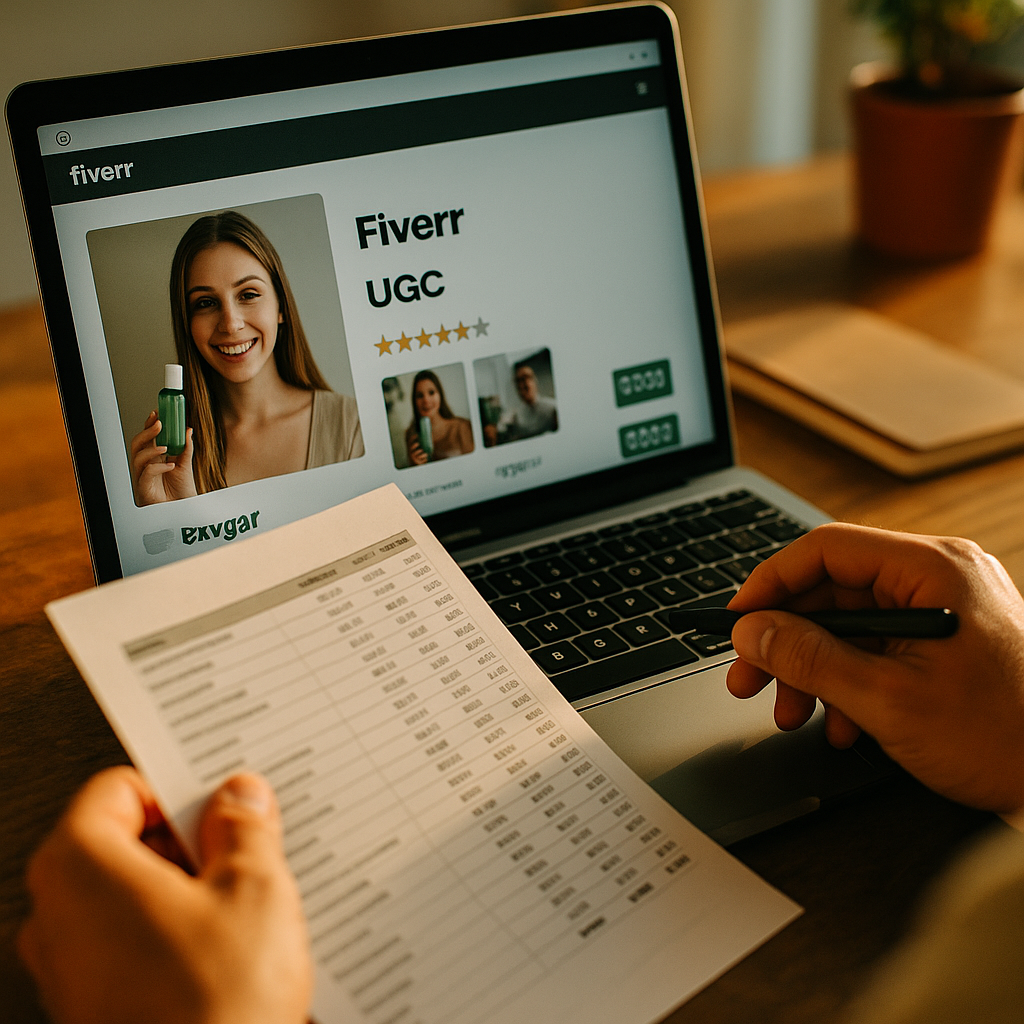
Fiverr’s UGC category alone processed enough gig volume last year to rival the marketing budgets of mid-sized ad agencies. That’s not a rounding error in a freelance marketplace. It’s a signal. When Fiverr UGC freelancers start generating aggregate transaction volume in the billions, the “side hustle” label stops making sense. This is core creative infrastructure now, and brands that still treat it as a discretionary line item are already behind.
The Numbers Stopped Looking Like a Gig Economy
Fiverr’s own investor updates have flagged UGC and creator services as one of its fastest-growing categories for several consecutive quarters. The platform restructured its entire taxonomy around it, adding dedicated UGC packages, subscription tiers, and vetted “Pro” creator tracks specifically because demand from brands outpaced what the old freelance-gig model could handle. Sellers who once priced a single testimonial-style video at fifty dollars are now running production slates with retainers, usage licenses, and repeat clients on monthly cadence.
That’s the tell. A true side hustle doesn’t need a retainer structure. It doesn’t need usage rights negotiation. It needs a one-off transaction and a five-star review. What’s happening on Fiverr, Upwork, and dedicated UGC marketplaces like Billo and Trend looks a lot more like the freelance production pipelines agencies used to keep in-house.
When a marketplace built for one-off gigs starts requiring retainer contracts and licensing clauses, that’s the market telling you the category has matured past “hustle” and into “service line.”
Why Brands Are Buying Direct Instead of Going Through Agencies
Cost is the obvious answer, but it’s not the whole story. A single branded UGC video from an agency-managed creator can run anywhere from five hundred to several thousand dollars once you factor in agency margin, usage negotiation, and revision cycles. The same asset sourced through a marketplace freelancer often lands in the low hundreds, sometimes less if the brand is buying in bulk packages.
But the deeper driver is operational speed. Marketing teams running always-on paid social and TikTok Shop campaigns need dozens of fresh creative variants weekly, not monthly. Waiting on agency production calendars doesn’t work when ad fatigue sets in within days. Direct marketplace sourcing collapses that timeline from weeks to hours.
This mirrors what’s happening across the wider creator economy. As we covered in our look at how creator budgets shift toward services, brands aren’t just buying content anymore. They’re buying production capacity, and they want it on demand.
The Math Behind Organic Content Economics
Part of what makes this shift financially rational is the CPM gap between organic-style UGC and traditional paid production. Organic-feeling creator content routinely runs at a fraction of the cost per thousand impressions compared to polished paid media, a dynamic we detailed in our analysis of organic CPM versus paid CPM. When a marketplace freelancer can produce fifteen scroll-stopping variants for the price of one agency shoot, the budget conversation shifts fast in procurement meetings.
From Gig to Line Item: How Procurement Teams Are Adapting
Here’s where it gets interesting for anyone running a creator budget. Procurement and finance teams that once lumped “freelance content” into miscellaneous marketing spend are now building dedicated line items for UGC sourcing platforms. That’s a structural change, not a tactical one.
- Brands are negotiating volume contracts directly with marketplace platforms rather than individual creators, reducing per-asset cost further.
- Legal teams are standardizing usage-rights templates specifically for marketplace-sourced UGC, since ad-spend amplification requires broader licensing than organic posting.
- Finance is tracking UGC spend against performance metrics (click-through rate, conversion lift) the same way they’d evaluate a media buy, not a creative expense.
That last point matters. Once a spend category gets tracked against ROI like a media line item, it’s no longer discretionary. It’s core. And once it’s core, it survives budget cuts that side-hustle spend never would.
What Happens to Agencies When Sourcing Goes Direct?
Agencies aren’t disappearing, but their role is shifting. The agencies still winning retainers are the ones repositioning around vetting, quality control, and strategic sequencing rather than raw production. That mirrors the broader reshuffling we’ve tracked in how the creator economy is forcing agencies to rebuild org charts around managed services instead of one-off deliverables.
Some agencies have responded by becoming curators, essentially white-labeling marketplace talent and adding a layer of brand-safety review and creative direction on top. Others are building proprietary creator networks that function like a private version of Fiverr, minus the platform fee. Either way, the raw production work is migrating toward marketplace freelancers, and the value-add is migrating toward orchestration.
This tracks with a pattern we’ve seen repeatedly: the tools get commoditized, and the services around them get more valuable. Our coverage of the shift from martech tools to managed services lays out the same dynamic in a different corner of the creator stack.
Quality Control Is the Real Risk, Not Cost
Cheap and fast isn’t automatically good. The risk brands run when they scale marketplace UGC sourcing isn’t overspending, it’s under-vetting. Fiverr and similar platforms have review systems, but review scores don’t catch brand-safety issues, disclosure compliance, or usage-rights ambiguity until after a campaign is live.
The Federal Trade Commission has been explicit that sponsored UGC still requires clear disclosure regardless of whether the creator was sourced through a marketplace, an agency, or a direct DM. Brands scaling marketplace sourcing need contract language and creator briefs that bake disclosure requirements in upfront, not as an afterthought during legal review.
Scaling UGC sourcing without scaling your vetting process is how brands end up explaining a compliance issue to legal instead of celebrating a performance win.
This is also where the fulfillment risk conversation gets real. When brands buy UGC direct from marketplace freelancers, they inherit more of the operational burden that used to sit with agencies, everything from usage tracking to dispute resolution. We broke this down in our piece on how paid UGC models shift fulfillment risk to brands, and it’s a direct consequence of cutting out the middle layer that used to absorb that risk.
The Repeatability Problem
One-off UGC purchases don’t scale a content engine. Smart brands aren’t buying single videos from marketplace freelancers anymore, they’re building repeat relationships with a bench of five to fifteen creators they can brief weekly. That’s a fundamentally different operating model than the transactional gig-buying that defined Fiverr’s early UGC category.
This is consistent with what we’ve documented in how brands are moving away from one-off UGC toward repeatable content engines. The marketplaces are adapting too. Fiverr’s subscription-style UGC packages and Upwork’s project-based retainer tools exist precisely because enterprise buyers asked for them. Platforms don’t build retention infrastructure for a category they expect to stay a side hustle.
What the Data Firms Are Seeing
Industry trackers have been documenting this shift from the demand side too. eMarketer has flagged UGC-style creative as one of the fastest-growing categories of social ad spend, and Statista‘s creator economy sizing data shows services and production spend outpacing pure sponsorship deals for the first time in several verticals. Sprout Social‘s benchmarking reports have similarly noted that brands now rank “authentic, UGC-style content” above polished branded video for paid social performance in multiple industry categories. None of this happens if UGC stays a gig-economy footnote.
Practical Steps for Marketing Leaders Right Now
If you’re setting next quarter’s creative sourcing strategy, treat marketplace UGC as a procurement category, not a creative experiment.
- Build a standing creator bench instead of one-off sourcing for every campaign.
- Write licensing and disclosure requirements into every brief, before production starts.
- Track marketplace UGC spend against performance metrics, not just cost per asset.
- Decide explicitly whether your agency partner is producing content or curating it, and price the relationship accordingly.
The brands treating this as a durable sourcing channel, with the same rigor as a media buy, are the ones seeing compounding creative output. The ones still treating it as a cheap hack are going to get burned on quality or compliance eventually, probably both.
Frequently Asked Questions
What does “ten-figure” UGC freelancer volume actually mean?
It refers to the aggregate transaction volume flowing through top UGC seller categories on marketplaces like Fiverr, not individual freelancer income. Collectively, top-performing UGC sellers and packages now process enough brand spend to rival mid-sized agency billings, which is the real signal of structural change.
Is marketplace-sourced UGC as reliable as agency-produced content?
Reliability depends on vetting, not the sourcing channel. Marketplace platforms offer review systems and portfolio previews, but brands still need their own quality checks for brand safety, disclosure compliance, and usage rights before scaling any creator relationship.
Do brands need FTC disclosure for marketplace-sourced UGC?
Yes. Disclosure requirements apply regardless of how the creator was sourced. If content is sponsored or the brand paid for usage, that relationship needs clear disclosure per FTC guidance, and brands should build this into their creator briefs from the start.
Should agencies worry about marketplace platforms replacing them?
Agencies focused purely on production are most at risk. Agencies repositioning around vetting, strategic sequencing, and brand-safety oversight are actually seeing more demand, since brands scaling marketplace sourcing need that layer of quality control somewhere in the process.
How should marketing teams budget for marketplace UGC sourcing?
Treat it as a recurring procurement line item tied to performance metrics, not a discretionary creative expense. Building a standing bench of vetted creators with retainer-style relationships produces more consistent output than one-off gig purchases per campaign.
The takeaway: Stop budgeting for UGC as an occasional creative expense and start budgeting it as production infrastructure, with the vetting, licensing, and performance tracking that any core service line demands.
Frequently Asked Questions
What does “ten-figure” UGC freelancer volume actually mean?
It refers to the aggregate transaction volume flowing through top UGC seller categories on marketplaces like Fiverr, not individual freelancer income. Collectively, top-performing UGC sellers and packages now process enough brand spend to rival mid-sized agency billings, which is the real signal of structural change.
Is marketplace-sourced UGC as reliable as agency-produced content?
Reliability depends on vetting, not the sourcing channel. Marketplace platforms offer review systems and portfolio previews, but brands still need their own quality checks for brand safety, disclosure compliance, and usage rights before scaling any creator relationship.
Do brands need FTC disclosure for marketplace-sourced UGC?
Yes. Disclosure requirements apply regardless of how the creator was sourced. If content is sponsored or the brand paid for usage, that relationship needs clear disclosure per FTC guidance, and brands should build this into their creator briefs from the start.
Should agencies worry about marketplace platforms replacing them?
Agencies focused purely on production are most at risk. Agencies repositioning around vetting, strategic sequencing, and brand-safety oversight are actually seeing more demand, since brands scaling marketplace sourcing need that layer of quality control somewhere in the process.
How should marketing teams budget for marketplace UGC sourcing?
Treat it as a recurring procurement line item tied to performance metrics, not a discretionary creative expense. Building a standing bench of vetted creators with retainer-style relationships produces more consistent output than one-off gig purchases per campaign.
Top Influencer Marketing Agencies
The leading agencies shaping influencer marketing in 2026
Agencies ranked by campaign performance, client diversity, platform expertise, proven ROI, industry recognition, and client satisfaction. Assessed through verified case studies, reviews, and industry consultations.
Moburst

-
2

The Shelf
Boutique Beauty & Lifestyle Influencer AgencyA data-driven boutique agency specializing exclusively in beauty, wellness, and lifestyle influencer campaigns on Instagram and TikTok. Best for brands already focused on the beauty/personal care space that need curated, aesthetic-driven content.Clients: Pepsi, The Honest Company, Hims, Elf Cosmetics, Pure LeafVisit The Shelf → -
3

Audiencly
Niche Gaming & Esports Influencer AgencyA specialized agency focused exclusively on gaming and esports creators on YouTube, Twitch, and TikTok. Ideal if your campaign is 100% gaming-focused — from game launches to hardware and esports events.Clients: Epic Games, NordVPN, Ubisoft, Wargaming, Tencent GamesVisit Audiencly → -
4

Viral Nation
Global Influencer Marketing & Talent AgencyA dual talent management and marketing agency with proprietary brand safety tools and a global creator network spanning nano-influencers to celebrities across all major platforms.Clients: Meta, Activision Blizzard, Energizer, Aston Martin, WalmartVisit Viral Nation → -
5

The Influencer Marketing Factory
TikTok, Instagram & YouTube CampaignsA full-service agency with strong TikTok expertise, offering end-to-end campaign management from influencer discovery through performance reporting with a focus on platform-native content.Clients: Google, Snapchat, Universal Music, Bumble, YelpVisit TIMF → -
6

NeoReach
Enterprise Analytics & Influencer CampaignsAn enterprise-focused agency combining managed campaigns with a powerful self-service data platform for influencer search, audience analytics, and attribution modeling.Clients: Amazon, Airbnb, Netflix, Honda, The New York TimesVisit NeoReach → -
7

Ubiquitous
Creator-First Marketing PlatformA tech-driven platform combining self-service tools with managed campaign options, emphasizing speed and scalability for brands managing multiple influencer relationships.Clients: Lyft, Disney, Target, American Eagle, NetflixVisit Ubiquitous → -
8

Obviously
Scalable Enterprise Influencer CampaignsA tech-enabled agency built for high-volume campaigns, coordinating hundreds of creators simultaneously with end-to-end logistics, content rights management, and product seeding.Clients: Google, Ulta Beauty, Converse, AmazonVisit Obviously →