


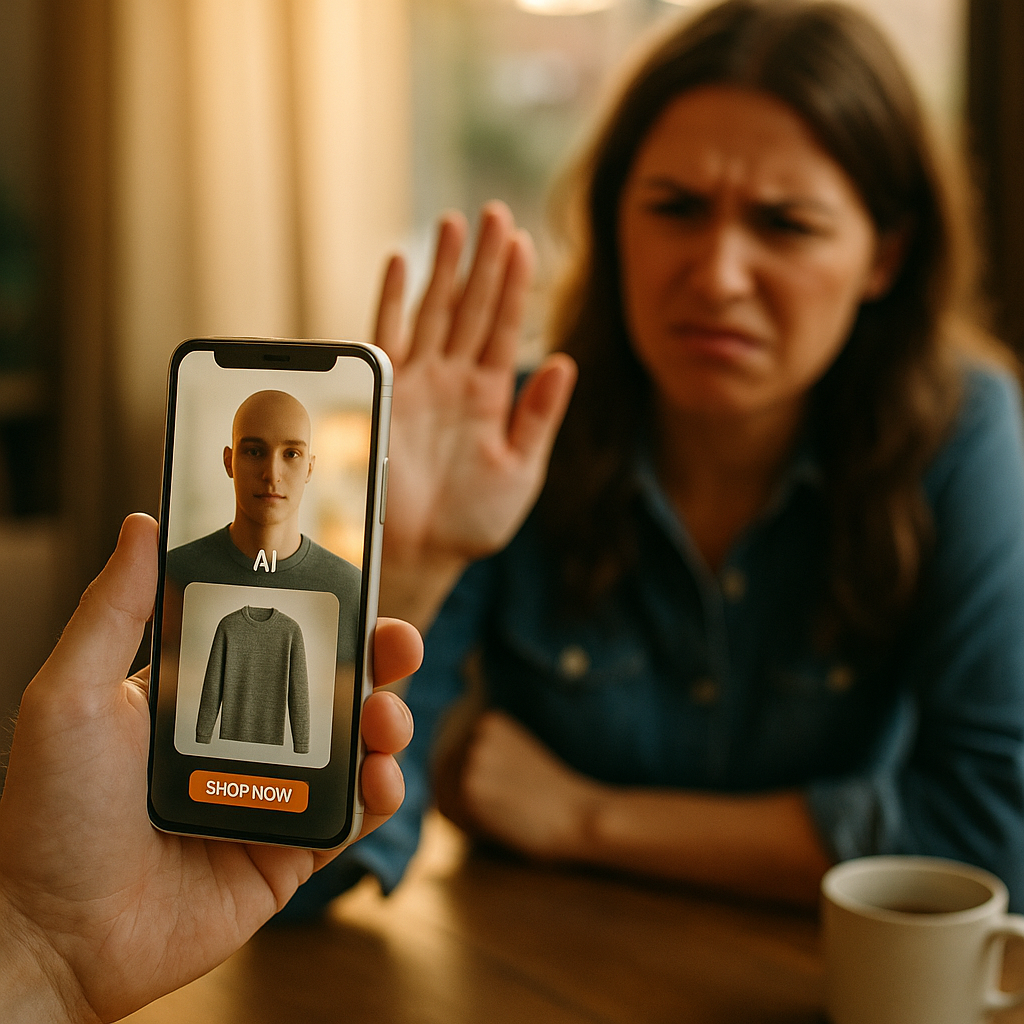
Seventy-one percent of marketers now use AI to personalize ad creative and targeting, yet consumer trust in AI-driven advertising has dropped for three straight quarters. That gap has a name now: the demand trust paradox. And if your media plan leans on AI personalization without addressing the trust side of the ledger, you’re building growth on a foundation that’s quietly cracking.
The Numbers Behind the Paradox
Something strange is happening in the funnel. Marketers are pouring more budget into AI-driven personalization tools than ever. Programmatic platforms, generative creative engines, dynamic product ads, all of it scaling fast. Adoption curves look like a hockey stick.
Meanwhile, trust metrics are sliding in the opposite direction. Surveys from eMarketer and Statista have both tracked declining confidence in personalized ads over the past several quarters, with consumers reporting increased discomfort when ads feel “too accurate.” Roughly four in ten consumers say a hyper-relevant ad makes them trust a brand less, not more. That’s the paradox in one sentence: the better the targeting works, the worse it feels.
Personalization was supposed to build intimacy. Instead, for a growing share of consumers, it reads as surveillance dressed up as service.
This isn’t a niche concern for privacy advocates anymore. It’s showing up in brand lift studies, in churn data, and in the qualitative feedback agencies collect during campaign post-mortems. The disconnect is now a board-level risk, not a footnote in a compliance memo.
Why “Relevant” Now Reads as “Invasive”
Here’s the mechanism. AI personalization engines have gotten so good at stitching together behavioral, contextual, and third-party signals that the output feels less like marketing and more like mind reading. Consumers can’t always articulate how a brand knew they were pregnant, job hunting, or shopping for a divorce lawyer. They just know it felt wrong.
That discomfort compounds because most brands never explain the “how.” There’s no visible logic, no plain-language disclosure, no obvious opt-out that actually works. The ad shows up, it’s eerily specific, and the brand offers zero context. Silence reads as concealment, even when the targeting is technically compliant.
Compare that to the AI chatbot experience, where slow or generic responses erode trust in a different but related way, as we covered in chatbot response time research. Speed builds trust in service contexts. Precision, oddly, destroys it in ad contexts. Same underlying AI infrastructure, opposite trust dynamics, depending on how the output is framed for the consumer.
The Compliance Clock Is Ticking
Regulators are catching up to what consumers already feel in their gut. The FTC has signaled increased scrutiny of algorithmic ad targeting practices, particularly around sensitive categories like health, finances, and age. The ICO in the UK has published guidance specifically addressing AI-driven profiling in advertising contexts, and enforcement actions are no longer theoretical.
This regulatory pressure is arriving at the same moment platforms are already tightening the rules around targeting minors and vulnerable users. Meta’s recent settlement over teen safety, detailed in our coverage of the global ad compliance shift, is a preview of what’s coming for AI personalization more broadly. Expect usage caps, disclosure mandates, and audit requirements to expand well beyond youth-focused categories over the next few budget cycles.
If your paid social program still relies on aggressive lookalike modeling or behavioral retargeting without a documented consent trail, now is the time to get ahead of it. Retrofitting compliance after a settlement is expensive. Building it in now is not.
Where the ROI Math Breaks
Here’s the part that should worry performance marketers specifically. Trust erosion doesn’t just create brand risk, it shows up directly in conversion and retention metrics. A personalized ad that triggers discomfort doesn’t just underperform, it can actively suppress future engagement across the entire brand relationship. That’s a compounding cost that most attribution models never capture.
This is closely related to a broader shift happening in how consumers research before they buy. As covered in AI search research, half of consumers now start product discovery inside AI-powered search tools rather than clicking ads directly. That means the ad impression itself is increasingly a trust signal, not a conversion event. If the ad damages trust, it can poison the well before the consumer ever reaches a branded search or a product page.
Attribution models built around last-click or even multi-touch frameworks weren’t designed to capture this kind of reputational drag. Our earlier piece on how zero-click search breaks attribution covers a related blind spot: the metrics marketers rely on are increasingly disconnected from how consumers actually experience and judge brand touchpoints.
What Brands Get Wrong: Optimization Over Transparency
Most brands treat personalization as a pure optimization problem. Feed the algorithm more data, tighten the targeting, watch CTR climb. Job done, right? Wrong. That framing ignores the second variable entirely: how the consumer experiences being targeted.
Three recurring mistakes show up across brand audits:
- No visible “why am I seeing this” mechanism. Most platforms offer one, few brands promote it or design creative that references it.
- Over-reliance on third-party data brokers whose sourcing practices the brand can’t fully explain or defend if challenged.
- Treating AI personalization as a black box internally, meaning nobody on the marketing team can actually walk a regulator, journalist, or customer through the logic.
This mirrors a pattern we’ve seen play out in influencer vetting, where AI-driven sourcing tools made discovery cheap but left brands with almost no defensible audit trail when a creator turned out to be fraudulent or misaligned. Speed without transparency is a recurring failure mode across every part of the AI marketing stack, not just paid ads.
How Leading Brands Are Closing the Gap
The brands managing this well aren’t slowing down AI adoption. They’re pairing it with visible trust infrastructure. A few practical moves worth stealing:
- Publish a plain-language targeting explainer linked directly from ad units, not buried three clicks deep in a privacy policy nobody reads.
- Cap sensitive-category targeting voluntarily, ahead of regulatory mandate, and say so publicly. It’s a cheap trust dividend.
- Audit third-party data vendors quarterly, the same way finance teams audit suppliers. Treat data provenance as a compliance line item, not a one-time onboarding checkbox.
- Train creative teams to design for disclosure, meaning ad copy that references the “why” without sounding robotic or defensive.
None of this requires abandoning AI personalization. It requires treating trust as a measurable input to the model, not an afterthought that gets handled by legal after the campaign launches. Tools like Meta Business and TikTok Ads Manager have both expanded native disclosure features over the past year. Most brands simply aren’t turning them on by default.
The Agent Layer Adds a New Wrinkle
There’s a fresh complication brewing as AI agents start handling more of the ad buying and optimization work autonomously. Our recent analysis on how AI agents are widening the marketing trust gap found that autonomous optimization, left unchecked, tends to chase short-term performance signals at the expense of long-term brand equity. Feed an agent a CTR-maximization goal and it will happily push into targeting territory that damages trust, because trust isn’t in its reward function.
That’s a structural problem, not a bug. Any brand deploying agentic AI for media buying needs to explicitly encode trust guardrails into the optimization criteria, or accept that the agent will eventually find the most invasive version of “working.”
The Bottom Line for Budget Owners
The demand trust paradox isn’t going away on its own, and it won’t be solved by better targeting algorithms. It gets solved by treating transparency as a performance lever, not a compliance tax. Audit your sensitive-category targeting this quarter, publish a plain-language disclosure on your top ad units, and measure whether trust-forward creative actually outperforms the black-box version over a full sales cycle. It usually does.
Frequently Asked Questions
What is the demand trust paradox in AI-driven advertising?
It refers to the growing gap between rising marketer adoption of AI personalization tools and declining consumer trust in the ads those tools produce. Usage keeps climbing while trust metrics fall, creating a hidden risk for brands that measure success on engagement alone.
Why does AI personalization sometimes reduce brand trust instead of building it?
When targeting feels too precise without any visible explanation, consumers interpret it as surveillance rather than service. The absence of a clear “why am I seeing this” mechanism turns relevance into discomfort.
Are regulators actively addressing AI ad personalization?
Yes. Bodies like the FTC and the ICO have issued guidance and increased enforcement attention on algorithmic targeting, especially involving sensitive categories such as health, finances, and age-based profiling.
How can brands measure the ROI impact of trust erosion?
Standard attribution models rarely capture it directly. Brands should track brand lift, repeat engagement rates, and opt-out or ad-block trends alongside standard conversion metrics to spot early signs of trust-driven performance decay.
What’s the fastest fix for brands worried about this trend?
Publish plain-language targeting disclosures on top-performing ad units and voluntarily cap sensitive-category targeting ahead of regulatory mandates. Both moves are low-cost and tend to improve long-term performance, not just perception.
Top Influencer Marketing Agencies
The leading agencies shaping influencer marketing in 2026
Agencies ranked by campaign performance, client diversity, platform expertise, proven ROI, industry recognition, and client satisfaction. Assessed through verified case studies, reviews, and industry consultations.
Moburst

-
2

The Shelf
Boutique Beauty & Lifestyle Influencer AgencyA data-driven boutique agency specializing exclusively in beauty, wellness, and lifestyle influencer campaigns on Instagram and TikTok. Best for brands already focused on the beauty/personal care space that need curated, aesthetic-driven content.Clients: Pepsi, The Honest Company, Hims, Elf Cosmetics, Pure LeafVisit The Shelf → -
3

Audiencly
Niche Gaming & Esports Influencer AgencyA specialized agency focused exclusively on gaming and esports creators on YouTube, Twitch, and TikTok. Ideal if your campaign is 100% gaming-focused — from game launches to hardware and esports events.Clients: Epic Games, NordVPN, Ubisoft, Wargaming, Tencent GamesVisit Audiencly → -
4

Viral Nation
Global Influencer Marketing & Talent AgencyA dual talent management and marketing agency with proprietary brand safety tools and a global creator network spanning nano-influencers to celebrities across all major platforms.Clients: Meta, Activision Blizzard, Energizer, Aston Martin, WalmartVisit Viral Nation → -
5

The Influencer Marketing Factory
TikTok, Instagram & YouTube CampaignsA full-service agency with strong TikTok expertise, offering end-to-end campaign management from influencer discovery through performance reporting with a focus on platform-native content.Clients: Google, Snapchat, Universal Music, Bumble, YelpVisit TIMF → -
6

NeoReach
Enterprise Analytics & Influencer CampaignsAn enterprise-focused agency combining managed campaigns with a powerful self-service data platform for influencer search, audience analytics, and attribution modeling.Clients: Amazon, Airbnb, Netflix, Honda, The New York TimesVisit NeoReach → -
7

Ubiquitous
Creator-First Marketing PlatformA tech-driven platform combining self-service tools with managed campaign options, emphasizing speed and scalability for brands managing multiple influencer relationships.Clients: Lyft, Disney, Target, American Eagle, NetflixVisit Ubiquitous → -
8

Obviously
Scalable Enterprise Influencer CampaignsA tech-enabled agency built for high-volume campaigns, coordinating hundreds of creators simultaneously with end-to-end logistics, content rights management, and product seeding.Clients: Google, Ulta Beauty, Converse, AmazonVisit Obviously →