


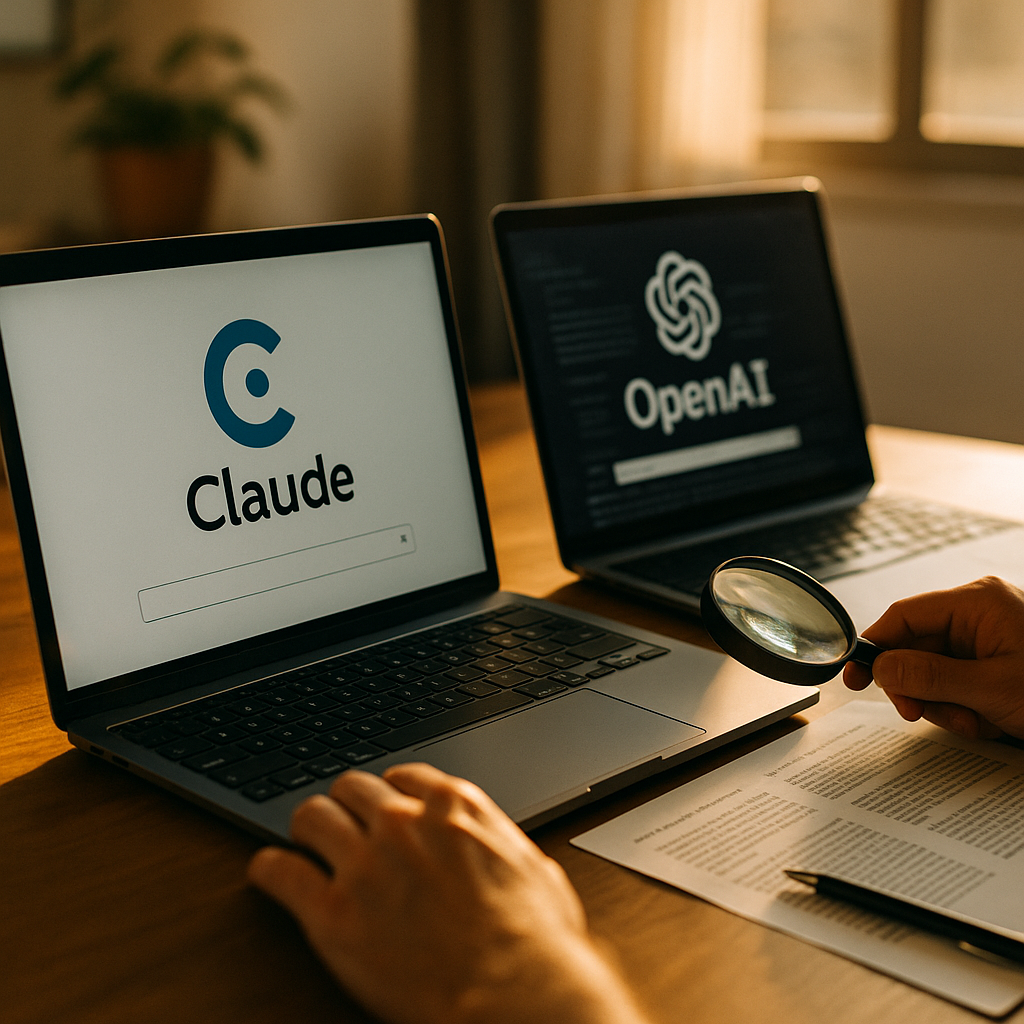
Nearly a third of AI-drafted marketing copy contains at least one claim nobody on the team can actually source, according to internal audits several agencies have quietly run this year. That’s not a hallucination problem anymore. It’s a liability problem. So when marketing ops leads ask whether Claude for Enterprise or OpenAI Enterprise Search Grounding does a better job keeping fact-checked content out of legal’s crosshairs, the answer isn’t obvious, and it isn’t the same for every team.
The Fact-Checking Problem Nobody Budgeted For
Marketing teams adopted generative AI for speed. What they got instead was a new review bottleneck. Every claim about product efficacy, pricing, or competitive comparison now needs a human to trace it back to a source before it ships, because the FTC doesn’t care whether a chatbot invented the statistic. The FTC’s guidance on endorsements and claims makes brands, not vendors, responsible for substantiation.
That’s why grounding, the practice of tying model output to verifiable source documents or live search results, has become the deciding factor in enterprise AI procurement. It’s less about which model writes better prose and more about which one leaves an audit trail. We’ve covered this tension before in RAG for creator briefs, and the same logic applies at the enterprise platform level.
Claude for Enterprise: Grounding Through Constitutional Caution
Anthropic built Claude’s enterprise tier around a specific philosophy: reduce confident wrongness before it happens, rather than catching it after. The Citations feature is the standout tool here. Feed Claude a set of source documents, whether that’s a product spec sheet, a clinical study PDF, or a competitor’s public pricing page, and it will ground each factual sentence to a specific span of text in that source. You can click a claim and see exactly where it came from.
For marketing teams writing compliance-heavy content (pharma, finance, insurance), this matters enormously. Claude’s larger context window lets legal teams upload entire regulatory documents, and the model won’t wander outside them the way general-purpose chat interfaces sometimes do. Admin controls, SSO, and data residency options round out the enterprise package, which is table stakes at this point but still worth checking against your procurement checklist.
Grounding isn’t about making AI smarter. It’s about making AI’s mistakes traceable, so a human can catch them before a customer or regulator does.
The tradeoff: Claude’s enterprise grounding works best with documents you supply. It’s not designed to be your primary live web search tool, and marketers chasing real-time competitive claims or breaking category news will feel that limitation quickly.
OpenAI Enterprise Search Grounding: Speed Meets Citation Depth
ChatGPT Enterprise takes a different route. Its search grounding leans on live web retrieval, pulling current sources and attaching citation links directly in the response. That’s a real advantage for content teams writing about fast-moving categories, think consumer electronics launches, travel pricing, or anything tied to news cycles, where a static knowledge base goes stale in days.
OpenAI also offers a file search and retrieval tool within its Assistants framework, which functions similarly to Claude’s document grounding but with less granular citation mapping. You get a source link, not always a highlighted span. For high-volume content teams pushing out dozens of briefs a week, that’s often an acceptable tradeoff for speed.
The catch is verification discipline. Live web grounding means the model can pull from low-quality or outdated pages if your retrieval settings aren’t tightly scoped. We’ve seen this exact failure mode play out in Gemini vs OpenAI grounding comparisons for creator briefs, where unscoped search grounding introduced claims from unreliable third-party blogs into supposedly fact-checked drafts.
Where the Two Approaches Actually Diverge
- Source control: Claude favors curated, uploaded documents. OpenAI favors live web retrieval with configurable scope.
- Citation granularity: Claude’s Citations feature maps claims to exact text spans. OpenAI typically links to a source URL or document.
- Context window: Claude’s larger window handles dense regulatory or legal source material better in a single pass.
- Freshness: OpenAI’s search grounding wins for anything tied to current events, pricing changes, or trending topics.
- Governance maturity: Both offer enterprise admin tooling, but audit logs and data handling policies differ enough that legal review of each vendor’s terms is non-negotiable.
Neither tool eliminates the need for a human fact-checker. What they change is how much time that fact-checker spends hunting for sources versus verifying ones already surfaced. That’s a meaningful efficiency gain, but it’s not zero-touch content production, no matter what the sales deck implies.
Which One Reduces Legal and Compliance Risk?
If your content touches regulated claims, product safety, financial performance, health outcomes, Claude’s document-grounded citation model generally produces a cleaner audit trail. Legal teams can trace a sentence back to a paragraph in a source PDF, which is exactly the kind of substantiation regulators ask for during an investigation.
If your content is more topical and volume-driven, social copy, trend commentary, competitive comparisons in fast-moving categories, OpenAI’s live search grounding keeps pace better and reduces the staleness risk that comes from static knowledge bases. The risk shifts from “unsubstantiated claim” to “citation from a mediocre source,” which is a different but still manageable problem with proper retrieval scoping.
Either way, the underlying data quality matters more than the model choice. We’ve made this point before: AI marketing agents fail on bad data, not weak models, and grounding tools are only as trustworthy as the corpus they’re grounded against.
Building the Right Workflow, Not Just Picking a Model
Vendor selection is the easy part. The harder work is building a repeatable review process around whichever grounding tool you choose. That means defining which content categories require document-level citation versus live search, setting retrieval scope rules so models don’t pull from unreliable domains, and assigning a human reviewer who actually checks the cited source, not just the presence of a citation.
Teams that skip this step end up with what we call citation theater: links that look like verification but nobody has actually opened. That’s arguably worse than no citation at all, because it creates false confidence. Our earlier coverage of RAG verification for creator briefs walks through a practical checklist for closing that gap, and much of it applies directly to enterprise search grounding tools too.
Budget matters here as well. Enterprise-tier access to either platform isn’t cheap once you factor in seat licenses, API usage for retrieval-heavy workflows, and the internal headcount needed for review. According to eMarketer’s coverage of enterprise AI spend, marketing organizations are increasingly treating grounding and verification tooling as a distinct line item, separate from general AI content generation budgets. That’s the right instinct. Compliance tooling for content generation is starting to be a durable, dedicated cost of production. And it’s worth benchmarking claims about content compliance against broader industry data from sources like HubSpot’s marketing research or Sprout Social’s platform reports before locking in a single-vendor strategy.
Frequently Asked Questions
Is Claude for Enterprise better than OpenAI Enterprise Search Grounding for fact-checked marketing content?
Neither is universally better. Claude for Enterprise tends to produce cleaner audit trails for document-grounded, regulated claims, while OpenAI’s search grounding handles fast-moving, topical content better because it pulls live web sources.
Can either tool fully replace a human fact-checker?
No. Both tools reduce the time spent hunting for sources, but a human still needs to verify that cited sources are accurate, current, and appropriately authoritative before content ships.
Which platform works better for regulated industries like pharma or finance?
Claude for Enterprise’s Citations feature, which maps claims to exact spans of source text, generally gives compliance and legal teams a more precise audit trail for regulated content categories.
Does live search grounding introduce more risk than document-based grounding?
It can, if retrieval scope isn’t configured carefully. Live web grounding may pull from low-quality or outdated sources unless a marketing team restricts the domains and content types it draws from.
How should marketing teams decide between the two for content operations?
Map your content categories first. Regulated or claims-heavy content favors document-grounded tools like Claude’s Citations, while topical or trend-driven content benefits from live search grounding with strict source scoping.
Pick the grounding tool that matches your content’s risk profile, not the one with the flashier demo. Then build a review workflow that actually opens the citations before anything ships.
Top Influencer Marketing Agencies
The leading agencies shaping influencer marketing in 2026
Agencies ranked by campaign performance, client diversity, platform expertise, proven ROI, industry recognition, and client satisfaction. Assessed through verified case studies, reviews, and industry consultations.
Moburst

-
2

The Shelf
Boutique Beauty & Lifestyle Influencer AgencyA data-driven boutique agency specializing exclusively in beauty, wellness, and lifestyle influencer campaigns on Instagram and TikTok. Best for brands already focused on the beauty/personal care space that need curated, aesthetic-driven content.Clients: Pepsi, The Honest Company, Hims, Elf Cosmetics, Pure LeafVisit The Shelf → -
3

Audiencly
Niche Gaming & Esports Influencer AgencyA specialized agency focused exclusively on gaming and esports creators on YouTube, Twitch, and TikTok. Ideal if your campaign is 100% gaming-focused — from game launches to hardware and esports events.Clients: Epic Games, NordVPN, Ubisoft, Wargaming, Tencent GamesVisit Audiencly → -
4

Viral Nation
Global Influencer Marketing & Talent AgencyA dual talent management and marketing agency with proprietary brand safety tools and a global creator network spanning nano-influencers to celebrities across all major platforms.Clients: Meta, Activision Blizzard, Energizer, Aston Martin, WalmartVisit Viral Nation → -
5

The Influencer Marketing Factory
TikTok, Instagram & YouTube CampaignsA full-service agency with strong TikTok expertise, offering end-to-end campaign management from influencer discovery through performance reporting with a focus on platform-native content.Clients: Google, Snapchat, Universal Music, Bumble, YelpVisit TIMF → -
6

NeoReach
Enterprise Analytics & Influencer CampaignsAn enterprise-focused agency combining managed campaigns with a powerful self-service data platform for influencer search, audience analytics, and attribution modeling.Clients: Amazon, Airbnb, Netflix, Honda, The New York TimesVisit NeoReach → -
7

Ubiquitous
Creator-First Marketing PlatformA tech-driven platform combining self-service tools with managed campaign options, emphasizing speed and scalability for brands managing multiple influencer relationships.Clients: Lyft, Disney, Target, American Eagle, NetflixVisit Ubiquitous → -
8

Obviously
Scalable Enterprise Influencer CampaignsA tech-enabled agency built for high-volume campaigns, coordinating hundreds of creators simultaneously with end-to-end logistics, content rights management, and product seeding.Clients: Google, Ulta Beauty, Converse, AmazonVisit Obviously →