


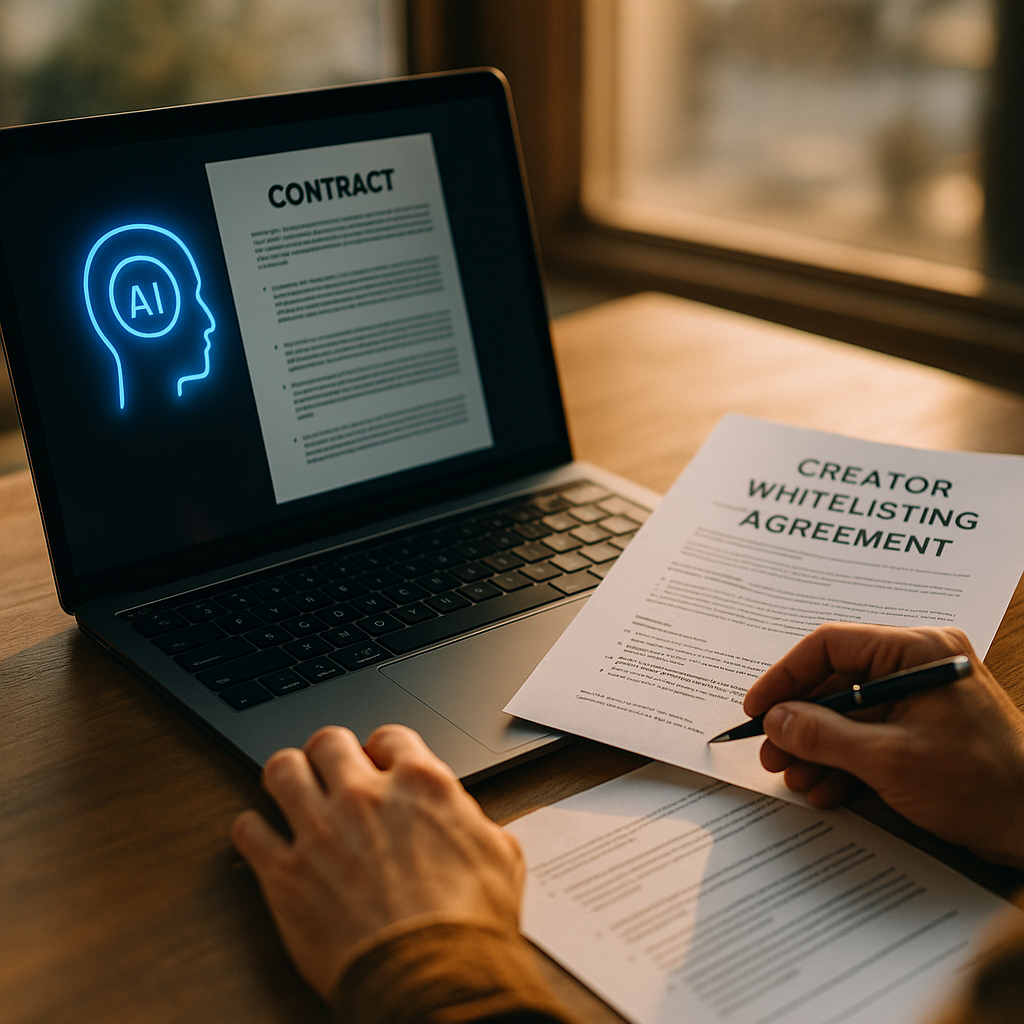
A single missed whitelisting clause can cost a brand six figures in FTC exposure, wasted ad spend, or a creator relationship gone nuclear. Yet most influencer teams still approve usage rights by skimming PDFs between meetings. Automating creator whitelisting approvals with AI contract parsing tools is quickly becoming the difference between a scalable paid-social program and a legal liability waiting to happen.
The Whitelisting Bottleneck Nobody Budgets For
Whitelisting (letting a brand run paid ads through a creator’s handle via Meta’s Partnership Ads or TikTok’s Spark Ads) is one of the highest-leverage tactics in influencer marketing. It also happens to be one of the most contract-dependent. Every deal specifies different usage windows, geographic restrictions, ad formats, and renewal terms. Multiply that across fifty creators in a single quarter, and legal review becomes the chokepoint that stalls campaign launches.
Ask any performance marketer how long it takes to get a whitelisting addendum reviewed and approved. The honest answer is usually days, sometimes weeks. Meanwhile, the media buying team is sitting on a tested hook that’s ready to scale, but can’t touch paid spend until someone confirms the creator actually granted usage rights for that specific ad account and date range.
Teams running high-volume whitelisting programs report spending 15 to 20 hours per week on manual contract review alone, time that directly delays paid amplification of proven content.
What AI Contract Parsing Actually Does
Contract parsing tools use natural language processing to extract structured data points from unstructured agreements: usage duration, platform scope, exclusivity clauses, renewal triggers, and territorial limits. Instead of a human reading a 12-page agreement, the system flags the exact clause governing paid usage and cross-references it against the campaign request.
In practice, this looks like an approval queue where a media buyer requests whitelisting access for a creator’s TikTok handle. The AI layer checks the signed contract, confirms the usage window hasn’t expired, verifies the ad format matches what was negotiated, and either greenlights the request or routes it to a human reviewer with the exact clause highlighted. No more digging through email threads to find the original agreement.
This isn’t speculative. Platforms building toward governed influencer stacks, like the capabilities previewed in CreatorIQ’s governed workflow tools, are already treating contract data as a first-class input rather than an afterthought bolted onto a spreadsheet.
Where the Risk Actually Hides
Here’s the uncomfortable truth: most whitelisting violations aren’t malicious. They’re clerical. A brand runs an ad past the agreed end date because nobody tracked the expiration. A media buyer uses a creator’s content on a platform the contract never covered. An agency rep approves a renewal that was never actually countersigned.
These aren’t hypothetical scenarios. The FTC’s endorsement guidelines make brands jointly liable for disclosure and usage violations, even when the creator’s team technically holds the paperwork. If your whitelisting approval process relies on someone remembering what a contract said three months ago, you’re carrying risk you probably haven’t quantified.
This connects directly to a broader problem in influencer operations: payout and compliance data often live in disconnected systems. As explored in coverage of payout compliance risk, the gap between what finance tracks and what legal has on file is exactly where whitelisting violations slip through undetected.
Building the Automated Workflow
A functional AI-assisted whitelisting pipeline generally includes four layers:
- Ingestion: Contracts are uploaded or synced from a CRM, and the parsing engine extracts usage rights metadata automatically.
- Validation: Each whitelisting request is checked against the extracted terms before any ad account gets access.
- Exception routing: Anything ambiguous, like a clause with unclear renewal language, gets flagged for human legal review instead of silently approved or silently blocked.
- Audit trail: Every approval and denial is logged with a timestamp and the specific clause it was matched against, which matters enormously if a creator disputes usage later.
The exception routing step is where most brands get it wrong. They either automate everything (risky) or automate nothing (slow). The smarter approach mirrors what’s happening in adjacent creative workflows, where AI handles the first pass and humans check the edge cases. Whitelisting approvals should work the same way: let the system clear the obvious 80%, and reserve human judgment for genuinely ambiguous contracts.
Does the ROI Actually Hold Up?
Speed is the obvious win. If a creator’s paid-ad clause is pre-verified the moment a media buyer requests access, campaigns launch same-day instead of the following week. For brands running always-on whitelisting programs across dozens of creators, that compounds fast.
But the bigger ROI driver is risk avoidance, which is harder to put a number on until something goes wrong. A single contract dispute over unauthorized usage can trigger renegotiation, creator churn, or reputational damage that costs far more than the ad spend it generated. Automated parsing doesn’t eliminate that risk, but it shrinks the odds of a clerical miss turning into a legal one.
Brands that connect contract data directly to campaign approval workflows report cutting whitelisting turnaround from an average of five business days to under 24 hours.
There’s also a budget allocation angle worth considering. Teams already weighing where to spend automation budget should look at frameworks like the ones in Forrester’s research on which creative tasks to automate first. Contract parsing consistently ranks as a high-value, low-risk automation candidate because it’s rules-based rather than creatively subjective.
Picking a Tool: What to Actually Check For
Not every “AI contract tool” is built for influencer whitelisting specifically. Generic legal-tech platforms parse contracts fine but have no concept of Meta’s Partnership Ads structure or TikTok’s Spark Ads code requirements. Before you buy anything, confirm the tool can:
- Map extracted usage rights directly to specific ad platform permissions, including Meta Partnership Ads and TikTok Spark Ads settings.
- Flag expiration dates automatically and push alerts before renewal deadlines, not after.
- Integrate with whatever influencer relationship management or CRM system your team already uses, rather than requiring a parallel data entry process.
- Produce an audit-ready log that legal can pull during a dispute without reconstructing history manually.
Guardrails matter just as much as speed. The same logic applies here as it does in outbound creator sourcing, where automated outreach systems need built-in compliance checks to avoid sending offers that violate exclusivity clauses nobody flagged. Whitelisting approval automation needs the same discipline: speed without guardrails just means you make mistakes faster.
The Compliance Layer Most Teams Skip
Disclosure rules add another wrinkle. A whitelisted ad still needs to carry appropriate FTC disclosure, and some contracts specify exactly how that disclosure must appear across different ad formats. Tools parsing usage rights should also surface disclosure requirements, not just date ranges and platform scope.
This is increasingly relevant as personalization and dynamic creative testing scale up. Research on personalization tools testing creator disclosure rules shows that as brands generate more ad variants per creator asset, the chance of a disclosure mismatch slipping through manual review rises proportionally. Automated parsing that checks disclosure language alongside usage rights closes that gap before it becomes a pattern.
According to eMarketer’s creator economy research, whitelisted ad spend continues to grow faster than organic influencer budgets, which means the operational infrastructure supporting it needs to scale just as fast. Manual review processes that worked for ten creators simply break down at a hundred.
FAQs
What is creator whitelisting in influencer marketing?
Creator whitelisting is the practice of a brand running paid ads through a creator’s social media handle, using platform features like Meta’s Partnership Ads or TikTok’s Spark Ads. It requires explicit contractual permission from the creator specifying usage scope, duration, and platform.
How does AI contract parsing improve whitelisting approvals?
AI contract parsing extracts structured data, such as usage windows and platform restrictions, from signed creator agreements. It then automatically validates whitelisting requests against those terms, approving straightforward cases and routing ambiguous ones to human legal review.
What risks does manual whitelisting approval create?
Manual approval relies on someone remembering or locating contract details, which increases the chance of running ads past expiration dates, outside agreed platforms, or without proper disclosure, all of which carry FTC compliance exposure.
Can AI contract parsing replace legal review entirely?
No. It handles routine validation at scale but should route ambiguous clauses, disputes, or unusual contract language to a human reviewer. Full automation without exception handling increases risk rather than reducing it.
What should brands look for in a whitelisting automation tool?
Look for direct integration with ad platform permission settings, automatic expiration alerts, CRM compatibility, and an audit trail that logs every approval decision against the specific contract clause it matched.
Where This Leaves Your Team
Start small: pick your highest-volume whitelisting relationships and run their contracts through a parsing tool before touching the broader program. If the exception rate stays low and the audit trail holds up under a dry-run legal review, you’ve got a process worth scaling, not just a shiny automation demo.
FAQs
What is creator whitelisting in influencer marketing?
Creator whitelisting is the practice of a brand running paid ads through a creator’s social media handle, using platform features like Meta’s Partnership Ads or TikTok’s Spark Ads. It requires explicit contractual permission from the creator specifying usage scope, duration, and platform.
How does AI contract parsing improve whitelisting approvals?
AI contract parsing extracts structured data, such as usage windows and platform restrictions, from signed creator agreements. It then automatically validates whitelisting requests against those terms, approving straightforward cases and routing ambiguous ones to human legal review.
What risks does manual whitelisting approval create?
Manual approval relies on someone remembering or locating contract details, which increases the chance of running ads past expiration dates, outside agreed platforms, or without proper disclosure, all of which carry FTC compliance exposure.
Can AI contract parsing replace legal review entirely?
No. It handles routine validation at scale but should route ambiguous clauses, disputes, or unusual contract language to a human reviewer. Full automation without exception handling increases risk rather than reducing it.
What should brands look for in a whitelisting automation tool?
Look for direct integration with ad platform permission settings, automatic expiration alerts, CRM compatibility, and an audit trail that logs every approval decision against the specific contract clause it matched.
Top Influencer Marketing Agencies
The leading agencies shaping influencer marketing in 2026
Agencies ranked by campaign performance, client diversity, platform expertise, proven ROI, industry recognition, and client satisfaction. Assessed through verified case studies, reviews, and industry consultations.
Moburst

-
2

The Shelf
Boutique Beauty & Lifestyle Influencer AgencyA data-driven boutique agency specializing exclusively in beauty, wellness, and lifestyle influencer campaigns on Instagram and TikTok. Best for brands already focused on the beauty/personal care space that need curated, aesthetic-driven content.Clients: Pepsi, The Honest Company, Hims, Elf Cosmetics, Pure LeafVisit The Shelf → -
3

Audiencly
Niche Gaming & Esports Influencer AgencyA specialized agency focused exclusively on gaming and esports creators on YouTube, Twitch, and TikTok. Ideal if your campaign is 100% gaming-focused — from game launches to hardware and esports events.Clients: Epic Games, NordVPN, Ubisoft, Wargaming, Tencent GamesVisit Audiencly → -
4

Viral Nation
Global Influencer Marketing & Talent AgencyA dual talent management and marketing agency with proprietary brand safety tools and a global creator network spanning nano-influencers to celebrities across all major platforms.Clients: Meta, Activision Blizzard, Energizer, Aston Martin, WalmartVisit Viral Nation → -
5

The Influencer Marketing Factory
TikTok, Instagram & YouTube CampaignsA full-service agency with strong TikTok expertise, offering end-to-end campaign management from influencer discovery through performance reporting with a focus on platform-native content.Clients: Google, Snapchat, Universal Music, Bumble, YelpVisit TIMF → -
6

NeoReach
Enterprise Analytics & Influencer CampaignsAn enterprise-focused agency combining managed campaigns with a powerful self-service data platform for influencer search, audience analytics, and attribution modeling.Clients: Amazon, Airbnb, Netflix, Honda, The New York TimesVisit NeoReach → -
7

Ubiquitous
Creator-First Marketing PlatformA tech-driven platform combining self-service tools with managed campaign options, emphasizing speed and scalability for brands managing multiple influencer relationships.Clients: Lyft, Disney, Target, American Eagle, NetflixVisit Ubiquitous → -
8

Obviously
Scalable Enterprise Influencer CampaignsA tech-enabled agency built for high-volume campaigns, coordinating hundreds of creators simultaneously with end-to-end logistics, content rights management, and product seeding.Clients: Google, Ulta Beauty, Converse, AmazonVisit Obviously →