


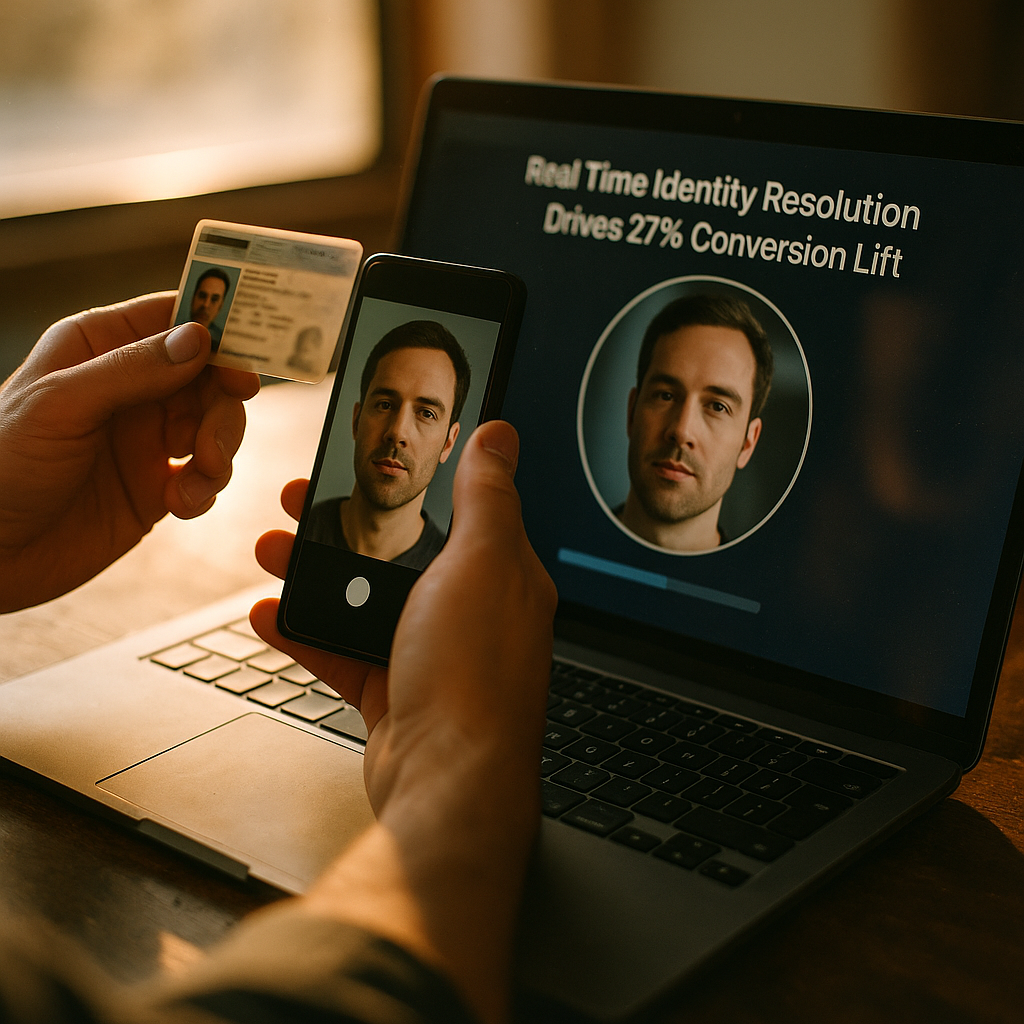
A quarter of your conversions might be dying in the gap between “user acted” and “system knew.” That’s the uncomfortable math behind Twilio Segment’s recent identity resolution benchmark, where brands running real-time data pipelines saw a 27% conversion lift compared to batch-based identity stitching. For marketing leaders still reconciling customer profiles overnight, that number should sting a little.
The 27% Number: What Twilio Segment Actually Measured
Twilio Segment’s internal case study, drawn from customers using its Unify product with real-time streaming pipelines, compared conversion rates on personalized triggers (cart abandonment emails, in-app offers, retargeting audiences) built on real-time identity graphs versus those built on nightly batch syncs. The lift wasn’t uniform across every use case. Time-sensitive triggers like browse abandonment and price-drop alerts saw the biggest gains, while longer-cycle lifecycle campaigns saw smaller but still meaningful improvement.
The mechanism is simple to explain and painfully common to encounter. In a batch world, a user browses on mobile at 9am, buys on desktop at 2pm, and your system doesn’t merge those identities until the midnight ETL job runs. Any personalization, suppression, or attribution logic that depended on knowing “this is the same person” simply didn’t have that information when it mattered most.
Every hour of identity resolution lag is an hour where your personalization engine is guessing instead of knowing.
Why Batch-Based Identity Resolution Was Bleeding Revenue
Most CDPs built before the streaming era were architected around batch ETL: collect events, dump them into a warehouse, run matching logic on a schedule, push results downstream. That worked fine when marketing cadence was weekly emails and quarterly retargeting refreshes. It breaks down the moment brands try to run real-time triggers, which is exactly where most budget has migrated.
Consider a mid-market DTC brand running abandoned cart flows. If identity resolution lags by six to twelve hours, the “abandoned cart” email fires long after the moment of intent has cooled. Recipients have already bought elsewhere, forgotten why they were shopping, or simply moved on. According to eMarketer research on lifecycle marketing timing, response rates on cart-recovery messages drop sharply after the first few hours post-abandonment. Batch pipelines structurally can’t hit that window consistently.
This isn’t a niche technical detail. It’s the difference between a marketing stack that reacts to yesterday’s customer and one that reacts to today’s. We covered a related angle in event streaming pipelines and how attribution models quietly rot when data arrives late, even if it arrives accurate.
What Changed Under the Hood?
Twilio Segment’s real-time approach relies on streaming ingestion (think Kafka-style event buses) paired with probabilistic and deterministic matching that runs continuously rather than on a schedule. Instead of waiting for a nightly job to reconcile anonymous cookie IDs, device IDs, and authenticated user IDs, the system resolves identity within seconds of an event firing.
- Deterministic matches (email, phone, login ID) resolve near-instantly across channels.
- Probabilistic matches (device fingerprinting, behavioral patterns) update continuously as new signals arrive.
- Downstream activation (ad platforms, email tools, on-site personalization) pulls from a live profile instead of a stale snapshot.
None of this is exotic technology. Kafka, Flink, and similar streaming frameworks have existed for years. What’s new is the packaging: Segment, along with competitors like Tealium and Databricks’ newer offerings, has made real-time identity resolution something a marketing ops team can configure without hiring a data engineering squad. That’s a meaningful shift for brands that previously assumed streaming architecture was reserved for companies with dedicated platform engineering teams.
The Real Cost of Latency in Attribution
Conversion lift gets the headline, but the attribution story underneath it deserves equal attention. When identity resolution lags, attribution models don’t just miss a few edge cases, they systematically misassign credit. A user who researched on mobile and bought on desktop gets counted as two separate people in a batch system, which corrupts multi-touch attribution and inflates the apparent cost of the channel that “closed” the sale while underselling the channel that actually drove awareness.
Marketing leaders who’ve been fighting with their attribution numbers not matching finance’s revenue reports have likely run into this exact problem. Server-side tracking fixes part of this by cleaning up data collection, but it doesn’t solve identity fragmentation on its own. You need both accurate collection and fast resolution.
This is also why the boardroom conversation around customer data has shifted from “do we have a CDP” to “does our CDP resolve identity fast enough to matter.” We’ve tracked this shift in unified customer data platforms becoming a standing agenda item rather than an IT line item.
Migration Playbook for Brands Considering the Switch
Ripping out a batch-based CDP and replacing it with a real-time pipeline is not a weekend project. It’s a multi-quarter initiative that touches data engineering, martech ops, legal (consent flows), and every downstream activation tool. A few things worth doing before signing a contract:
- Audit your current match rate and latency, not just your feature list. Ask your incumbent vendor directly how long identity resolution takes end to end, not how fast events are ingested.
- Map which use cases actually need real-time resolution. Not every campaign benefits equally. Browse abandonment and dynamic pricing benefit enormously; quarterly newsletter segmentation barely notices the difference.
- Stress-test consent and governance under streaming conditions. Real-time systems can propagate a consent withdrawal just as fast as they propagate a purchase event, but only if it’s built into the pipeline design, not bolted on afterward.
- Run a parallel pilot before full cutover. Segment, Tealium, and most enterprise CDPs support side-by-side testing so you can measure actual lift against your baseline rather than trusting a vendor’s benchmark blindly.
If you’re weighing Segment against warehouse-native alternatives, our breakdown of Databricks CustomerLake vs Segment and Tealium is a useful starting point for figuring out which architecture fits your existing data stack rather than forcing a rebuild.
Where This Breaks Down
Real-time identity resolution isn’t a silver bullet, and vendors pitching it as one deserve some skepticism. A few honest caveats:
- Garbage in, garbage out still applies. Streaming data that’s poorly instrumented or missing consent metadata resolves fast, but it resolves fast into the wrong profile just as easily as a slow batch job does.
- Cost scales with event volume. Streaming infrastructure charges for throughput. High-traffic ecommerce brands can see real-time pipeline costs climb well past what a nightly batch job ever cost, so the 27% lift needs to be weighed against actual infrastructure spend, not assumed as free upside.
- Vendor benchmarks are self-reported. Twilio Segment’s number comes from its own customer base and its own definition of “conversion.” Treat it as a directional signal, not a guarantee, and run your own A/B test before reallocating budget. We’ve seen similar inflated-sounding match rate claims get scrutinized before, as in our review of match rate claims from other identity vendors, and the pattern holds: independently verify before you rebuild your architecture around a single vendor’s case study.
Identity resolution vendors outside the CDP category are also worth a look, particularly if your stack skews toward email and lifecycle marketing rather than paid media. Our identity resolution buyers guide covers how Wunderkind and Cordial approach the same problem from a different angle, which is a useful comparison point before committing to a streaming-first rebuild.
Compliance teams should also stay close to this conversation. Real-time systems make it easier to honor deletion and opt-out requests quickly, which regulators increasingly expect. The FTC’s guidance on data practices and frameworks referenced by the ICO both point toward faster, more auditable consent propagation as a baseline expectation, not a nice-to-have.
What This Means for Budget Conversations
If you’re building next year’s martech budget, the identity resolution architecture question deserves a line item of its own, separate from “which CDP do we buy.” According to Statista’s martech spend tracking, customer data infrastructure remains one of the fastest-growing categories in the marketing stack, and the gap between fast and slow identity resolution is increasingly where that spend gets justified or questioned by finance.
Before greenlighting a migration, run the numbers on your own funnel. A 27% lift sounds dramatic in a vendor deck. It sounds different, and more credible, when it’s measured against your own abandonment rates, your own average order value, and your own definition of a resolved identity. Start with a data audit framework before you assume streaming architecture is the fix, because sometimes the problem is upstream instrumentation, not resolution speed.
Frequently Asked Questions
What is real-time identity resolution in a CDP context?
It’s the process of matching anonymous and known customer identifiers, such as cookies, device IDs, and login credentials, into a single profile as events happen, rather than on a scheduled batch cycle. This lets marketing systems personalize and trigger campaigns based on the most current view of a customer.
Is Twilio Segment’s 27% conversion lift figure independently verified?
No. The figure comes from Twilio Segment’s own customer benchmarking and internal case study reporting. Brands considering a migration should treat it as a directional signal and run their own pilot test against their existing baseline before making budget decisions.
How long does a migration to real-time data pipelines typically take?
Most enterprise migrations run several months to over a year, depending on the complexity of existing data sources, the number of downstream activation tools, and how much legacy batch infrastructure needs to be decommissioned or run in parallel during testing.
Does real-time identity resolution cost more than batch processing?
Generally yes, because streaming infrastructure charges for continuous event throughput rather than periodic batch jobs. High-volume brands should model infrastructure cost increases against expected conversion lift before committing to a full rebuild.
Which use cases benefit most from real-time identity resolution?
Time-sensitive triggers such as cart abandonment, browse abandonment, dynamic pricing, and fraud detection see the largest gains. Longer-cycle campaigns like quarterly newsletters or seasonal promotions see smaller improvements since timing sensitivity is lower.
Frequently Asked Questions
Next step: pull your last quarter’s abandonment-to-conversion timing data before you evaluate any real-time pipeline vendor. If your identity resolution lag exceeds two hours on high-intent triggers, you already have your business case, and the vendor conversation becomes about architecture fit, not whether the upgrade is worth pursuing.
Top Influencer Marketing Agencies
The leading agencies shaping influencer marketing in 2026
Agencies ranked by campaign performance, client diversity, platform expertise, proven ROI, industry recognition, and client satisfaction. Assessed through verified case studies, reviews, and industry consultations.
Moburst

-
2

The Shelf
Boutique Beauty & Lifestyle Influencer AgencyA data-driven boutique agency specializing exclusively in beauty, wellness, and lifestyle influencer campaigns on Instagram and TikTok. Best for brands already focused on the beauty/personal care space that need curated, aesthetic-driven content.Clients: Pepsi, The Honest Company, Hims, Elf Cosmetics, Pure LeafVisit The Shelf → -
3

Audiencly
Niche Gaming & Esports Influencer AgencyA specialized agency focused exclusively on gaming and esports creators on YouTube, Twitch, and TikTok. Ideal if your campaign is 100% gaming-focused — from game launches to hardware and esports events.Clients: Epic Games, NordVPN, Ubisoft, Wargaming, Tencent GamesVisit Audiencly → -
4

Viral Nation
Global Influencer Marketing & Talent AgencyA dual talent management and marketing agency with proprietary brand safety tools and a global creator network spanning nano-influencers to celebrities across all major platforms.Clients: Meta, Activision Blizzard, Energizer, Aston Martin, WalmartVisit Viral Nation → -
5

The Influencer Marketing Factory
TikTok, Instagram & YouTube CampaignsA full-service agency with strong TikTok expertise, offering end-to-end campaign management from influencer discovery through performance reporting with a focus on platform-native content.Clients: Google, Snapchat, Universal Music, Bumble, YelpVisit TIMF → -
6

NeoReach
Enterprise Analytics & Influencer CampaignsAn enterprise-focused agency combining managed campaigns with a powerful self-service data platform for influencer search, audience analytics, and attribution modeling.Clients: Amazon, Airbnb, Netflix, Honda, The New York TimesVisit NeoReach → -
7

Ubiquitous
Creator-First Marketing PlatformA tech-driven platform combining self-service tools with managed campaign options, emphasizing speed and scalability for brands managing multiple influencer relationships.Clients: Lyft, Disney, Target, American Eagle, NetflixVisit Ubiquitous → -
8

Obviously
Scalable Enterprise Influencer CampaignsA tech-enabled agency built for high-volume campaigns, coordinating hundreds of creators simultaneously with end-to-end logistics, content rights management, and product seeding.Clients: Google, Ulta Beauty, Converse, AmazonVisit Obviously →