


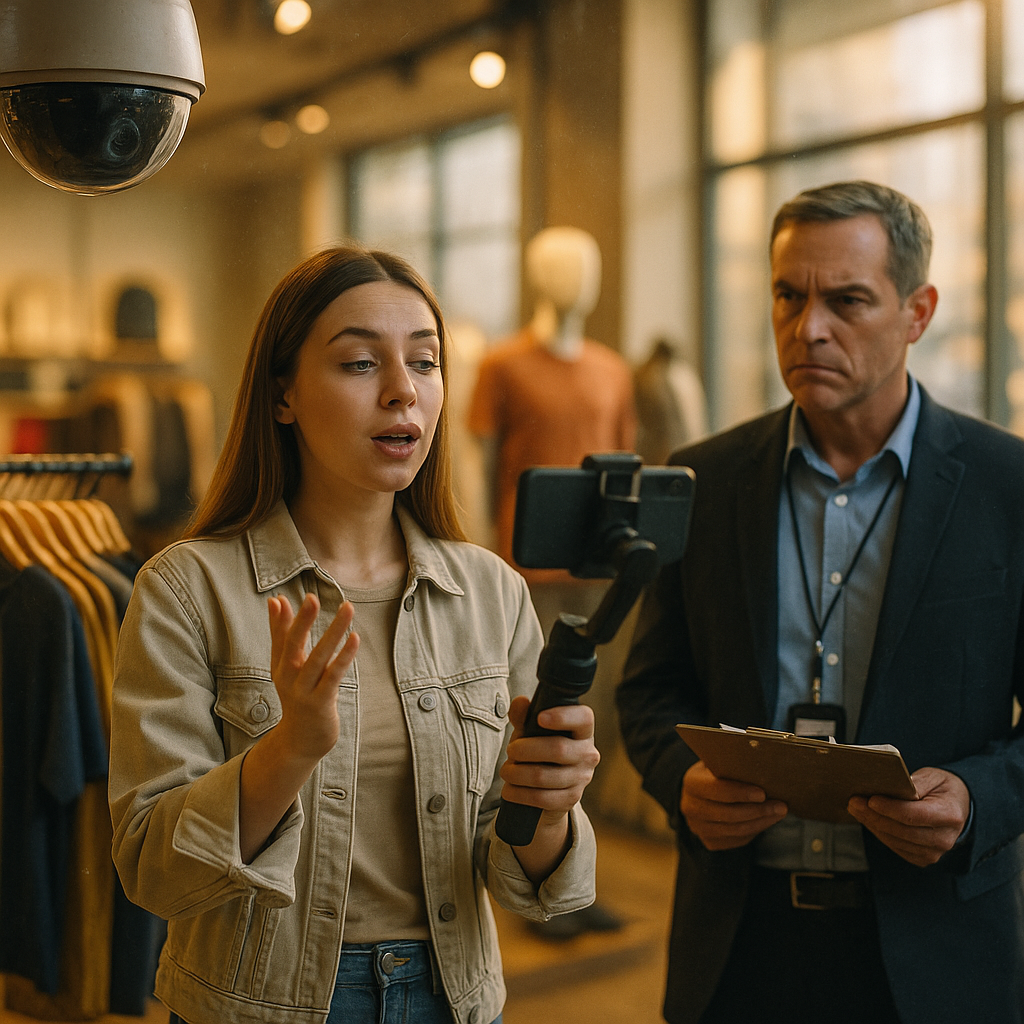
A customer trips over a ring light. A stockroom door swings into a filming employee holding a $2,000 gimbal rig. Who pays? Ask most retail brands and you’ll get a blank stare, because the honest answer is: probably nobody’s insurance, at least not cleanly. The insurance and liability gaps created when employees film branded content in store are quietly becoming one of the messiest exposures in retail marketing, and most risk teams haven’t caught up.
The Store Floor Is Now a Content Studio, and Nobody Told Risk Management
Retail brands love employee generated content. It’s cheap, it converts, and it reads as authentic in a way that polished ad creative rarely does. Store associates filming try-on hauls, “day in the life” clips, or product demos have become a core pillar of many brands’ social strategy. Sprout Social’s own research on employee advocacy consistently shows higher engagement rates on staff-created content than on brand-account posts.
But here’s the operational reality nobody budgeted for: the moment an hourly retail employee picks up a phone to film “content” instead of doing their scheduled job, the activity shifts categories. It’s no longer straightforward retail operations. It’s media production happening inside a commercial space, often during working hours, often using store equipment, and often without anyone from legal or risk management ever reviewing the setup.
Most general liability and workers’ comp policies were written for a world where employees stock shelves and ring up sales, not one where they’re also acting as unpaid content creators on camera.
Where the Coverage Actually Breaks Down
Standard commercial general liability (CGL) policies cover bodily injury and property damage arising from normal business operations. Filming branded content sits in a gray zone. Insurers increasingly ask a pointed question during claims review: was this activity part of the insured’s regular course of business, or was it incidental, discretionary content production that falls outside the policy’s intended scope?
Property Damage From Filming Setups
Tripods, ring lights, phone mounts, extension cords taped across walkways. Any of these can cause a slip, a fall, or a shelf collapse. If a customer is injured tripping over filming equipment, the store’s CGL policy may pay the claim, but expect the insurer to scrutinize whether the equipment was “business property” or a personal item an employee brought in on their own initiative for a side hustle-style video.
Product Damage During Demos
Filming a product demo that goes wrong, a dropped appliance, a spilled skincare product, a damaged display unit, creates inventory loss that’s rarely tracked as a marketing cost. It gets buried in shrinkage numbers, which means finance never sees the true cost of the content program and can’t price the risk accurately.
Third-Party Bystander Injury
This is the sleeper risk. A customer walks into frame, trips over a cable, or gets bumped by an employee backing up for a better camera angle. That’s a textbook premises liability claim, and it’s the scenario most likely to end up in litigation because the injured party isn’t the employee, it’s an uninvolved third party who never consented to being part of a filming environment.
Who’s Liable When a Customer Gets Hurt On Camera?
Liability typically flows to the entity that controls the premises and directed (or tolerated) the activity, meaning the brand or franchisee, not the individual employee. Courts generally look at whether the employer knew the filming was happening, whether it benefited the business commercially, and whether reasonable safety precautions were in place. If corporate marketing approved the content calendar and reposted the video to the brand’s official channels, that’s strong evidence the activity was within the scope of employment, which pulls the incident squarely into the company’s liability picture.
This is exactly the same logic playing out in the broader employee generated content compliance conversation. If you haven’t already mapped how your EGC program intersects with disclosure obligations, the FTC disclosure compliance guide is a useful starting point, because the same “was this within scope of employment” question that determines disclosure liability also determines insurance liability.
The Workers’ Comp Question Nobody Wants to Ask
If an employee is injured while filming, is that a workers’ comp claim? Usually yes, if the filming was requested, encouraged, or rewarded by the employer, even informally. A store manager saying “hey, can you do a quick TikTok for us” is enough to establish that the activity occurred within the course of employment. That means a fall, a repetitive strain injury from constant phone holding, or even a vehicle accident driving to a filming location for a branded segment could all trigger comp claims.
The complication: many brands treat in-store content creation as a casual, off-the-cuff activity rather than a formal job duty. No written policy, no safety briefing, no equipment standards. That informality doesn’t reduce liability, it increases it, because there’s no documented safety protocol to point to if a claim gets contested.
Treating employee filming as “just something fun the team does” is precisely what turns a minor incident into an uninsured, contested claim.
This overlaps with classification risk more broadly. Brands that blur the line between employee duties and creator-style content obligations are already under scrutiny from regulators, as covered in our breakdown of DOL classification rules and brand liability exposure.
IP, Consent, and the Bystander Problem
Insurance isn’t the only gap. Filming in a retail environment means capturing customers, other employees, and sometimes vendors in the background, often without consent. If someone’s face ends up in a paid social ad without a release, that’s a publicity rights claim waiting to happen, and it’s rarely covered under standard CGL or media liability endorsements unless the policy specifically addresses advertising injury from unauthorized use of likeness.
Brands running employee content programs at scale should also revisit who owns the footage once it’s filmed. Ownership disputes get messy fast when an employee leaves the company and claims rights to content they starred in. The IP assignment clauses guide lays out the contract language that should exist before any employee touches a camera on the clock, and it pairs directly with the insurance conversation because unresolved IP disputes often surface during claims litigation as a secondary issue.
Five Fixes That Actually Close the Gap
- Add a media production endorsement. Talk to your broker about a specific rider covering incidental content production activities, distinct from standard retail operations. Most carriers can quote this cheaply once they understand the actual activity, filming a 30-second clip is a very different risk profile than running a broadcast studio.
- Write a filming safety protocol. Designate approved filming zones, cable management rules, and equipment storage standards. This single document does more to reduce claims than any insurance policy, because it prevents the incident in the first place.
- Formalize the activity as a job duty. If filming is expected, put it in writing, with training on safe setup and a clear escalation path if something goes wrong. Ambiguity is the enemy here, not clarity.
- Build a bystander consent process. Signage at store entrances during active filming, plus a quick verbal consent check for anyone who ends up clearly in frame, closes most of the publicity rights exposure before it starts.
- Route content through an approval workflow. Every piece of employee footage that gets published should pass through the same review gate as agency-produced creative. If you don’t have one, our creator ad approval workflow audit is a solid framework to adapt for internal teams.
None of this needs to be expensive. A one-page policy, a ten-minute training video, and a conversation with your broker will close 80% of the exposure. What’s expensive is discovering the gap after a customer’s lawyer calls.
For brands benchmarking how much employee generated content actually drives, eMarketer’s creator economy research and HubSpot’s marketing benchmark reports are useful reference points when building the business case for a proper insurance rider to finance or ops leadership.
Frequently Asked Questions
Does general liability insurance cover injuries from employees filming in a store?
Sometimes, but coverage is often contested. Standard CGL policies are written around normal business operations, and insurers may argue that content filming falls outside that scope unless the policy specifically addresses media or advertising activity. A dedicated rider closes this ambiguity.
Is a workplace injury during content filming covered by workers’ compensation?
Generally yes, if the employer requested, encouraged, or benefited from the filming, even informally. The lack of a written policy doesn’t eliminate the claim, it just makes the claims process messier and more likely to be contested.
Who is liable if a customer is injured by filming equipment in a retail store?
Liability typically falls on the brand or franchise operator that controls the premises, especially if the filming was known to or approved by management. Courts look at whether the activity commercially benefited the business.
Do brands need consent from customers who appear in employee-filmed content?
Yes, if the footage is used commercially and the customer is identifiable. Failing to secure consent can create a publicity rights or right-of-likeness claim, which most standard liability policies do not automatically cover.
What’s the cheapest way to reduce this risk without new insurance?
Write a simple filming safety protocol covering equipment placement, designated filming zones, and bystander consent signage. Most claims stem from preventable setup issues, not exotic legal edge cases.
Next step: Pull your current CGL and workers’ comp policies this week and ask your broker one direct question: “Are injuries or property damage arising from employee content filming explicitly covered?” If the answer is unclear, that’s your gap, and it’s cheaper to close now than after a claim.
FAQs
Does general liability insurance cover injuries from employees filming in a store?
Sometimes, but coverage is often contested. Standard CGL policies are written around normal business operations, and insurers may argue that content filming falls outside that scope unless the policy specifically addresses media or advertising activity. A dedicated rider closes this ambiguity.
Is a workplace injury during content filming covered by workers’ compensation?
Generally yes, if the employer requested, encouraged, or benefited from the filming, even informally. The lack of a written policy doesn’t eliminate the claim, it just makes the claims process messier and more likely to be contested.
Who is liable if a customer is injured by filming equipment in a retail store?
Liability typically falls on the brand or franchise operator that controls the premises, especially if the filming was known to or approved by management. Courts look at whether the activity commercially benefited the business.
Do brands need consent from customers who appear in employee-filmed content?
Yes, if the footage is used commercially and the customer is identifiable. Failing to secure consent can create a publicity rights or right-of-likeness claim, which most standard liability policies do not automatically cover.
What’s the cheapest way to reduce this risk without new insurance?
Write a simple filming safety protocol covering equipment placement, designated filming zones, and bystander consent signage. Most claims stem from preventable setup issues, not exotic legal edge cases.
Top Influencer Marketing Agencies
The leading agencies shaping influencer marketing in 2026
Agencies ranked by campaign performance, client diversity, platform expertise, proven ROI, industry recognition, and client satisfaction. Assessed through verified case studies, reviews, and industry consultations.
Moburst

-
2

The Shelf
Boutique Beauty & Lifestyle Influencer AgencyA data-driven boutique agency specializing exclusively in beauty, wellness, and lifestyle influencer campaigns on Instagram and TikTok. Best for brands already focused on the beauty/personal care space that need curated, aesthetic-driven content.Clients: Pepsi, The Honest Company, Hims, Elf Cosmetics, Pure LeafVisit The Shelf → -
3

Audiencly
Niche Gaming & Esports Influencer AgencyA specialized agency focused exclusively on gaming and esports creators on YouTube, Twitch, and TikTok. Ideal if your campaign is 100% gaming-focused — from game launches to hardware and esports events.Clients: Epic Games, NordVPN, Ubisoft, Wargaming, Tencent GamesVisit Audiencly → -
4

Viral Nation
Global Influencer Marketing & Talent AgencyA dual talent management and marketing agency with proprietary brand safety tools and a global creator network spanning nano-influencers to celebrities across all major platforms.Clients: Meta, Activision Blizzard, Energizer, Aston Martin, WalmartVisit Viral Nation → -
5

The Influencer Marketing Factory
TikTok, Instagram & YouTube CampaignsA full-service agency with strong TikTok expertise, offering end-to-end campaign management from influencer discovery through performance reporting with a focus on platform-native content.Clients: Google, Snapchat, Universal Music, Bumble, YelpVisit TIMF → -
6

NeoReach
Enterprise Analytics & Influencer CampaignsAn enterprise-focused agency combining managed campaigns with a powerful self-service data platform for influencer search, audience analytics, and attribution modeling.Clients: Amazon, Airbnb, Netflix, Honda, The New York TimesVisit NeoReach → -
7

Ubiquitous
Creator-First Marketing PlatformA tech-driven platform combining self-service tools with managed campaign options, emphasizing speed and scalability for brands managing multiple influencer relationships.Clients: Lyft, Disney, Target, American Eagle, NetflixVisit Ubiquitous → -
8

Obviously
Scalable Enterprise Influencer CampaignsA tech-enabled agency built for high-volume campaigns, coordinating hundreds of creators simultaneously with end-to-end logistics, content rights management, and product seeding.Clients: Google, Ulta Beauty, Converse, AmazonVisit Obviously →