


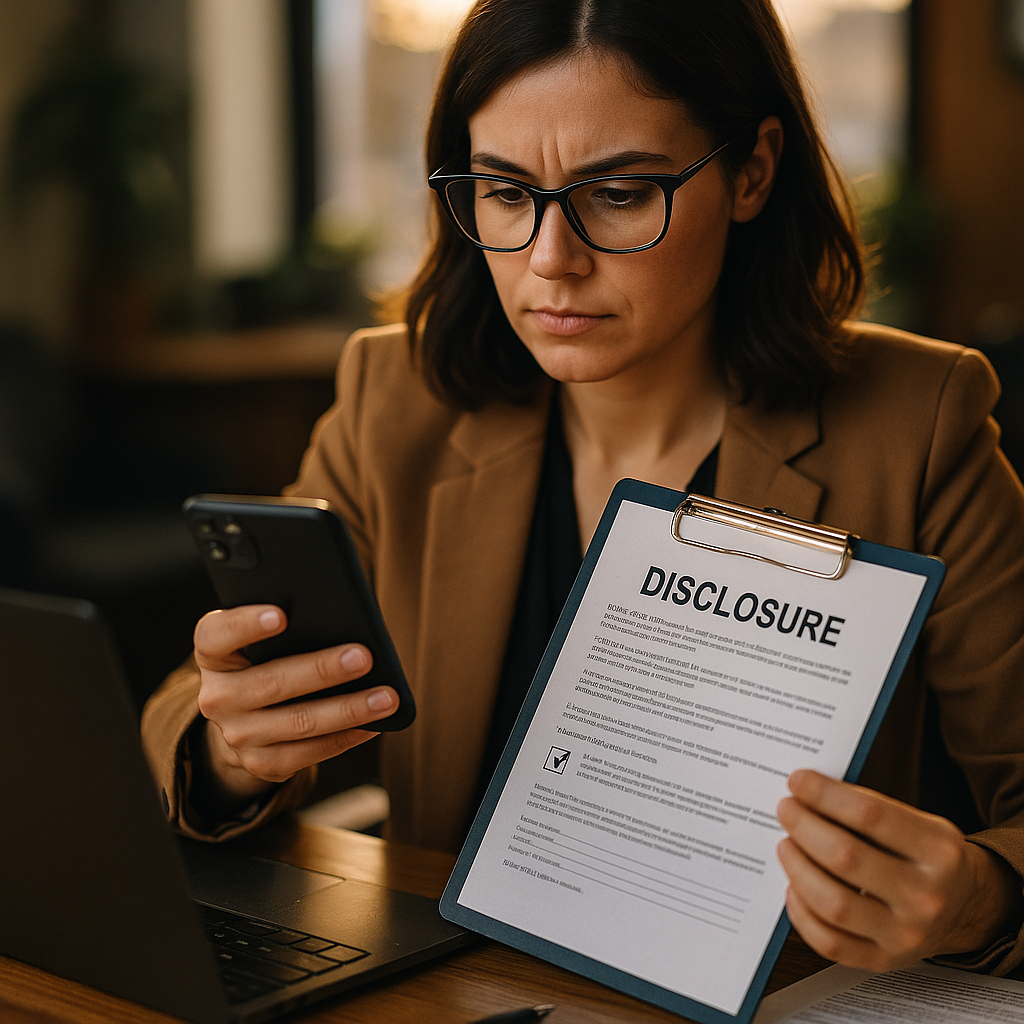
Your employees post more branded content than your influencer roster does, and almost none of it carries a disclosure. That’s not a hunch. It’s the predictable outcome of “ambassador” programs built for reach, not compliance. Employee generated content sits in a legal gray zone that most brands have never actually mapped, and the FTC has made clear it doesn’t care whether the paycheck comes from a brand deal or a W-2.
The Compensation Question Nobody Asks
Here’s the test that trips up most legal teams: disclosure obligations under the FTC’s Endorsement Guides don’t hinge on whether someone is a “creator.” They hinge on whether there’s a material connection between the endorser and the brand that consumers wouldn’t reasonably expect. An employee posting about their employer’s product is, by definition, materially connected. They’re paid by the company whose product they’re praising. That’s not a nuance, it’s the textbook example the FTC’s own guidance uses.
So why does it feel like a gray area? Because marketing teams conflate “employee” with “not an influencer” and assume the rules only apply to paid creator contracts. Wrong assumption, expensive consequence.
If a viewer would change their opinion of a claim upon learning the speaker works for the company, the connection is material, and it must be disclosed. Employment itself is the connection.
What Counts as Employee Generated Content
Employee generated content (EGC) covers a wide range of formats, and brands are leaning into it hard because it converts. Sprout Social and other platforms have reported that audiences trust peer and employee voices more than polished brand accounts, which is exactly why programs like “ambassador challenges” and internal creator incentives have exploded. But volume creates exposure. Common EGC formats include:
- Staff “day in the life” videos featuring company products or services
- Sales team posts on LinkedIn praising a new product launch
- TikTok or Reels content from retail or frontline employees demoing merchandise
- Internal contests where employees post branded content for prizes or recognition
- Executive thought leadership that doubles as product promotion
None of these are exempt from disclosure just because HR, not marketing, technically “owns” the relationship. The FTC looks at the endorsement, not the org chart.
Where Brands Actually Get This Wrong
Three failure patterns show up again and again in EGC programs, and they’re worth naming directly because each one is fixable with almost no budget.
First, brands treat employee posts as “organic” because there’s no contract or payment beyond salary. But salary is compensation. An employee doesn’t need a brand deal fee to trigger a material connection, their job itself is the incentive structure. This is the same logic regulators apply to whitelisted or boosted content, which we’ve covered in dark post disclosure gaps, where the paid relationship is hidden behind ad tech rather than absent altogether.
Second, brands assume a LinkedIn job title is disclosure enough. It isn’t. A bio that says “Marketing Manager at Acme Co.” doesn’t tell a viewer, in that specific post, that the glowing product review comes from someone financially tied to the outcome. Disclosure has to be clear and conspicuous in the content itself, not buried three clicks away.
Third, brands run incentive-driven UGC contests for staff (bonus points, PTO, gift cards) without labeling the arrangement as compensation. Incentive tied to content performance is textbook material connection territory, similar to the fake review risks we broke down in our FTC fake review rule audit.
Is a Hashtag Enough?
Short answer: sometimes, if done right. A clear #ad, #employee, or “I work at [Company]” statement placed prominently, not buried in a hashtag pile, generally satisfies FTC expectations. What doesn’t work is a vague #sponsored buried under twelve unrelated tags, or a disclosure that only appears in a caption when the content itself is a video where most viewers watch without expanding text.
Platform-specific labels matter here too. TikTok’s Branded Content Toggle and Instagram’s Paid Partnership label are built for creator deals, but they work fine for employee content when the relationship is disclosed accurately. We’ve dug into the mechanics of this distinction in paid partnership labels versus verbal ad callouts, and the same logic applies whether the poster is a hired creator or a staff member on the loyalty team.
Building a Compliant Employee Advocacy Program
None of this means brands should kill employee advocacy programs. They’re too valuable, and honestly, they’re one of the more authentic distribution channels marketing has left. The fix is operational, not existential. A few concrete moves:
- Write disclosure into the program guidelines, not just the legal fine print. If employees are onboarded into an advocacy platform, disclosure requirements should be part of the same training as brand voice guidelines.
- Standardize the language. Give employees an approved, simple phrase: “I work at [Brand]” or “#employee” placed in the first line of caption or spoken aloud in video. Consistency reduces enforcement risk and looks intentional rather than reactive.
- Audit incentive structures. If bonuses, recognition, or internal leaderboards are tied to post performance, treat that as compensation triggering disclosure, the same way you would a paid creator deal.
- Build approval workflows. Borrow from creator ad review processes. Our guide on auditing creator ad approval workflows applies almost directly to employee content review, just swap “creator” for “staff member” in the checklist.
- Document IP and usage rights up front. Employee content often gets repurposed into paid ads later, which raises a separate set of ownership questions covered in IP assignment clauses for employee creator programs.
An unlabeled employee video that goes viral isn’t a marketing win if it triggers a state AG inquiry six months later. Reach without compliance is just deferred risk.
State Regulators Are Watching Too
The FTC isn’t the only enforcement body paying attention. State attorneys general have run their own sweeps on influencer and endorsement disclosure, and employee content is squarely within scope if it makes product claims that turn out to be misleading or unsubstantiated. We covered the mechanics of this trend in state AG sweeps on influencer disclosure, and it’s a useful audit checklist even for programs that never touch a paid creator contract. California’s disclosure statute adds another layer for brands operating there, detailed in our state by state compliance map.
None of this is theoretical anxiety. According to eMarketer’s ongoing tracking of creator economy spend, brand investment in employee and micro-advocacy content continues climbing precisely because it’s cheaper and converts well, which means enforcement attention will scale right alongside it.
AI Tools Are Making This Messier
Add AI-generated scripts, avatars, or voice clones into the employee advocacy mix and the disclosure math gets more complicated fast. If an employee’s video uses an AI-written script optimized for conversion, or a synthetic voiceover layered over UGC-style footage, brands may need to stack a synthetic media disclosure on top of the material connection disclosure. Our breakdown of the EU AI Act synthetic media labeling rules and the TikTok AI content disclosure mandate are both relevant starting points if your employee advocacy platform touches AI production tools, which most modern ones increasingly do.
The ROI Argument for Getting This Right
Compliance teams often lose the internal argument because disclosure feels like friction on a channel that’s working. Flip the framing. A one-line “#employee” caption costs nothing and doesn’t meaningfully dent engagement, HubSpot’s research on trust and transparency in marketing consistently shows that disclosed content performs comparably to undisclosed content when audiences already have positive brand sentiment. See HubSpot’s marketing research hub for the broader trust data trend. The downside of skipping disclosure, by contrast, is asymmetric: regulatory inquiry, brand reputation damage, and legal costs that dwarf whatever marginal lift you got from looking “more authentic.”
Next step: pull your last 90 days of employee-posted content across LinkedIn, TikTok, and Instagram, flag anything mentioning your product or brand, and check for a clear, conspicuous disclosure. If fewer than half pass, your advocacy program has a compliance gap that’s bigger than your creator program’s.
FAQs
Does an employee need to disclose if they’re not paid extra for posting?
Yes. Salary and employment status alone establish a material connection under FTC guidance. No separate payment or bonus is required to trigger disclosure obligations.
Is putting “Employee at [Company]” in a bio sufficient disclosure?
Generally no. Disclosure needs to be clear and conspicuous within the specific post or video, not buried in a profile bio that viewers may never see.
Do executives and founders have the same disclosure obligations as frontline staff?
Yes. Job title doesn’t change the analysis. An executive posting favorably about company products carries the same material connection as any other employee.
What’s the simplest compliant disclosure format for employee videos?
A spoken or on-screen statement like “I work at [Brand]” placed early in the video, paired with a text disclosure such as #employee in the first line of the caption, generally satisfies FTC expectations.
Can employee generated content be reused in paid ads without new disclosure?
Reused content still needs disclosure if the underlying endorsement relationship (employment) remains undisclosed to the new audience. Reusing it in paid media adds separate ad-labeling requirements on top.
Who is liable if an employee forgets to disclose, the employee or the brand?
The FTC has pursued both endorsers and the companies that fail to establish reasonable monitoring and training programs. Brands carry significant exposure regardless of individual employee mistakes.
Top Influencer Marketing Agencies
The leading agencies shaping influencer marketing in 2026
Agencies ranked by campaign performance, client diversity, platform expertise, proven ROI, industry recognition, and client satisfaction. Assessed through verified case studies, reviews, and industry consultations.
Moburst

-
2

The Shelf
Boutique Beauty & Lifestyle Influencer AgencyA data-driven boutique agency specializing exclusively in beauty, wellness, and lifestyle influencer campaigns on Instagram and TikTok. Best for brands already focused on the beauty/personal care space that need curated, aesthetic-driven content.Clients: Pepsi, The Honest Company, Hims, Elf Cosmetics, Pure LeafVisit The Shelf → -
3

Audiencly
Niche Gaming & Esports Influencer AgencyA specialized agency focused exclusively on gaming and esports creators on YouTube, Twitch, and TikTok. Ideal if your campaign is 100% gaming-focused — from game launches to hardware and esports events.Clients: Epic Games, NordVPN, Ubisoft, Wargaming, Tencent GamesVisit Audiencly → -
4

Viral Nation
Global Influencer Marketing & Talent AgencyA dual talent management and marketing agency with proprietary brand safety tools and a global creator network spanning nano-influencers to celebrities across all major platforms.Clients: Meta, Activision Blizzard, Energizer, Aston Martin, WalmartVisit Viral Nation → -
5

The Influencer Marketing Factory
TikTok, Instagram & YouTube CampaignsA full-service agency with strong TikTok expertise, offering end-to-end campaign management from influencer discovery through performance reporting with a focus on platform-native content.Clients: Google, Snapchat, Universal Music, Bumble, YelpVisit TIMF → -
6

NeoReach
Enterprise Analytics & Influencer CampaignsAn enterprise-focused agency combining managed campaigns with a powerful self-service data platform for influencer search, audience analytics, and attribution modeling.Clients: Amazon, Airbnb, Netflix, Honda, The New York TimesVisit NeoReach → -
7

Ubiquitous
Creator-First Marketing PlatformA tech-driven platform combining self-service tools with managed campaign options, emphasizing speed and scalability for brands managing multiple influencer relationships.Clients: Lyft, Disney, Target, American Eagle, NetflixVisit Ubiquitous → -
8

Obviously
Scalable Enterprise Influencer CampaignsA tech-enabled agency built for high-volume campaigns, coordinating hundreds of creators simultaneously with end-to-end logistics, content rights management, and product seeding.Clients: Google, Ulta Beauty, Converse, AmazonVisit Obviously →