


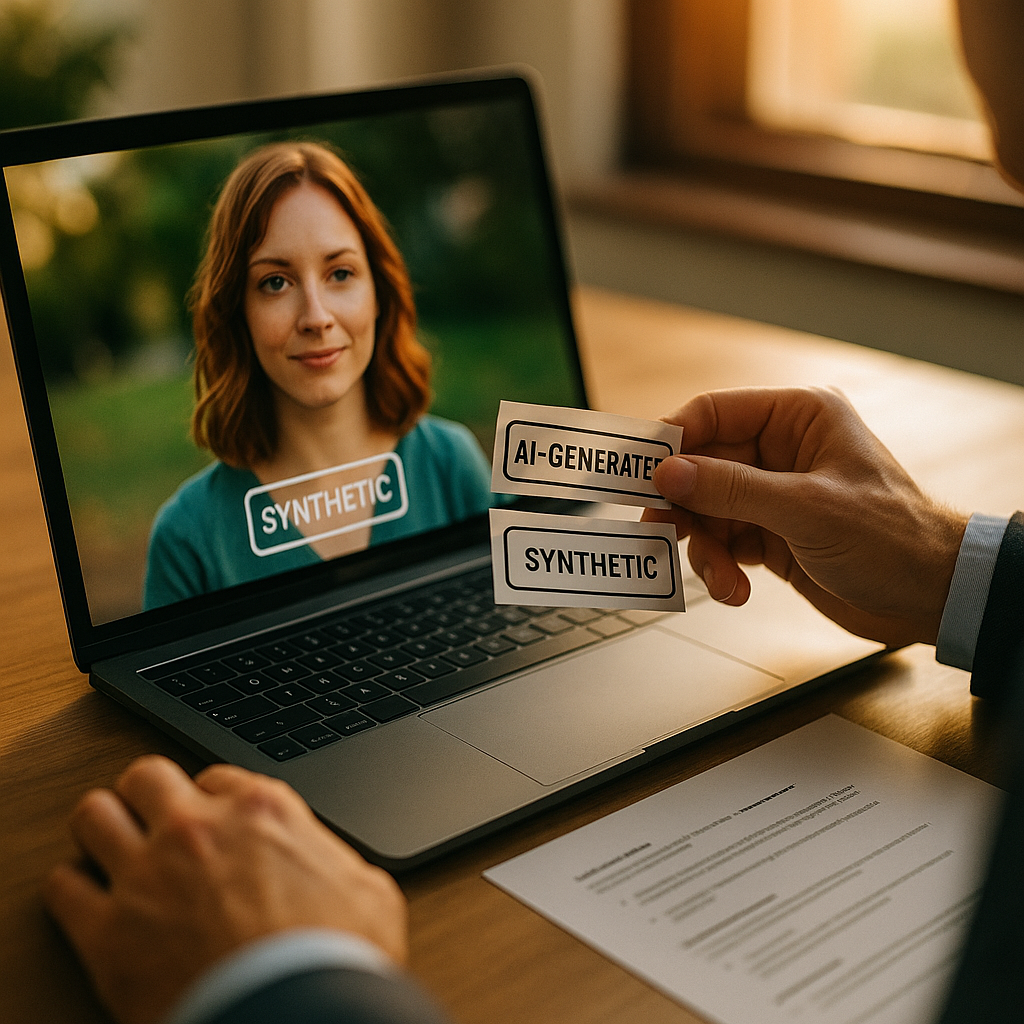
Under the EU AI Act, failing to label AI-generated or AI-altered content in a marketing campaign isn’t a technicality. It’s a fineable offense. Article 50’s transparency obligations kick in fully in mid-2026, and most brand marketing teams still treat “AI disclosure” as a box they check on TikTok, not a legal requirement with teeth. EU AI Act synthetic media labels now apply to a huge swath of everyday creator content: face swaps, voice clones, AI b-roll, even heavily retouched product shots generated by tools like Midjourney or Runway.
What the EU AI Act Actually Requires
Article 50 of the AI Act creates transparency duties for providers and deployers of AI systems that generate or manipulate content. If a brand deploys, commissions, or publishes synthetic audio, image, video, or text content that could be mistaken for authentic human-created material, that content needs a clear, machine-readable disclosure. The obligation applies regardless of whether the AI tool sits with the brand, the agency, or the creator, which is exactly why so many marketing teams are getting caught flat-footed.
The regulation distinguishes between “deep fakes” (realistic synthetic content depicting real people, places, or events) and general AI-generated content used for entertainment, satire, or artistic purposes, which get lighter-touch disclosure rules. But most branded content doesn’t fall neatly into the satire bucket. A skincare ad using an AI-generated version of a real influencer’s face? That’s a deep fake under the Act’s definition, full stop.
If your creator content uses AI to alter a real person’s voice, face, or likeness in a way a viewer could mistake for unedited footage, EU law now treats that as a labeling obligation, not a creative choice.
Which Content Triggers the Label?
This is where brand teams keep getting tripped up. It’s not just fully synthetic AI influencers or obvious deepfakes. The trigger list is broader than most compliance checklists account for:
- AI voice cloning used to dub a creator’s video into another language
- Face or body retouching that goes beyond standard color correction, using generative fill or AI beautification
- AI-generated product demonstrations where no physical product was actually filmed
- Virtual try-on content generated by AI rather than filmed on a real model
- AI-assisted script or caption generation that mimics a creator’s personal voice without disclosure
- Synthetic background replacement using generative AI rather than green screen
Notice what’s missing from most brand AI policies: minor edits. A brightness adjustment doesn’t trigger disclosure. But generative fill to remove a blemish, extend a background, or “fix” a creator’s outfit? That likely does, because it alters the substance of what’s depicted, not just its presentation.
The Label Itself: Format, Placement, Wording
The Act doesn’t hand brands a single approved sticker, but the implementing guidance and harmonized standards being developed point toward a few consistent requirements. Labels need to be:
- Clear and unambiguous, not buried in a five-paragraph caption or a terms-of-service link
- Machine-readable where technically feasible, meaning metadata tagging (think C2PA content credentials) alongside any visible text
- Visible at the point of consumption, so a label in a video description that nobody scrolls to doesn’t satisfy the requirement for the video itself
- Persistent across re-shares and platform re-uploads, which is a genuine technical headache once content leaves an owned channel
Practically, this means brands should be pairing an on-screen or in-frame disclosure (“AI-enhanced” or “Contains AI-generated content”) with embedded metadata using open provenance standards. Relying purely on a hashtag like #AIgenerated in a caption is thin coverage at best, and regulators have signaled they view caption-only disclosure skeptically, particularly for video and audio content where the label needs to be perceivable without extra clicks.
This overlaps heavily with existing disclosure obligations brands already manage for sponsored content. If your legal team has already built out frameworks from state disclosure enforcement work in the US, extending that muscle to AI labeling is a logical next step rather than a from-scratch build.
Why This Isn’t Just an EU Problem
Here’s the thing global brands keep underestimating: the AI Act applies based on where content reaches EU consumers, not where the brand is headquartered. A US DTC brand running influencer content that gets served to French or German audiences through paid amplification is in scope. Organic reach that happens to land in the EU market complicates things further, since enforcement bodies are still clarifying thresholds for incidental versus targeted distribution.
Add in that the UK’s Information Commissioner’s Office has flagged AI-generated content transparency as an enforcement priority independent of the EU framework, and the FTC in the US continues to scrutinize undisclosed AI use under existing endorsement guides, and you get a regulatory pincer movement. Brands running global creator programs can’t treat this as a regional carve-out. One unified labeling standard, built to the strictest jurisdiction’s requirements, is far cheaper than maintaining five different disclosure regimes.
Marketers who’ve already built compliance frameworks for deepfake endorsement risk have a head start here, since the contractual language addressing consent and likeness use overlaps substantially with what synthetic media labeling requires.
Building the Compliance Workflow
Labeling isn’t a creative team decision made at the last minute before publish. It needs to live in the production pipeline, ideally at the brief stage. Here’s a workable structure:
- Flag AI use at the brief. Any creative brief involving generative tools, voice cloning, or synthetic visuals should require the creator or agency to declare it upfront, not discover it during editing.
- Route through human review. AI-touched content should hit a compliance checkpoint before publish, similar to the review gates outlined in human-in-the-loop approval workflows already used for FTC-sensitive ad copy.
- Embed provenance metadata at export. Tools that support C2PA content credentials should be the default export setting for any AI-touched asset, not an optional add-on.
- Standardize the visible label. One approved wording, one placement convention, applied consistently across every market rather than improvised per creator.
- Audit distribution, not just creation. Track where AI-labeled content ends up republished, since paid boosting or cross-posting can strip metadata or crop out visible labels.
Brands that already run pre-flight compliance checks on creator content have the easiest lift here, it’s a matter of adding synthetic media fields to an existing checklist rather than building new infrastructure from zero.
Contract Language Brands Are Missing
Most influencer agreements still don’t address who’s liable if a creator uses an undisclosed AI tool, a voice filter, or a beauty AI effect that crosses into deep fake territory. Contracts need explicit warranties: the creator confirms what AI tools were used, agrees to disclosure requirements, and indemnifies the brand for undisclosed synthetic alterations discovered post-publish. This is functionally the same gap addressed in indemnification language for AI creator matching, just applied to labeling specifically rather than platform liability broadly.
Where Brands Get This Wrong
The most common failure mode isn’t ignorance, it’s assuming platform-level AI labels (TikTok’s “AI-generated” tag, Meta’s “Made with AI” flag) satisfy the legal obligation. They don’t, necessarily. Platform labels are useful signals but they’re controlled by the platform, applied inconsistently, and can be stripped or missed depending on upload method. Regulators are looking at whether the brand or deployer met its own disclosure duty, not whether the platform happened to auto-tag the content correctly.
Second failure: treating this as a one-time creative sign-off rather than an ongoing audit trail. If a regulator or platform trust and safety team asks for proof of disclosure six months after publish, “we think we labeled it” isn’t an answer. Brands need a searchable log tying every AI-touched asset to its disclosure method, similar to the documentation trail recommended in source verification frameworks for enterprise AI marketing programs.
Third, and this one stings: agencies producing white-label AI content for multiple brand clients often don’t disclose their own tool stack clearly enough for the brand to make an informed labeling decision. Ask vendors directly which generative tools touched an asset before it reaches your review queue. According to eMarketer research on AI adoption in marketing, a majority of brands now use generative AI somewhere in their creative pipeline, yet a much smaller share have formal disclosure policies matched to that usage. That gap is exactly where enforcement risk concentrates.
What This Costs If You Skip It
Non-compliance penalties under the AI Act’s transparency provisions can reach into the millions of euros or a percentage of global annual turnover, depending on the violation category. But the bigger practical risk for most brands is reputational: getting called out publicly for an undisclosed AI-altered ad is its own crisis, independent of regulatory fines. Consumer trust research from Sprout Social consistently shows audiences penalize brands more harshly for perceived deception than for the AI use itself. Disclosure, done well, is actually a trust signal, not a liability admission.
Start by auditing every piece of creator content currently in your paid rotation for undisclosed AI alteration, then build the labeling checkpoint into your next production brief before your next campaign, not after your first regulatory inquiry.
Frequently Asked Questions
Does the EU AI Act apply to brands based outside the EU?
Yes. The obligation is tied to whether AI-generated content reaches or targets users in the EU, not where the brand or agency is headquartered. Paid distribution into EU markets clearly triggers scope, and organic reach is an evolving gray area brands should treat conservatively.
Is a platform’s built-in AI label enough to satisfy the requirement?
Not necessarily. Platform tags like TikTok’s or Meta’s AI labels are useful but are controlled by the platform and can be stripped, cropped, or applied inconsistently. Brands are still responsible for their own disclosure obligation as the deployer of the content.
What counts as “AI-enhanced” for labeling purposes?
Anything beyond minor color or brightness correction that meaningfully alters what’s depicted, including generative fill, face or voice alteration, AI-generated backgrounds, or synthetic product demonstrations, generally falls within scope.
Do brands need to label AI-generated captions or ad copy?
Text-based AI content has lighter obligations than deep fakes, but if AI-generated text is presented as a creator’s authentic personal opinion without disclosure, it raises both AI Act and advertising disclosure concerns simultaneously.
How should brands document compliance for audits?
Maintain a searchable log linking each AI-touched asset to its disclosure method, the tools used, and sign-off records, so the brand can produce evidence quickly if a regulator or platform trust team requests it.
Top Influencer Marketing Agencies
The leading agencies shaping influencer marketing in 2026
Agencies ranked by campaign performance, client diversity, platform expertise, proven ROI, industry recognition, and client satisfaction. Assessed through verified case studies, reviews, and industry consultations.
Moburst

-
2

The Shelf
Boutique Beauty & Lifestyle Influencer AgencyA data-driven boutique agency specializing exclusively in beauty, wellness, and lifestyle influencer campaigns on Instagram and TikTok. Best for brands already focused on the beauty/personal care space that need curated, aesthetic-driven content.Clients: Pepsi, The Honest Company, Hims, Elf Cosmetics, Pure LeafVisit The Shelf → -
3

Audiencly
Niche Gaming & Esports Influencer AgencyA specialized agency focused exclusively on gaming and esports creators on YouTube, Twitch, and TikTok. Ideal if your campaign is 100% gaming-focused — from game launches to hardware and esports events.Clients: Epic Games, NordVPN, Ubisoft, Wargaming, Tencent GamesVisit Audiencly → -
4

Viral Nation
Global Influencer Marketing & Talent AgencyA dual talent management and marketing agency with proprietary brand safety tools and a global creator network spanning nano-influencers to celebrities across all major platforms.Clients: Meta, Activision Blizzard, Energizer, Aston Martin, WalmartVisit Viral Nation → -
5

The Influencer Marketing Factory
TikTok, Instagram & YouTube CampaignsA full-service agency with strong TikTok expertise, offering end-to-end campaign management from influencer discovery through performance reporting with a focus on platform-native content.Clients: Google, Snapchat, Universal Music, Bumble, YelpVisit TIMF → -
6

NeoReach
Enterprise Analytics & Influencer CampaignsAn enterprise-focused agency combining managed campaigns with a powerful self-service data platform for influencer search, audience analytics, and attribution modeling.Clients: Amazon, Airbnb, Netflix, Honda, The New York TimesVisit NeoReach → -
7

Ubiquitous
Creator-First Marketing PlatformA tech-driven platform combining self-service tools with managed campaign options, emphasizing speed and scalability for brands managing multiple influencer relationships.Clients: Lyft, Disney, Target, American Eagle, NetflixVisit Ubiquitous → -
8

Obviously
Scalable Enterprise Influencer CampaignsA tech-enabled agency built for high-volume campaigns, coordinating hundreds of creators simultaneously with end-to-end logistics, content rights management, and product seeding.Clients: Google, Ulta Beauty, Converse, AmazonVisit Obviously →