


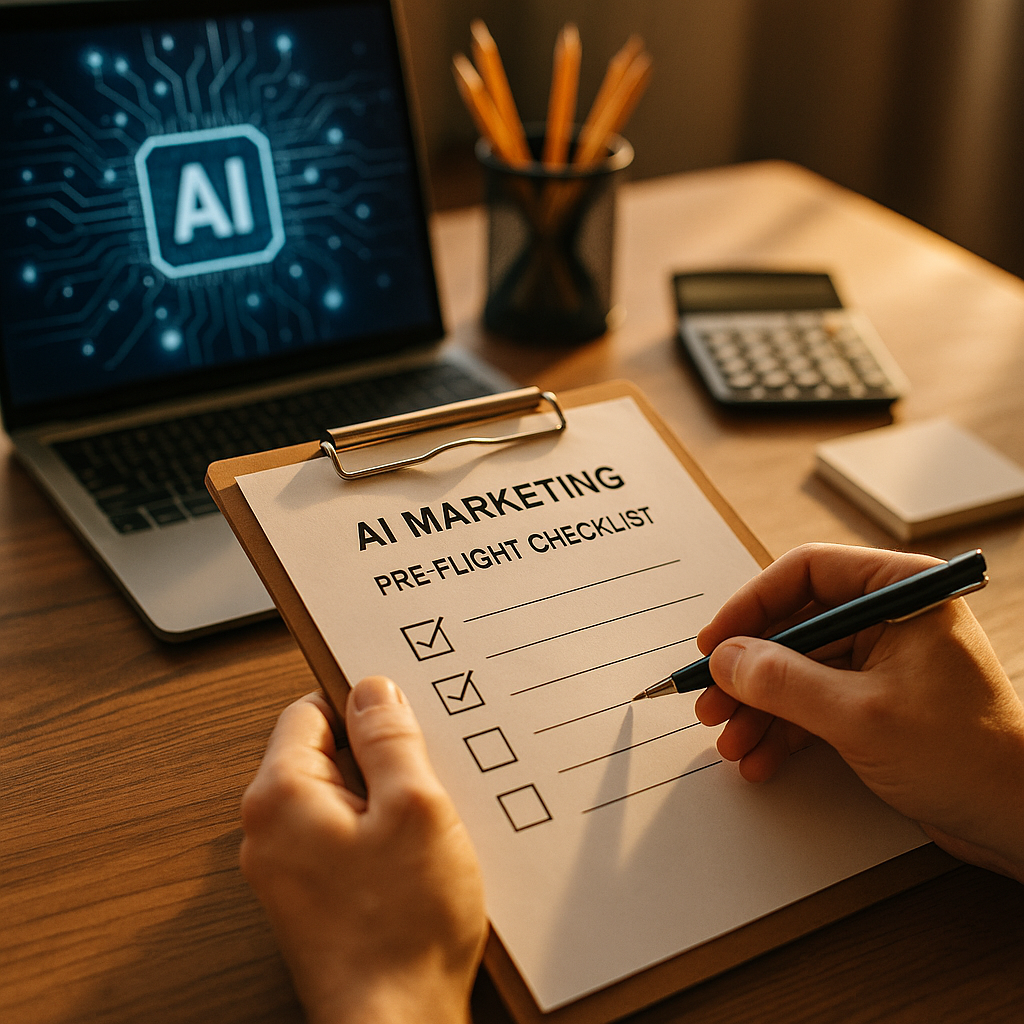
Seventy-two percent of marketers now use generative AI somewhere in their content pipeline, yet fewer than a third have a formal sign-off process before that content goes live. That gap is where lawsuits, FTC letters, and brand-safety disasters live. A pre-flight human-in-the-loop check isn’t bureaucracy. It’s the seatbelt you don’t notice until the day you need it.
This piece lays out a governance template you can adapt this quarter, not a theoretical framework you’ll shelve after one meeting.
Why “Move Fast” Is the Wrong Instinct for AI Marketing Output
Generative AI compressed content production timelines from weeks to minutes. That’s the pitch every vendor makes. What they don’t put on the slide: the same speed that produces a hundred ad variants overnight can also push a hallucinated claim, a biometric likeness violation, or a mispriced offer into market before anyone with judgment ever looks at it.
Marketing leaders have started treating AI output the way pilots treat weather data: useful, often accurate, but never a substitute for a checklist before takeoff. The FTC has made clear it doesn’t care whether a false or misleading claim came from a human copywriter or a language model. Liability lands on the brand either way, a point regulators reinforced in their guidance on AI-generated advertising claims.
If your only quality control is “the AI seemed confident,” you don’t have a governance process. You have a hope.
What a Pre-Flight Check Actually Covers
Borrow the aviation metaphor deliberately. Pilots don’t re-inspect the entire aircraft before every flight. They run a short, standardized list targeting the failure points most likely to kill people. Your AI marketing checklist should work the same way: narrow, repeatable, and focused on the outputs most likely to trigger legal, financial, or reputational damage.
A workable pre-flight template covers five checkpoints:
- Factual accuracy: Are product claims, statistics, and comparative language verifiable against a source document?
- Disclosure compliance: Does the output correctly flag sponsorship, AI generation, or material connections where required?
- Likeness and identity risk: Does any generated image, voice, or video use a real person’s biometric data without documented consent?
- Pricing and offer integrity: Do dynamic or AI-generated prices match approved logic, not a hallucinated discount?
- Brand and cultural safety: Would this output survive scrutiny from a skeptical journalist or a regulator, not just an internal reviewer?
Each checkpoint needs an owner, a pass/fail threshold, and a timestamped record. Without the record, you don’t have governance, you have a Slack message nobody can retrieve during a legal hold.
Who Actually Signs Off?
This is where most templates fall apart. Companies assign “human review” to whoever is available, which usually means a coordinator with no legal training and no authority to say no. That’s not human-in-the-loop, that’s a rubber stamp with extra steps.
A functional model separates review by risk tier:
- Low-stakes outputs (routine social captions, internal drafts): single-reviewer approval, spot-checked weekly.
- Medium-stakes outputs (paid ad copy, influencer briefs, product descriptions): marketing lead plus a compliance-trained reviewer.
- High-stakes outputs (health, finance, youth-targeted, political, or pricing content): dual sign-off from legal and a senior marketing decision-maker, with documented rationale.
This tiering mirrors the escalation logic already used in approval workflows for AI creator ads, and it’s worth aligning your internal audit process with the same standard described in creator ad approval audits so legal and marketing aren’t running two separate rulebooks.
The Checklist Itself: A Practical Template
Here’s a version you can lift almost verbatim into a shared document. Adjust thresholds to your risk appetite, but keep the structure.
- Source verification: Every factual claim traces to an approved, dated source. No source, no publish. This is the same discipline outlined in AI marketing source verification frameworks now standard at larger enterprises.
- Disclosure tagging: Confirm AI-generated visuals, synthetic voices, or sponsored content carry the correct label under current FTC native advertising expectations, a line that keeps shifting according to FTC native advertising guidance.
- Consent and rights check: Any likeness, voice clone, or biometric element has a signed release on file, particularly relevant given tightening biometric privacy rules.
- Pricing logic audit: If AI touches dynamic pricing or promotional copy, confirm it matches approved rules, not a model’s improvisation, a risk explored in depth in the AI livestream pricing audit.
- Youth and vulnerable audience screen: Flag any output that could reach minors or protected groups for additional review, consistent with the standards brands are adopting around youth safety rules for creator campaigns.
- Rollback readiness: Document how the output can be pulled or corrected if a problem surfaces post-launch, mirroring lessons from AI agent rollback risk analysis.
Six checkpoints, one page, no ambiguity about who owns each line. That’s the entire point. A checklist that requires a training seminar to interpret will never survive contact with a Tuesday afternoon deadline.
Documentation Isn’t Optional, It’s Your Defense File
Every checkpoint above needs a timestamp, a reviewer name, and a stored copy of what was actually approved, not a paraphrase. Regulators and plaintiffs’ attorneys don’t accept “we’re pretty sure someone looked at it.” They want a record.
Think of your pre-flight log the way finance teams think of an audit trail: tedious until the moment it saves you. Brands that skipped this step have already paid for it, as seen in the wave of scrutiny following Meta’s data consent settlement, where the absence of clear internal records made every subsequent conversation with regulators harder.
A checklist without a stored, timestamped record isn’t governance. It’s a memory of governance, and memories don’t hold up in discovery.
Where Teams Get This Wrong
Three failure patterns show up repeatedly when we talk to compliance and marketing ops leads:
- Checklist theater. A document exists, nobody actually completes it, and it only surfaces when a client asks for proof of process.
- Reviewer fatigue. One overworked compliance person reviews two hundred pieces of AI output a week and starts rubber-stamping by hour three.
- No feedback loop. Errors caught in review never get fed back into the prompt engineering or model fine-tuning process, so the same mistake repeats weekly.
The fix for all three is the same: fewer checkpoints, applied consistently, with real authority behind them. A twenty-item checklist that gets skipped is worth less than a five-item checklist that’s enforced without exception.
Insurance is part of this conversation too. As AI-generated creator content scales, the coverage gaps around liability for AI errors are becoming a real budget line, something covered in detail in creator partnership insurance planning. A pre-flight check reduces the frequency of claims. It doesn’t eliminate the need for a policy that covers the ones that slip through anyway.
Building the Habit, Not Just the Document
A governance template only works if it becomes muscle memory. That means training reviewers on real examples, not hypotheticals, and running quarterly tabletop exercises where the team walks through a hypothetical bad output and traces exactly where the pre-flight check should have caught it. Marketing teams that treat this as a live, evolving practice, informed by data on where AI adoption trends are heading and how social platforms are handling AI disclosure, stay ahead of both regulators and competitors who are still improvising.
It’s also worth benchmarking your internal process against industry frameworks like HubSpot’s marketing operations resources, not because you’ll copy them wholesale, but because seeing how other functions structure sign-off chains sharpens your own.
Next step: Pull your last ten AI-generated marketing outputs and run them through the six-checkpoint template above. Whatever fails, that’s your actual risk exposure, not the theoretical kind you write about in a policy memo.
Frequently Asked Questions
What is a pre-flight human-in-the-loop check in AI marketing?
It’s a standardized review step, completed by a designated human reviewer before an AI-generated marketing output goes live, checking for factual accuracy, disclosure compliance, consent issues, and pricing integrity.
How is this different from standard content approval?
Standard approval often focuses on brand voice and creative quality. A pre-flight check specifically targets the failure modes unique to AI generation: hallucinated facts, missing AI disclosures, unauthorized likeness use, and pricing errors that a model may introduce without human oversight.
Who should own the sign-off for high-stakes AI outputs?
High-stakes content, including health, finance, youth-targeted, political, or pricing-related material, should require dual sign-off from legal or compliance staff and a senior marketing decision-maker, with documented rationale kept on file.
Does a checklist really reduce FTC risk?
Yes, when it includes documented, timestamped review records. Regulators evaluate whether a brand had a reasonable process in place, not just whether an error occurred. A documented checklist demonstrates that process.
How often should the checklist be updated?
Review it quarterly at minimum, and immediately after any regulatory guidance change, platform policy update, or internal incident that exposes a gap in the current template.
Top Influencer Marketing Agencies
The leading agencies shaping influencer marketing in 2026
Agencies ranked by campaign performance, client diversity, platform expertise, proven ROI, industry recognition, and client satisfaction. Assessed through verified case studies, reviews, and industry consultations.
Moburst

-
2

The Shelf
Boutique Beauty & Lifestyle Influencer AgencyA data-driven boutique agency specializing exclusively in beauty, wellness, and lifestyle influencer campaigns on Instagram and TikTok. Best for brands already focused on the beauty/personal care space that need curated, aesthetic-driven content.Clients: Pepsi, The Honest Company, Hims, Elf Cosmetics, Pure LeafVisit The Shelf → -
3

Audiencly
Niche Gaming & Esports Influencer AgencyA specialized agency focused exclusively on gaming and esports creators on YouTube, Twitch, and TikTok. Ideal if your campaign is 100% gaming-focused — from game launches to hardware and esports events.Clients: Epic Games, NordVPN, Ubisoft, Wargaming, Tencent GamesVisit Audiencly → -
4

Viral Nation
Global Influencer Marketing & Talent AgencyA dual talent management and marketing agency with proprietary brand safety tools and a global creator network spanning nano-influencers to celebrities across all major platforms.Clients: Meta, Activision Blizzard, Energizer, Aston Martin, WalmartVisit Viral Nation → -
5

The Influencer Marketing Factory
TikTok, Instagram & YouTube CampaignsA full-service agency with strong TikTok expertise, offering end-to-end campaign management from influencer discovery through performance reporting with a focus on platform-native content.Clients: Google, Snapchat, Universal Music, Bumble, YelpVisit TIMF → -
6

NeoReach
Enterprise Analytics & Influencer CampaignsAn enterprise-focused agency combining managed campaigns with a powerful self-service data platform for influencer search, audience analytics, and attribution modeling.Clients: Amazon, Airbnb, Netflix, Honda, The New York TimesVisit NeoReach → -
7

Ubiquitous
Creator-First Marketing PlatformA tech-driven platform combining self-service tools with managed campaign options, emphasizing speed and scalability for brands managing multiple influencer relationships.Clients: Lyft, Disney, Target, American Eagle, NetflixVisit Ubiquitous → -
8

Obviously
Scalable Enterprise Influencer CampaignsA tech-enabled agency built for high-volume campaigns, coordinating hundreds of creators simultaneously with end-to-end logistics, content rights management, and product seeding.Clients: Google, Ulta Beauty, Converse, AmazonVisit Obviously →