


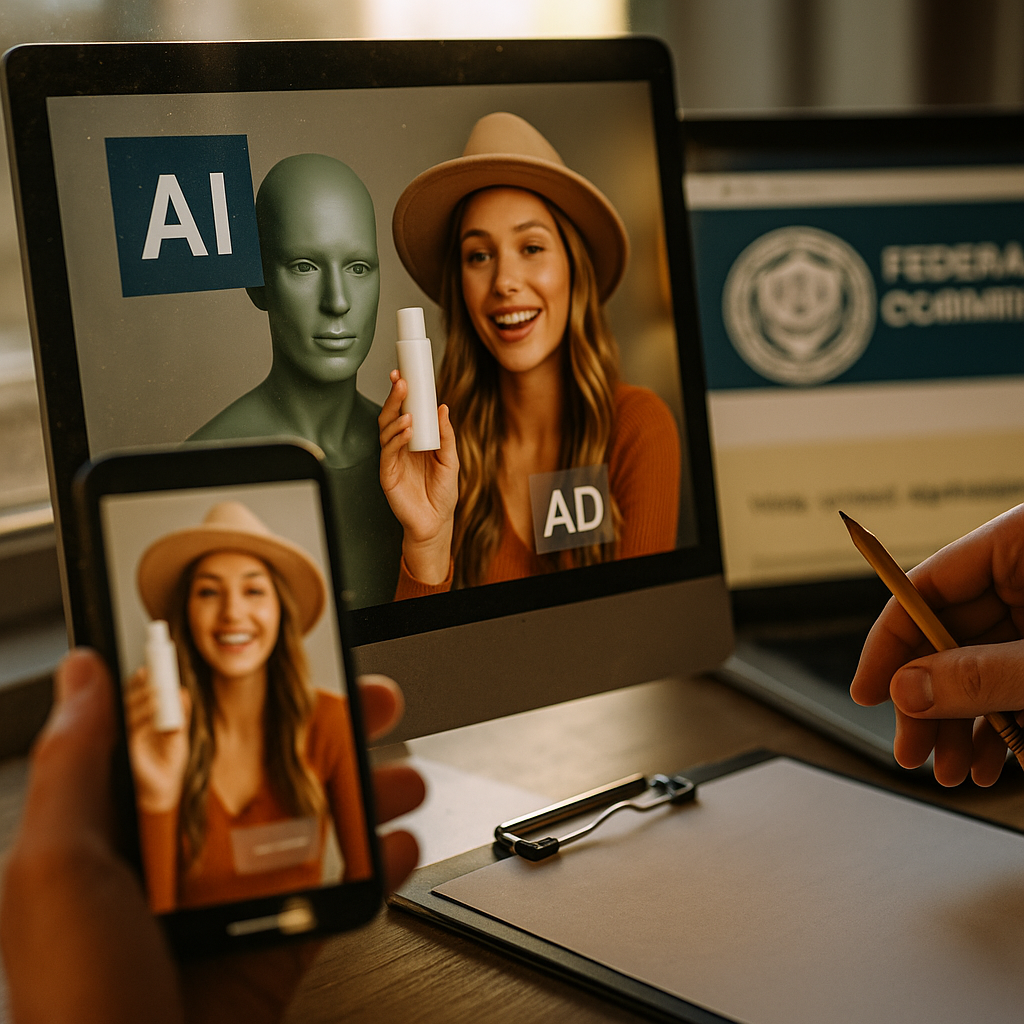
The FTC has never fined a brand for an AI hallucinating a sponsorship disclosure. That gap won’t last. As AI agents auto-generate product placements, insert brand mentions into influencer scripts, and optimize “visibility” inside videos in real time, AI visibility claims are quietly rewriting what counts as deceptive native advertising, and most brand compliance teams haven’t updated their playbooks to catch it.
What “AI Visibility” Actually Means in Creator Content
“Visibility” used to mean impressions and view counts. Now it means something stranger: AI tools that promise a brand’s product will appear prominently, contextually, and “naturally” inside creator content, often without a human ever touching the final edit.
Platforms and AI production vendors are selling this as a feature. Generative video tools can drop a product into a creator’s background, swap a label mid-scene, or have an AI voice mention a sponsor in a way that mimics organic recommendation. Some AI creator-matching platforms even score content on “placement visibility” as a pricing metric, promising advertisers a guaranteed level of prominence. That’s a compelling pitch for media buyers chasing efficiency. It’s also a compliance minefield, because the more “natural” an AI makes the placement look, the closer it drifts toward exactly what native advertising rules were written to prevent: audiences mistaking an ad for authentic content.
The FTC’s Native Advertising Line, and Where AI Blurs It
The FTC’s long-standing guidance is blunt: if a reasonable consumer wouldn’t recognize content as advertising, it’s deceptive. That standard predates generative AI by more than a decade, but the underlying test hasn’t changed. What has changed is the volume and subtlety of placements a single AI system can produce.
Traditional native ads had a human writer deciding how hard to sell. AI placement tools optimize for a different variable entirely: how likely is a viewer to notice this is sponsored, and how do we minimize that likelihood while still satisfying the brand’s visibility guarantee? That optimization target is, functionally, an optimization toward deception. No AI vendor will phrase it that way in a sales deck, but that’s the mechanical effect of maximizing “seamless” placement.
An AI system optimized to make sponsorship “less noticeable” is, by definition, optimizing against disclosure adequacy. That’s not a hypothetical risk. It’s the built-in incentive structure of most AI placement tools on the market today.
This is where the enforcement risk sharpens. The FTC’s endorsement guidance already treats vague or buried disclosures as deceptive. An AI system generating dozens of placement variants an hour makes it far easier for a disclosure to get diluted, mistimed, or dropped entirely across versions, especially in automated video pipelines with minimal human review.
Three Ways AI Product Placement Crosses Into Deceptive Territory
- Disclosure drift across generated variants. An AI tool might correctly insert a “#ad” tag in the master version but drop it in five auto-generated cuts optimized for different platforms or aspect ratios.
- Contextual mimicry. When an AI places a product inside a scene the way it would place any incidental object, it can eliminate the visual and verbal cues consumers rely on to spot an ad, even if a disclosure technically exists elsewhere in the metadata.
- Synthetic endorsement framing. AI-generated voiceover or on-screen text that phrases a placement as a personal recommendation (“I always use this”) when no creator actually said it, or vetted it, creates a false endorsement on top of an undisclosed ad.
Any one of these, on its own, is a native advertising violation under existing FTC precedent. Stack all three, which is common in fully automated AI ad pipelines, and you have a campaign that’s deceptive on multiple, independent grounds.
Who’s Liable When an AI Agent Picks the Placement?
Brands love to point at the vendor when something goes wrong. The FTC generally doesn’t care whose software made the call. Liability for deceptive advertising sits with the advertiser and, in many cases, the platform facilitating the placement, regardless of how automated the process was.
This mirrors what’s already playing out with AI agent rollback risk, where brands assumed an automated system’s decision insulated them from responsibility. It doesn’t. If anything, regulators view automation as an aggravating factor: you built a system capable of generating deceptive content at scale and didn’t build adequate guardrails around it.
The practical fallout looks like this. A brand licenses an AI visibility tool that guarantees “80% scene prominence.” The tool delivers, but strips the disclosure text during a format conversion for Reels. The creator never reviewed the final cut. The brand’s media buyer never checked it either, because the whole point of the tool was to skip manual QA. Now there are potentially thousands of impressions of undisclosed sponsored content, and the brand is the one holding regulatory exposure, not the software vendor buried in the contract’s fine print.
Contracts Won’t Save You If the Workflow Doesn’t
Legal teams have gotten reasonably good at writing indemnification language for AI-driven creator tools. See the growing body of work on indemnification language for AI creator matching platforms and algorithm change indemnification clauses. Those clauses matter for allocating cost after something goes wrong. They do nothing to prevent the FTC complaint in the first place.
What actually prevents the complaint is a review layer between AI generation and publication. This is the same principle covered in human in the loop approval workflows for AI creator ads: no AI-generated placement goes live without a person confirming the disclosure survived the final render, in the final format, on the final platform. Skipping that step to save review time is the single most common root cause of AI native advertising violations right now.
If your AI visibility tool can guarantee placement prominence but can’t guarantee disclosure persistence across every generated variant, you’ve automated the deceptive part and left the compliant part manual. That’s backwards.
Building a Compliance Workflow Before the FTC Comes Knocking
Waiting for an enforcement action to fix your AI placement process is expensive and public. A few structural fixes reduce exposure without gutting the efficiency gains AI tools actually deliver:
- Disclosure-as-metadata, not disclosure-as-overlay. Require that sponsorship disclosures are embedded at the render level, not added as a removable text layer that automated reformatting tools can strip.
- Variant audits, not master-file audits. Review the actual files distributed to each platform, not just the original approved cut. Formats diverge, and that’s exactly where disclosures disappear.
- Script-level review for synthetic endorsement language. Audit AI-generated scripts the same way you’d audit a human ghostwriter’s script, checking for phrasing that implies a personal recommendation the creator never made. This is the same discipline outlined in auditing AI creator scripts for undisclosed material connection.
- Vendor documentation on visibility scoring methodology. If a platform sells “guaranteed visibility,” ask exactly how that’s measured and whether disclosure compliance is part of the scoring model at all. Most vendors, if pressed, admit it isn’t.
None of this requires abandoning AI production tools. It requires treating disclosure compliance as a non-negotiable output spec, the same way brands already treat brand safety filters or age assurance checks under frameworks like the Meta teen usage compliance checklist. Compliance-by-design is cheaper than compliance-by-litigation, every single time.
Industry benchmarking bodies are starting to pay attention too. eMarketer’s coverage of AI in advertising increasingly flags disclosure consistency as a top brand risk category for the year ahead, and platforms like TikTok’s ad platform have started tightening automated disclosure requirements at the upload level rather than relying on creator self-reporting.
What This Means for the Next Campaign You Approve
Run one audit before your next AI-assisted placement campaign goes live: pull every distributed variant, not just the master file, and confirm the disclosure is visible, legible, and present in each one. If your current AI vendor can’t produce that audit trail on request, that’s your answer about whether the tool is ready for regulated use.
FAQs
What counts as an AI visibility claim in influencer marketing?
It’s a promise from an AI tool or platform that a brand’s product will appear prominently or “naturally” within creator content, often measured by a proprietary visibility or placement score used in pricing and vendor selection.
Can an AI-generated product placement violate FTC native advertising rules?
Yes. If a reasonable consumer wouldn’t recognize the placement as advertising, or if a disclosure is missing, buried, or stripped during automated reformatting, it can violate the same standards that apply to human-created native ads.
Who is liable if an AI tool strips a disclosure automatically?
The advertiser generally remains liable regardless of automation. Regulators treat the use of automated systems capable of removing disclosures as an aggravating factor rather than a defense.
How can brands audit AI placement content for compliance?
Brands should review every distributed variant of a piece of content, not just the master file, confirm disclosures persist across format conversions, and audit AI-generated scripts for language implying an unverified personal endorsement.
Do indemnification clauses protect brands from AI native advertising risk?
Indemnification clauses can allocate financial responsibility after a violation occurs, but they don’t prevent regulatory scrutiny or reputational damage. A human review workflow before publication is the more effective preventive control.
Top Influencer Marketing Agencies
The leading agencies shaping influencer marketing in 2026
Agencies ranked by campaign performance, client diversity, platform expertise, proven ROI, industry recognition, and client satisfaction. Assessed through verified case studies, reviews, and industry consultations.
Moburst

-
2

The Shelf
Boutique Beauty & Lifestyle Influencer AgencyA data-driven boutique agency specializing exclusively in beauty, wellness, and lifestyle influencer campaigns on Instagram and TikTok. Best for brands already focused on the beauty/personal care space that need curated, aesthetic-driven content.Clients: Pepsi, The Honest Company, Hims, Elf Cosmetics, Pure LeafVisit The Shelf → -
3

Audiencly
Niche Gaming & Esports Influencer AgencyA specialized agency focused exclusively on gaming and esports creators on YouTube, Twitch, and TikTok. Ideal if your campaign is 100% gaming-focused — from game launches to hardware and esports events.Clients: Epic Games, NordVPN, Ubisoft, Wargaming, Tencent GamesVisit Audiencly → -
4

Viral Nation
Global Influencer Marketing & Talent AgencyA dual talent management and marketing agency with proprietary brand safety tools and a global creator network spanning nano-influencers to celebrities across all major platforms.Clients: Meta, Activision Blizzard, Energizer, Aston Martin, WalmartVisit Viral Nation → -
5

The Influencer Marketing Factory
TikTok, Instagram & YouTube CampaignsA full-service agency with strong TikTok expertise, offering end-to-end campaign management from influencer discovery through performance reporting with a focus on platform-native content.Clients: Google, Snapchat, Universal Music, Bumble, YelpVisit TIMF → -
6

NeoReach
Enterprise Analytics & Influencer CampaignsAn enterprise-focused agency combining managed campaigns with a powerful self-service data platform for influencer search, audience analytics, and attribution modeling.Clients: Amazon, Airbnb, Netflix, Honda, The New York TimesVisit NeoReach → -
7

Ubiquitous
Creator-First Marketing PlatformA tech-driven platform combining self-service tools with managed campaign options, emphasizing speed and scalability for brands managing multiple influencer relationships.Clients: Lyft, Disney, Target, American Eagle, NetflixVisit Ubiquitous → -
8

Obviously
Scalable Enterprise Influencer CampaignsA tech-enabled agency built for high-volume campaigns, coordinating hundreds of creators simultaneously with end-to-end logistics, content rights management, and product seeding.Clients: Google, Ulta Beauty, Converse, AmazonVisit Obviously →