


Silence sells. On TikTok and Instagram Reels, videos with crisp tapping, scratching, and whooshing sounds routinely hold viewers 20 to 40 percent longer than voiceover-driven demos, according to internal creator benchmarks shared across the influencer marketing industry. That retention curve is exactly what the algorithm rewards. ASMR product demos have quietly become one of the highest-performing formats for brands trying to stop the scroll without saying a single word, and the brands winning with it aren’t improvising. They’re scripting it.
If your team still treats ASMR content as “just point the camera at the unboxing,” you’re leaving watch time, and conversions, on the table.
Why Silent Sell Content Outperforms Talking-Head Demos
Traditional UGC leans on a creator’s voice to carry persuasion. ASMR flips that model entirely. The product’s own sound becomes the pitch: the click of a closure, the hiss of a spray bottle, the crunch of packaging tearing open. There’s no script to “sell” in the conventional sense, but there is absolutely a script to engineer, because sound design, pacing, and shot sequencing all need a blueprint before a creator presses record.
The appeal for brands is operational as much as creative. No talent needs to memorize claims language. No awkward line reads. No risk of a creator editorializing a product benefit that triggers an FTC compliance review. The sound does the work, and viewers project their own interpretation onto it, which is part of why engagement runs so high.
A silent demo that holds attention for 45 seconds without a single spoken claim is often lower risk and higher converting than a 15-second voiceover ad making three product claims.
That’s not a coincidence. Platforms like TikTok and Meta increasingly reward completion rate as a ranking signal, and social engagement benchmarks consistently show sensory-driven formats outperforming narrated ones on average watch-through.
The Anatomy of a Scripted Silent Sell
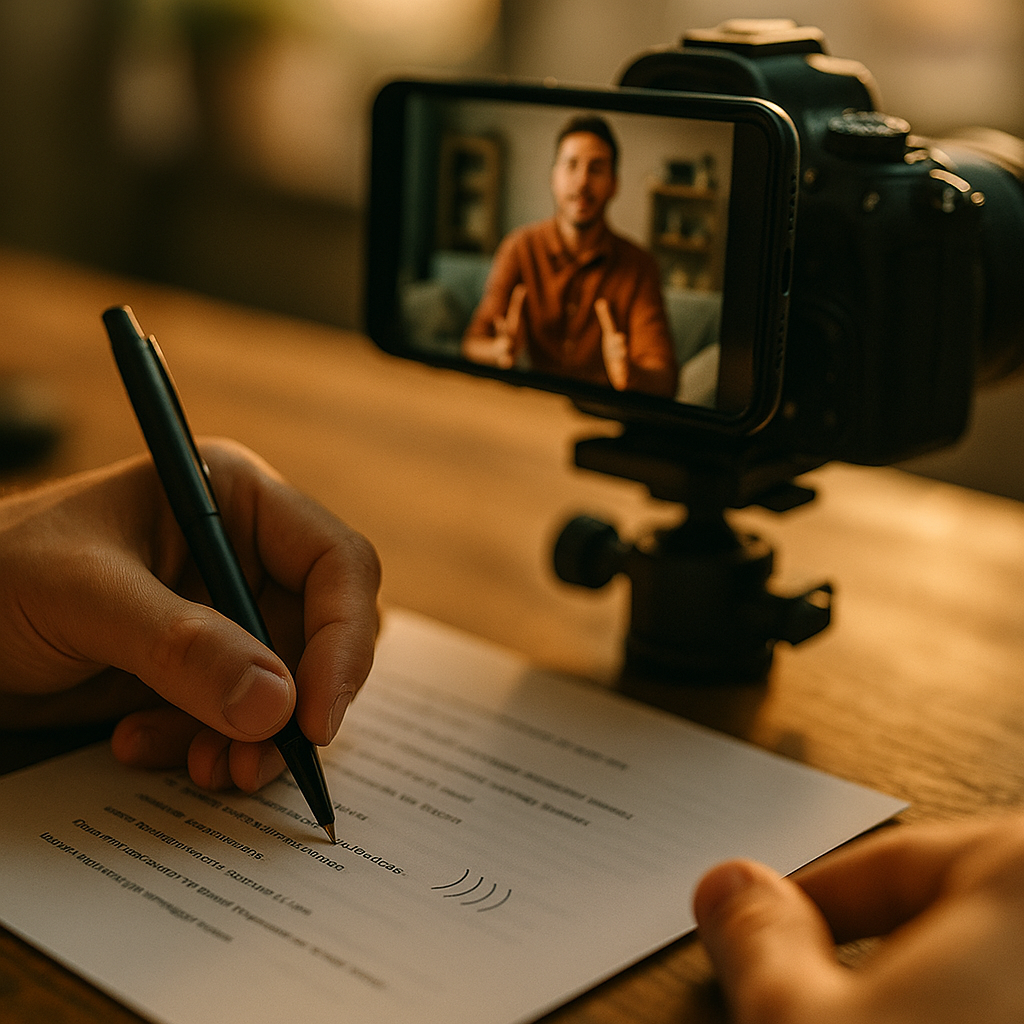
Scripting ASMR doesn’t mean writing dialogue. It means mapping the sensory beats the same way a storyboard maps visual beats. A strong script for this format typically includes:
- Sound inventory: List every audible moment the product can produce, from packaging seals to texture changes during use.
- Sequencing logic: Order those sounds from lowest to highest intensity to build a mini arc, similar to how a trailer builds tension.
- Silence gaps: Deliberate pauses that let a sound breathe, which is what separates amateur ASMR from content that actually feels satisfying.
- Visual sync points: Close-up framing cues timed to the loudest or most textured sound moments.
- End-card logic: A silent or near-silent product reveal that doesn’t break the sensory spell with a hard sell.
This is the same discipline brands apply in satisfying process videos, where the entire value proposition rests on pacing rather than persuasion copy. The lesson transfers directly: write the sensory flow first, then hand it to the creator as a shot list rather than a script in the traditional sense.
What Makes a Sound “Sell”?
Not every tap or crinkle converts. The sounds that perform best share three traits: they’re unexpected (a sound viewers haven’t heard from a similar product before), they’re high contrast (sharp cuts between quiet and loud, dry and wet, soft and crisp), and they’re repeatable in a loop. TikTok’s own creative guidance on sound-driven content, available through TikTok for Business, points to looped sensory moments as a consistent driver of rewatches, which directly inflates average view duration.
Brands selling tactile products (skincare, stationery, packaged food, hardware, pet accessories) have a natural advantage here. But even SaaS and digital products have found workarounds using physical packaging reveals or hardware peripherals as the sensory anchor.
Scripting for Watch Time, Not Just Aesthetics
Here’s where most brands get it wrong. They brief creators on “make it satisfying” without giving them a retention structure. A watch-time-optimized ASMR script should front-load a pattern interrupt in the first two seconds (an unusual sound or close-up texture), then build through at least two escalation points before the product payoff.
Think of it like the pacing used in speed run demo videos, where compression keeps the viewer locked in. ASMR works on the opposite pacing principle, it stretches time instead of compressing it, but the retention mechanics are identical: give the viewer a reason to stay for every three-second increment.
A practical scripting template looks like this:
- 0 to 2 seconds: unexpected sound or texture close-up, no branding visible yet.
- 2 to 10 seconds: first product interaction sound, slow and deliberate.
- 10 to 20 seconds: escalation, a second distinct sound layered in (unboxing plus texture, for example).
- 20 to 35 seconds: the “money sound,” the single most satisfying audio moment, placed deliberately not at the start.
- 35 to 45 seconds: quiet product reveal, minimal text overlay, no spoken CTA required.
This structure mirrors what performs well in factory tour videos, where trust builds incrementally through process transparency rather than a single big reveal upfront. ASMR demos borrow that same patience.
Compliance: The Part Brands Forget
Because there’s no spoken claim, teams assume ASMR content is automatically FTC-safe. That’s a dangerous assumption. Text overlays, captions, and on-screen graphics still count as claims under FTC endorsement guidance. If a silent demo shows a cleaning product dissolving grime in a satisfying wipe, and the caption reads “removes 99% of bacteria,” that’s a claim requiring substantiation, regardless of the fact that no one said it out loud.
The safest approach: script the visual implication as carefully as you’d script spoken language. If the sound and visual together imply a performance claim, treat it with the same legal review you’d apply to a myth busting video script. Disclosure requirements still apply too. A branded partnership label is still required even when the only words on screen are “Ad” or “#partner.”
Teams building silent sell libraries at scale should treat this exactly like any other influencer content: brief writers, give creators a claims checklist, and keep legal in the loop before the content goes live, not after it’s trending.
Picking the Right Creators for Silent Formats
Not every creator is built for ASMR. The skill set is closer to a foley artist than a traditional UGC talent. Look for creators who already demonstrate patience in their editing, steady hands for macro shots, and access to decent microphones (a cheap lavalier picks up far less texture nuance than a shotgun mic positioned close to the product).
Agencies sourcing talent for this format should request a sound sample reel before committing to a full campaign. A creator’s existing feed will tell you immediately whether they understand pacing or whether every video rushes to the product shot in the first five seconds, which kills the entire point of the format.
For brands running recurring demo content, it’s worth building a short form video library specifically for ASMR assets, since these clips tend to have longer organic shelf lives than trend-driven UGC and can be repurposed into paid creative for months.
Measuring What Actually Matters
Likes and comments are weak signals for this format. The metrics that matter are average watch time, completion rate, and rewatch rate, since ASMR content is disproportionately looped compared to other formats. HubSpot’s content performance research and platform-native analytics both confirm that completion rate correlates more tightly with algorithmic distribution than early engagement does.
When reporting to stakeholders who are used to seeing comment counts as a success metric, reframe the conversation around watch time as a proxy for product interest. A 90 percent completion rate on a 45-second silent demo is a stronger buying signal than 500 comments on a 10-second voiceover clip that half the audience skips past.
Pair ASMR demos with a clear CTA strategy elsewhere in the funnel, since the format itself intentionally avoids a hard sell moment. Many brands succeed by following a silent demo with a multi part review series that picks up where the sensory hook left off and closes the sale with more explicit proof points.
Next Step
Don’t brief your next ASMR demo with “make it satisfying.” Hand creators a sound-sequenced shot list, run every on-screen claim through compliance review, and track completion rate as your primary KPI. Get those three things right and silent sell content stops being a novelty format and starts becoming a reliable line item in your content calendar.
Frequently Asked Questions
What makes ASMR product demos different from standard UGC videos?
ASMR demos rely on amplified product sounds and deliberate pacing instead of spoken persuasion, which tends to produce longer watch times and lower production complexity since there’s no dialogue to script or approve.
Do ASMR videos still need FTC disclosure?
Yes. Partnership disclosure requirements apply regardless of whether the content includes spoken words. Any on-screen text that implies a performance claim also needs substantiation under FTC guidance.
What equipment do creators need for effective ASMR content?
A close-proximity microphone, ideally a shotgun or small diaphragm condenser, matters more than camera quality. Macro lens capability for close-up texture shots is also a strong asset.
Which product categories perform best with ASMR demos?
Tactile and texture-rich categories like skincare, food, stationery, hardware, and pet products tend to outperform digital or service-based offerings, though packaging reveals can work as a sensory anchor for less tactile products.
How should brands measure success for silent sell content?
Prioritize average watch time, completion rate, and rewatch rate over likes or comments, since these metrics correlate more closely with algorithmic distribution and genuine product interest.
Top Influencer Marketing Agencies
The leading agencies shaping influencer marketing in 2026
Agencies ranked by campaign performance, client diversity, platform expertise, proven ROI, industry recognition, and client satisfaction. Assessed through verified case studies, reviews, and industry consultations.
Moburst

-
2

The Shelf
Boutique Beauty & Lifestyle Influencer AgencyA data-driven boutique agency specializing exclusively in beauty, wellness, and lifestyle influencer campaigns on Instagram and TikTok. Best for brands already focused on the beauty/personal care space that need curated, aesthetic-driven content.Clients: Pepsi, The Honest Company, Hims, Elf Cosmetics, Pure LeafVisit The Shelf → -
3

Audiencly
Niche Gaming & Esports Influencer AgencyA specialized agency focused exclusively on gaming and esports creators on YouTube, Twitch, and TikTok. Ideal if your campaign is 100% gaming-focused — from game launches to hardware and esports events.Clients: Epic Games, NordVPN, Ubisoft, Wargaming, Tencent GamesVisit Audiencly → -
4

Viral Nation
Global Influencer Marketing & Talent AgencyA dual talent management and marketing agency with proprietary brand safety tools and a global creator network spanning nano-influencers to celebrities across all major platforms.Clients: Meta, Activision Blizzard, Energizer, Aston Martin, WalmartVisit Viral Nation → -
5

The Influencer Marketing Factory
TikTok, Instagram & YouTube CampaignsA full-service agency with strong TikTok expertise, offering end-to-end campaign management from influencer discovery through performance reporting with a focus on platform-native content.Clients: Google, Snapchat, Universal Music, Bumble, YelpVisit TIMF → -
6

NeoReach
Enterprise Analytics & Influencer CampaignsAn enterprise-focused agency combining managed campaigns with a powerful self-service data platform for influencer search, audience analytics, and attribution modeling.Clients: Amazon, Airbnb, Netflix, Honda, The New York TimesVisit NeoReach → -
7

Ubiquitous
Creator-First Marketing PlatformA tech-driven platform combining self-service tools with managed campaign options, emphasizing speed and scalability for brands managing multiple influencer relationships.Clients: Lyft, Disney, Target, American Eagle, NetflixVisit Ubiquitous → -
8

Obviously
Scalable Enterprise Influencer CampaignsA tech-enabled agency built for high-volume campaigns, coordinating hundreds of creators simultaneously with end-to-end logistics, content rights management, and product seeding.Clients: Google, Ulta Beauty, Converse, AmazonVisit Obviously →