


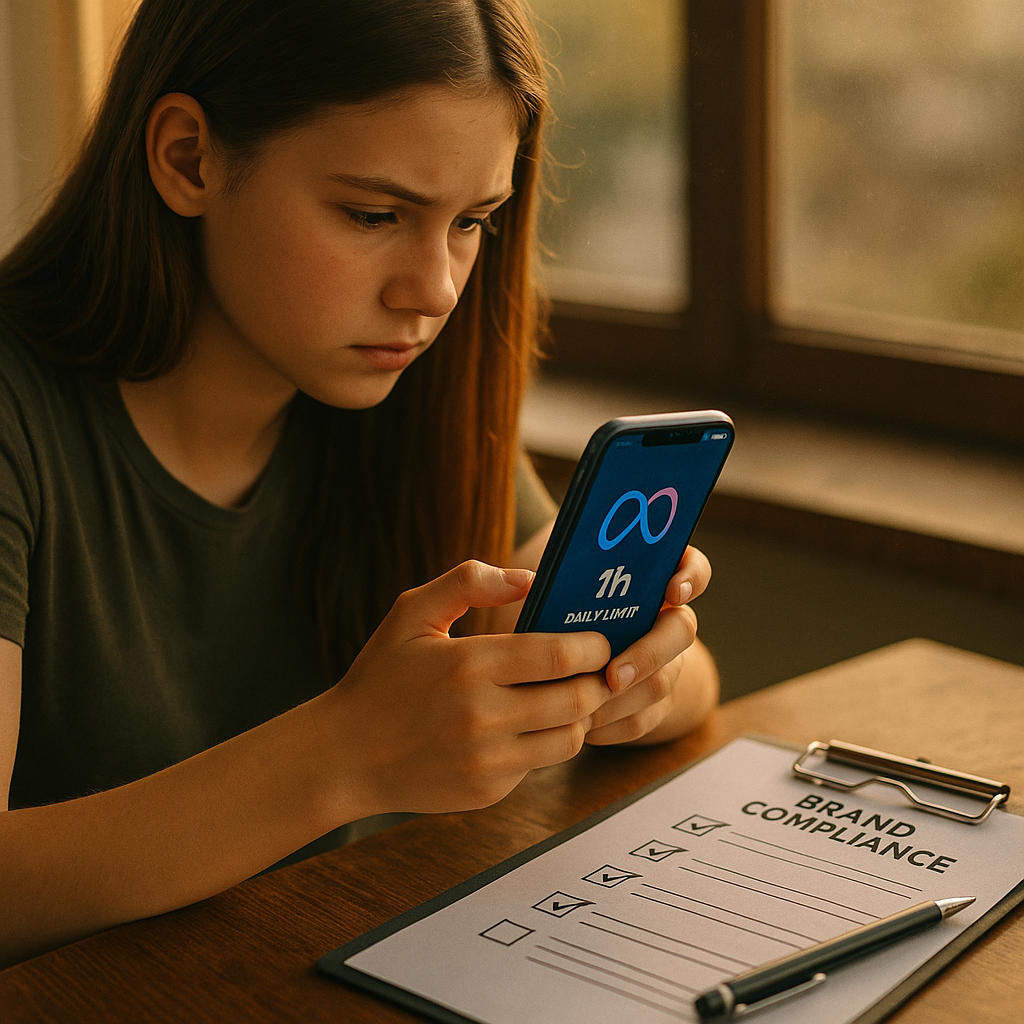
Two hours. That’s the new ceiling on daily teen usage Meta has committed to enforcing across Instagram and Facebook, and it’s already scrambling media plans built around after-school and late-night engagement windows. If your youth-adjacent creator campaigns were scheduled assuming teens scroll for four or five hours a day, you have a scheduling problem and a compliance problem stacked on top of each other. This compliance checklist walks through how to reconcile Meta’s teen usage cap with the campaign calendars you already built.
Why the Two Hour Cap Breaks More Than Just Reach Projections
Meta’s teen usage cap isn’t a soft nudge. It’s a default daily limit enforced at the account level, part of the broader youth safety commitments that followed regulatory pressure and the high-profile settlement covered in our data consent audit breakdown. Once a teen account hits two hours, notifications throttle, feed refresh slows, and in some configurations the app nudges toward logout screens. That means your carefully timed drop schedule, the one built around 3pm to 6pm after-school peaks and 9pm to 11pm evening scroll sessions, is now competing with a hard usage wall that resets unpredictably depending on when each individual user started their session.
Most brand teams built their creator content calendars around aggregate engagement data, not individual session caps. That’s the disconnect. You were optimizing for when teens are online in general. Meta is now optimizing for when they stop being online, per account, per day.
A campaign scheduled for peak teen engagement hours can now underperform simply because a meaningful share of the audience has already exhausted its daily allotment before your content ever hits the feed.
Audit Your Existing Schedule Before You Touch Creative
Don’t start with the creative brief. Start with the calendar. Pull every active and planned campaign that targets or reasonably reaches users under 18, and map posting times against Meta’s default enforcement windows. If you’re relying on frequency capping assumptions from six months ago, throw them out. The math has changed.
- List every creator partnership with a youth-adjacent or mixed-age audience, including nano and micro creators whose followers skew teen even if the brief never mentioned age.
- Cross-reference posting cadence (how many posts per day, per week) against the likelihood that teen followers hit the cap before your content posts.
- Flag any campaign relying on multiple touchpoints per day from the same creator, since sequential content is most vulnerable to cap-related drop-off.
- Check whether paid amplification budgets were allocated assuming teen reach windows that no longer hold.
The Compliance Checklist
This is the operational core. Work through it with your legal, media planning, and creator relations teams in the room, not sequentially. Reconciling a usage cap with an existing schedule is a cross-functional problem, and treating it as a media-only fix will leave compliance gaps.
- Confirm age-detection accuracy on your target audience segments. Meta’s age assurance systems, discussed in depth in our age assurance roadmap, determine which accounts fall under the cap in the first place. If your audience data doesn’t align with Meta’s classification, your scheduling assumptions are built on sand.
- Re-map posting windows to account for early cap exhaustion. Shift high-value creator content earlier in plausible daily usage cycles, since a teen who hits two hours by 4pm won’t see your 8pm drop.
- Reduce sequential daily touchpoints from a single creator. If one creator was posting three times a day for a youth-skewing campaign, that’s now three competing chances to burn through a capped budget of attention. Consolidate to fewer, stronger posts.
- Document a fallback distribution channel. TikTok, YouTube Shorts, or owned email/SMS can absorb reach that Instagram and Facebook can no longer guarantee for capped accounts.
- Update creator briefs to reflect non-personalized feed realities. Our non-personalized teen feed action plan covers how content discovery mechanics shift when algorithmic personalization is stripped from teen accounts, which compounds the cap’s effect on reach.
- Revisit contractual deliverable timing with creators. If your influencer agreements specify exact posting windows tied to old engagement data, renegotiate before the next flight, not after underperformance shows up in the report.
- Build a monitoring cadence for cap enforcement changes. Meta has already adjusted default settings once since the original teen safety settlement roadmap was published, and further tightening is plausible given continued regulatory attention.
Contracts Written for a Different Reality
Here’s the uncomfortable part. Most existing creator contracts were drafted before the cap existed, or before it was enforced this strictly. That means deliverable schedules, exclusivity windows, and performance guarantees may be built on reach assumptions that Meta itself just invalidated.
If your agency signed a six-month retainer with a creator promising X impressions among a youth-adjacent audience, and Meta’s cap now structurally limits that audience’s daily exposure, you have a performance gap that isn’t the creator’s fault. That’s a brand-side planning failure, and it needs a contractual fix, not a creator penalty. Our creator contract audit guide is a useful companion here for renegotiating deliverable language without souring creator relationships.
Legal teams should also revisit indemnification clauses tied to platform algorithm or policy changes. If Meta’s enforcement of the cap shifts mid-campaign, who absorbs the underperformance risk? Our piece on algorithm change indemnification lays out language that protects brands when a platform’s own policy shift tanks a flight’s KPIs.
What About Cross-Platform Campaigns?
If your youth-adjacent strategy spans Meta, TikTok, and YouTube, the cap doesn’t apply uniformly. TikTok has its own age-based screen time defaults, and the two platforms don’t reset on the same clock or use identical enforcement logic. Reconciling a multi-platform teen-facing schedule means building separate exposure models per platform rather than a single blended reach number. Review our international youth safety rules breakdown if any portion of your audience sits outside the US, since regional enforcement of usage caps and age verification varies meaningfully.
Practical Fixes You Can Ship This Quarter
Reconciliation doesn’t require ripping up every campaign. It requires targeted adjustments.
- Shift the heaviest creator content pushes to the first half of the plausible daily usage window rather than clustering in the evening.
- Reduce reliance on repeat daily touchpoints from the same creator account; spread reach across a wider creator roster instead.
- Negotiate deliverable language that ties compensation to reach realistically achievable under the cap, not legacy benchmarks.
- Add a quarterly checkpoint to reassess Meta’s enforcement settings, since defaults have already shifted once and will likely shift again.
- Loop compliance and legal into media planning meetings, not just creative approval, since the cap is a regulatory response mechanism, not a product feature.
Industry benchmarking from eMarketer continues to show teen attention fragmenting across shorter, more frequent sessions rather than fewer, longer ones, which actually supports a shift toward more frequent, lower-intensity creator touchpoints rather than fewer, heavier drops. That’s a silver lining if you’re willing to restructure cadence.
The brands that adapt fastest aren’t the ones cutting youth-adjacent budgets. They’re the ones rebuilding cadence around shorter, earlier, more distributed touchpoints instead of a handful of high-intensity drops.
Consult Meta’s own business resources for the current default settings by region, since enforcement details continue to be updated and vary by market. Pair that with FTC guidance on endorsement disclosure requirements if your youth-adjacent creators are also running sponsored content, since the two compliance layers now intersect more than they used to.
FAQs
What exactly is Meta’s two hour teen usage cap?
It’s a default daily usage limit applied to teen accounts on Instagram and Facebook, part of Meta’s youth safety commitments. Once a teen account reaches roughly two hours of daily use, the app throttles notifications and nudges toward logout, reducing the effective window for content exposure.
Does the cap apply to all teen accounts automatically?
It applies as a default setting for accounts Meta classifies as belonging to minors through its age assurance systems. Accuracy of that classification directly affects which of your audience segments are actually capped.
How should brands adjust creator posting schedules?
Shift heavier content pushes earlier in plausible daily usage windows, reduce repeat same-day touchpoints from a single creator, and spread reach across a broader creator roster instead of concentrating it in a few high-frequency accounts.
Do existing creator contracts need to be renegotiated because of the cap?
In many cases, yes. Contracts drafted before the cap’s strict enforcement may guarantee reach or impression benchmarks that are no longer realistically achievable, and deliverable language should be updated to reflect current platform mechanics.
Is the usage cap consistent across regions?
No. Enforcement defaults and age verification requirements vary by market, particularly across the US, UK, EU, and Australia, so multi-region campaigns need separate compliance mapping per jurisdiction.
Next step: Pull your active youth-adjacent campaign calendar this week, map it against Meta’s current default cap settings, and flag any creator contract with reach guarantees written before the cap was strictly enforced. That single audit will surface most of your exposure before the next billing cycle does it for you.
Frequently Asked Questions
What exactly is Meta’s two hour teen usage cap?
It’s a default daily usage limit applied to teen accounts on Instagram and Facebook, part of Meta’s youth safety commitments. Once a teen account reaches roughly two hours of daily use, the app throttles notifications and nudges toward logout, reducing the effective window for content exposure.
Does the cap apply to all teen accounts automatically?
It applies as a default setting for accounts Meta classifies as belonging to minors through its age assurance systems. Accuracy of that classification directly affects which of your audience segments are actually capped.
How should brands adjust creator posting schedules?
Shift heavier content pushes earlier in plausible daily usage windows, reduce repeat same-day touchpoints from a single creator, and spread reach across a broader creator roster instead of concentrating it in a few high-frequency accounts.
Do existing creator contracts need to be renegotiated because of the cap?
In many cases, yes. Contracts drafted before the cap’s strict enforcement may guarantee reach or impression benchmarks that are no longer realistically achievable, and deliverable language should be updated to reflect current platform mechanics.
Is the usage cap consistent across regions?
No. Enforcement defaults and age verification requirements vary by market, particularly across the US, UK, EU, and Australia, so multi-region campaigns need separate compliance mapping per jurisdiction.
Top Influencer Marketing Agencies
The leading agencies shaping influencer marketing in 2026
Agencies ranked by campaign performance, client diversity, platform expertise, proven ROI, industry recognition, and client satisfaction. Assessed through verified case studies, reviews, and industry consultations.
Moburst

-
2

The Shelf
Boutique Beauty & Lifestyle Influencer AgencyA data-driven boutique agency specializing exclusively in beauty, wellness, and lifestyle influencer campaigns on Instagram and TikTok. Best for brands already focused on the beauty/personal care space that need curated, aesthetic-driven content.Clients: Pepsi, The Honest Company, Hims, Elf Cosmetics, Pure LeafVisit The Shelf → -
3

Audiencly
Niche Gaming & Esports Influencer AgencyA specialized agency focused exclusively on gaming and esports creators on YouTube, Twitch, and TikTok. Ideal if your campaign is 100% gaming-focused — from game launches to hardware and esports events.Clients: Epic Games, NordVPN, Ubisoft, Wargaming, Tencent GamesVisit Audiencly → -
4

Viral Nation
Global Influencer Marketing & Talent AgencyA dual talent management and marketing agency with proprietary brand safety tools and a global creator network spanning nano-influencers to celebrities across all major platforms.Clients: Meta, Activision Blizzard, Energizer, Aston Martin, WalmartVisit Viral Nation → -
5

The Influencer Marketing Factory
TikTok, Instagram & YouTube CampaignsA full-service agency with strong TikTok expertise, offering end-to-end campaign management from influencer discovery through performance reporting with a focus on platform-native content.Clients: Google, Snapchat, Universal Music, Bumble, YelpVisit TIMF → -
6

NeoReach
Enterprise Analytics & Influencer CampaignsAn enterprise-focused agency combining managed campaigns with a powerful self-service data platform for influencer search, audience analytics, and attribution modeling.Clients: Amazon, Airbnb, Netflix, Honda, The New York TimesVisit NeoReach → -
7

Ubiquitous
Creator-First Marketing PlatformA tech-driven platform combining self-service tools with managed campaign options, emphasizing speed and scalability for brands managing multiple influencer relationships.Clients: Lyft, Disney, Target, American Eagle, NetflixVisit Ubiquitous → -
8

Obviously
Scalable Enterprise Influencer CampaignsA tech-enabled agency built for high-volume campaigns, coordinating hundreds of creators simultaneously with end-to-end logistics, content rights management, and product seeding.Clients: Google, Ulta Beauty, Converse, AmazonVisit Obviously →