


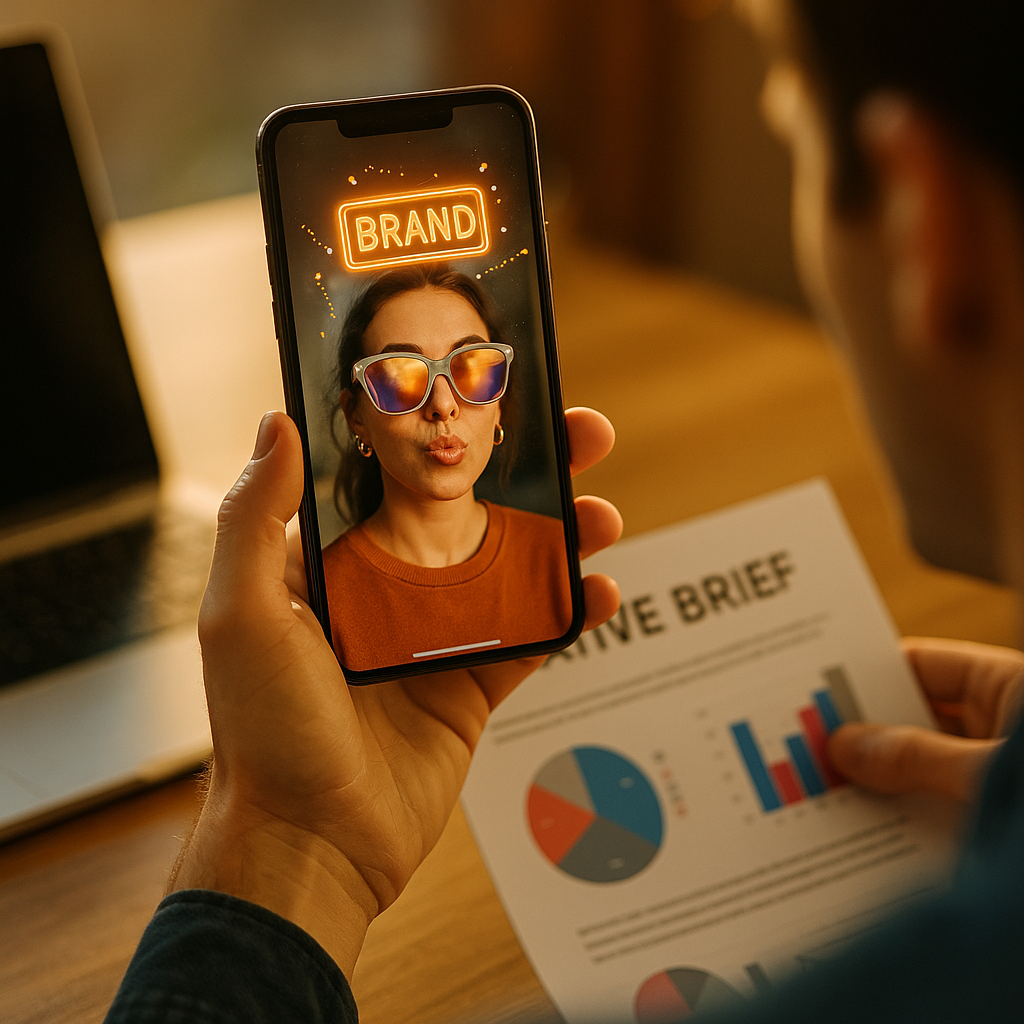
Snapchat’s Lens Studio filters generate over 6 billion daily views across the platform, yet most brands still treat AR filter campaigns like a novelty add-on instead of a real media line. That’s a mistake. A tightly briefed branded lens can outperform a paid video placement on cost per engagement, and it leaves a reusable asset behind. The gap between brands that win with AR and brands that waste budget on it comes down to one thing: the creative brief.
Why AR Filters Still Belong in Your Budget
Augmented reality effects got written off as a 2020-era gimmick by some media planners. That take is wrong, and the platforms have the numbers to prove it. Instagram, TikTok, and Snapchat have all quietly rebuilt their effects tools for creators and brands alike, and the format has matured from face filters into full product try-on, gamified challenges, and shoppable overlays.
What changed isn’t the technology so much as the intent. Early branded lenses existed to generate buzz. Today’s best AR campaigns exist to generate data: try-on completion rates, share velocity, and direct attribution to product pages. Meta’s ad platform now supports AR try-on units directly inside Instagram Shopping, which means a filter can sit one tap away from checkout instead of living as a standalone toy.
An AR filter isn’t a content format. It’s a distribution mechanic that turns every user who tries it into a walking billboard for as long as the effect stays on their face or feed.
What Actually Belongs in an AR Creative Brief
Most AR briefs fail because they’re written like a design ticket instead of a marketing document. A designer needs specs. A campaign needs objectives, guardrails, and a plan for what happens after launch. Here’s the structure that holds up across Snapchat Lens Studio, TikTok Effect House, and Meta Spark builds.
- Objective and success metric: Is this reach (unique lens opens), engagement (shares, remixes), or conversion (try-on to add-to-cart)? Pick one primary metric. Trying to optimize for all three at once produces a mediocre filter that does nothing well.
- Platform and technical constraints: Snapchat lenses, TikTok effects, and Instagram/Meta Spark filters each have different face-tracking APIs, file size limits, and approval timelines. Specify the platform before the concept, not after.
- Trigger mechanism: Face-tracking, world-tracking (surface placement), hand gesture, or voice activation. This decision shapes the entire creative, so lock it early.
- Brand asset integration: Logo placement rules, product 3D model specs, color accuracy requirements, and any legal disclaimers that must render on-screen.
- Duration and dismissal behavior: How long does the effect run before it loops or exits? Does the user have to manually close it, and does that create friction?
- Creator activation plan: Which creators will use the filter first, and what’s the seeding brief that goes with it? A filter with no creator push at launch dies in the discover feed within 48 hours.
- Measurement and reporting cadence: Daily opens for the first 72 hours, then weekly. Define what a “successful” open rate looks like before launch so you’re not guessing at readout time.
Notice what’s missing from that list: nothing about “making it fun.” Fun is table stakes. A brief that treats novelty as the deliverable will produce exactly that, a novelty, and nothing measurable to show a CFO.
Face Filters vs. World Effects: Picking the Right Format
Face-tracking filters (the classic “put a hat on the user” format) still drive the highest share rates because they’re inherently self-referential. People share things that make them look good or funny. That’s basic psychology, and it hasn’t changed since the first Snapchat dog-ear lens went viral.
World-effects, where the AR object sits in the environment rather than on the user’s face, work better for product visualization. A furniture brand letting shoppers place a virtual sofa in their living room isn’t chasing shares, it’s removing purchase hesitation. IKEA and Wayfair have run versions of this for years with measurable lift in conversion for AR-engaged sessions.
The brief has to name which job the filter is doing. Awareness plays lean face-tracking and shareability. Consideration and conversion plays lean world-tracking and utility. Blending the two without a clear priority is how you end up with a filter that’s mildly interesting and commercially useless.
Where the Budget Actually Goes
Production costs for a polished branded lens range widely depending on complexity: a simple 2D overlay filter can run a few thousand dollars through a specialized AR studio, while a full 3D try-on experience with realistic lighting and physics can run into six figures. The bigger line item most brands underestimate is creator seeding and paid amplification to get the filter discovered in the first place. A gorgeous filter nobody finds is a wasted budget line, full stop.
Plan for roughly 60% of total spend on production and 40% on distribution, including creator fees to demo the effect and paid placements in Snapchat’s Discover or TikTok’s Effect gallery. That ratio will shift depending on whether you already have an engaged creator roster willing to activate the filter organically.
Compliance Isn’t Optional With AR
Branded AR sits at an uncomfortable intersection of advertising disclosure rules and platform-specific content policies, and regulators are paying attention. If a filter promotes a product and a creator uses it in sponsored content, that’s a paid partnership requiring disclosure under FTC guidelines just like any other branded post. Brands that treat the filter itself as exempt from disclosure rules because “it’s just a filter” are exposing themselves to the same enforcement risk as an undisclosed sponsored video.
There’s a second layer specific to AR: biometric data. Face-tracking filters process facial geometry, and depending on jurisdiction, that can trigger biometric privacy statutes. Illinois’ BIPA is the most litigated example in the US, and several class actions have targeted platforms over face filter data handling. Your legal team should sign off on data retention and consent language before the filter goes live, not after a user complaint. The UK’s ICO guidance on biometric data is a useful reference point even for US-based teams running global campaigns.
If your legal review for an AR campaign looks identical to your review for a static social post, you’re missing the biometric data question, and that’s the one regulators are actually watching right now.
Build a compliance checklist into the brief itself: disclosure language for any creator activation, data retention window for face-tracking sessions, and a clear opt-out path for users. This isn’t bureaucratic overhead. It’s the difference between a campaign that scales safely and one that becomes a case study in what not to do.
Briefing Creators to Activate the Filter
A filter without creator activation is a tree falling in an empty forest. The discovery mechanics on Snapchat and TikTok both favor content that demonstrates the effect in an authentic, low-production way. This means your creator brief for AR looks a lot more like the reaction-content briefs used for other native formats than a polished commercial shoot. If your team has already built a POV reaction brief for other campaigns, borrow that structure. It transfers well to filter demos because the goal is the same: capture a genuine first reaction, not a scripted performance.
Sequencing matters too. Instead of blasting the filter to every creator on your roster simultaneously, stagger it. A relay brief approach where a handful of creators activate first, then a wider tier picks it up once early engagement signals look strong, mimics the organic momentum that gets filters surfaced in platform discovery tabs. Snapchat’s algorithm and TikTok’s Effect House ranking both reward early velocity, so the first 24 to 48 hours of creator activation matter disproportionately.
Keep the ask simple: show the filter in a natural setting, react honestly, and tag the effect so followers can find and use it themselves. Over-directing this content kills the authenticity that makes AR shareable in the first place. For teams building out a broader library of creator brief templates, the same lightweight approach used in niche content frameworks applies well here: fewer rigid rules, clearer intent.
Measuring What Matters (and Ignoring Vanity Metrics)
Total lens opens is the metric every platform dashboard leads with, and it’s the least useful number in the report. It tells you reach, not impact. The metrics that actually inform whether to run another AR campaign are completion rate (did users engage with the full effect or bail after one second), share rate per open, and, where trackable, the conversion path from try-on to purchase.
Snapchat’s Lens Studio analytics and TikTok’s Effect House dashboard both report swipe-up or link-click data when the filter is tied to a landing page. Insist on that link tracking at the brief stage. Too many teams launch a filter, generate impressive open numbers, and then can’t answer the follow-up question every finance stakeholder asks: did this move product? Build the tracking pixel or UTM structure into the brief before build begins, not as an afterthought during reporting week. Platforms like Sprout Social and eMarketer both track broader benchmark data on AR engagement rates that’s useful for setting realistic internal targets before launch.
A Quick Gut Check Before You Greenlight
- Does the filter have a clear, singular objective tied to a specific business metric?
- Has legal reviewed the biometric data handling and disclosure requirements?
- Is there a creator seeding plan for the first 48 hours post-launch?
- Is conversion tracking built into the filter’s link-out, not bolted on later?
If any of those four questions gets a shrug instead of a confident answer, the brief isn’t ready. Send it back before it goes to production.
FAQs
Frequently Asked Questions
How much does a branded AR filter campaign typically cost?
Production alone can range from a few thousand dollars for a simple overlay to well over six figures for a photorealistic 3D try-on experience. Add creator seeding and paid amplification, and total campaign budgets often split roughly 60% production, 40% distribution.
Which platform is best for branded AR filters: Snapchat, TikTok, or Instagram?
It depends on the objective. Snapchat’s Lens Studio has the most mature AR ad infrastructure and strong Gen Z reach. TikTok’s Effect House favors virality and creator-driven discovery. Instagram/Meta Spark integrates most directly with shopping features for conversion-focused campaigns.
Do branded AR filters require FTC disclosure?
Yes, if a creator uses the filter as part of a paid partnership or sponsored content, standard FTC disclosure rules apply just as they would for any other branded post.
What’s the biggest legal risk with face-tracking filters?
Biometric data handling. Face-tracking filters process facial geometry data, which can trigger privacy statutes like Illinois’ BIPA. Legal review of data retention and consent language should happen before launch.
How do I measure whether an AR filter campaign actually worked?
Look past total opens. Track completion rate, share rate per open, and, where possible, conversion from try-on to purchase using UTM-tagged link-outs built into the filter from the start.
Start your next AR filter brief with the objective and the compliance checklist, not the visual concept. Everything else, from platform choice to creator activation, follows from those two decisions.
Top Influencer Marketing Agencies
The leading agencies shaping influencer marketing in 2026
Agencies ranked by campaign performance, client diversity, platform expertise, proven ROI, industry recognition, and client satisfaction. Assessed through verified case studies, reviews, and industry consultations.
Moburst

-
2

The Shelf
Boutique Beauty & Lifestyle Influencer AgencyA data-driven boutique agency specializing exclusively in beauty, wellness, and lifestyle influencer campaigns on Instagram and TikTok. Best for brands already focused on the beauty/personal care space that need curated, aesthetic-driven content.Clients: Pepsi, The Honest Company, Hims, Elf Cosmetics, Pure LeafVisit The Shelf → -
3

Audiencly
Niche Gaming & Esports Influencer AgencyA specialized agency focused exclusively on gaming and esports creators on YouTube, Twitch, and TikTok. Ideal if your campaign is 100% gaming-focused — from game launches to hardware and esports events.Clients: Epic Games, NordVPN, Ubisoft, Wargaming, Tencent GamesVisit Audiencly → -
4

Viral Nation
Global Influencer Marketing & Talent AgencyA dual talent management and marketing agency with proprietary brand safety tools and a global creator network spanning nano-influencers to celebrities across all major platforms.Clients: Meta, Activision Blizzard, Energizer, Aston Martin, WalmartVisit Viral Nation → -
5

The Influencer Marketing Factory
TikTok, Instagram & YouTube CampaignsA full-service agency with strong TikTok expertise, offering end-to-end campaign management from influencer discovery through performance reporting with a focus on platform-native content.Clients: Google, Snapchat, Universal Music, Bumble, YelpVisit TIMF → -
6

NeoReach
Enterprise Analytics & Influencer CampaignsAn enterprise-focused agency combining managed campaigns with a powerful self-service data platform for influencer search, audience analytics, and attribution modeling.Clients: Amazon, Airbnb, Netflix, Honda, The New York TimesVisit NeoReach → -
7

Ubiquitous
Creator-First Marketing PlatformA tech-driven platform combining self-service tools with managed campaign options, emphasizing speed and scalability for brands managing multiple influencer relationships.Clients: Lyft, Disney, Target, American Eagle, NetflixVisit Ubiquitous → -
8

Obviously
Scalable Enterprise Influencer CampaignsA tech-enabled agency built for high-volume campaigns, coordinating hundreds of creators simultaneously with end-to-end logistics, content rights management, and product seeding.Clients: Google, Ulta Beauty, Converse, AmazonVisit Obviously →