


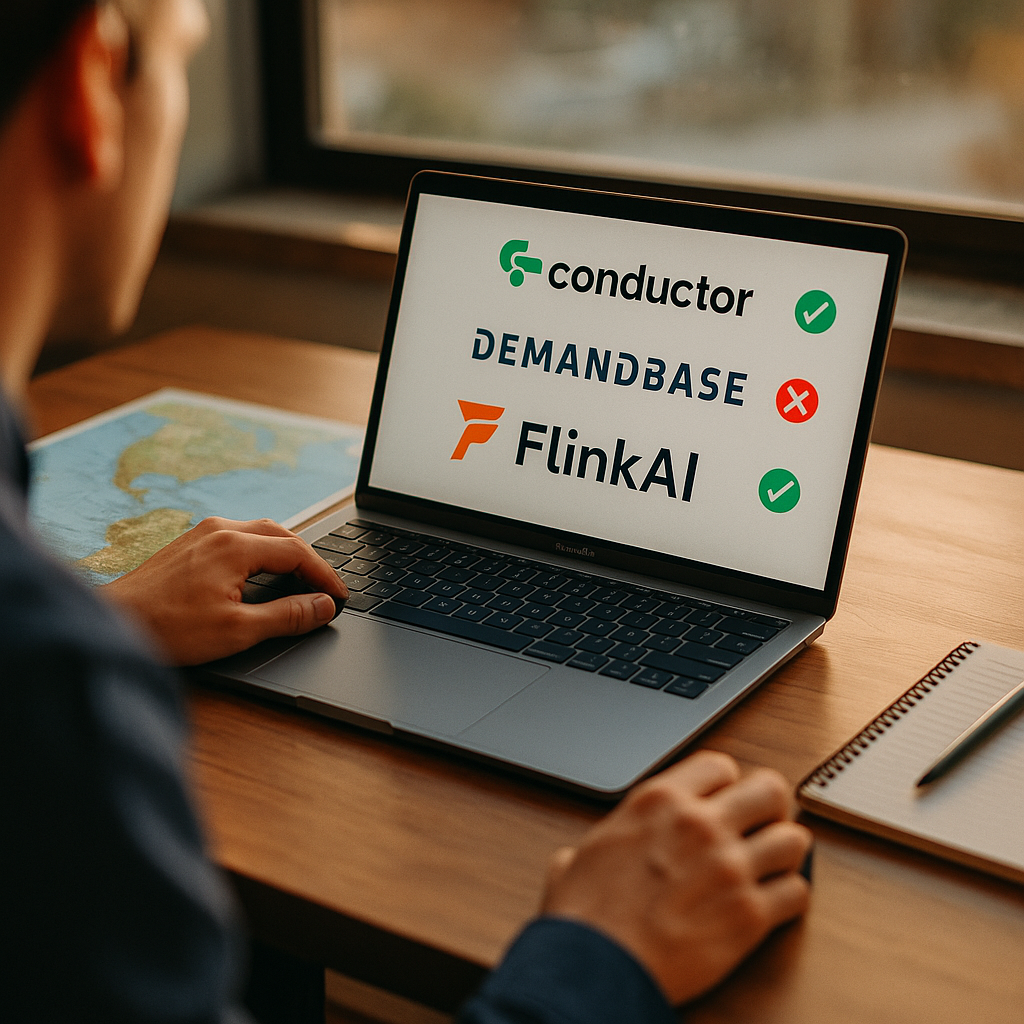
Only 27% of enterprise marketing leaders say they can confidently measure how often their brand shows up in ChatGPT, Gemini, or Perplexity answers, according to recent industry surveys. That gap is exactly why GEO platforms have gone from experimental line items to board-level budget conversations. If your brand isn’t cited in AI answers, it doesn’t exist to a growing share of buyers. So which vendor actually closes that gap: Conductor, Demandbase AI, or FlinkAI?
What GEO Actually Means for Enterprise Teams
Generative Engine Optimization (GEO) is the practice of making your brand, product, and content citable inside AI-generated answers, not just rankable in a list of blue links. Traditional SEO optimized for clicks. GEO optimizes for mentions, citations, and share of voice inside a synthesized response the user never has to click through to get.
That distinction matters more than most marketing teams realize. As zero-click search rewrites how attribution works, the platforms that help you monitor, influence, and prove AI visibility become as strategic as your CRM or your ad server. Enter Conductor, Demandbase AI, and FlinkAI, three tools taking noticeably different paths to the same goal.
The brands winning at GEO right now aren’t the ones with the biggest content libraries. They’re the ones with the cleanest, most structured entity data feeding the models.
Conductor: SEO Heritage Meets AI Answer Tracking
Conductor built its reputation as an enterprise SEO platform, and that lineage shows in how it approaches GEO. Rather than starting from scratch, Conductor extended its existing content intelligence engine to track brand mentions across AI Overviews, ChatGPT, and Perplexity, layering that on top of the technical SEO auditing enterprises already rely on.
The practical upside: teams that already run Conductor for organic search don’t need a second dashboard. Content gaps identified for traditional SEO surface alongside AI citation gaps, letting content strategists prioritize a single roadmap instead of juggling two disconnected tools. For large publishers and retail brands with sprawling content libraries, that consolidation alone can justify the license fee.
Where Conductor is thinner is on the structured data and entity resolution side. It’s strong at telling you where you’re missing from AI answers, less strong at fixing the underlying data quality issues that caused the miss in the first place. That’s a real gap, since clean entity data is often the actual root cause of citation failures, not content thinness.
Best fit
Enterprise content and SEO teams who already run Conductor for organic search and want AI visibility bolted onto an existing workflow rather than a net-new platform to manage.
Demandbase AI: GEO Through an ABM Lens
Demandbase comes at this from account-based marketing, not organic content, and that framing changes everything about how the platform prioritizes visibility. Instead of asking “are we cited for this keyword,” Demandbase AI asks “are we cited when our named target accounts are researching this category.” That’s a fundamentally different, and arguably more commercially useful, question for B2B enterprises running six or seven-figure deal cycles.
The platform ties AI visibility signals to its existing intent data and account scoring, so a marketing ops leader can see whether a target account’s research pattern in an LLM correlates with pipeline movement. That’s a meaningful evolution of the kind of dark funnel tracking B2B teams have been demanding for years.
The tradeoff is scope. Demandbase AI is optimized for B2B account-based programs, and it shows less depth for consumer brands or content-heavy publishers who need broad, topic-level AI visibility rather than account-specific signals. If your GTM motion isn’t account-based, you’re paying for capability you won’t use.
Best fit
B2B enterprises running ABM programs who want AI citation data connected directly to named-account pipeline, not general brand visibility.
FlinkAI: Built Native for the Answer Engine Era
FlinkAI didn’t retrofit an existing SEO or ABM tool. It was built from the ground up as a GEO-first platform, and that shows in its feature depth on the things legacy tools bolt on as afterthoughts: prompt-level tracking across multiple LLMs, competitive citation share, and automated structured data recommendations that update as model behavior shifts.
FlinkAI’s standout feature is its prompt simulation engine, which lets teams test how a brand shows up across thousands of realistic buyer prompts before a campaign launches, rather than discovering visibility gaps after the fact. That’s a meaningfully different workflow from reactive monitoring, closer to how agent studio testing approaches now let teams pressure-test AI campaigns before scaling spend.
The catch: FlinkAI is younger, with a smaller integration ecosystem than Conductor or Demandbase. Enterprises with heavy investment in existing martech stacks may find themselves doing more manual data stitching than they’d like. It’s also priced more aggressively toward mid-market and challenger brands, which can be a signal that enterprise-grade support and SLAs are still maturing.
Best fit
Brands that need granular, prompt-level competitive intelligence and are willing to trade some integration maturity for feature depth on the GEO problem itself.
Head to Head: Where Each Platform Actually Wins
- Conductor wins on content-to-citation workflow consolidation for teams already invested in enterprise SEO.
- Demandbase AI wins on tying AI visibility to pipeline for account-based B2B programs.
- FlinkAI wins on prompt-level granularity and pre-launch testing for teams that need to move fast on new content.
None of the three fully solves the attribution problem on its own. All three still require your team to define what “success” looks like in an AI answer, since none of them can hand you a clean, universally agreed-upon KPI the way click-through rate once did. That’s a governance problem, not a tooling problem, and it belongs in the same conversation as building an AI attribution roadmap before you sign any contract.
The Real Cost of Getting This Wrong
Enterprises tend to treat GEO platform selection as a marketing tooling decision. It’s actually a risk mitigation decision. If your commercial data, product listings, and executive bios are inconsistent across your website, review sites, and knowledge panels, no GEO platform can fully compensate. Bad inputs produce bad citations regardless of which dashboard you’re staring at.
This is where the conversation connects to a broader data hygiene problem enterprises have been slow to fix. Dirty CRM data and fragmented product feeds don’t just hurt personalization, they actively suppress AI citation rates because language models can’t confidently attribute claims to a source they can’t verify. Before signing a GEO platform contract, most enterprises would get more ROI from a two-week data audit than from a six-figure license.
A GEO platform can tell you that you’re invisible. It can’t fix the underlying data mess that made you invisible in the first place. That’s still a human job.
There’s also a compliance dimension that’s easy to overlook. As AI adoption stalls at compliance handoffs across marketing orgs, legal and privacy teams increasingly want visibility into how these platforms scrape, store, and reprocess brand and customer data. Ask each vendor directly how they handle data retention and whether their monitoring crawlers respect the same standards outlined by groups like the Federal Trade Commission on data practices. It’s a due diligence step too many procurement teams skip in the rush to “just get a GEO tool.”
Budget Reality: What These Platforms Actually Cost
Pricing across all three vendors is largely custom-quoted, which is standard for enterprise martech but frustrating for teams trying to build a business case. As a rough guide, expect Conductor and Demandbase AI to price in line with existing enterprise SEO and ABM suites respectively, often bundled into broader contract renewals. FlinkAI, as the newer entrant, tends to offer more flexible entry tiers to win market share, though enterprise features and support scale up quickly once you cross into larger seat counts.
Whatever the sticker price, benchmark it against the cost of invisibility. Industry data from firms like eMarketer and Statista continues to show AI-driven search interactions climbing quarter over quarter, which means the cost of doing nothing rises every single quarter you wait.
FAQs
What is a GEO platform, and how is it different from SEO software?
A GEO platform tracks and improves how often a brand is cited or mentioned inside AI-generated answers from tools like ChatGPT, Gemini, and Perplexity. Traditional SEO software optimizes for search engine rankings and click-through traffic, while GEO platforms optimize for citation frequency and accuracy inside synthesized, often zero-click, AI responses.
Can enterprises use more than one GEO platform at once?
Yes, and many do during evaluation periods. Running Conductor alongside FlinkAI, for example, lets teams compare AI citation data against a broader content strategy platform, though most enterprises consolidate to one primary tool once they’ve validated data accuracy and integration fit.
Does Demandbase AI work for consumer brands, or only B2B?
Demandbase AI is purpose-built for account-based B2B marketing and ties AI visibility signals to named-account intent data. Consumer brands without an ABM motion typically find better fit with Conductor or FlinkAI, which focus on broader topic and category visibility rather than named-account tracking.
How long does it take to see measurable GEO results?
Most enterprises report initial visibility data within two to four weeks of implementation, but meaningful citation improvements from content and structured data changes typically take eight to twelve weeks, since AI models don’t reindex and reweight sources as quickly as traditional search crawlers.
Do these platforms guarantee brand citations in AI answers?
No reputable vendor guarantees citations, since none of them control the underlying models. Conductor, Demandbase AI, and FlinkAI all position themselves as monitoring and optimization tools that improve the probability and consistency of citation, not as tools with direct control over model outputs.
Choose Conductor if AI visibility needs to live inside an existing SEO workflow, Demandbase AI if it needs to prove pipeline impact for named accounts, and FlinkAI if you need prompt-level depth before your next big content push. Whichever you pick, run the data audit first, the platform second.
Frequently Asked Questions
What is a GEO platform, and how is it different from SEO software?
A GEO platform tracks and improves how often a brand is cited or mentioned inside AI-generated answers from tools like ChatGPT, Gemini, and Perplexity. Traditional SEO software optimizes for search engine rankings and click-through traffic, while GEO platforms optimize for citation frequency and accuracy inside synthesized, often zero-click, AI responses.
Can enterprises use more than one GEO platform at once?
Yes, and many do during evaluation periods. Running Conductor alongside FlinkAI, for example, lets teams compare AI citation data against a broader content strategy platform, though most enterprises consolidate to one primary tool once they’ve validated data accuracy and integration fit.
Does Demandbase AI work for consumer brands, or only B2B?
Demandbase AI is purpose-built for account-based B2B marketing and ties AI visibility signals to named-account intent data. Consumer brands without an ABM motion typically find better fit with Conductor or FlinkAI, which focus on broader topic and category visibility rather than named-account tracking.
How long does it take to see measurable GEO results?
Most enterprises report initial visibility data within two to four weeks of implementation, but meaningful citation improvements from content and structured data changes typically take eight to twelve weeks, since AI models don’t reindex and reweight sources as quickly as traditional search crawlers.
Do these platforms guarantee brand citations in AI answers?
No reputable vendor guarantees citations, since none of them control the underlying models. Conductor, Demandbase AI, and FlinkAI all position themselves as monitoring and optimization tools that improve the probability and consistency of citation, not as tools with direct control over model outputs.
Top Influencer Marketing Agencies
The leading agencies shaping influencer marketing in 2026
Agencies ranked by campaign performance, client diversity, platform expertise, proven ROI, industry recognition, and client satisfaction. Assessed through verified case studies, reviews, and industry consultations.
Moburst

-
2

The Shelf
Boutique Beauty & Lifestyle Influencer AgencyA data-driven boutique agency specializing exclusively in beauty, wellness, and lifestyle influencer campaigns on Instagram and TikTok. Best for brands already focused on the beauty/personal care space that need curated, aesthetic-driven content.Clients: Pepsi, The Honest Company, Hims, Elf Cosmetics, Pure LeafVisit The Shelf → -
3

Audiencly
Niche Gaming & Esports Influencer AgencyA specialized agency focused exclusively on gaming and esports creators on YouTube, Twitch, and TikTok. Ideal if your campaign is 100% gaming-focused — from game launches to hardware and esports events.Clients: Epic Games, NordVPN, Ubisoft, Wargaming, Tencent GamesVisit Audiencly → -
4

Viral Nation
Global Influencer Marketing & Talent AgencyA dual talent management and marketing agency with proprietary brand safety tools and a global creator network spanning nano-influencers to celebrities across all major platforms.Clients: Meta, Activision Blizzard, Energizer, Aston Martin, WalmartVisit Viral Nation → -
5

The Influencer Marketing Factory
TikTok, Instagram & YouTube CampaignsA full-service agency with strong TikTok expertise, offering end-to-end campaign management from influencer discovery through performance reporting with a focus on platform-native content.Clients: Google, Snapchat, Universal Music, Bumble, YelpVisit TIMF → -
6

NeoReach
Enterprise Analytics & Influencer CampaignsAn enterprise-focused agency combining managed campaigns with a powerful self-service data platform for influencer search, audience analytics, and attribution modeling.Clients: Amazon, Airbnb, Netflix, Honda, The New York TimesVisit NeoReach → -
7

Ubiquitous
Creator-First Marketing PlatformA tech-driven platform combining self-service tools with managed campaign options, emphasizing speed and scalability for brands managing multiple influencer relationships.Clients: Lyft, Disney, Target, American Eagle, NetflixVisit Ubiquitous → -
8

Obviously
Scalable Enterprise Influencer CampaignsA tech-enabled agency built for high-volume campaigns, coordinating hundreds of creators simultaneously with end-to-end logistics, content rights management, and product seeding.Clients: Google, Ulta Beauty, Converse, AmazonVisit Obviously →