


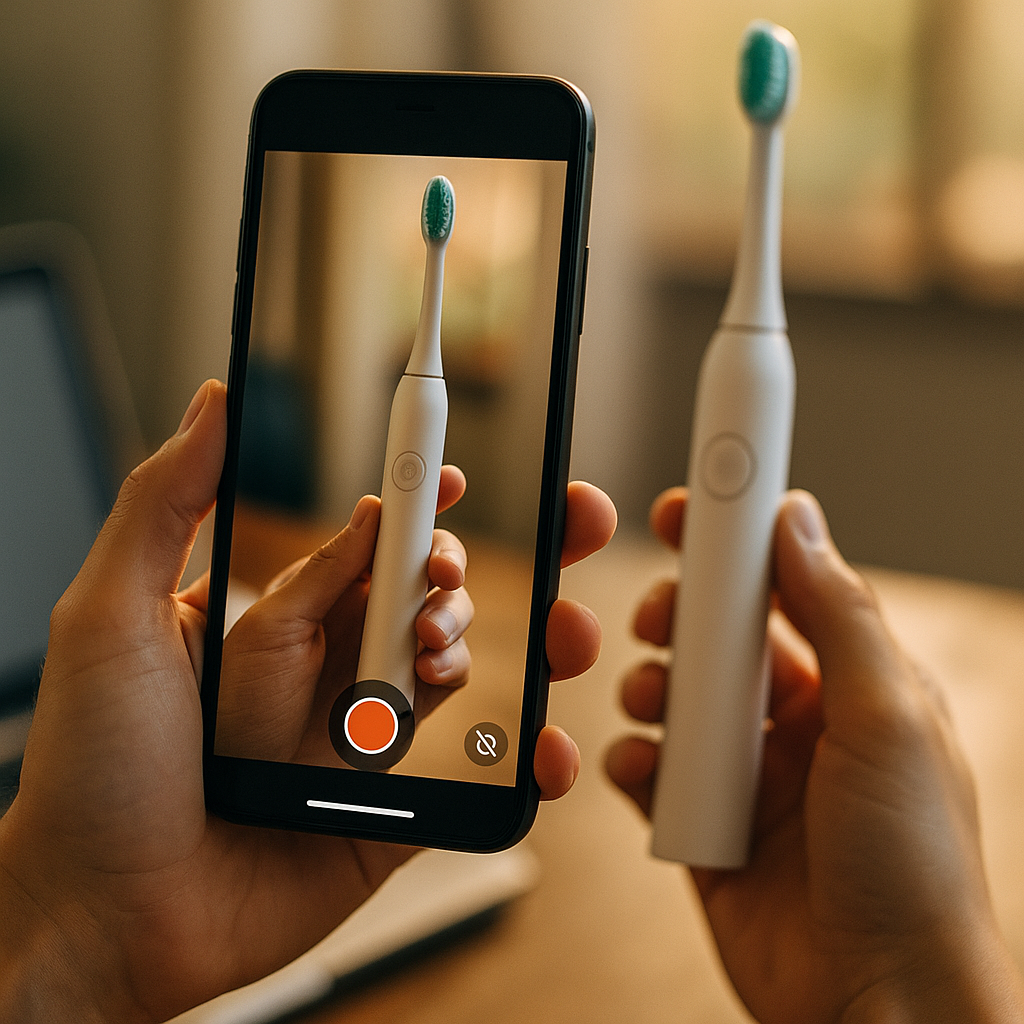
Roughly 85% of Facebook video is watched with the sound off, and TikTok’s own internal data has long pushed creators toward captioned, muted-friendly cuts. Yet most brand briefs still treat audio as the hero. The silent product demo flips that assumption, and it’s quietly outperforming voiceover heavy content on watch time, completion rate, and yes, conversions. If your influencer program hasn’t tested sound off, you’re leaving retention on the table.
What Is a Silent Product Demo, Exactly?
A silent product demo is a short form video, usually 15 to 45 seconds, that communicates a product’s value entirely through visuals, on screen text, and captions. No talking head. No voiceover script. Just tight cuts, satisfying b roll, and text overlays that do the selling.
Think of the genre that made “clean girl” skincare routines and kitchen gadget unboxings go viral: hands entering frame, a product doing exactly what it promises, a caption punchline landing at the right beat. The creator never says a word. The scroll stops anyway.
This isn’t a new invention. ASMR crossed into this territory years ago, and satisfying content (slime, soap cutting, pressure washing) proved that sound wasn’t the retention driver people assumed it was. What’s new is brands treating it as a repeatable, briefable format instead of a happy accident.
Why Sound Off Is Winning Watch Time Right Now
Three forces are converging. First, autoplay behavior on TikTok, Reels, and Shorts means most first impressions happen without audio, often in public places, offices, or waiting rooms where sound is off by default. Second, TikTok’s algorithm rewards completion rate and rewatches, and silent demos with tight visual pacing tend to loop better than talk heavy content. Third, caption literacy has exploded. Gen Z and younger millennials read fast and skim faster, so a well timed text overlay lands quicker than a spoken sentence.
Silent demos aren’t a workaround for muted autoplay. They’re a format optimized for how people actually consume short video: fast, in public, and without earbuds in.
There’s also a production economics angle brands love. No script rewrites for tone of voice. No re-recording because a creator flubbed a line. No dubbing headaches for multi market rollouts. A silent demo shot once can run in five markets with five caption translations, no reshoot required. That’s a real cost saving when you’re scaling a loop optimized reel format across regions.
The Data Behind the Trend
Platforms have been signaling this for a while. Meta’s business resources have repeatedly flagged that captioned, sound off compatible video drives longer watch time on mobile feeds. Sprout Social’s ongoing benchmarking of short form engagement consistently shows caption heavy, dialogue light videos holding attention longer in the first three seconds, which is the window that determines whether the algorithm keeps pushing a video or lets it die.
Ad platforms have adapted too. TikTok’s ad guidance encourages advertisers to design creative that works with sound off as the baseline, not the exception. If the platform itself is telling advertisers this, ignoring it in organic and paid influencer briefs is just leaving performance on the table.
Where This Format Actually Works Best
Not every product story survives without narration. Silent demos thrive in categories where the transformation is visual and immediate:
- Beauty and skincare: texture, application, before and after.
- Home and kitchen gadgets: the “does it actually work” reveal.
- Fashion and apparel: fit, movement, styling transitions.
- Cleaning and household products: the satisfying before/after cut.
- Tech accessories: unboxing, setup speed, physical build quality.
Categories that lean heavily on complex claims, technical specs, or nuanced comparisons struggle here. You can’t explain a subscription pricing tier or a B2B software integration in silence. For those, formats like comparison demo scripts or narrated data overlay reviews still do the heavier lifting.
Briefing Creators for Silent Demos (Without Killing Their Style)
Here’s where a lot of brands mess this up. They send a script anyway, then wonder why the creator’s “silent” video still has three lines of scripted voiceover buried in there. If you want sound off performance, the brief needs to be built for it from the start, not retrofitted after the fact.
A working brief structure looks like this:
- Hook shot in the first second: product in motion, a surprising visual, or a close up that raises a question.
- Three to five caption beats: short phrases, not sentences. Think “watch this” not “in this video I’m going to show you.”
- A demonstrated payoff: the product doing the thing it claims to do, shown, not told.
- A closing CTA overlay: link in bio, shop now, swipe up, whatever fits the platform’s native shopping surface.
- Optional ambient sound or trending audio: not dialogue, just texture. A trending sound bed can still boost discoverability even in a “silent” demo.
That last point matters. Silent doesn’t mean muted track. Most high performing sound off demos still carry a trending audio clip in the background, because trending sounds feed discovery algorithms even when no one’s speaking over them. If you’re already building an audio strategy, pair this with an original sound brief so creators have a reusable asset instead of chasing whatever’s trending that week.
Caption Craft Is the New Copywriting
When there’s no voiceover, the caption overlay carries the entire narrative load. That’s a copywriting discipline most brand marketing teams underinvest in. A weak caption (“Our new formula!”) gets scrolled past. A sharp one (“This replaced four products in my routine”) stops the thumb.
Treat caption sequencing like a mini script. Each overlay should answer the viewer’s next unspoken question: what is this, why should I care, does it work, how do I get it. Four beats, four captions, done. Overwriting kills the format. If you need six lines of text to explain the product, it’s probably not a silent demo candidate.
Measuring What Actually Matters
Watch time is the headline metric, but don’t stop there. Track completion rate, rewatch rate, and average watch percentage separately, since silent demos tend to outperform on rewatch specifically (the loop effect). Compare these against your talking head baseline for the same product category before declaring a winner.
On the conversion side, silent demos pair well with shoppable tagging since there’s no audio pacing to disrupt with a product card overlay. If you’re running paid amplification, this format slots cleanly into shoppable reel specs where the visual demo and the buy button need to sync without a voice competing for attention.
Also worth tracking: accessibility compliance. Captioned content isn’t just a watch time hack, it’s a genuine accessibility win for deaf and hard of hearing audiences, and it keeps you aligned with platform guidance and general FTC disclosure requirements since on screen text is often where sponsorship disclosures live in this format anyway. Keep your #ad or #sponsored tag visible in the caption stack, not buried in a description field nobody reads.
Common Mistakes Brands Make With This Format
A few patterns show up again and again in underperforming silent demos:
- Too much text, too fast. If viewers can’t read it in the time it’s on screen, it doesn’t exist.
- No hook in the first second. Silent demos live or die on the opening frame since there’s no voice to pull people in during a slow build.
- Forcing it on the wrong product. Complex B2B or service products rarely translate. Don’t force a square peg into a round trend.
- Skipping the creative brief entirely. “Just make it silent” is not a brief. Creators need beat structure, just like any other format.
The fix for most of these is treating silent demos as a format with its own rules, not a stripped down version of a talking video. It has different pacing, different copy demands, and different success metrics. Brief it that way and it earns its own line item.
Next Step
Pick one product with an obvious visual payoff, brief three creators using the beat structure above, and run it against your current talking head baseline for two weeks. Let the completion rate decide whether sound off earns a permanent spot in your content mix.
Frequently Asked Questions
Does a silent product demo need captions to work?
Yes. Captions carry the entire narrative when there’s no voiceover, so treat them as the primary copy, not an afterthought added in editing.
Can silent demos include music or trending sounds?
Absolutely. Silent refers to the absence of spoken narration, not the absence of all audio. Trending sound beds can still boost discoverability.
Which platforms reward this format most?
TikTok and Instagram Reels show the strongest performance data, largely because autoplay defaults to muted and completion rate heavily influences distribution on both platforms.
Is this format suitable for B2B or complex product categories?
Generally no. Products requiring explanation of specs, pricing tiers, or technical integration tend to underperform without narration and are better served by narrated or comparison based formats.
How long should a silent product demo run?
Most high performing examples land between 15 and 45 seconds. Longer cuts risk losing viewers without a voice to sustain pacing through slower moments.
Top Influencer Marketing Agencies
The leading agencies shaping influencer marketing in 2026
Agencies ranked by campaign performance, client diversity, platform expertise, proven ROI, industry recognition, and client satisfaction. Assessed through verified case studies, reviews, and industry consultations.
Moburst

-
2

The Shelf
Boutique Beauty & Lifestyle Influencer AgencyA data-driven boutique agency specializing exclusively in beauty, wellness, and lifestyle influencer campaigns on Instagram and TikTok. Best for brands already focused on the beauty/personal care space that need curated, aesthetic-driven content.Clients: Pepsi, The Honest Company, Hims, Elf Cosmetics, Pure LeafVisit The Shelf → -
3

Audiencly
Niche Gaming & Esports Influencer AgencyA specialized agency focused exclusively on gaming and esports creators on YouTube, Twitch, and TikTok. Ideal if your campaign is 100% gaming-focused — from game launches to hardware and esports events.Clients: Epic Games, NordVPN, Ubisoft, Wargaming, Tencent GamesVisit Audiencly → -
4

Viral Nation
Global Influencer Marketing & Talent AgencyA dual talent management and marketing agency with proprietary brand safety tools and a global creator network spanning nano-influencers to celebrities across all major platforms.Clients: Meta, Activision Blizzard, Energizer, Aston Martin, WalmartVisit Viral Nation → -
5

The Influencer Marketing Factory
TikTok, Instagram & YouTube CampaignsA full-service agency with strong TikTok expertise, offering end-to-end campaign management from influencer discovery through performance reporting with a focus on platform-native content.Clients: Google, Snapchat, Universal Music, Bumble, YelpVisit TIMF → -
6

NeoReach
Enterprise Analytics & Influencer CampaignsAn enterprise-focused agency combining managed campaigns with a powerful self-service data platform for influencer search, audience analytics, and attribution modeling.Clients: Amazon, Airbnb, Netflix, Honda, The New York TimesVisit NeoReach → -
7

Ubiquitous
Creator-First Marketing PlatformA tech-driven platform combining self-service tools with managed campaign options, emphasizing speed and scalability for brands managing multiple influencer relationships.Clients: Lyft, Disney, Target, American Eagle, NetflixVisit Ubiquitous → -
8

Obviously
Scalable Enterprise Influencer CampaignsA tech-enabled agency built for high-volume campaigns, coordinating hundreds of creators simultaneously with end-to-end logistics, content rights management, and product seeding.Clients: Google, Ulta Beauty, Converse, AmazonVisit Obviously →