


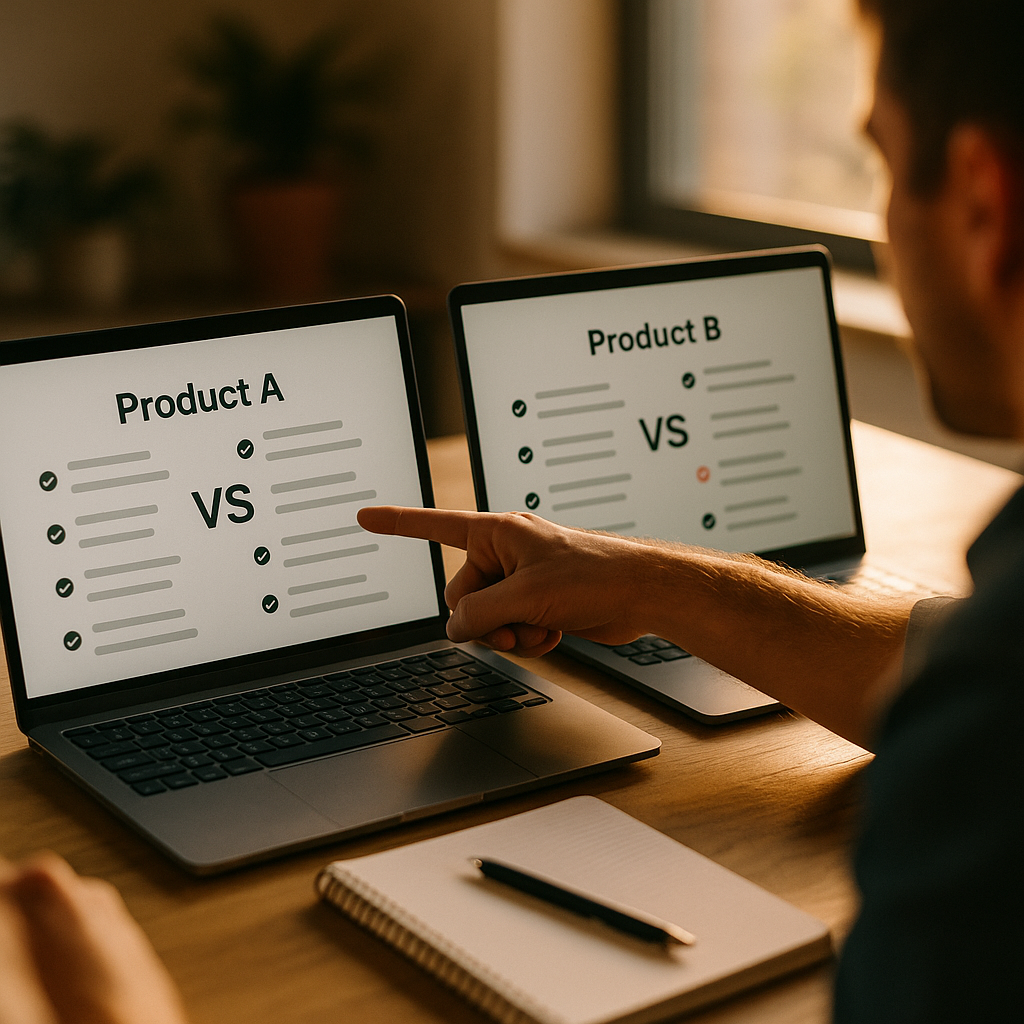
73% of shoppers say they watched a product comparison video before their last online purchase, yet most brands still script demos like solo product tours. That mismatch is costing conversions. The comparison versus format, two products or two outcomes shown side by side in a single frame, works because it mirrors how humans actually decide: not in a vacuum, but against an alternative. Get the script wrong, though, and you end up with a cluttered split screen nobody finishes watching.
Why Side-by-Side Beats the Solo Demo
A single-product demo asks viewers to imagine the alternative. Comparison versus format removes that cognitive step entirely. You put the “before” or the competitor right next to your product, and the brain does instant pattern matching. No imagination required, no benefit of the doubt extended to a claim you haven’t proven.
This isn’t a new insight in retail (think Pepsi Challenge tables), but short-form video has made it scalable in a way that in-store demos never could be. A creator with a ring light and two products can generate the same persuasion mechanics that used to require a physical booth and a sampling budget.
Comparison content converts because it answers the one question every buyer is silently asking: “Compared to what?” A demo that skips that question is just a monologue.
The Anatomy of a Script That Actually Converts
Most brands treat the script brief as an afterthought, a loose suggestion to “show ours versus theirs.” That’s how you end up with a creator holding two boxes and shrugging. A converting script has four load-bearing beats, and skipping any one of them tanks watch-through rate.
- The setup (0 to 3 seconds): State the comparison plainly. “I tried the $12 serum against the $45 one.” No throat-clearing, no branded intro music.
- The parallel test: Both products go through the identical action, filmed in the same lighting, same angle, same pacing. Asymmetry here (one product gets a close-up, the other doesn’t) reads as bias, even if unintentional.
- The tension beat: A moment where the “expected” winner falters, or the underdog surprises. This is the retention hook. Without a twist, viewers assume they know the outcome and swipe away.
- The verdict with receipts: A specific, quantified reason for the winner. “Held curl for 6 hours versus 2” beats “this one’s just better.”
Brands that lift this from our comparison versus videos framework consistently report higher save and share rates than single-product review content, because the format is inherently more shareable, people send comparisons to friends who are mid-decision.
Split Screen Isn’t Just an Edit Choice, It’s a Trust Signal
The visual grammar matters as much as the words. A true split screen, where both products occupy the frame simultaneously, signals fairness to the viewer even before a word is spoken. Sequential cuts (product A, then product B) invite suspicion that the editor buried the weaker footage. If your production budget allows for it, borrow structure from split screen reaction briefs, which use the same simultaneous-frame logic to borrow credibility fast.
For a slightly different angle, the split screen duet reviews format pairs two creators reacting to the same product rather than two products head to head. It’s worth testing both structures against your specific category before locking a brief template.
Scripting for the Skeptic, Not the Fan
Here’s an uncomfortable truth: your existing customers weren’t the ones you needed to convince. The comparison format’s real job is winning over the skeptic scrolling past, someone who has a competitor’s product in their cart already. Script for that person specifically.
That means the creator’s tone should lean neutral-to-skeptical at the start, not enthusiastic. “I’ve used the leading brand for two years, so I wasn’t expecting much from this” builds far more credibility than “OMG you guys have to see this.” Disclosure language matters here too. The FTC’s endorsement guidance requires clear and conspicuous disclosure whenever a material connection exists, and comparison content involving a paid partnership needs that disclosed before the “verdict” beat, not buried in a caption.
Data-driven framing also raises trust. Overlaying a stat, a price per use, a lab result, a third-party rating, gives the skeptic viewer something concrete to hang their decision on. This is the same principle behind data overlay vlogs, where numbers on screen do the persuasion work that adjectives can’t.
Where Brands Get the Brief Wrong
Three recurring mistakes show up when reviewing agency briefs for this format:
- Scripting a foregone conclusion. If viewers can guess the winner in the first five seconds, they leave. Build in a genuine moment of doubt, even a manufactured one, to sustain watch time.
- Over-branding the losing side. If the “competitor” product looks like a strawman, cheap packaging, unfair use case, audiences smell the setup and distrust the whole video.
- No clear unit of comparison. “Better” is not a metric. Time, cost per use, ingredient count, battery life: pick one measurable axis and stick to it for the whole script.
Where This Format Fits in the Funnel
Comparison versus content performs best at the consideration stage, when a buyer has narrowed options but hasn’t committed. It’s a poor fit for pure awareness plays (nobody unfamiliar with the category cares about a comparison yet) and it can feel heavy-handed at the loyalty stage. Map it against your funnel before greenlighting spend.
For paid amplification, pairing comparison scripts with shoppable formats compounds the effect. A viewer convinced by the verdict beat should be one tap from checkout. Brands running this combination alongside shoppable reel formats tend to see lower CPMs, because the format’s higher completion rate improves the ad’s relevance signal on platforms like TikTok Ads Manager and Meta Business Suite.
Attribution is the part most teams skip. If you can’t tie the comparison video back to a purchase event, you’re optimizing on vanity metrics. Build UTM and pixel tracking into the brief itself rather than bolting it on after the creator delivers cuts, a lesson covered in depth in our piece on tracking fields that feed CRM attribution.
Measuring What Actually Matters
Standard engagement metrics undersell this format. Track these instead:
- Full-watch rate on the verdict beat, not just overall completion. If viewers drop before the reveal, your tension beat isn’t working.
- Comment sentiment split, how many commenters argue the results versus agree. Some pushback is healthy; it signals the comparison felt real rather than scripted for the sponsor.
- Save-to-share ratio, since comparisons get sent to friends mid-purchase-decision far more than typical UGC.
- Post-click conversion rate against a control creative, ideally a straight product demo, to isolate the lift the comparison structure itself is providing.
According to eMarketer research on short-form video performance, comparison and versus-style content routinely outperforms straight product demonstrations on both completion rate and click-through, which tracks with what most performance marketing teams see internally once they isolate the variable.
If your comparison video’s drop-off point is the reveal, the problem isn’t the edit. It’s that the script gave the answer away too early.
Briefing Creators Without Killing the Authenticity
Over-scripting is the fastest way to kill a comparison video’s credibility. Creators need structural beats (setup, parallel test, tension, verdict) but not word-for-word lines. Give them the metric to test and the fairness rules (equal lighting, equal time, equal framing) and let their voice fill in the rest. A brief that reads like a legal document produces a video that sounds like one too.
It also helps to build a small library of proven hooks creators can riff on, similar to how original sound briefs give creators a reusable asset rather than a rigid script. Flexibility inside structure is the goal, not a word-for-word teleprompter.
Test one comparison script this week against your current best-performing demo, same product, same creator tier, only the format changed, and let the completion-rate delta decide whether comparison versus format earns a permanent slot in your content calendar.
Frequently Asked Questions
What makes comparison versus format different from a standard product demo?
A standard demo shows one product in isolation and asks the viewer to imagine alternatives. Comparison versus format puts two products or outcomes in the same frame, removing the guesswork and letting viewers judge directly against a reference point.
How long should a comparison versus script run?
Most effective versions run 20 to 45 seconds on short-form platforms. Long enough to complete the parallel test and land the verdict, short enough to avoid losing viewers before the reveal.
Do comparison videos require disclosure if a competitor product is shown?
Yes, if the creator has a paid or material relationship with either brand shown, FTC disclosure rules apply regardless of which product wins the comparison. Disclosure should appear clearly before the verdict, not just in a caption.
What’s the biggest scripting mistake brands make with this format?
Scripting a conclusion that’s obvious from the first few seconds. Without a genuine moment of tension or doubt, viewers assume they know the outcome and stop watching before the verdict lands.
Where does comparison versus format work best in the funnel?
It performs strongest at the consideration stage, when buyers are actively weighing named options. It’s less effective for pure top-of-funnel awareness or late-stage loyalty content.
Top Influencer Marketing Agencies
The leading agencies shaping influencer marketing in 2026
Agencies ranked by campaign performance, client diversity, platform expertise, proven ROI, industry recognition, and client satisfaction. Assessed through verified case studies, reviews, and industry consultations.
Moburst

-
2

The Shelf
Boutique Beauty & Lifestyle Influencer AgencyA data-driven boutique agency specializing exclusively in beauty, wellness, and lifestyle influencer campaigns on Instagram and TikTok. Best for brands already focused on the beauty/personal care space that need curated, aesthetic-driven content.Clients: Pepsi, The Honest Company, Hims, Elf Cosmetics, Pure LeafVisit The Shelf → -
3

Audiencly
Niche Gaming & Esports Influencer AgencyA specialized agency focused exclusively on gaming and esports creators on YouTube, Twitch, and TikTok. Ideal if your campaign is 100% gaming-focused — from game launches to hardware and esports events.Clients: Epic Games, NordVPN, Ubisoft, Wargaming, Tencent GamesVisit Audiencly → -
4

Viral Nation
Global Influencer Marketing & Talent AgencyA dual talent management and marketing agency with proprietary brand safety tools and a global creator network spanning nano-influencers to celebrities across all major platforms.Clients: Meta, Activision Blizzard, Energizer, Aston Martin, WalmartVisit Viral Nation → -
5

The Influencer Marketing Factory
TikTok, Instagram & YouTube CampaignsA full-service agency with strong TikTok expertise, offering end-to-end campaign management from influencer discovery through performance reporting with a focus on platform-native content.Clients: Google, Snapchat, Universal Music, Bumble, YelpVisit TIMF → -
6

NeoReach
Enterprise Analytics & Influencer CampaignsAn enterprise-focused agency combining managed campaigns with a powerful self-service data platform for influencer search, audience analytics, and attribution modeling.Clients: Amazon, Airbnb, Netflix, Honda, The New York TimesVisit NeoReach → -
7

Ubiquitous
Creator-First Marketing PlatformA tech-driven platform combining self-service tools with managed campaign options, emphasizing speed and scalability for brands managing multiple influencer relationships.Clients: Lyft, Disney, Target, American Eagle, NetflixVisit Ubiquitous → -
8

Obviously
Scalable Enterprise Influencer CampaignsA tech-enabled agency built for high-volume campaigns, coordinating hundreds of creators simultaneously with end-to-end logistics, content rights management, and product seeding.Clients: Google, Ulta Beauty, Converse, AmazonVisit Obviously →