


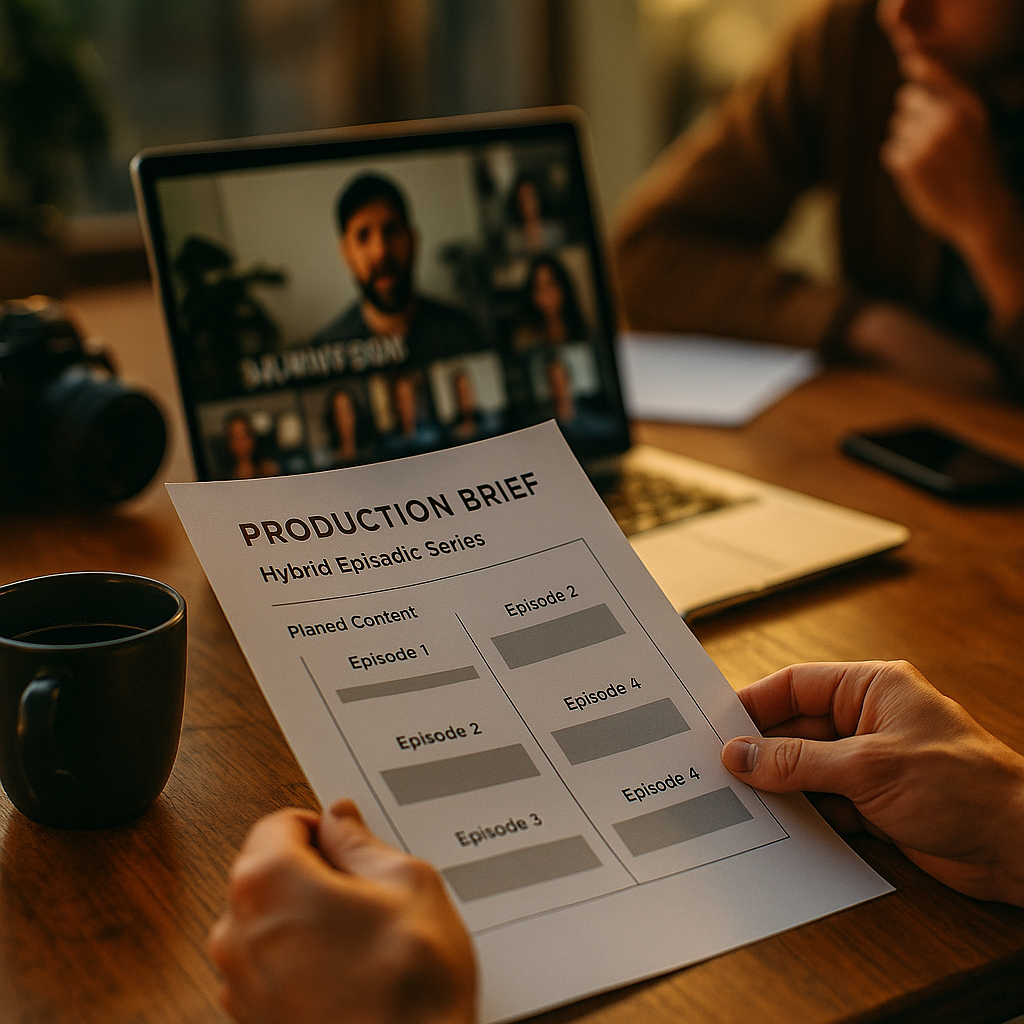
Only 8% of branded video content gets watched past the 30 second mark, yet multi episode brand series routinely hold audiences for 12 minutes or more. That gap is why a growing number of marketing teams are greenlighting a hybrid long form episodic series instead of another one off hero video. The format borrows structure from streaming television and stitches it to the creator economy’s production speed. Done right, it turns a media budget into an owned audience.
What a Hybrid Long Form Episodic Series Actually Is
Strip away the jargon and it’s simple: a branded story told across multiple episodes, mixing scripted narrative with creator led, semi documentary segments. Think of it as a docuseries with a plot. Episode one might open with a scripted cold open, episode two might drop into a creator’s raw, handheld take on the same storyline. The “hybrid” part matters because pure scripted content feels like an ad, and pure creator content lacks narrative gravity to justify a season length commitment.
This isn’t the same animal as a single sponsored integration. It’s closer to the model covered in season deal licensing, where brands option a creator’s format for a defined run rather than paying per post. The production brief has to account for continuity across episodes: recurring characters, a visual identity bible, and a release cadence that platforms can actually support.
Why Now, and Why Not Just Run More Short Form?
Short form still wins on volume and CPM efficiency. But attention spans aggregate differently at scale. eMarketer has repeatedly flagged that time spent with long form video on mobile is climbing even as short form dominates impressions, which tells you audiences will commit to length if the payoff is worth it. A hybrid episodic structure lets a brand capture both: short cutdowns feed the algorithm, while the full episodes build the emotional through line that a 15 second clip never can.
A single hero video gets one shot at attention. An episodic series gets a subscription relationship, and subscription relationships are what actually move brand lift and repeat purchase metrics over a quarter.
There’s also a defensive angle. Competitors are already doing this. Categories like beauty, fintech, and outdoor gear have all produced multi episode creator series in the past year, and the format is spreading into CPG and B2B SaaS faster than most media planners expected.
Building the Production Brief: What Goes On the Page
A brief for this format needs more scaffolding than a standard influencer brief. It has to function like a mini writers’ room document while still giving creators room to improvise. At minimum, include the following:
- Season arc summary. A one page synopsis of where the story goes across all episodes, even if only episode one is fully scripted.
- Character and creator roles. Who is playing a version of themselves, who is scripted talent, and how those two lanes interact on camera.
- Episode length and cadence. Weekly drops perform differently than binge dumps. Decide this before production starts, not after editing.
- Platform cut specs. Full episode for YouTube, a 90 second recap for Reels, a vertical teaser for TikTok. Build these into the shot list, don’t retrofit them later.
- Brand integration points. Where product appears, how it’s framed, and what’s off limits creatively.
- Continuity notes. Wardrobe, locations, running jokes or callbacks that need to survive from episode two into episode five.
This structure overlaps with what we outlined in multi episode arc briefs, but a hybrid series adds one more layer: you’re briefing two production tracks at once, scripted and creator native, and they need to feel like one show by the time it’s edited.
Budgeting for a Season, Not a Post
Budget conversations get messy fast because finance teams are used to thinking in cost per asset, not cost per season. A realistic hybrid series budget usually splits roughly into: 40% production (shoot days, editing, scripting), 30% creator talent fees across the season, 20% media and distribution, 10% held back for reshoots or a bonus episode if episode one overperforms. That reserve matters more than people expect. Streaming platforms greenlight seasons based on pilot performance; there’s no reason a brand series shouldn’t do the same.
HubSpot’s content benchmarking work has consistently shown that repeat engagement compounds faster with serialized formats than one off pieces, which is the financial argument to bring into the budget meeting when someone asks why episode three costs almost as much as episode one.
Where It Lives: Platform Strategy Isn’t an Afterthought
Full episodes belong on YouTube or an owned hub, where watch time is rewarded and mid roll ad placement can offset cost. TikTok and Instagram function as the trailer and recap layer, not the home for the full cut. This is the same logic behind placement briefs built around platform behavior rather than a single asset pushed everywhere identically.
Don’t underestimate the discovery layer either. A well cut 60 second teaser posted natively, following the sound off and silent hook principles used in silent product demo formats, will often outperform a polished trailer with dialogue, simply because it survives autoplay without sound.
Meta’s business resources note that video series with consistent posting cadences build stronger recall than sporadic drops, which lines up with what most agencies see anecdotally: irregular episode schedules kill momentum faster than a mediocre plot does.
Behind the Scenes as a Distinct Content Layer
One underused trick: treat the making of the series as its own content stream. Raw footage, blooper reels, and creator commentary on the shoot extend the season’s life without new production spend. This is essentially the same brief logic used in behind the scenes content briefs, and it slots naturally between episode drops to keep the feed active on off weeks.
If the series has any lore, running theories, or callback jokes, fans will start speculating on their own. That’s free content. Brands that actively brief for it, rather than ignoring it, tend to see stronger season two renewal numbers, a pattern we’ve covered in fan theory content strategy.
Measurement: What to Actually Report On
Standard influencer metrics (reach, engagement rate, CPM) don’t capture what a series is built to do. Track these instead:
- Episode to episode retention. The percentage of episode one viewers who return for episode two is the single best predictor of season ROI.
- Average view duration per episode. Not just completion rate. A 20 minute episode watched to minute 14 is a stronger signal than a 3 minute clip watched to completion.
- Search lift and branded query volume. Series content tends to drive direct search behavior more than single posts do, according to patterns Sprout Social has documented in its own content performance research.
- Cross platform attribution. If someone watches the teaser on TikTok and finishes the episode on YouTube, your tracking needs to connect those two events, not treat them as separate audiences.
Statista’s media consumption data continues to show long form video retention as a leading indicator of brand favorability lift, which is a useful stat to have ready when a CFO asks why a season took six weeks to produce instead of six days.
Compliance and Disclosure Don’t Get Easier With Length
More episodes means more disclosure touchpoints, not fewer. FTC guidance on endorsements applies to every episode where a creator features product, not just the pilot. Build disclosure language into the brief for every cut, including short form teasers and behind the scenes clips, and check current requirements directly on the FTC’s website before the season locks. If creators are UK based or the series runs across UK platforms, cross reference guidance from the ICO as well, particularly around data handling if the series includes any interactive or sign up elements.
Where This Breaks: Common Mistakes
The most frequent failure point isn’t creative, it’s cadence. Teams greenlight six episodes, ship three, then quietly let the series die because the fourth episode wasn’t ready. Audiences notice. A second common mistake is treating the creator as talent only, without giving them input on dialogue or pacing. Creators know their own audience’s tolerance for scripted moments better than any brand strategist does, and ignoring that input shows up in the comments fast.
A third mistake: no clear off ramp for people who only want the short version. Not every viewer wants a 12 minute commitment. Build a comparison style companion cut for people who want the highlight, similar to the approach used in comparison format videos, so the series doesn’t gatekeep its own audience.
Start small: commission a two episode pilot arc, brief the behind the scenes layer from day one, and set a hard retention benchmark before committing budget to episode three.
FAQs
What makes a series “hybrid” rather than just scripted or creator led?
A hybrid series alternates between or blends scripted brand narrative and creator native, unscripted segments within the same season, so the show feels authored but not staged.
How many episodes should a first season include?
Most brands starting out should pilot with two to four episodes, gauge episode to episode retention, then commit further budget only if that retention holds above roughly 50%.
Which platform should host the full episodes?
YouTube or an owned media hub is generally best for full length cuts, since both reward watch time and support mid roll monetization, while TikTok and Instagram work better as teaser and recap channels.
How is success measured differently from a single sponsored post?
Track episode to episode retention, average view duration, branded search lift, and cross platform attribution rather than one off engagement rate or CPM.
Do disclosure requirements change across a multi episode series?
No, they apply consistently. Every episode and every cutdown featuring product placement needs its own clear disclosure, per FTC endorsement guidance.
Top Influencer Marketing Agencies
The leading agencies shaping influencer marketing in 2026
Agencies ranked by campaign performance, client diversity, platform expertise, proven ROI, industry recognition, and client satisfaction. Assessed through verified case studies, reviews, and industry consultations.
Moburst

-
2

The Shelf
Boutique Beauty & Lifestyle Influencer AgencyA data-driven boutique agency specializing exclusively in beauty, wellness, and lifestyle influencer campaigns on Instagram and TikTok. Best for brands already focused on the beauty/personal care space that need curated, aesthetic-driven content.Clients: Pepsi, The Honest Company, Hims, Elf Cosmetics, Pure LeafVisit The Shelf → -
3

Audiencly
Niche Gaming & Esports Influencer AgencyA specialized agency focused exclusively on gaming and esports creators on YouTube, Twitch, and TikTok. Ideal if your campaign is 100% gaming-focused — from game launches to hardware and esports events.Clients: Epic Games, NordVPN, Ubisoft, Wargaming, Tencent GamesVisit Audiencly → -
4

Viral Nation
Global Influencer Marketing & Talent AgencyA dual talent management and marketing agency with proprietary brand safety tools and a global creator network spanning nano-influencers to celebrities across all major platforms.Clients: Meta, Activision Blizzard, Energizer, Aston Martin, WalmartVisit Viral Nation → -
5

The Influencer Marketing Factory
TikTok, Instagram & YouTube CampaignsA full-service agency with strong TikTok expertise, offering end-to-end campaign management from influencer discovery through performance reporting with a focus on platform-native content.Clients: Google, Snapchat, Universal Music, Bumble, YelpVisit TIMF → -
6

NeoReach
Enterprise Analytics & Influencer CampaignsAn enterprise-focused agency combining managed campaigns with a powerful self-service data platform for influencer search, audience analytics, and attribution modeling.Clients: Amazon, Airbnb, Netflix, Honda, The New York TimesVisit NeoReach → -
7

Ubiquitous
Creator-First Marketing PlatformA tech-driven platform combining self-service tools with managed campaign options, emphasizing speed and scalability for brands managing multiple influencer relationships.Clients: Lyft, Disney, Target, American Eagle, NetflixVisit Ubiquitous → -
8

Obviously
Scalable Enterprise Influencer CampaignsA tech-enabled agency built for high-volume campaigns, coordinating hundreds of creators simultaneously with end-to-end logistics, content rights management, and product seeding.Clients: Google, Ulta Beauty, Converse, AmazonVisit Obviously →