


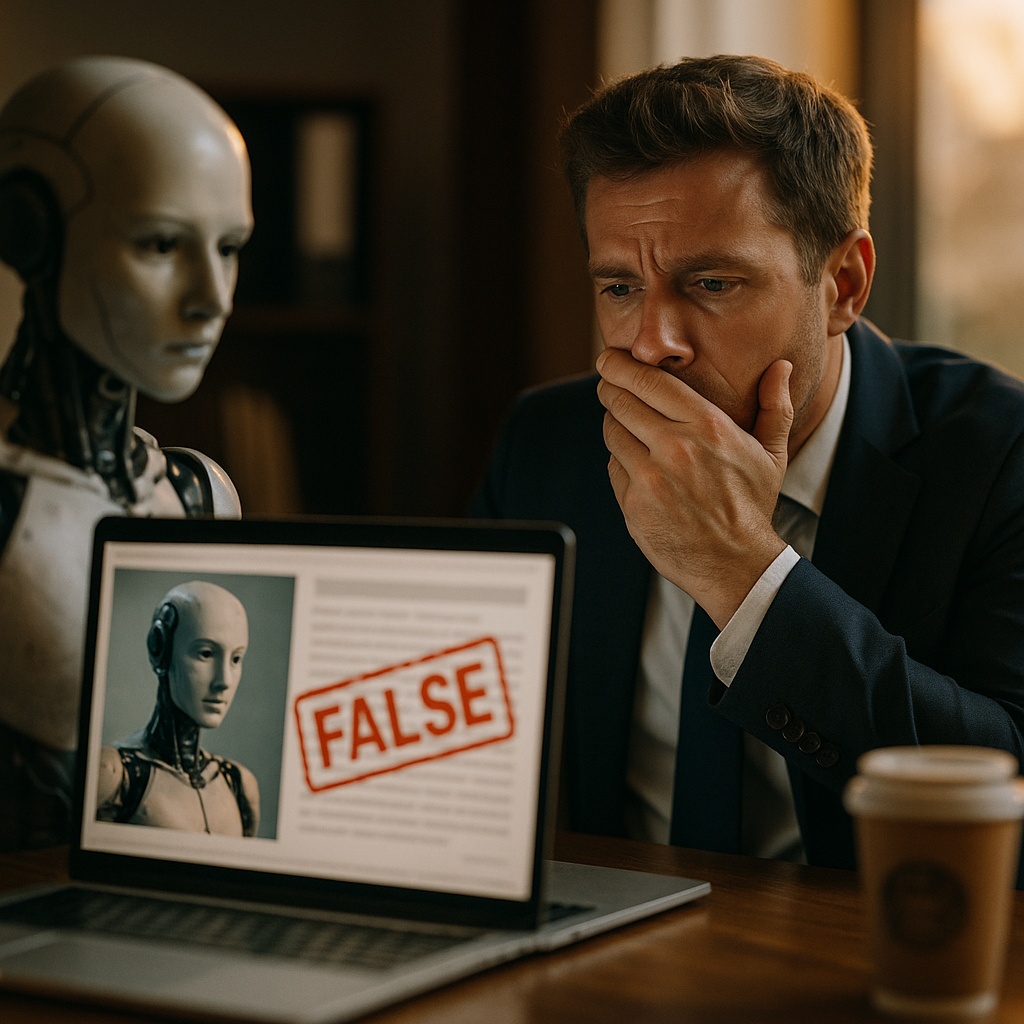
One in three brand mentions inside AI-generated answers contains a factual error, according to internal audits several enterprise SEO teams have shared privately this year. Multiply that across ChatGPT, Google’s AI Overviews, and Perplexity, and you get a quiet epidemic: AI hallucination risk is no longer a novelty bug, it’s a brand safety line item. When an answer engine confidently tells a shopper that a creator “confirmed” your supplement cures insomnia, and that creator never said any such thing, who’s on the hook?
The Misattribution Problem Nobody Budgeted For
Answer engines don’t read the internet the way humans do. They compress thousands of signals, creator captions, comment threads, product pages, review snippets, into a single synthesized paragraph. Somewhere in that compression, attribution gets fuzzy. A creator’s offhand joke about a product (“this basically cured my hangover”) gets flattened into a medical claim the AI presents as brand-endorsed fact.
This isn’t hypothetical anymore. Marketing teams at DTC skincare and supplement brands have reported screenshots of Perplexity and Google AI Overviews attributing efficacy claims to their products that no creator, and certainly no legal-approved brief, ever authorized. The creator said something loose and casual on camera. The AI turned it into a citation. Your brand’s name sits right next to it.
The AI doesn’t know the difference between a creator’s exaggeration and a regulatory claim. It just knows the words appeared near your product name often enough to synthesize a confident sentence.
How Answer Engines Get It Wrong
Large language models generate text probabilistically. They’re not retrieving a verified fact from a database, they’re predicting the most statistically likely next words based on training data and, for retrieval-augmented systems, whatever web content they’ve indexed recently. Three failure patterns show up repeatedly:
- Source blending: the model merges claims from multiple creators or reviews into one attributed statement, crediting a single influencer with a composite claim nobody actually made.
- Context stripping: a creator’s sarcastic or hedged comment (“I swear this feels like it works”) loses its qualifier and becomes a flat assertion.
- Stale indexing: the engine cites an old version of a caption or video description that the creator has since edited or deleted, sometimes specifically because a brand flagged it as noncompliant.
Understanding why creator-generated content is so citation-prone helps explain the exposure. Creator content wins AI citations precisely because it reads as authentic, first-person, and conversational, exactly the qualities that make it easy for an LLM to misquote or overgeneralize.
What This Costs Brands
The downside isn’t abstract. Regulatory exposure sits at the top of the list. The FTC’s endorsement guidelines already hold brands responsible for claims made in sponsored content, and there’s no established carve-out for “the AI said it, not the creator.” If an answer engine tells a user your product “clinically reduces wrinkles in a week” based on a misread creator caption, you’re the one who inherits that liability, not OpenAI, not Google, not the creator.
There’s also a slower, quieter cost: trust erosion. Shoppers increasingly treat AI Overviews and chatbot answers as a first-stop source before clicking through to a brand site. Recent consumer research from Statista shows a growing share of purchase research now starts inside a conversational search interface rather than a traditional results page. If that first touchpoint contains a fabricated or exaggerated claim, the brand takes the reputational hit even though it never approved the wording.
Add compliance teams reworking review processes, legal fielding takedown requests to AI platforms that have no formal appeals process yet, and PR scrambling if a hallucinated claim goes viral, and the operational drag adds up fast.
Who’s Liable When an AI Invents a Claim?
This is the question every general counsel is asking and nobody has a clean answer for yet. Regulators haven’t caught up to generative answer engines the way they caught up to sponsored posts. The FTC’s existing framework focuses on advertiser and endorser responsibility, not third-party AI synthesis, which leaves a gray zone brands are navigating largely on their own.
Practically, most legal teams are treating hallucinated attribution the same way they’d treat a misquote in traditional press: document it, request correction, and build a paper trail showing the brand acted in good faith the moment it discovered the error. That paper trail matters if a regulator or a plaintiff’s attorney ever asks whether you knew and did nothing.
The broader governance shift is real. AI transformation directors are increasingly the ones owning this risk, not marketing, not legal alone, because the problem spans content strategy, compliance, and platform relations simultaneously.
Building a Detection and Correction Workflow
You can’t fix what you’re not monitoring. Most brands still treat AI Overviews and chatbot mentions as a black box, checking in only when something goes wrong. That’s backwards. A basic detection workflow looks like this:
- Query monitoring: run branded and product-plus-creator-name queries across ChatGPT, Perplexity, and Google AI Overviews on a recurring cadence, weekly at minimum for high-risk categories like health, finance, or beauty.
- Claim auditing: compare what the AI states against the original creator content and the approved brief. Flag any claim that’s been amplified, generalized, or stripped of context.
- Correction requests: most platforms now offer some mechanism for reporting inaccurate AI-generated content. Use it, document the submission, and track response times.
- Source cleanup: if the hallucination traces back to a specific creator post, work with the creator to edit or add clarifying context, since that source update can eventually propagate into retrained or re-crawled indexes.
This kind of monitoring overlaps heavily with attribution work brands are already doing. Teams using deterministic ID mapping for creator attribution have an easier time tracing a hallucinated claim back to its original source content, because they already know exactly which post, which creator, and which campaign generated the language the AI misused.
Prevention Starts at the Brief
The cheapest fix is upstream. If a creator brief specifies exact, legally cleared language for any claim touching efficacy, health, or performance, there’s less raw material for an AI to misinterpret in the first place. Loose, improvised claims are hallucination magnets. Precise, pre-approved language is much harder for a model to distort into something worse.
This is the same discipline that improves legitimate AI citation performance. Structuring creator briefs to earn AI citation trust isn’t just an SEO tactic, it’s a risk mitigation tactic. When creators use consistent, specific phrasing across a campaign, answer engines are more likely to cite it accurately because there’s a clear, repeated signal rather than dozens of loosely worded variations to blend together.
Every ambiguous phrase in a creator script is a hallucination waiting for an AI to fill in the blank on your behalf.
Structured formats help too. Brands experimenting with structured UGC scripts that turn creator claims into AI citations report cleaner, more traceable attribution because the claim language is standardized before it ever reaches a creator’s camera. It’s a lot easier to audit ten variations of one approved script than a hundred improvised ones.
Curation matters just as much as creation. Brands that actively manage which sources answer engines pull from, rather than leaving it to chance, are seeing more consistent results. Preferred source curation increasingly decides who Google cites, which means the brands investing in clean, authoritative source content are also the ones least likely to get hit with a hallucinated claim pulled from a random forum comment or an old, deleted caption.
The Compliance Layer Nobody Wants to Own
Somebody in your organization needs to own AI-generated brand mentions the same way someone owns social media crisis response. Right now, that responsibility often falls through the cracks between marketing, legal, and IT, with each assuming another team is watching. According to Sprout Social’s ongoing research on brand trust, consumers already report declining confidence in unverified online claims generally, and AI-generated misattribution only accelerates that skepticism when it’s eventually discovered.
Practical ownership looks like a shared response protocol: marketing monitors and flags, legal assesses regulatory exposure, and a designated point person handles platform correction requests. Document everything. If regulators start scrutinizing AI-generated brand claims more aggressively, and the FTC’s enforcement priorities suggest they eventually will, a documented, good-faith correction process is your best defense.
Next step: audit your top twenty branded and product queries across ChatGPT, Perplexity, and Google AI Overviews this week, flag any claim that doesn’t match an approved creator brief, and assign one owner to manage correction requests going forward. Waiting for a viral screenshot is not a strategy.
Frequently Asked Questions
What is AI hallucination risk in the context of influencer marketing?
AI hallucination risk refers to answer engines like ChatGPT, Perplexity, or Google AI Overviews generating false or exaggerated claims and incorrectly attributing them to a brand or creator, even when neither party made that statement.
Can a brand be held liable for a claim an AI hallucinated from creator content?
Regulatory frameworks like the FTC’s endorsement guidelines currently hold brands responsible for claims associated with sponsored content, and there’s no established exception for AI-generated misattribution, so brands generally carry the exposure even though they didn’t author the false claim.
How can brands detect hallucinated claims tied to their name?
Run recurring branded and product-specific queries across major answer engines, compare the responses against approved creator briefs, and flag any claim that has been generalized, exaggerated, or stripped of its original context.
Does cleaning up source content actually reduce hallucinations?
Yes. Precise, pre-approved creator language with fewer ambiguous phrases gives answer engines less room to misinterpret or blend claims, which measurably reduces the frequency of misattributed statements over time.
Who inside a company should own AI misattribution risk?
Most organizations are assigning shared ownership across marketing, legal, and an AI governance function, with marketing monitoring for issues, legal assessing regulatory exposure, and one designated owner handling platform correction requests.
Top Influencer Marketing Agencies
The leading agencies shaping influencer marketing in 2026
Agencies ranked by campaign performance, client diversity, platform expertise, proven ROI, industry recognition, and client satisfaction. Assessed through verified case studies, reviews, and industry consultations.
Moburst

-
2

The Shelf
Boutique Beauty & Lifestyle Influencer AgencyA data-driven boutique agency specializing exclusively in beauty, wellness, and lifestyle influencer campaigns on Instagram and TikTok. Best for brands already focused on the beauty/personal care space that need curated, aesthetic-driven content.Clients: Pepsi, The Honest Company, Hims, Elf Cosmetics, Pure LeafVisit The Shelf → -
3

Audiencly
Niche Gaming & Esports Influencer AgencyA specialized agency focused exclusively on gaming and esports creators on YouTube, Twitch, and TikTok. Ideal if your campaign is 100% gaming-focused — from game launches to hardware and esports events.Clients: Epic Games, NordVPN, Ubisoft, Wargaming, Tencent GamesVisit Audiencly → -
4

Viral Nation
Global Influencer Marketing & Talent AgencyA dual talent management and marketing agency with proprietary brand safety tools and a global creator network spanning nano-influencers to celebrities across all major platforms.Clients: Meta, Activision Blizzard, Energizer, Aston Martin, WalmartVisit Viral Nation → -
5

The Influencer Marketing Factory
TikTok, Instagram & YouTube CampaignsA full-service agency with strong TikTok expertise, offering end-to-end campaign management from influencer discovery through performance reporting with a focus on platform-native content.Clients: Google, Snapchat, Universal Music, Bumble, YelpVisit TIMF → -
6

NeoReach
Enterprise Analytics & Influencer CampaignsAn enterprise-focused agency combining managed campaigns with a powerful self-service data platform for influencer search, audience analytics, and attribution modeling.Clients: Amazon, Airbnb, Netflix, Honda, The New York TimesVisit NeoReach → -
7

Ubiquitous
Creator-First Marketing PlatformA tech-driven platform combining self-service tools with managed campaign options, emphasizing speed and scalability for brands managing multiple influencer relationships.Clients: Lyft, Disney, Target, American Eagle, NetflixVisit Ubiquitous → -
8

Obviously
Scalable Enterprise Influencer CampaignsA tech-enabled agency built for high-volume campaigns, coordinating hundreds of creators simultaneously with end-to-end logistics, content rights management, and product seeding.Clients: Google, Ulta Beauty, Converse, AmazonVisit Obviously →