


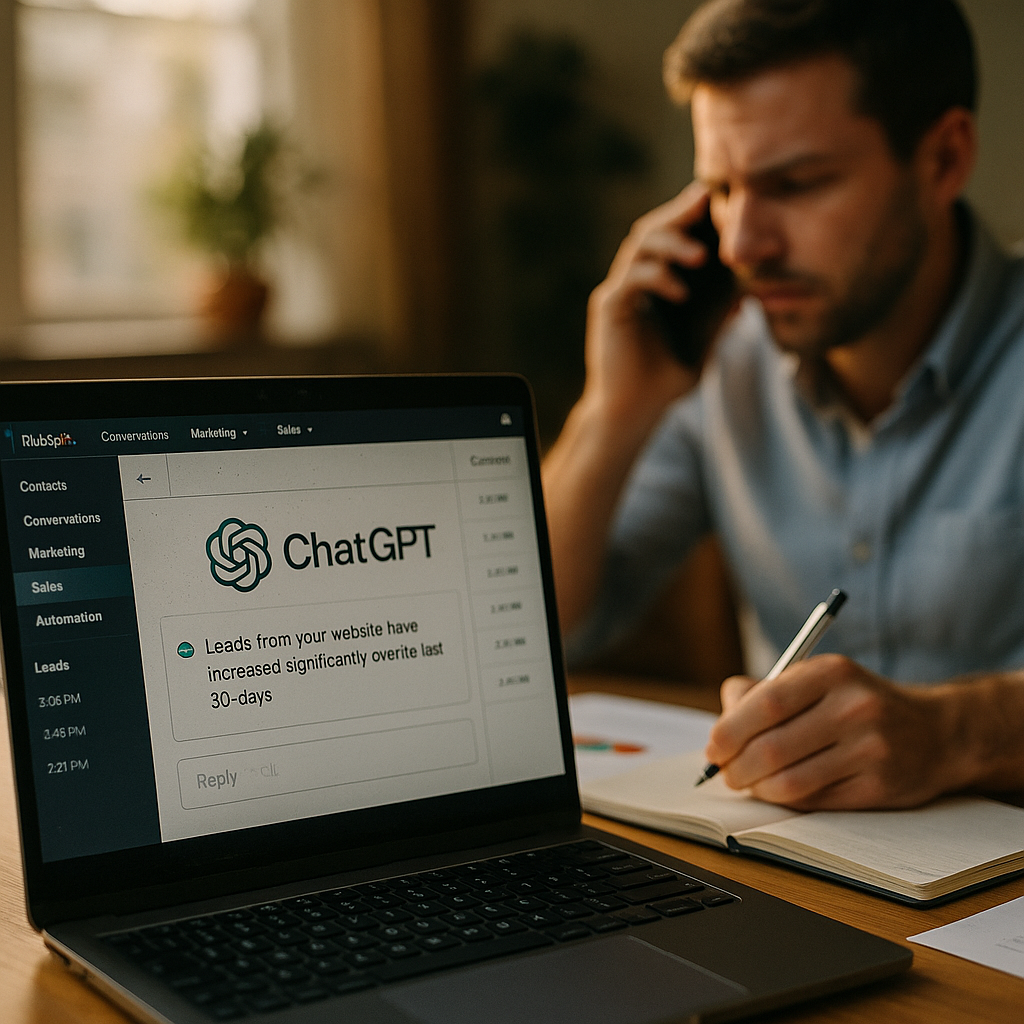
Sixty percent of B2B buyers now research a purchase through a conversational AI tool before a human ever hears from them, according to eMarketer estimates on AI-assisted buying journeys. Now that ChatGPT ad agents sync directly with HubSpot CRM, that research trail lands in your pipeline automatically, tagged, scored, and waiting for a rep who has no idea what conversation actually happened. If your follow up sequence still assumes a lead came from a form fill or a cold click, you’re already behind.
What the ChatGPT to HubSpot Sync Actually Does
OpenAI’s advertising agents can now push conversation-derived leads directly into HubSpot’s contact and deal records, complete with intent signals pulled from the chat itself. Instead of a generic “downloaded whitepaper” tag, sales teams get context: what the buyer asked, which objections came up, what comparison they were making against competitors. That’s a meaningfully richer starting point than most inbound channels have ever offered.
But richer data isn’t automatically useful data. HubSpot’s own workflow tools were built around form submissions, email opens, and page visits, not free-text conversational intent. Mapping a ChatGPT conversation summary into a lead score that means anything to a sales rep requires new scoring logic, new field structures, and honestly, a new mental model for what “qualified” even means anymore.
A lead that talked to an AI agent for eight minutes about pricing tiers is not the same as a lead who clicked a retargeting ad. Treating them identically in your follow up cadence is the fastest way to waste a genuinely warm opportunity.
The Follow Up Gap Nobody Budgeted For
Here’s the uncomfortable part. Most sales teams have follow up playbooks built for a world where the first human touchpoint is also the first real conversation. That world is gone. The AI agent already had the first conversation. Your rep’s job is now the second one, and if they don’t know what the first one covered, they’ll ask questions the buyer already answered. That’s not a minor annoyance, it’s a trust killer.
Think about it from the buyer’s side. They spent time explaining their use case to an AI agent, got specific answers, maybe even a recommendation. Then a sales rep calls and says “so tell me a bit about what you’re looking for.” That disconnect signals the company doesn’t actually listen, even though the technology captured everything perfectly. The data existed. Nobody built the workflow to surface it at the right moment.
This is the same operational blind spot we flagged when covering HubSpot’s Breeze agent rollout: the platform capability arrives faster than the internal process to use it well. Sync speed isn’t the bottleneck anymore. Human readiness is.
Rebuilding Lead Scoring for AI-Sourced Conversations
Traditional lead scoring rewards behavior: number of pages visited, email clicks, form completions. AI-sourced leads need a different rubric because the signal is conversational depth, not click volume. A brand sales team rebuilding this in HubSpot should be scoring on things like:
- Specificity of the questions asked (pricing detail versus vague category browsing)
- Whether the agent surfaced a competitor comparison and how the buyer responded
- Stated timeline or budget constraints mentioned in the chat
- Whether the conversation ended with a request for a demo, a quote, or just information
None of this maps cleanly onto HubSpot’s default lifecycle stages out of the box. Teams are having to build custom properties just to capture “conversation intent tier” as a field reps can actually see on the contact record. It’s not glamorous work, but skipping it means your reps are flying blind on the exact leads that should be your hottest.
We’ve seen a similar pattern play out in predictive CRM scoring pilots, where static drip logic got replaced by real-time signal weighting. The same principle applies here: static scoring rules can’t keep up with dynamic conversational data.
Sales Scripts Written for a Pre-AI World Won’t Work
Reps trained on discovery-call scripts are going to sound out of touch fast if they don’t acknowledge that the buyer already had a substantive AI conversation. The fix isn’t complicated in concept: pull the chat summary before the call, reference it directly, skip the questions already answered. In practice, it requires retraining an entire sales floor on a new opening move.
Some brands are experimenting with a simple script adjustment: “I can see you were comparing our onboarding timeline against a couple of alternatives, want to pick up from there?” That single line does more for buyer trust than twenty minutes of generic rapport-building. It tells the prospect the company was actually paying attention.
Sales enablement teams should treat this the way they’d treat any new tool rollout, with real training time, not a Slack message and a hope. HubSpot’s own enablement resources are a decent starting point, but the script rewrite has to be internal and specific to your product’s actual objection patterns.
Where Multi-Agent Handoffs Get Messy
It gets more complicated when more than one AI agent touches a lead before a human does, say, an ad agent for initial capture and a separate chat agent for qualification. Whose data takes priority in the CRM record? What happens when the two agents log conflicting intent signals? This is the exact tension we explored in multi-agent coordination and campaign disputes: the agents run the workflow, but the brand still owns the mess if something contradicts.
Sales ops leads need a clear source-of-truth hierarchy before this becomes a live problem, not after a rep calls a lead with the wrong pitch because two systems disagreed on intent. Document which agent’s data wins in a conflict, and build that logic into the HubSpot workflow rules, not into individual reps’ judgment calls.
Compliance and Consent Are Not Optional Add-Ons
Conversational data pulled from an AI ad agent into a CRM raises consent questions that a lot of teams haven’t fully worked through. Did the buyer agree to have that conversation summarized and stored in a sales database? Is that disclosed anywhere in the chat experience? The FTC has been increasingly vocal about AI-driven data collection practices, and getting this wrong isn’t just a PR risk, it’s a regulatory one.
Brands should audit exactly what data the ChatGPT ad agent is capturing, how it’s labeled once it lands in HubSpot, and whether your privacy policy actually covers this data flow. This connects directly to the governance gaps we outlined in agentic AI foundation standards: if you don’t have an audit checklist before launch, you’re building compliance debt you’ll pay for later.
Sync speed between ChatGPT and HubSpot isn’t the risk. Undisclosed data capture inside that sync is the risk, and it’s entirely preventable with an audit step most teams skip.
Data hygiene matters just as much on the back end. If lead records from AI conversations feed into payout or attribution systems downstream, the same error patterns we flagged in CDP to CRM feedback loop coverage will show up here too: bad field mapping upstream becomes bad decisions downstream.
Comparing Your Options Before You Commit Fully
HubSpot isn’t the only CRM racing to integrate agentic AI tools, and brands evaluating which platform fits their sales motion should look past the marketing copy. Our breakdown of Breeze, Agentforce, and Jasper on outreach risk is worth revisiting here, because the same evaluation criteria (data ownership, audit trail, override controls) apply directly to how ChatGPT-sourced leads get handled once they’re inside your system.
Don’t assume the sync working technically means it’s working operationally. Run a 30-day audit where a human reviews every AI-sourced lead’s conversation history against the score HubSpot assigned it. You’ll find mismatches. Use them to tune the scoring model before you scale the workflow across the whole sales floor.
What Sales Ops Should Do This Quarter
Practically, here’s the short list: rebuild lead scoring fields to capture conversational intent, retrain reps on referencing prior AI conversations instead of re-asking, establish a source-of-truth hierarchy for multi-agent handoffs, and run a compliance audit on consent and data capture. None of this is optional if the sync is already live in your instance. According to Statista data on CRM adoption trends, HubSpot remains one of the most widely deployed platforms among mid-market B2B teams, which means this isn’t a niche problem, it’s the default state for a huge share of sales organizations right now.
Get your sales enablement and RevOps teams in the same room before the next quarterly planning cycle. This isn’t a “wait and see” integration. It’s already routing leads.
FAQs
Do ChatGPT ad agents replace HubSpot’s existing lead capture forms?
No. They add a new lead source alongside forms and existing channels, but the conversational data they generate requires different scoring and handling than a standard form submission.
What fields should sales teams add to HubSpot for AI-sourced leads?
Custom properties capturing conversation intent tier, stated timeline or budget, competitor comparisons mentioned, and requested next step (demo, quote, information) tend to give reps the most usable context.
Is it legal to store ChatGPT conversation summaries in a CRM?
It depends on disclosure and consent at the point of capture. Brands should confirm their privacy policy covers this data flow and consult guidance from bodies like the FTC before scaling the integration.
How quickly should a rep follow up on an AI-sourced lead?
Fast. Conversational leads cool quickly because the buyer already invested effort in the AI interaction. Reference the prior conversation directly within the first outreach to maintain momentum.
Does this integration work the same way across other CRMs?
Not identically. Data mapping, field structures, and consent handling vary by platform, so teams using Salesforce or other CRMs should not assume HubSpot’s workflow logic transfers directly.
The sync between ChatGPT ad agents and HubSpot CRM is live now, not a future roadmap item. Audit your current lead scoring fields this week, rewrite your reps’ opening scripts before their next call queue fills up, and don’t let a compliance gap sit unaddressed while the leads keep flowing in.
Top Influencer Marketing Agencies
The leading agencies shaping influencer marketing in 2026
Agencies ranked by campaign performance, client diversity, platform expertise, proven ROI, industry recognition, and client satisfaction. Assessed through verified case studies, reviews, and industry consultations.
Moburst

-
2

The Shelf
Boutique Beauty & Lifestyle Influencer AgencyA data-driven boutique agency specializing exclusively in beauty, wellness, and lifestyle influencer campaigns on Instagram and TikTok. Best for brands already focused on the beauty/personal care space that need curated, aesthetic-driven content.Clients: Pepsi, The Honest Company, Hims, Elf Cosmetics, Pure LeafVisit The Shelf → -
3

Audiencly
Niche Gaming & Esports Influencer AgencyA specialized agency focused exclusively on gaming and esports creators on YouTube, Twitch, and TikTok. Ideal if your campaign is 100% gaming-focused — from game launches to hardware and esports events.Clients: Epic Games, NordVPN, Ubisoft, Wargaming, Tencent GamesVisit Audiencly → -
4

Viral Nation
Global Influencer Marketing & Talent AgencyA dual talent management and marketing agency with proprietary brand safety tools and a global creator network spanning nano-influencers to celebrities across all major platforms.Clients: Meta, Activision Blizzard, Energizer, Aston Martin, WalmartVisit Viral Nation → -
5

The Influencer Marketing Factory
TikTok, Instagram & YouTube CampaignsA full-service agency with strong TikTok expertise, offering end-to-end campaign management from influencer discovery through performance reporting with a focus on platform-native content.Clients: Google, Snapchat, Universal Music, Bumble, YelpVisit TIMF → -
6

NeoReach
Enterprise Analytics & Influencer CampaignsAn enterprise-focused agency combining managed campaigns with a powerful self-service data platform for influencer search, audience analytics, and attribution modeling.Clients: Amazon, Airbnb, Netflix, Honda, The New York TimesVisit NeoReach → -
7

Ubiquitous
Creator-First Marketing PlatformA tech-driven platform combining self-service tools with managed campaign options, emphasizing speed and scalability for brands managing multiple influencer relationships.Clients: Lyft, Disney, Target, American Eagle, NetflixVisit Ubiquitous → -
8

Obviously
Scalable Enterprise Influencer CampaignsA tech-enabled agency built for high-volume campaigns, coordinating hundreds of creators simultaneously with end-to-end logistics, content rights management, and product seeding.Clients: Google, Ulta Beauty, Converse, AmazonVisit Obviously →