


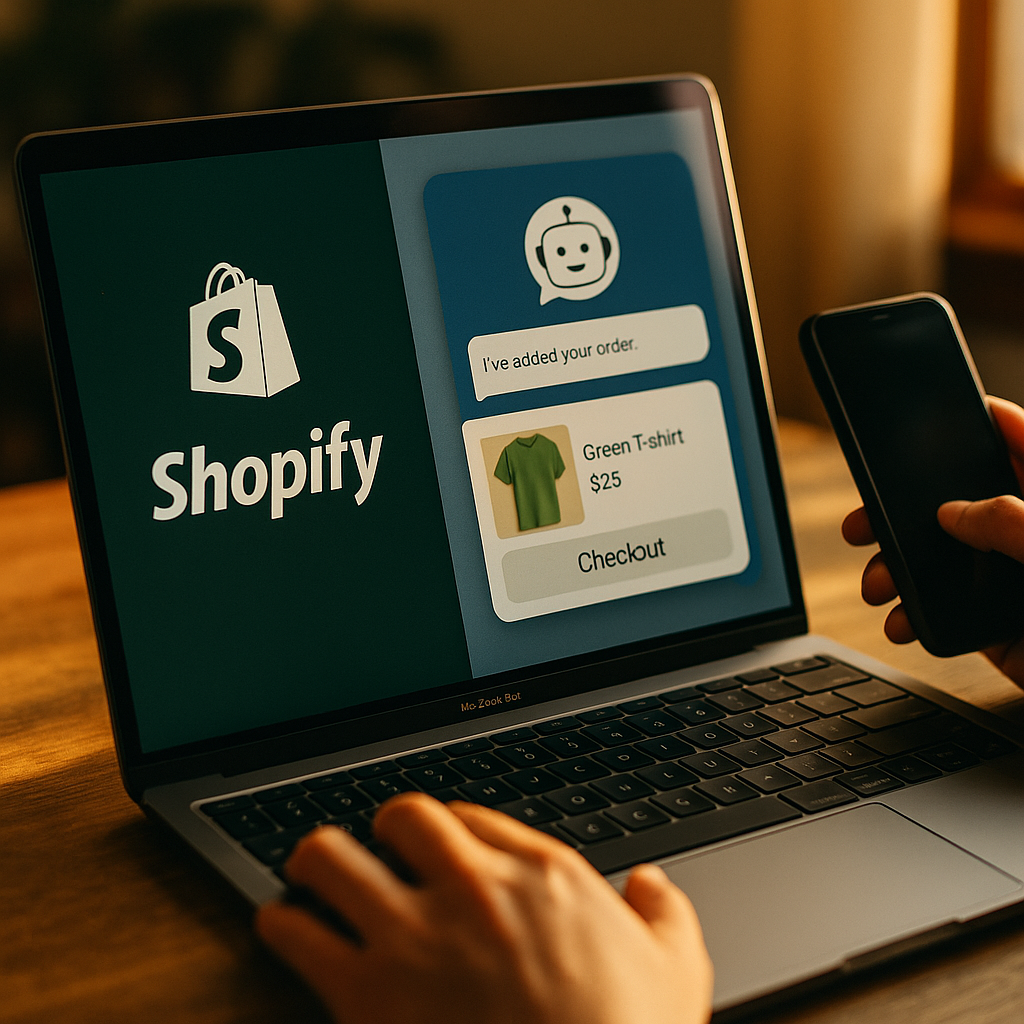
ChatGPT now has a buy button. When Shopify and OpenAI wired product catalogs directly into conversational AI, they didn’t just add a feature, they rebuilt the path from discovery to purchase. Retail brands that spent a decade optimizing for Google’s blue links and Instagram’s algorithm now face a funnel with no search results page at all. The Shopify OpenAI integration is the clearest signal yet that agentic commerce isn’t a pilot project anymore. It’s live, and it’s already routing real transactions.
What Actually Changed When Shopify Plugged Into OpenAI
The mechanics are simpler than the implications. Shopify merchants can now surface products inside ChatGPT conversations, and shoppers can complete checkout without leaving the chat window. No redirect to a product page. No cart abandonment at the payment gateway. OpenAI handles the conversational layer, Shopify handles inventory, pricing, and fulfillment through its existing merchant infrastructure.
For brands, this collapses three funnel stages into one interaction. Discovery, consideration, and purchase used to happen across separate properties: a search engine, a product review site, a retailer’s checkout flow. Now an AI agent can walk a shopper through all three in a single thread, then hand off a completed order to Shopify’s backend before the user even asks “are you sure?”
The agentic commerce funnel doesn’t have a landing page. It has a conversation, and brands that can’t get cited inside that conversation don’t exist to the shopper at all.
Mapping the New Funnel: Where Brands Actually Sit
Traditional funnel models assumed a human clicking through stages at their own pace. Agentic commerce compresses that timeline and hands navigation control to the AI. Here’s roughly how it now plays out for a retail brand:
- Prompt intent: A shopper asks ChatGPT for a recommendation (“best running shoes for flat feet under $150”). No brand name is mentioned.
- Agent sourcing: The model pulls from indexed product data, reviews, and Shopify catalog feeds to shortlist options.
- Conversational narrowing: The agent asks clarifying questions and adjusts recommendations in real time, effectively running its own micro consideration phase.
- Checkout handoff: Once the shopper commits, Shopify processes the transaction natively inside the chat interface.
Notice what’s missing: a search results page, a comparison shopping site, a retargeting ad. The brand’s job shifted from winning clicks to winning citations at the sourcing stage. If your product data isn’t structured well enough for the model to confidently recommend it, you’re invisible before the conversation even starts. This is the same dynamic playing out across AI citation strategy, just applied to transactional intent instead of informational queries.
Why This Matters More Than a Typical Platform Update
Marketers have watched plenty of “revolutionary” integrations fizzle. This one is different for a structural reason: it removes the ad-supported middle layer that funded the open web for two decades. Google Shopping, comparison engines, affiliate review sites, all of these existed because brands paid to be seen in a browsing environment. Agentic checkout doesn’t need that layer. The AI agent is the browsing environment.
Early data backs up the urgency. Adobe’s holiday shopping analysis found AI-driven traffic to US retail sites climbed sharply year over year, and that was before native checkout existed inside the chat window itself. Once purchase completion happens in-thread, the incentive to leave the AI environment drops to nearly zero. That’s a demand-side shift retail marketers can’t optimize around with the old playbook.
It also changes who controls the customer relationship. Shopify still owns the merchant infrastructure, and brands still own their store, but OpenAI now owns a meaningful slice of the discovery moment. That’s a new dependency, and dependencies always come with risk questions attached: data access, ranking logic, and dispute resolution when something goes wrong mid-transaction. Some of that risk mirrors what’s already surfacing in multi-agent campaign coordination, where brands are learning the hard way that they absorb liability even when an AI system is executing the workflow.
Operational Questions Brand Teams Should Be Asking Now
Strategy conversations about “AI commerce” tend to stay abstract. Here’s where it gets concrete for anyone running a Shopify storefront or managing brand presence across retail partners.
Is your product feed actually machine readable?
Structured data, accurate inventory sync, and clean attribute tagging aren’t nice-to-haves anymore. They’re the raw material an AI agent uses to decide whether your product gets recommended at all. Sparse or inconsistent metadata means the model defaults to competitors with cleaner feeds, regardless of your actual product quality.
Who approves pricing and promotions inside a conversational checkout?
Dynamic pricing, discount codes, and bundle logic all need to translate cleanly into a chat-based transaction. If your promo engine assumes a human is reading fine print on a landing page, test it against a scenario where an AI agent is summarizing terms on your behalf. Misrepresented terms inside a chat transaction are still your liability, not OpenAI’s.
What happens when the agent gets it wrong?
AI agents hallucinate. They occasionally misstate a return policy, invent a discount that doesn’t exist, or recommend an out-of-stock item as available. Brands need a documented process for correcting these errors fast, because a false claim inside a checkout flow isn’t a hypothetical reputational risk, it’s a live transaction dispute. This is the exact failure mode covered in AI hallucination risk for brands, and it applies just as much to commerce agents as to content generators.
If an AI agent misquotes your return policy mid-checkout, the customer blames your brand, not the model that made the error.
Attribution Just Got Harder, Not Easier
Marketers already struggled to prove which touchpoint drove a sale. Agentic checkout compresses the customer journey into a single opaque conversation, which sounds simpler but actually destroys most of the attribution signals brands rely on. There’s no referral URL, no UTM parameter chain, no multi-session browsing history to reconstruct in an analytics dashboard.
Teams that have already invested in deterministic identity approaches are better positioned here. Deterministic ID mapping and identity graph infrastructure built for creator attribution translate reasonably well to agentic commerce, because both rely on matching a transaction back to a known customer record rather than a clickstream. If your measurement stack still leans on last-click attribution, this is the moment to rebuild it, not next quarter.
Media mix modeling is going to need an update too. Traditional MMM inputs assume observable channel spend and traffic. Agentic commerce introduces a channel where spend is closer to “structured data investment and product feed optimization” than a media buy. Approaches like AI-assisted MMM tied to revenue proof are the closest existing model for making sense of a channel that doesn’t generate a clean media log.
Where Creator Partnerships Fit Into an Agentic Checkout World
Here’s the part retail marketers underestimate: creator content is becoming training and citation material for these commerce agents, not just top-of-funnel awareness content. If ChatGPT is summarizing product recommendations, it’s pulling signal from reviews, UGC, and creator commentary that exists across the web. A product with strong, well-structured creator coverage has a real advantage in getting surfaced accurately.
That means brief structure matters more than ever. Creators producing vague, off-brand copy don’t just underperform on engagement, they actively confuse the models that now sit between a shopper and a purchase decision. Brands serious about this need to structure creator briefs for AI citation trust, treating creator output as structured product signal, not just social content.
It also raises the stakes on creator vetting. Predictive fit scoring and LTV-based creator selection matter more in a world where a creator’s content might get pulled into an AI’s product recommendation logic months after publication. You’re not just buying a post anymore. You’re feeding a dataset that could influence purchase decisions long after the campaign ends.
Building an Evaluation Framework Before You Commit Budget
Shopify merchants shouldn’t treat this integration as a checkbox to flip on. Treat it like any other platform decision with real operational stakes.
- Audit your product feed for structured data gaps before assuming AI agents can represent your catalog accurately.
- Pressure test your return, refund, and promo policies against a scenario where a chatbot is summarizing them to a customer.
- Assign clear internal ownership for disputes that originate from an AI-facilitated transaction gone wrong.
- Rebuild attribution models around deterministic identity rather than session-based tracking.
- Extend creator brief standards to account for AI citation, not just social engagement metrics.
Frameworks already exist for vetting agentic platforms before budget commits, and the same discipline applies here. Whether you’re evaluating a media buying agent or a commerce checkout integration, the diligence questions are nearly identical: who owns errors, how is performance measured, and what’s the rollback plan if the integration underperforms or misfires. Reference points like evaluating agentic campaign platforms and agentic AI foundation standards give brand teams a starting checklist rather than reinventing governance from scratch.
For broader context on how quickly commerce and AI adoption curves are moving, resources from eMarketer and Statista track shifting consumer trust in AI-assisted shopping, while HubSpot and Sprout Social publish regular benchmarks on how conversational AI is reshaping marketing funnels more generally. Worth checking quarterly, not annually, given how fast this space is moving.
Frequently Asked Questions
What is the Shopify OpenAI integration exactly?
It’s a partnership that lets Shopify merchant product catalogs surface inside ChatGPT conversations, with checkout completed natively in the chat interface instead of redirecting to a separate retail website.
Does this replace traditional ecommerce websites?
Not entirely. Brands still need a functioning storefront for browsing, returns, and customers who prefer traditional shopping. But a growing share of discovery and purchase intent is shifting into conversational AI, which means the storefront becomes one channel among several rather than the default entry point.
How do brands optimize for AI-driven product recommendations?
Clean, structured product data is the foundation. Beyond that, brands need strong creator content and reviews that AI models can accurately reference, plus a documented process for correcting errors when an agent misstates product details or policies.
Who is liable if an AI agent gives a customer wrong information during checkout?
In practice, the brand absorbs reputational and often financial liability, even though the error originated with the AI system. This makes proactive monitoring and clear internal dispute processes essential before scaling any agentic commerce integration.
Can brands track which sales came from ChatGPT versus other channels?
Partially, though attribution is harder than in traditional ecommerce because conversational sessions don’t generate the same referral data. Deterministic identity matching offers a more reliable path than legacy click-based attribution for this channel.
The brands that win the agentic commerce funnel will be the ones that treat product data, creator content, and error handling as one integrated system today, not three separate teams scrambling to react after the next platform update lands.
Top Influencer Marketing Agencies
The leading agencies shaping influencer marketing in 2026
Agencies ranked by campaign performance, client diversity, platform expertise, proven ROI, industry recognition, and client satisfaction. Assessed through verified case studies, reviews, and industry consultations.
Moburst

-
2

The Shelf
Boutique Beauty & Lifestyle Influencer AgencyA data-driven boutique agency specializing exclusively in beauty, wellness, and lifestyle influencer campaigns on Instagram and TikTok. Best for brands already focused on the beauty/personal care space that need curated, aesthetic-driven content.Clients: Pepsi, The Honest Company, Hims, Elf Cosmetics, Pure LeafVisit The Shelf → -
3

Audiencly
Niche Gaming & Esports Influencer AgencyA specialized agency focused exclusively on gaming and esports creators on YouTube, Twitch, and TikTok. Ideal if your campaign is 100% gaming-focused — from game launches to hardware and esports events.Clients: Epic Games, NordVPN, Ubisoft, Wargaming, Tencent GamesVisit Audiencly → -
4

Viral Nation
Global Influencer Marketing & Talent AgencyA dual talent management and marketing agency with proprietary brand safety tools and a global creator network spanning nano-influencers to celebrities across all major platforms.Clients: Meta, Activision Blizzard, Energizer, Aston Martin, WalmartVisit Viral Nation → -
5

The Influencer Marketing Factory
TikTok, Instagram & YouTube CampaignsA full-service agency with strong TikTok expertise, offering end-to-end campaign management from influencer discovery through performance reporting with a focus on platform-native content.Clients: Google, Snapchat, Universal Music, Bumble, YelpVisit TIMF → -
6

NeoReach
Enterprise Analytics & Influencer CampaignsAn enterprise-focused agency combining managed campaigns with a powerful self-service data platform for influencer search, audience analytics, and attribution modeling.Clients: Amazon, Airbnb, Netflix, Honda, The New York TimesVisit NeoReach → -
7

Ubiquitous
Creator-First Marketing PlatformA tech-driven platform combining self-service tools with managed campaign options, emphasizing speed and scalability for brands managing multiple influencer relationships.Clients: Lyft, Disney, Target, American Eagle, NetflixVisit Ubiquitous → -
8

Obviously
Scalable Enterprise Influencer CampaignsA tech-enabled agency built for high-volume campaigns, coordinating hundreds of creators simultaneously with end-to-end logistics, content rights management, and product seeding.Clients: Google, Ulta Beauty, Converse, AmazonVisit Obviously →