


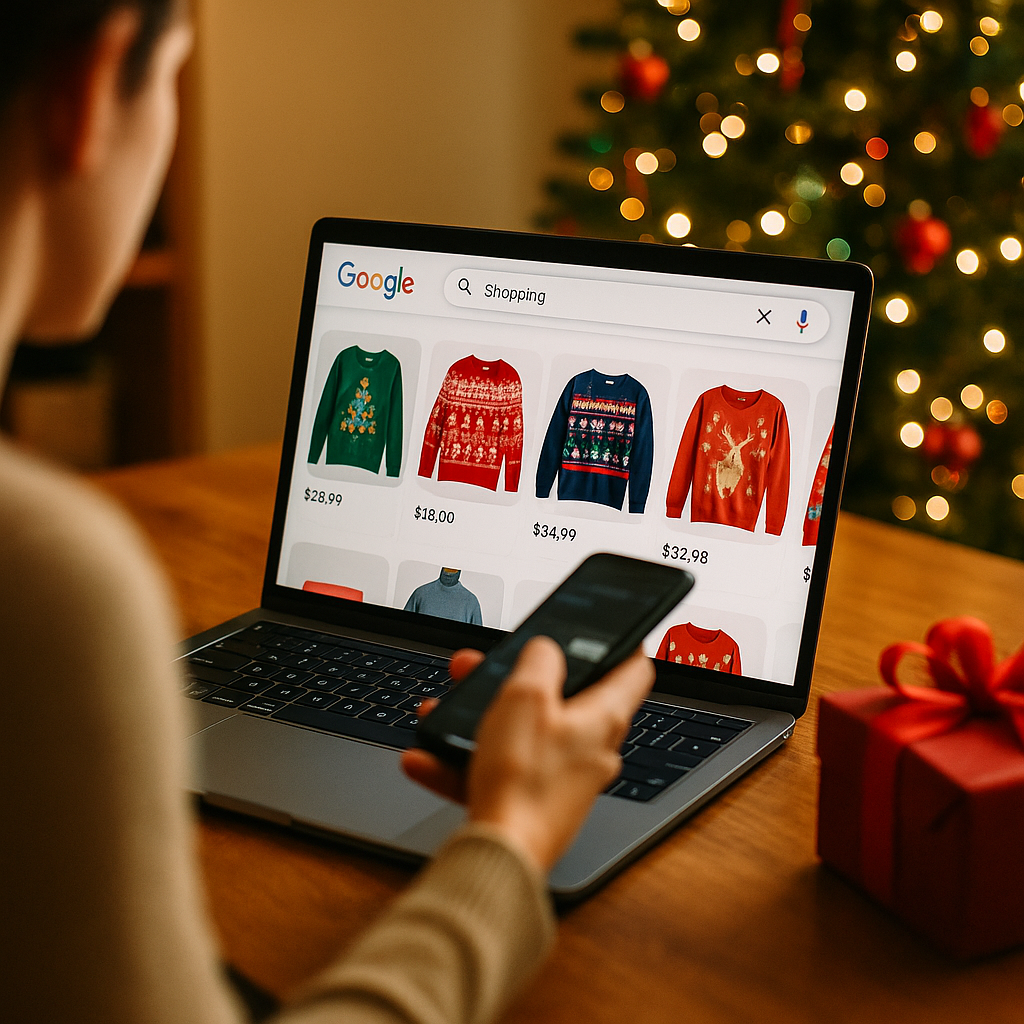
Google now completes an estimated 40% more shopping-related actions inside AI Overviews and Gemini-powered search than it did a year ago, and the holiday shopping window just shrank by nearly a week. If your creator campaigns are still built for a search results page that scrolls, you’re already behind. Google’s agentic shopping updates are rewriting how products get discovered, compared, and bought, and the compressed holiday timeline gives brands almost no room to adjust mid-flight.
What Actually Changed With Google’s Agentic Shopping Push
Google spent the back half of the year quietly turning search into a transaction layer. Gemini can now compare products, pull reviews, check stock, and in some pilot markets, complete checkout without the shopper ever landing on a retailer’s site. That’s not a minor UX tweak. It’s a fundamental shift in where the “moment of influence” happens.
For years, creator content existed to drive traffic toward a product page where the brand controlled the final pitch. Agentic shopping collapses that journey. The AI agent now does the comparing, the summarizing, and often the recommending, using whatever content it can find and trust. If your brand’s creator content isn’t structured in a way these agents can parse and cite, you’re invisible at the exact moment a shopper is ready to buy.
This mirrors what we’ve already seen with zero-click search behavior, where attribution models built for click-based journeys stopped reflecting reality months ago. Agentic shopping is the next layer of that same problem, just with a purchase button attached.
When an AI agent completes the purchase decision before a human ever sees your product page, your creator content has to earn trust at the citation level, not the click level.
The Holiday Calendar Just Got Shorter, And Nobody Adjusted Their Timelines
Here’s the uncomfortable math. Thanksgiving falls later relative to key retail dates this year, which trims roughly five to six operational days off the traditional planning-to-launch window most brands rely on for Q4 creator campaigns. Add agentic shopping’s earlier decision-making point (some Gemini shopping queries now surface comparison answers weeks before a purchase actually happens), and you get a compressed timeline stacked on top of a shifted one.
eMarketer data has shown holiday research behavior starting earlier each year, and AI-assisted shopping accelerates that further. Shoppers aren’t waiting for Black Friday to ask an AI agent “what’s the best gift for a runner.” They’re asking in October and letting the agent remember the answer.
Most brand marketers built their briefing calendars assuming a six to eight week runway from concept to live content. That window is now closer to four weeks if you want creator content indexed, cited, and performing before agentic shopping tools lock in their recommendation sets. Waiting until November to brief creators on holiday content isn’t late this year, it’s disqualifying.
Why Creator Content Is Becoming the Raw Material for AI Shopping Agents
Google’s shopping agents don’t generate product opinions from nothing. They pull from reviews, comparison content, unboxing videos, and creator commentary that already exists across the web and on retail platforms. This is exactly the dynamic we’ve covered in how creative models earn citations inside AI chat interfaces, and it applies just as directly to shopping queries as it does to informational ones.
Practically, this means the creator content your brand publishes in the next few weeks isn’t just campaign material. It’s training data for how an AI agent will describe your product to a shopper in December. Get the framing wrong now, and you’re stuck with an AI-generated summary of your product that undersells it, misstates a feature, or worse, hallucinates a claim your legal team never approved.
That last risk isn’t hypothetical. We’ve already documented cases where AI systems attribute false claims to brands based on ambiguous or poorly sourced creator content. Holiday season, with its compressed timeline and volume of rushed content, is exactly when that risk spikes.
What This Means for Brief Structure
Briefs need to change shape. Instead of optimizing purely for engagement or aesthetic, creator briefs now need explicit product attribute language: materials, sizing, compatibility, price positioning, use cases. This is the same discipline outlined in structuring briefs for AI citation trust, and it matters more during holiday campaigns because agents are actively comparing your product against three or four competitors in a single response.
- Include specific, factual product language creators can repeat verbatim (not just vibes)
- Require disclosure language that meets FTC standards, since agentic summaries increasingly surface disclosure status as a trust signal
- Ask creators to name the product and category explicitly, rather than relying on visual context alone, since AI agents parse text far more reliably than imagery
Building a Prep Playbook That Actually Fits the Shorter Runway
You don’t have time for a full campaign overhaul. What you have time for is a tightened, sequenced process that front-loads the decisions that used to happen in week three.
- Lock creator selection using predictive fit, not follower count. With less runway, you can’t afford a mismatched creator whose audience doesn’t convert. Predictive fit scoring shortens the vetting cycle significantly compared to manual audience review.
- Pull LTV data before, not after, negotiating rates. Holiday budgets are tight and agentic shopping rewards creators whose content actually retains customers, not just drives one-off clicks. LTV modeling helps you allocate holiday spend toward creators who move the retention needle.
- Draft contracts fast, but keep human review on the negotiation. AI-assisted contract drafting has gotten genuinely useful for speed, but as we noted in AI-drafted creator contracts, the negotiation itself still needs a person who understands leverage and relationship context.
- Set attribution expectations before launch, not during reporting. With agentic shopping muddying the click path further, brands need deterministic attribution mapping in place before holiday spend starts, not scrambled together in January.
Compliance Doesn’t Get a Holiday Pass
Agentic shopping tools are pulling creator content into purchase decisions faster than most legal and compliance teams can review it. That’s a genuine exposure point. The FTC’s disclosure guidance hasn’t changed just because an AI agent is summarizing the content instead of a human reading it directly, and regulators have made clear that disclosure obligations follow the content, not the distribution channel.
Brands running rushed holiday campaigns are the most likely to skip disclosure review, and that’s precisely the scenario where an AI shopping agent might amplify an undisclosed partnership to thousands of shoppers before anyone catches it. Build a 24 hour compliance check into your compressed timeline, even if it feels like a luxury you can’t afford. You can’t afford the alternative either.
For programs already dealing with fragmented data across platforms, tightening your first-party data pipelines also helps you verify performance claims before they get baked into an AI-generated product summary. Reporting tools like those covered by HubSpot’s marketing resources and audience benchmarking from eMarketer can help brands validate creator performance claims before the holiday crunch, rather than after.
One Practical Test Before You Launch Anything
Before greenlighting holiday creator content, run this test: search your product category using an AI shopping assistant and see what comes back. If your brand doesn’t appear, or appears with outdated or incorrect information, that’s your actual starting point, not the creative concept your team already fell in love with.
This single step catches more problems than any brief revision. It tells you whether your product data, reviews, and existing creator content are even legible to the systems that will influence December purchase decisions. Google’s own Merchant Center guidance is a reasonable starting point for confirming your product feed data is accurate and current, since agentic shopping tools often lean on that same feed data as ground truth.
Get this audit done this week. The holiday timeline won’t extend itself to accommodate a slow start, and every day spent debating creative concepts is a day your competitors’ products are the ones the AI agent recommends first.
FAQs
What is agentic shopping and why does it matter for creator campaigns?
Agentic shopping refers to AI systems, like Google’s Gemini-powered search tools, that can compare products, pull reviews, and in some cases complete purchases on a shopper’s behalf. It matters for creator campaigns because these AI agents pull from existing creator content to form their recommendations, meaning brands lose direct control over the final pitch a shopper sees.
How much shorter is the holiday planning window this year?
Calendar shifts have trimmed roughly five to six operational days off the traditional planning-to-launch window, and earlier AI-assisted shopping research behavior pushes the effective decision point even earlier, cutting typical brief-to-launch timelines from six to eight weeks down to roughly four.
Does creator disclosure still matter if an AI agent is summarizing the content?
Yes. FTC disclosure requirements apply to the underlying content regardless of how it’s distributed or summarized, so undisclosed partnerships remain a compliance risk even when an AI shopping agent is relaying the recommendation rather than a human reading the original post.
What should brands change in creator briefs for agentic shopping?
Briefs should include explicit, factual product language (materials, sizing, compatibility, pricing) that creators can state clearly, since AI agents rely heavily on text for comparison. Vague or purely visual content is far less likely to get cited accurately in an AI-generated shopping summary.
How can a brand check if it’s ready for agentic shopping now?
Search your own product category using an AI shopping assistant and review what surfaces. If your brand is missing, outdated, or misrepresented, that gap points directly to where your product feed data or creator content needs attention before holiday campaigns launch.
Top Influencer Marketing Agencies
The leading agencies shaping influencer marketing in 2026
Agencies ranked by campaign performance, client diversity, platform expertise, proven ROI, industry recognition, and client satisfaction. Assessed through verified case studies, reviews, and industry consultations.
Moburst

-
2

The Shelf
Boutique Beauty & Lifestyle Influencer AgencyA data-driven boutique agency specializing exclusively in beauty, wellness, and lifestyle influencer campaigns on Instagram and TikTok. Best for brands already focused on the beauty/personal care space that need curated, aesthetic-driven content.Clients: Pepsi, The Honest Company, Hims, Elf Cosmetics, Pure LeafVisit The Shelf → -
3

Audiencly
Niche Gaming & Esports Influencer AgencyA specialized agency focused exclusively on gaming and esports creators on YouTube, Twitch, and TikTok. Ideal if your campaign is 100% gaming-focused — from game launches to hardware and esports events.Clients: Epic Games, NordVPN, Ubisoft, Wargaming, Tencent GamesVisit Audiencly → -
4

Viral Nation
Global Influencer Marketing & Talent AgencyA dual talent management and marketing agency with proprietary brand safety tools and a global creator network spanning nano-influencers to celebrities across all major platforms.Clients: Meta, Activision Blizzard, Energizer, Aston Martin, WalmartVisit Viral Nation → -
5

The Influencer Marketing Factory
TikTok, Instagram & YouTube CampaignsA full-service agency with strong TikTok expertise, offering end-to-end campaign management from influencer discovery through performance reporting with a focus on platform-native content.Clients: Google, Snapchat, Universal Music, Bumble, YelpVisit TIMF → -
6

NeoReach
Enterprise Analytics & Influencer CampaignsAn enterprise-focused agency combining managed campaigns with a powerful self-service data platform for influencer search, audience analytics, and attribution modeling.Clients: Amazon, Airbnb, Netflix, Honda, The New York TimesVisit NeoReach → -
7

Ubiquitous
Creator-First Marketing PlatformA tech-driven platform combining self-service tools with managed campaign options, emphasizing speed and scalability for brands managing multiple influencer relationships.Clients: Lyft, Disney, Target, American Eagle, NetflixVisit Ubiquitous → -
8

Obviously
Scalable Enterprise Influencer CampaignsA tech-enabled agency built for high-volume campaigns, coordinating hundreds of creators simultaneously with end-to-end logistics, content rights management, and product seeding.Clients: Google, Ulta Beauty, Converse, AmazonVisit Obviously →