


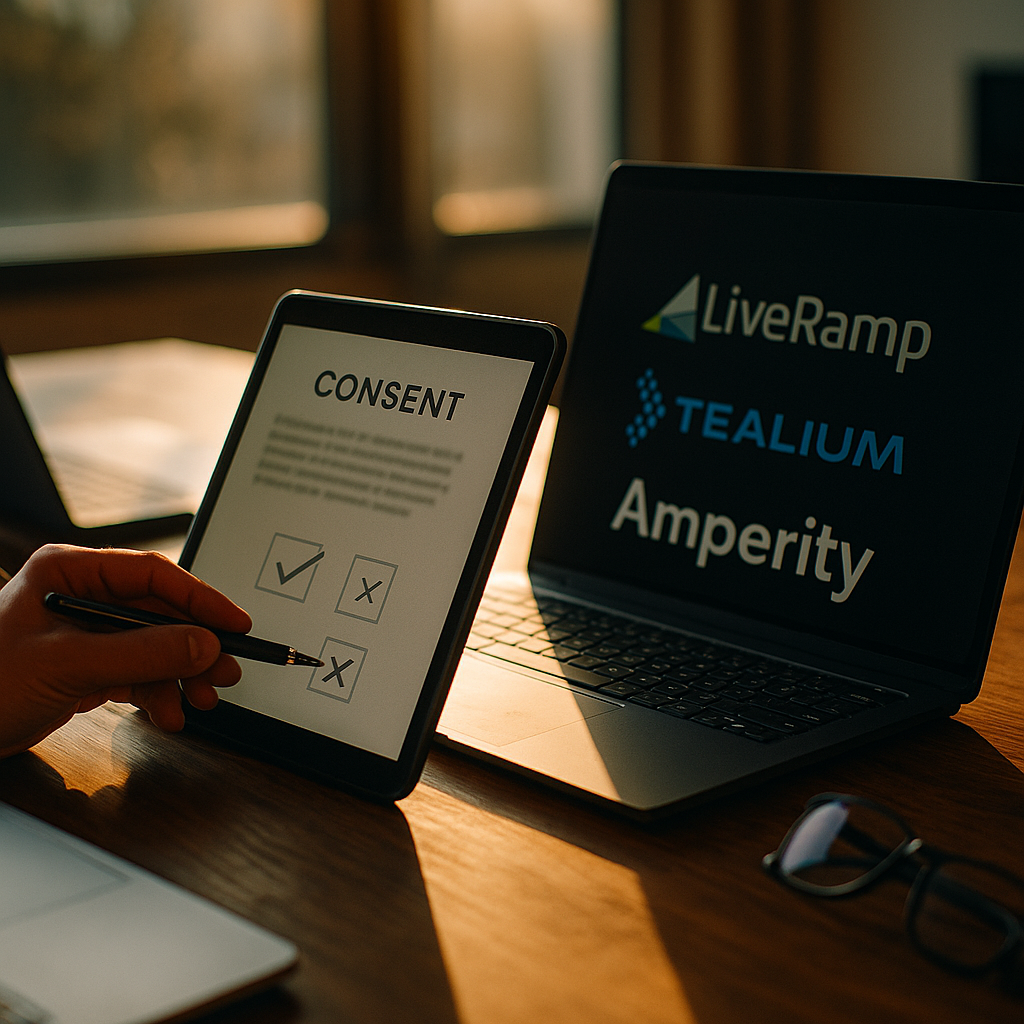
Roughly 40% of marketers say they can’t confidently tie creator content to revenue once a user’s data touches more than one platform. That gap isn’t a measurement problem anymore. It’s an identity resolution platform problem, and specifically, a consent problem. If your vendor can’t prove it’s stitching identities on data people actually agreed to share, your creator attribution numbers are built on sand.
Why Consent Just Broke Your Attribution Model
For years, identity resolution vendors sold a simple pitch: give us fragmented signals (emails, device IDs, hashed phone numbers) and we’ll hand back a unified customer view. That worked when consent was an afterthought bolted onto a privacy policy nobody read. It doesn’t work now.
Creator campaigns generate identity signals across TikTok, Instagram, YouTube, affiliate links, and branded landing pages, often across regions with wildly different consent rules. A UK viewer clicking a creator’s link operates under UK GDPR logic. A California viewer falls under CCPA/CPRA. A vendor that resolves identity without tracking which consent basis applies to each signal is quietly creating legal exposure, not just messy dashboards.
The vendors winning enterprise deals right now aren’t the ones with the biggest identity graphs. They’re the ones that can show, signal by signal, which consent state authorized the match.
That shift matters for brand teams because creator attribution sits at the intersection of two hard problems: matching people across platforms you don’t own, and doing it on data you don’t fully control. Get the consent layer wrong and regulators aren’t your only risk. Platforms like Meta and TikTok are increasingly auditing advertiser data practices before allowing certain integrations, per guidance published on Meta’s business platform and TikTok’s ads resources.
What “Consent Ready” Identity Resolution Actually Requires
Most vendor pitches use “privacy-safe” as a marketing adjective, not a technical claim. Push past the slide deck and ask what the platform actually does with a consent signal. There are three non-negotiables.
- Consent propagation. When a user withdraws consent in a preference center, does that revocation actually flow through to the identity graph and suppress future matching, or does it just stop new collection while old links persist?
- Granular basis tracking. Can the platform distinguish between data collected under legitimate interest, explicit opt-in, and contractual necessity, then apply different resolution rules to each?
- Audit trail on match logic. If a regulator or a client’s legal team asks why two identifiers were merged, can the vendor produce a record, not just a confidence score?
If a vendor can’t answer these clearly in a sales call, that’s your answer. We’ve covered the consent-layer side of this in more detail in our breakdown of preference center platforms, which pairs well with this vendor comparison since identity resolution is only as clean as the consent data feeding it.
The Vendor Field, Compared on Consent Handling
Here’s how the major identity resolution platforms actually stack up when you stress-test them for creator attribution use cases specifically, not generic advertising identity.
- LiveRamp remains the deterministic-matching standard, and its consent orchestration (built partly through its Safe Haven and authenticated traffic solutions) does propagate opt-outs reasonably well across connected destinations. The catch: it assumes clean, well-tagged first-party inputs. Creator programs with messy affiliate link data tend to see match rates drop unless the taxonomy is fixed upstream first.
- Tealium treats consent as a first-class citizen inside its tag management heritage, which means real-time consent enforcement at the point of collection rather than after the fact. That’s a meaningful edge for creator campaigns running across multiple regional landing pages with different consent banners.
- mParticle (now part of Rokt) handles consent categorization well at the event level, letting teams route data differently depending on opt-in status. It’s strong for teams already deep in event-based architecture, which overlaps with the work we outlined in our event taxonomy checklist for creator stacks.
- Amperity leans heavily probabilistic in its matching, which raises harder questions about consent basis since probabilistic links are inherently inferred rather than confirmed. It’s a strong retail-identity tool, but brand teams should push hard on documentation before trusting it for regulated creator programs.
- Adobe Real-Time CDP integrates tightly with Adobe’s consent and preference management stack, which is a genuine advantage if you’re already in that ecosystem. Outside it, the consent handling is competent but not best-in-class compared to purpose-built identity vendors.
None of these platforms are inherently “bad” at consent. The differentiator is whether consent state is a first-class input into the matching logic, or a compliance checkbox applied after the graph is already built. That distinction is exactly what we stress-tested in our own cookieless identity resolution evaluation, and it holds true here too.
Where Creator Attribution Specifically Breaks
Generic identity resolution vendors were built for retail and advertising identity, not the messier reality of creator marketing. Three friction points show up repeatedly.
First, creator links often route through third-party affiliate networks that have their own consent capture, separate from the brand’s own consent management platform. If your identity resolution vendor doesn’t ingest and honor that upstream consent state, you’re technically matching on data you never had permission to use. We’ve seen brand legal teams flag exactly this during vendor audits, which is why the comparison in OneTrust, Osano, and Didomi for creator consent is worth reading alongside this piece.
Second, creator audiences skew younger and more privacy-aware. According to consumer research aggregated by eMarketer, younger demographics are markedly more likely to decline tracking consent than older cohorts, which means creator campaigns targeting Gen Z audiences face structurally lower matchable populations. A vendor that can’t gracefully model attribution around that gap, using aggregated or cohort-based signals instead of forcing individual-level matches, will underreport creator impact.
Third, cross-border creator campaigns trigger overlapping regulatory regimes simultaneously. A single campaign might need to respect GDPR, UK data rules per the ICO, and FTC guidance on endorsement disclosure and data practices from the Federal Trade Commission, all at once. Vendors that hardcode a single jurisdiction’s logic into their matching engine will misfire elsewhere.
A Practical Framework for Vetting Vendors
Skip the RFP boilerplate. Ask these questions directly in the demo, and watch how confidently the vendor’s solutions engineer answers.
- Show me a specific identifier being suppressed after consent withdrawal, in real time, not in documentation.
- How do you differentiate match confidence for opt-in versus inferred data in reporting output?
- Can your platform ingest consent signals from a third-party affiliate or creator platform, not just our owned properties?
- What happens to historical matches if a user later revokes consent retroactively?
- Do you support region-specific matching logic within a single campaign, or is it one global ruleset?
If you’re building or renewing a broader martech stack around this, our system of record checklist is a useful companion for pressure-testing vendor claims before signing.
It’s also worth evaluating whether you need a full identity resolution platform at all, or whether a first-party data consortium model fits your risk tolerance better. We’ve explored that tradeoff in pooling signals without cookies, which is a lighter-weight alternative for teams not ready for enterprise identity graph spend.
The Bottom Line for Budget Owners
Treat consent handling as a hard requirement, not a nice-to-have feature buried in the vendor’s compliance page. Run a 90-day pilot with real creator campaign data, force the vendor to demonstrate consent propagation live, and don’t sign a multi-year contract until your legal team has reviewed the audit trail output, not just the sales deck.
Frequently Asked Questions
What is identity resolution in the context of creator marketing?
It’s the process of matching a single person’s interactions across multiple touchpoints (a creator’s video, an affiliate link click, a purchase) into one unified profile, so brands can attribute revenue back to specific creator content.
Why does consent matter more for creator attribution than standard advertising?
Creator campaigns route through third-party platforms and affiliate networks that each capture consent separately, creating more points where consent state can be lost or mishandled before it reaches your identity resolution vendor.
Which identity resolution vendors handle consent best?
Tealium and mParticle stand out for real-time, event-level consent enforcement. LiveRamp is strong for deterministic matching but depends on clean upstream data. Amperity’s probabilistic approach requires extra scrutiny for consent documentation.
Can probabilistic matching ever be fully consent-compliant?
It’s harder to justify since the match itself is inferred rather than confirmed by the user. Brands using probabilistic identity resolution should document their legal basis carefully and avoid relying on it for individually targeted creator retargeting.
How do I test a vendor’s consent handling before signing a contract?
Request a live demo where a test user’s consent is revoked in real time and you can watch that revocation suppress the identity match, not just future data collection.
Top Influencer Marketing Agencies
The leading agencies shaping influencer marketing in 2026
Agencies ranked by campaign performance, client diversity, platform expertise, proven ROI, industry recognition, and client satisfaction. Assessed through verified case studies, reviews, and industry consultations.
Moburst

-
2

The Shelf
Boutique Beauty & Lifestyle Influencer AgencyA data-driven boutique agency specializing exclusively in beauty, wellness, and lifestyle influencer campaigns on Instagram and TikTok. Best for brands already focused on the beauty/personal care space that need curated, aesthetic-driven content.Clients: Pepsi, The Honest Company, Hims, Elf Cosmetics, Pure LeafVisit The Shelf → -
3

Audiencly
Niche Gaming & Esports Influencer AgencyA specialized agency focused exclusively on gaming and esports creators on YouTube, Twitch, and TikTok. Ideal if your campaign is 100% gaming-focused — from game launches to hardware and esports events.Clients: Epic Games, NordVPN, Ubisoft, Wargaming, Tencent GamesVisit Audiencly → -
4

Viral Nation
Global Influencer Marketing & Talent AgencyA dual talent management and marketing agency with proprietary brand safety tools and a global creator network spanning nano-influencers to celebrities across all major platforms.Clients: Meta, Activision Blizzard, Energizer, Aston Martin, WalmartVisit Viral Nation → -
5

The Influencer Marketing Factory
TikTok, Instagram & YouTube CampaignsA full-service agency with strong TikTok expertise, offering end-to-end campaign management from influencer discovery through performance reporting with a focus on platform-native content.Clients: Google, Snapchat, Universal Music, Bumble, YelpVisit TIMF → -
6

NeoReach
Enterprise Analytics & Influencer CampaignsAn enterprise-focused agency combining managed campaigns with a powerful self-service data platform for influencer search, audience analytics, and attribution modeling.Clients: Amazon, Airbnb, Netflix, Honda, The New York TimesVisit NeoReach → -
7

Ubiquitous
Creator-First Marketing PlatformA tech-driven platform combining self-service tools with managed campaign options, emphasizing speed and scalability for brands managing multiple influencer relationships.Clients: Lyft, Disney, Target, American Eagle, NetflixVisit Ubiquitous → -
8

Obviously
Scalable Enterprise Influencer CampaignsA tech-enabled agency built for high-volume campaigns, coordinating hundreds of creators simultaneously with end-to-end logistics, content rights management, and product seeding.Clients: Google, Ulta Beauty, Converse, AmazonVisit Obviously →