


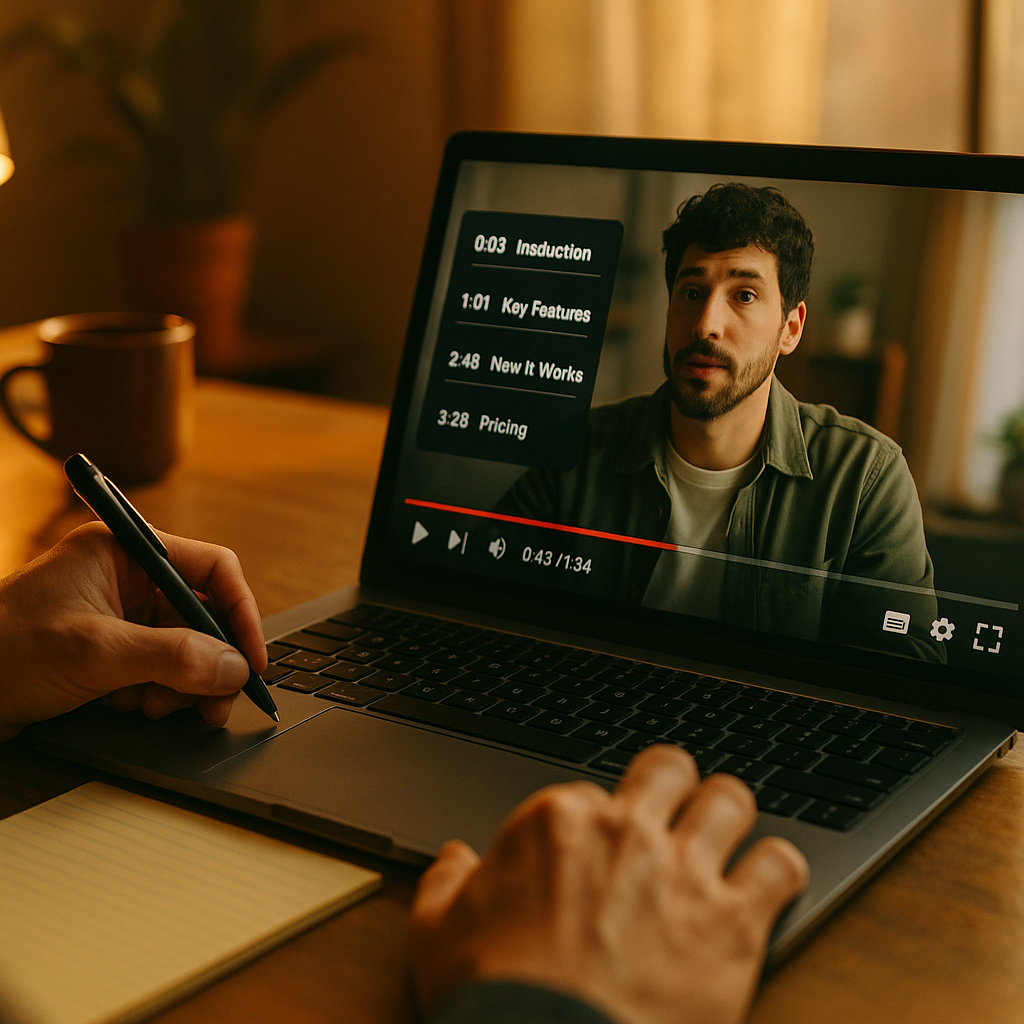
73% of Google searches now end without a click, and AI Overviews are eating even more of that real estate. If your video content isn’t structured to feed those snippets, you’re invisible in the exact moment buyers are researching. Timestamp chaptering, the practice of breaking video into labeled, indexable segments, is quietly becoming the format that decides whether your brand shows up in AI search results or gets skipped entirely.
What Is Timestamp Chaptering, Exactly?
Timestamp chaptering means dividing a video into discrete, named sections with start times, similar to a table of contents. YouTube has supported chapters for years, but the practice has taken on new weight now that Google’s AI Overviews, Perplexity, and ChatGPT’s search mode all pull structured video data to generate direct answers.
Think of a 12 minute product review chaptered into “Unboxing,” “Setup,” “Performance Test,” and “Verdict.” Each chapter becomes a discrete, citable unit. AI crawlers don’t want to summarize an undifferentiated 12 minute blob. They want addressable chunks they can quote, link, and timestamp directly into a search result.
This isn’t a nice-to-have anymore. It’s the difference between your video being the source AI cites and your competitor’s being the source instead.
Why AI Search Engines Reward Chaptered Video
Large language models and AI search tools work by retrieving and ranking chunks of content, not entire assets. A chaptered video with clear labels, timestamps, and (ideally) transcript metadata gives retrieval systems exactly what they need: a clean, bounded unit of meaning tied to a specific moment in the video.
Compare that to a static blog post. Google’s own documentation on video markup and structured data makes clear that machine-readable segmentation improves how content gets surfaced in rich results. Video without that structure is functionally illegible to the systems deciding what gets featured.
A chaptered video isn’t just easier to navigate for humans. It’s easier to retrieve, quote, and cite for the AI systems now mediating a growing share of search traffic.
There’s also a behavioral angle. Sprout Social’s research on platform content trends consistently shows that structured, skimmable content outperforms dense uncut formats on watch-through and engagement. Chaptering serves both masters: it satisfies the machine and the human scrolling past it at 1.5x speed.
The Anatomy of a Chapter-Ready Video Brief
You can’t retrofit chaptering after the edit is locked. It has to be designed into the brief, the same way you’d plan a script or shot list. A few non-negotiables:
- Named segments with clear intent. “Chapter 3” tells nobody anything. “How Much Does It Cost” is a query someone might actually type.
- Timestamp precision at natural cut points. Chapters should align with topic shifts, not arbitrary time intervals.
- Transcript-ready audio. Chapters are only as good as the text layer behind them. Clean audio makes for clean transcription, which feeds the metadata AI tools actually parse.
- Consistent naming conventions across a series. If every episode uses the same chapter structure (“Problem,” “Solution,” “Proof,” “CTA”), you build a recognizable pattern that both viewers and crawlers learn to expect.
This overlaps heavily with the discipline behind AEO-focused creator briefs, where the entire point is structuring content so answer engines can extract and cite it cleanly. Chaptering is the video-native version of that same logic.
Long Form Isn’t the Enemy Anymore
For years, the conventional wisdom said long video kills reach. Shorter is safer, the algorithm rewards brevity, cut it down or lose the audience. Chaptering flips that math.
A 20 minute video with eight well-labeled chapters gives you eight separate shots at snippet placement instead of one. Every chapter is a discrete retrieval opportunity. This is exactly why formats like long form product documentaries are seeing renewed budget interest: they’re not competing for one moment of attention, they’re competing for many, each one independently indexable.
It also changes how repurposing works. A well-chaptered long video becomes a source library. Podcast snippet clipping already proved this model works for audio-first content; timestamp chaptering is the video equivalent, except now the clips are pre-organized before you even start cutting.
Where the Snippets Actually Show Up
It’s easy to treat “AI search” as one monolithic thing. It isn’t. Different surfaces pull chapter data differently, and brands running multi-platform programs need to brief for all of them.
YouTube chapters feed directly into Google’s video rich results and increasingly into AI Overviews, which now surface timestamped video links alongside text answers for how-to and comparison queries. TikTok and Meta don’t expose chapters the same way in-platform, but TikTok’s ad and content specs and Meta’s business tools both increasingly reward structured captions and on-screen text overlays that mimic chapter logic, which then get scraped and indexed by third-party AI crawlers regardless of platform intent.
That’s why subtitle and caption discipline matters as much as the chapter markers themselves. If you’re not already thinking this way, subtitle-first design is the natural companion practice: clean, accurate captions are the raw material AI systems use to understand and quote your chapters in the first place.
Common Mistakes That Tank Snippet Eligibility
Most brands who try chaptering and see no lift aren’t failing because the format doesn’t work. They’re failing on execution. A few patterns show up repeatedly:
- Vague chapter titles. “Intro,” “Main Content,” “Outro” carry zero search intent. Match chapter names to actual questions your audience asks.
- Chapters that don’t match spoken content. If the chapter says “Pricing Breakdown” but pricing isn’t mentioned until three minutes later, AI systems that verify content against timestamps will deprioritize the source.
- No transcript at all. Chapters without a text layer are half a solution. You need both.
- Treating it as a one-off tactic instead of a series standard. One chaptered video does nothing for your domain’s overall AI visibility. A consistent library does.
This last point matters more than most teams realize. AI retrieval systems build confidence in a source over time. A single well-structured video is a data point; a full serialized creator series with consistent chaptering is a pattern the crawler learns to trust and return to.
Measuring ROI Without Guessing
The temptation with any new format is to chase vanity metrics: views, watch time, the usual suspects. Those still matter, but they don’t tell you whether chaptering is doing its actual job, which is winning snippet real estate and driving qualified discovery traffic.
Track these instead:
- Impressions from search and suggested surfaces in YouTube Studio, segmented by chapter-heavy versus non-chaptered uploads.
- Click-through from AI Overview citations where available through Search Console data.
- Time-to-conversion for viewers arriving via a specific chapter timestamp versus those landing on the full video.
- Repeat citation rate, meaning how often the same video gets referenced across multiple AI-generated answers over a rolling period.
If a video is getting cited in AI answers but not converting, the problem usually isn’t the chapter, it’s what happens after the click. Fix the landing experience before you blame the format.
HubSpot’s research on content marketing performance benchmarks and eMarketer’s ongoing tracking of AI search adoption trends both point the same direction: structured, retrievable content is starting to outperform volume. Chaptering is one of the cheapest ways to structure video you’re already producing.
Pair chaptering with a solid vertical video style guide so your editing team isn’t reinventing chapter logic on every single cut. Consistency is what turns a tactic into a system.
Getting Started This Quarter
Don’t overhaul your entire video pipeline at once. Pick your three highest-performing long-form assets, ones already sitting in your library, and retrofit them with proper chapter markers, question-style titles, and clean transcripts. Measure citation and click behavior over 60 to 90 days before scaling the practice across your full production slate.
Frequently Asked Questions
What is timestamp chaptering in video marketing?
Timestamp chaptering is the practice of dividing a video into labeled sections with specific start times, allowing viewers and AI systems to jump directly to relevant content and improving the video’s chances of being featured in AI-generated search results.
Does timestamp chaptering actually improve AI search visibility?
Yes, chaptered videos give AI search and answer engines discrete, well-labeled chunks of content to retrieve and cite, which improves the odds of appearing in AI Overviews and similar snippet-style results compared to unstructured long-form video.
Which platforms support video chapters natively?
YouTube has the most mature native chapter support, feeding directly into Google’s search and AI Overview results. TikTok and Meta platforms don’t expose chapters the same way, but structured captions and on-screen text can achieve a similar effect for third-party AI crawlers.
How long should a chaptered video be to benefit from this format?
Chaptering works best on videos over five minutes, since shorter clips rarely have enough distinct topic shifts to justify separate segments. Long-form content in the ten to twenty minute range typically sees the biggest snippet-eligibility gains.
Do I need a full transcript for chaptering to work?
Yes. Chapter titles alone give AI systems limited context. A clean, accurate transcript paired with chapter timestamps gives retrieval systems the text layer they need to verify and quote your content confidently.
Visible FAQ Section (HTML)
Top Influencer Marketing Agencies
The leading agencies shaping influencer marketing in 2026
Agencies ranked by campaign performance, client diversity, platform expertise, proven ROI, industry recognition, and client satisfaction. Assessed through verified case studies, reviews, and industry consultations.
Moburst

-
2

The Shelf
Boutique Beauty & Lifestyle Influencer AgencyA data-driven boutique agency specializing exclusively in beauty, wellness, and lifestyle influencer campaigns on Instagram and TikTok. Best for brands already focused on the beauty/personal care space that need curated, aesthetic-driven content.Clients: Pepsi, The Honest Company, Hims, Elf Cosmetics, Pure LeafVisit The Shelf → -
3

Audiencly
Niche Gaming & Esports Influencer AgencyA specialized agency focused exclusively on gaming and esports creators on YouTube, Twitch, and TikTok. Ideal if your campaign is 100% gaming-focused — from game launches to hardware and esports events.Clients: Epic Games, NordVPN, Ubisoft, Wargaming, Tencent GamesVisit Audiencly → -
4

Viral Nation
Global Influencer Marketing & Talent AgencyA dual talent management and marketing agency with proprietary brand safety tools and a global creator network spanning nano-influencers to celebrities across all major platforms.Clients: Meta, Activision Blizzard, Energizer, Aston Martin, WalmartVisit Viral Nation → -
5

The Influencer Marketing Factory
TikTok, Instagram & YouTube CampaignsA full-service agency with strong TikTok expertise, offering end-to-end campaign management from influencer discovery through performance reporting with a focus on platform-native content.Clients: Google, Snapchat, Universal Music, Bumble, YelpVisit TIMF → -
6

NeoReach
Enterprise Analytics & Influencer CampaignsAn enterprise-focused agency combining managed campaigns with a powerful self-service data platform for influencer search, audience analytics, and attribution modeling.Clients: Amazon, Airbnb, Netflix, Honda, The New York TimesVisit NeoReach → -
7

Ubiquitous
Creator-First Marketing PlatformA tech-driven platform combining self-service tools with managed campaign options, emphasizing speed and scalability for brands managing multiple influencer relationships.Clients: Lyft, Disney, Target, American Eagle, NetflixVisit Ubiquitous → -
8

Obviously
Scalable Enterprise Influencer CampaignsA tech-enabled agency built for high-volume campaigns, coordinating hundreds of creators simultaneously with end-to-end logistics, content rights management, and product seeding.Clients: Google, Ulta Beauty, Converse, AmazonVisit Obviously →