


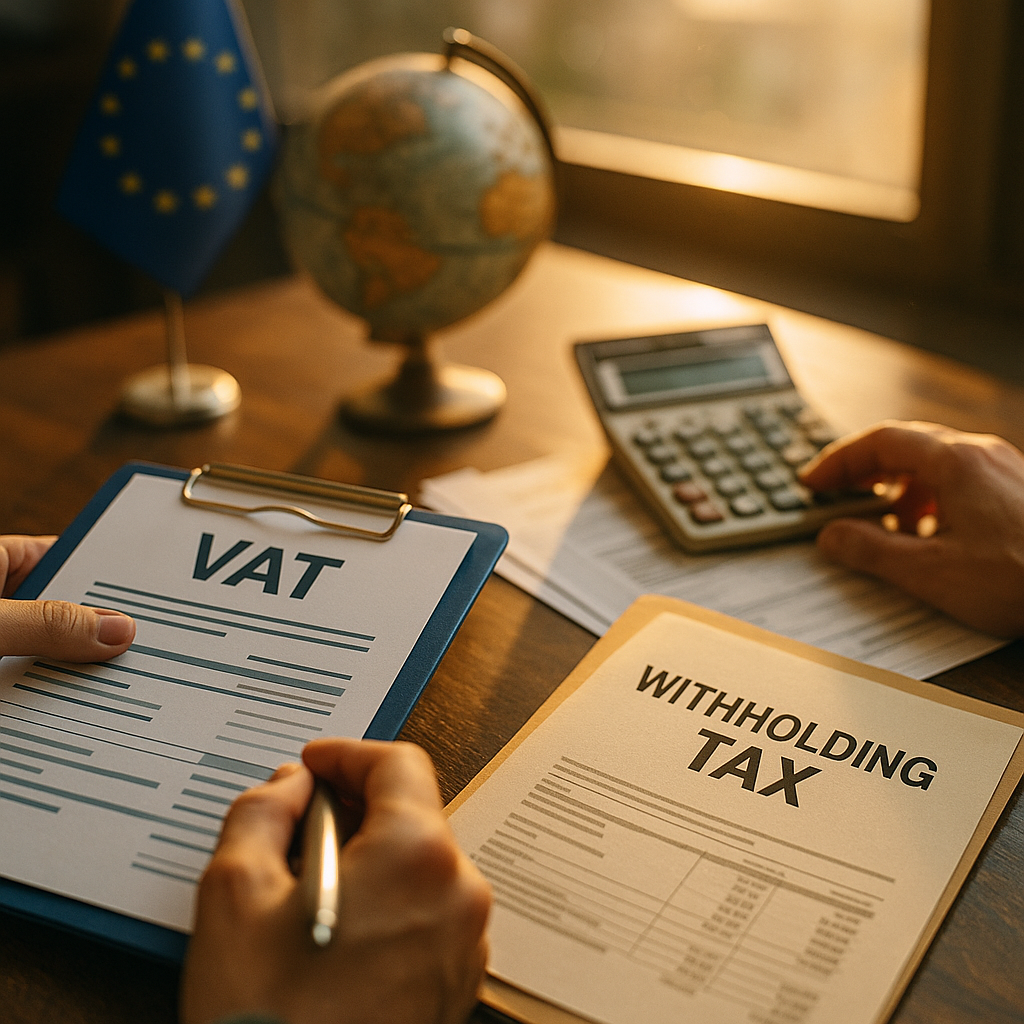
Pay a creator in Manila from a bank account in Ohio, and you have not just executed a marketing transaction. You have potentially triggered VAT obligations in the Philippines, withholding tax exposure in the United States, and a paper trail that two different tax authorities may want to see. Most brands running cross border creator payments treat the wire transfer as the finish line. It is actually the starting gun for a compliance process most marketing teams have never built.
Influencer budgets crossed borders long before finance teams caught up. A 2024 eMarketer estimate put global influencer marketing spend well north of $30 billion, and a meaningful share of that now flows to creators outside the brand’s home country. Nobody trained the average brand marketer to think about tax treaties. Yet that is exactly the skill set cross border payouts now demand.
Why This Is a Finance Problem Wearing a Marketing Costume
Here is the uncomfortable truth: the marketing team usually signs the creator contract, but the finance and tax teams inherit the liability. When a US brand pays a UK-based creator for a sponsored video, the question is not just “did we get the content approved.” It’s whether the payment counts as US-sourced income subject to withholding, whether the creator’s home country expects VAT on the service, and whether the brand has the documentation to prove it handled both correctly.
Tax authorities do not care that the payment ran through an influencer platform or a payment processor. They care about the underlying economic activity: a service was rendered, money changed hands across a border, and someone owes tax somewhere. Often, more than one jurisdiction thinks it’s owed.
A creator contract that never mentions tax residency or withholding responsibility is not a lean contract. It’s a liability with a signature on it.
Withholding Tax: The 30% Nobody Budgets For
US-based brands paying foreign creators face one of the most misunderstood rules in the influencer economy: the default 30% withholding requirement on US-sourced income paid to non-resident aliens under IRS rules. If a foreign creator produces content that counts as performed in the US, or the payment is otherwise treated as US-sourced, the brand may be required to withhold nearly a third of the payment and remit it to the IRS, regardless of what the contract says about gross payout amounts.
The mechanism that reduces or eliminates this withholding is Form W-8BEN (for individuals) or W-8BEN-E (for entities), paired with a valid tax treaty claim. No form on file? Full withholding applies by default. Brands routinely skip this step because nobody on the marketing side knows the form exists, and the creator certainly is not going to bring it up before an invoice gets approved.
This is not a hypothetical risk. We covered the mechanics in depth in foreign creator withholding obligations, and the core lesson holds: when a brand fails to withhold correctly, the IRS does not chase the creator first. It chases the payer. That means your brand, not the influencer, absorbs the penalty, interest, and back tax when an audit surfaces the gap.
Where the Confusion Usually Starts
Three recurring mistakes show up across brand finance teams:
- Assuming platform payments handle it. Marketplaces and creator platforms often disclaim tax withholding responsibility entirely, pushing it back to the brand in their terms of service.
- Treating all foreign creators the same. Withholding obligations, treaty benefits, and documentation requirements vary by country and by whether the creator is an individual or a registered business entity.
- No renewal cycle for tax forms. A W-8BEN can expire. Brands that collected the form once and filed it away often discover, mid-audit, that it lapsed two years ago.
VAT Is the Other Half of the Puzzle
Withholding tax gets more attention in the US, but VAT (value added tax) is the bigger operational headache for brands paying creators in the EU, UK, and dozens of other markets that use consumption tax systems. Here’s the twist: VAT rules on cross border digital services are notoriously counterintuitive. The obligation to charge, collect, or self-account for VAT often depends on where the buyer (the brand) is located, not where the creator sits.
Under EU VAT rules for digital services, a business-to-business transaction between a brand and a creator in a different EU member state typically shifts the VAT liability to the brand through what’s called the reverse charge mechanism. The brand self-assesses the VAT rather than the creator charging it on the invoice. Get this wrong, and you either underpay VAT you owed or double pay VAT the creator already charged incorrectly.
UK creators working with EU or US brands post-Brexit face a separate set of rules entirely, since the UK operates its own VAT regime outside the EU framework. A brand running pan-European influencer campaigns could easily be dealing with three or four different VAT treatments in a single quarter, depending on where each creator is registered.
A single influencer campaign spanning five countries can generate five different VAT treatments. Treating them as one line item in your accounting system is how audits happen.
The Registration Question Nobody Wants to Ask
Does the brand need to register for VAT in the creator’s country? Usually not, if the reverse charge mechanism applies and the brand is VAT-registered in its own jurisdiction. But there are edge cases: high-volume payments to creators in specific markets, or transactions structured through local entities, can trigger local VAT registration thresholds. This is where generic finance software falls short. Standard accounting platforms are not built to flag “this specific creator payment may require VAT registration in Ireland.” That judgment call requires a tax advisor who understands digital services rules, not just a bookkeeper reconciling invoices.
Building a Payment Workflow That Doesn’t Blow Up Later
The fix is not complicated in concept, though it does require discipline that most influencer programs currently lack. A defensible cross border payment workflow needs four components:
- Tax residency documentation collected before the first payment. W-8BEN, W-8BEN-E, or local equivalents, gathered as a condition of onboarding, not an afterthought chased down at invoice time.
- Country-by-country VAT treatment mapped in advance. Know whether reverse charge applies, whether the creator should be charging VAT, and whether that rate has changed recently.
- A renewal cadence for expiring forms. Tax documentation is not “collect once and forget.” Build reminders into the same system that tracks contract renewals.
- An audit trail that survives scrutiny. Every payment should be traceable to a signed contract, a tax form, and a documented VAT treatment decision. If a regulator or auditor asks “why didn’t you withhold on this payment,” you need a paper answer, not a shrug.
This overlaps significantly with sanctions and payment screening work brands already need to do. If your team has built an OFAC screening checklist for cross border payouts, the tax documentation process should sit in the same workflow, ideally the same onboarding form, so creators are not filling out five disconnected compliance documents across three different systems.
Contracts Are Where This Gets Fixed or Fumbled
Every creator contract involving cross border payment should explicitly state who is responsible for withholding, who bears the cost if tax authorities later determine additional tax is owed, and what documentation the creator is required to provide before the first invoice is paid. Vague language like “creator is responsible for their own taxes” does not protect the brand from withholding obligations that legally sit with the payer, not the payee.
This is a similar structural problem to the one we outlined around exclusive creator retainers and employee status: contracts written by marketing teams without tax or legal review tend to assume risk sits somewhere other than where it actually does. The same pattern shows up in multi-state payment structures for minor creators, where the brand’s payment mechanics create legal exposure the marketing brief never anticipated.
Practical fix: build a standard tax clause template with your legal and finance teams, then require it in every cross border creator contract without exception. No custom carve-outs negotiated by an account manager who does not know what a W-8BEN is.
What Happens When You Get It Wrong
The failure mode is not a scary letter that arrives the week after the campaign. It’s an audit two or three years later that reconstructs every cross border payment your brand made, checks whether withholding was applied, and calculates penalties plus interest on every gap it finds. By then, the campaign is long forgotten, the marketing manager who approved it may have moved to a different company, and finance is left explaining a six-figure exposure that traces back to a handful of missing tax forms.
Reputational cost matters too. Creators talk. A brand that surprises a foreign creator with an unexpected 30% withholding deduction, discovered only when the payment lands, damages trust fast. That creator will mention it. Other creators will hear about it. In a market where creator relationships are increasingly long-term partnerships rather than one-off transactions, that reputational hit compounds.
Next Step
Audit your last four quarters of cross border creator payments right now: pull the list, check for missing W-8 forms, and flag any VAT treatment you cannot explain in one sentence. If you find gaps, fix the intake process before the next payment cycle, not after the next audit notice.
FAQs
Do brands need to withhold tax on every payment to a foreign creator?
Not automatically. Withholding depends on whether the payment is classified as US-sourced income (or sourced in the relevant payer country), the creator’s tax residency, and whether a valid treaty claim reduces or eliminates the default rate. Without proper documentation like a W-8BEN on file, brands typically must withhold at the default statutory rate to stay compliant.
Who is responsible for VAT on cross border influencer payments, the brand or the creator?
It depends on the transaction structure and jurisdictions involved. Under many reverse charge mechanisms used in EU VAT rules, the brand self-accounts for VAT rather than the creator charging it directly. Local rules vary, so this should be confirmed with a tax advisor familiar with digital services VAT treatment in the relevant countries.
What happens if a brand fails to collect proper tax documentation from a foreign creator?
The brand, as the payer, generally bears the liability for underwithholding, including back taxes, penalties, and interest. Tax authorities typically pursue the payer first since they control the funds, which means the marketing budget owner, not the creator, absorbs the financial and administrative fallout.
Can influencer marketing platforms handle tax withholding automatically?
Some platforms offer basic tax document collection, but many explicitly disclaim responsibility for withholding accuracy in their terms of service. Brands should verify exactly what a platform does and does not handle before assuming withholding and VAT obligations are covered.
How often should tax documentation be renewed for recurring creator relationships?
Forms like the W-8BEN typically have a validity period and can expire or become invalid if a creator’s circumstances change. Brands running ongoing creator programs should build renewal reminders into their contract management or onboarding systems rather than treating tax documentation as a one-time collection task.
Top Influencer Marketing Agencies
The leading agencies shaping influencer marketing in 2026
Agencies ranked by campaign performance, client diversity, platform expertise, proven ROI, industry recognition, and client satisfaction. Assessed through verified case studies, reviews, and industry consultations.
Moburst

-
2

The Shelf
Boutique Beauty & Lifestyle Influencer AgencyA data-driven boutique agency specializing exclusively in beauty, wellness, and lifestyle influencer campaigns on Instagram and TikTok. Best for brands already focused on the beauty/personal care space that need curated, aesthetic-driven content.Clients: Pepsi, The Honest Company, Hims, Elf Cosmetics, Pure LeafVisit The Shelf → -
3

Audiencly
Niche Gaming & Esports Influencer AgencyA specialized agency focused exclusively on gaming and esports creators on YouTube, Twitch, and TikTok. Ideal if your campaign is 100% gaming-focused — from game launches to hardware and esports events.Clients: Epic Games, NordVPN, Ubisoft, Wargaming, Tencent GamesVisit Audiencly → -
4

Viral Nation
Global Influencer Marketing & Talent AgencyA dual talent management and marketing agency with proprietary brand safety tools and a global creator network spanning nano-influencers to celebrities across all major platforms.Clients: Meta, Activision Blizzard, Energizer, Aston Martin, WalmartVisit Viral Nation → -
5

The Influencer Marketing Factory
TikTok, Instagram & YouTube CampaignsA full-service agency with strong TikTok expertise, offering end-to-end campaign management from influencer discovery through performance reporting with a focus on platform-native content.Clients: Google, Snapchat, Universal Music, Bumble, YelpVisit TIMF → -
6

NeoReach
Enterprise Analytics & Influencer CampaignsAn enterprise-focused agency combining managed campaigns with a powerful self-service data platform for influencer search, audience analytics, and attribution modeling.Clients: Amazon, Airbnb, Netflix, Honda, The New York TimesVisit NeoReach → -
7

Ubiquitous
Creator-First Marketing PlatformA tech-driven platform combining self-service tools with managed campaign options, emphasizing speed and scalability for brands managing multiple influencer relationships.Clients: Lyft, Disney, Target, American Eagle, NetflixVisit Ubiquitous → -
8

Obviously
Scalable Enterprise Influencer CampaignsA tech-enabled agency built for high-volume campaigns, coordinating hundreds of creators simultaneously with end-to-end logistics, content rights management, and product seeding.Clients: Google, Ulta Beauty, Converse, AmazonVisit Obviously →