


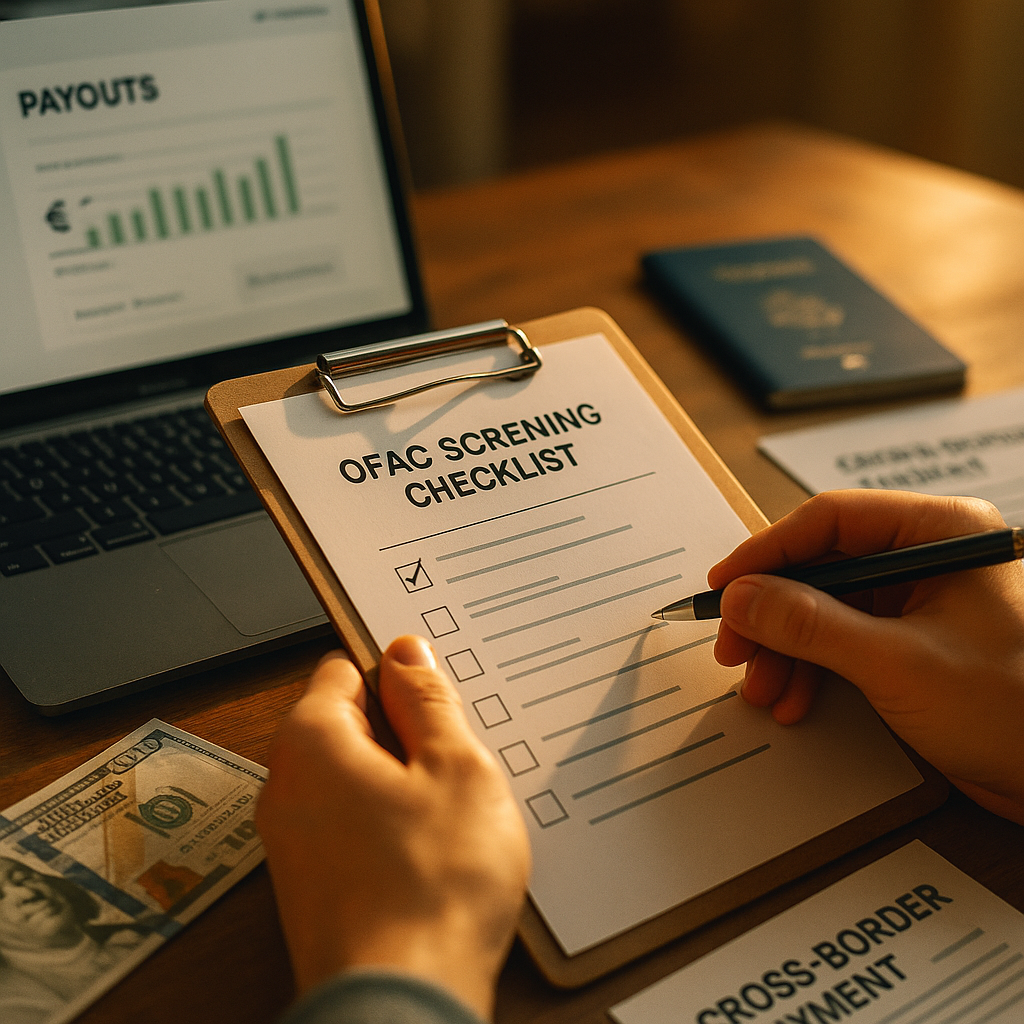
One missed OFAC match on a single creator payout can freeze an entire campaign, trigger a federal investigation, and cost more in legal fees than the influencer deal was ever worth. Yet most brands running global creator programs still treat sanctions screening for cross border creator payments as an afterthought, something finance handles after the contract is signed. That order of operations is exactly backwards.
Why This Suddenly Matters to Marketing Teams
Influencer marketing stopped being a domestic game years ago. Brands now route budget to creators in Lagos, Manila, Sao Paulo, and dozens of other markets where reach is cheap and engagement is high. That global sourcing is smart media buying. It is also a compliance minefield, because the U.S. Treasury’s Office of Foreign Assets Control (OFAC) does not care whether a payment is labeled “influencer fee” or “consulting invoice.” If the recipient, their agency, or even the payment intermediary appears on a sanctions list, the paying brand is liable regardless of intent.
Marketing leaders rarely think of themselves as sanctions officers. But when you’re wiring payments across 15 countries a quarter through PayPal, Payoneer, Tipalti, or direct bank transfer, you’ve effectively become an international payments operation. Treasury and legal teams have known this for years. Marketing is catching up slower.
OFAC penalties are strict liability. Brands can be fined even if they had no knowledge the recipient was sanctioned, which makes screening a mandatory control, not a nice-to-have.
What Sanctions Screening Actually Checks For
Sanctions screening is the process of comparing a payee’s identifying information (name, address, date of birth, business registration, sometimes IP or banking details) against government watchlists before money moves. The core list most U.S. brands screen against is OFAC’s Specially Designated Nationals (SDN) list, but a thorough program also checks:
- OFAC’s Sectoral Sanctions Identifications (SSI) list
- The UK’s OFSI consolidated list
- EU consolidated sanctions list
- UN Security Council sanctions list
- Country-specific embargo restrictions (Cuba, Iran, North Korea, Syria, Russia, and shifting regional designations)
Here’s the part that trips up marketing teams: screening isn’t a one-time check at onboarding. Names get added to lists constantly. A creator who cleared screening in January could be designated in June because of a business relationship, a shell company connection, or geopolitical developments totally unrelated to their content. Programs that screen once and never rescreen are running on stale data, which is functionally the same as not screening at all.
Who Actually Needs to Be Screened?
Not just the creator. This is where most checklists fall short. A rigorous program screens:
- The individual creator or talent
- Their management agency or MCN, if payment routes through one
- Any LLC or loan-out company the creator invoices through
- The receiving bank or payment processor’s beneficial ownership, in high-risk corridors
Brands that only screen the name on the contract miss the layer where actual risk hides: shell entities and third-party payment intermediaries in loosely regulated jurisdictions.
The Compliance Checklist: Building a Screening Workflow That Holds Up
Below is the operational sequence brands and agencies should run before, during, and after every cross border creator payment.
1. Screen Before Contract Signature, Not Before Payment
If legal only screens at the invoice stage, you’ve already spent negotiation time and possibly deposited creative briefs with a sanctioned party. Build the check into the intake form: no creator moves to contract until screening clears.
2. Use an Automated Screening Tool, Not Manual Google Searches
Manual name checks miss transliteration variants, aliases, and near-matches. Tools like ComplyAdvantage, Sanctions.io, or built-in screening modules inside payment platforms such as Tipalti and Trolley automate fuzzy matching across multiple lists simultaneously. If your payment volume exceeds roughly 50 international creators a quarter, manual checking is no longer defensible as due diligence.
4. Document Every Screening Result, Match or No Match
Regulators and auditors want a paper trail. A “no match” result should be logged with a timestamp, the list versions checked, and the tool used. This record becomes your defense if a name is later flagged retroactively.
5. Rescreen on a Fixed Cadence
Quarterly rescreening is the common baseline for active creator rosters. High-risk geographies (anywhere near active conflict zones or under partial sanctions regimes) warrant monthly checks. Build rescreening into the same calendar cycle as contract renewals, since renewal audits are already a natural checkpoint for reviewing creator relationships.
6. Escalate True Matches to Legal Immediately, Not Marketing Judgment Calls
A partial name match doesn’t automatically mean “block payment.” It means “escalate to compliance counsel for review.” Marketing managers should never be the ones deciding whether a match is close enough to act on. That’s a legal determination with regulatory consequences.
7. Screen Payment Rails, Not Just People
Some regions have banking corridors with heightened sanctions exposure even when the individual creator is clean. If you’re wiring funds through an intermediary bank with correspondent relationships in a restricted country, that adds a layer of risk independent of the creator’s identity.
A 2024 Association of Certified Financial Crime Specialists survey found that over 60% of mid-size companies had no formalized rescreening cadence for existing vendors, relying entirely on onboarding checks. Creator programs, largely unregulated compared to traditional vendor management, likely skew worse.
Where This Intersects With Tax and Contract Compliance
Sanctions screening rarely operates in isolation. It sits alongside withholding tax obligations and worker classification questions that already complicate foreign creator payments. Brands that already collect W-8BEN forms for tax withholding purposes have a natural checkpoint to layer in sanctions screening, since both processes require verified legal identity and entity documentation upfront.
This is also where contract language matters. Payment terms should include a clause allowing the brand to withhold or claw back payment if a sanctions match is discovered post-payment. Without that clause, you may have already sent funds you cannot legally recover, and your only remedy is reporting the transaction to OFAC voluntarily, which is its own regulatory process. Brands managing international tax compliance should treat sanctions screening as a parallel workstream, not a separate department’s problem.
Building It Into the Vendor Management System
The most efficient brands don’t run screening as a standalone step. They embed it into the same vendor management or influencer relationship platform that handles contracts, payments, and content approval. Platforms like Aspire, GRIN, and CreatorIQ increasingly offer compliance modules, though few have native sanctions screening built in yet, meaning most brands still need a third-party integration or manual export/import workflow to a dedicated screening tool.
If your influencer platform doesn’t support this integration, ask your vendor when it’s on the roadmap. If the answer is vague, that’s a signal to evaluate alternatives or build a manual bridge process now rather than after an incident.
What Happens When You Get It Wrong
The consequences aren’t theoretical. OFAC has levied penalties against companies for payments to designated parties even where the violation was inadvertent, because sanctions liability is largely strict liability under U.S. law. Fines can reach the greater of a statutory cap or twice the value of the transaction, per violation. For a creator campaign spanning dozens of international payouts, that math escalates fast. Beyond fines, there’s reputational fallout: paying a sanctioned party, even unknowingly, invites press coverage no brand safety team wants to manage.
There’s also a quieter cost: payment delays. Banks increasingly run their own sanctions screening on international wires, and if your creator’s name triggers a flag on their end, your payment gets held, sometimes for weeks, while the bank investigates. That delay damages creator relationships and can violate contractual payment timelines you’ve promised talent. Screening proactively on your end reduces the odds of the bank’s screening becoming a bottleneck later.
Practical Rollout: Where to Start This Quarter
- Audit your current creator roster and flag anyone paid across borders in the last twelve months
- Pick one screening tool and run a retroactive check on that list
- Add a mandatory screening checkbox to your creator onboarding workflow, blocking contract signature until cleared
- Draft a clawback clause for payment agreements and get legal sign-off
- Set a recurring calendar reminder for quarterly rescreening tied to your renewal cycle
None of this requires a large budget. Most screening tools price per check or per seat, and the cost is negligible compared to a single OFAC penalty. This is a governance gap, not a budget gap, and it’s closely tied to broader identity verification issues covered in creator identity verification practices. For a deeper dive specifically on OFAC mechanics and creator payment structures, see our companion piece on OFAC screening for creator payouts.
FAQs
Do we need to screen every creator, or only those in certain countries?
Every cross border payment should be screened regardless of country, since sanctioned individuals and entities can be based anywhere, including jurisdictions not typically considered high risk. Country-based risk scoring can prioritize review speed but shouldn’t be used to skip screening entirely.
What’s the difference between OFAC screening and general KYC?
Know Your Customer (KYC) verifies who someone is for fraud and identity purposes. Sanctions screening specifically checks that verified identity against government watchlists. You typically need both, but they serve different regulatory purposes and often use different tools.
How often should we rescreen existing creator relationships?
Quarterly is a reasonable baseline for most brands, with monthly checks for creators in higher-risk regions or with complex ownership structures. Rescreening should also trigger automatically whenever a contract renews or payment terms change.
What do we do if a screening tool returns a partial match?
Escalate to legal or compliance counsel before taking any action on the payment. Partial matches are common due to name similarities and don’t automatically mean the creator is sanctioned, but the determination should never be made by marketing staff alone.
Can a payment platform handle sanctions screening for us automatically?
Some payment platforms, including Tipalti and Trolley, offer built-in screening as part of their global payout infrastructure. If your current platform doesn’t, you’ll likely need a separate integration with a dedicated screening tool like ComplyAdvantage or Sanctions.io.
FAQs
Do we need to screen every creator, or only those in certain countries?
Every cross border payment should be screened regardless of country, since sanctioned individuals and entities can be based anywhere, including jurisdictions not typically considered high risk. Country-based risk scoring can prioritize review speed but shouldn’t be used to skip screening entirely.
What’s the difference between OFAC screening and general KYC?
Know Your Customer (KYC) verifies who someone is for fraud and identity purposes. Sanctions screening specifically checks that verified identity against government watchlists. You typically need both, but they serve different regulatory purposes and often use different tools.
How often should we rescreen existing creator relationships?
Quarterly is a reasonable baseline for most brands, with monthly checks for creators in higher-risk regions or with complex ownership structures. Rescreening should also trigger automatically whenever a contract renews or payment terms change.
What do we do if a screening tool returns a partial match?
Escalate to legal or compliance counsel before taking any action on the payment. Partial matches are common due to name similarities and don’t automatically mean the creator is sanctioned, but the determination should never be made by marketing staff alone.
Can a payment platform handle sanctions screening for us automatically?
Some payment platforms, including Tipalti and Trolley, offer built-in screening as part of their global payout infrastructure. If your current platform doesn’t, you’ll likely need a separate integration with a dedicated screening tool like ComplyAdvantage or Sanctions.io.
Sanctions screening isn’t a legal team’s side project anymore, it’s an operational requirement for any brand paying creators across borders. Start by auditing last year’s international payouts against a screening tool this week, and build the checkbox into your onboarding flow before the next campaign brief goes out.
Top Influencer Marketing Agencies
The leading agencies shaping influencer marketing in 2026
Agencies ranked by campaign performance, client diversity, platform expertise, proven ROI, industry recognition, and client satisfaction. Assessed through verified case studies, reviews, and industry consultations.
Moburst

-
2

The Shelf
Boutique Beauty & Lifestyle Influencer AgencyA data-driven boutique agency specializing exclusively in beauty, wellness, and lifestyle influencer campaigns on Instagram and TikTok. Best for brands already focused on the beauty/personal care space that need curated, aesthetic-driven content.Clients: Pepsi, The Honest Company, Hims, Elf Cosmetics, Pure LeafVisit The Shelf → -
3

Audiencly
Niche Gaming & Esports Influencer AgencyA specialized agency focused exclusively on gaming and esports creators on YouTube, Twitch, and TikTok. Ideal if your campaign is 100% gaming-focused — from game launches to hardware and esports events.Clients: Epic Games, NordVPN, Ubisoft, Wargaming, Tencent GamesVisit Audiencly → -
4

Viral Nation
Global Influencer Marketing & Talent AgencyA dual talent management and marketing agency with proprietary brand safety tools and a global creator network spanning nano-influencers to celebrities across all major platforms.Clients: Meta, Activision Blizzard, Energizer, Aston Martin, WalmartVisit Viral Nation → -
5

The Influencer Marketing Factory
TikTok, Instagram & YouTube CampaignsA full-service agency with strong TikTok expertise, offering end-to-end campaign management from influencer discovery through performance reporting with a focus on platform-native content.Clients: Google, Snapchat, Universal Music, Bumble, YelpVisit TIMF → -
6

NeoReach
Enterprise Analytics & Influencer CampaignsAn enterprise-focused agency combining managed campaigns with a powerful self-service data platform for influencer search, audience analytics, and attribution modeling.Clients: Amazon, Airbnb, Netflix, Honda, The New York TimesVisit NeoReach → -
7

Ubiquitous
Creator-First Marketing PlatformA tech-driven platform combining self-service tools with managed campaign options, emphasizing speed and scalability for brands managing multiple influencer relationships.Clients: Lyft, Disney, Target, American Eagle, NetflixVisit Ubiquitous → -
8

Obviously
Scalable Enterprise Influencer CampaignsA tech-enabled agency built for high-volume campaigns, coordinating hundreds of creators simultaneously with end-to-end logistics, content rights management, and product seeding.Clients: Google, Ulta Beauty, Converse, AmazonVisit Obviously →