


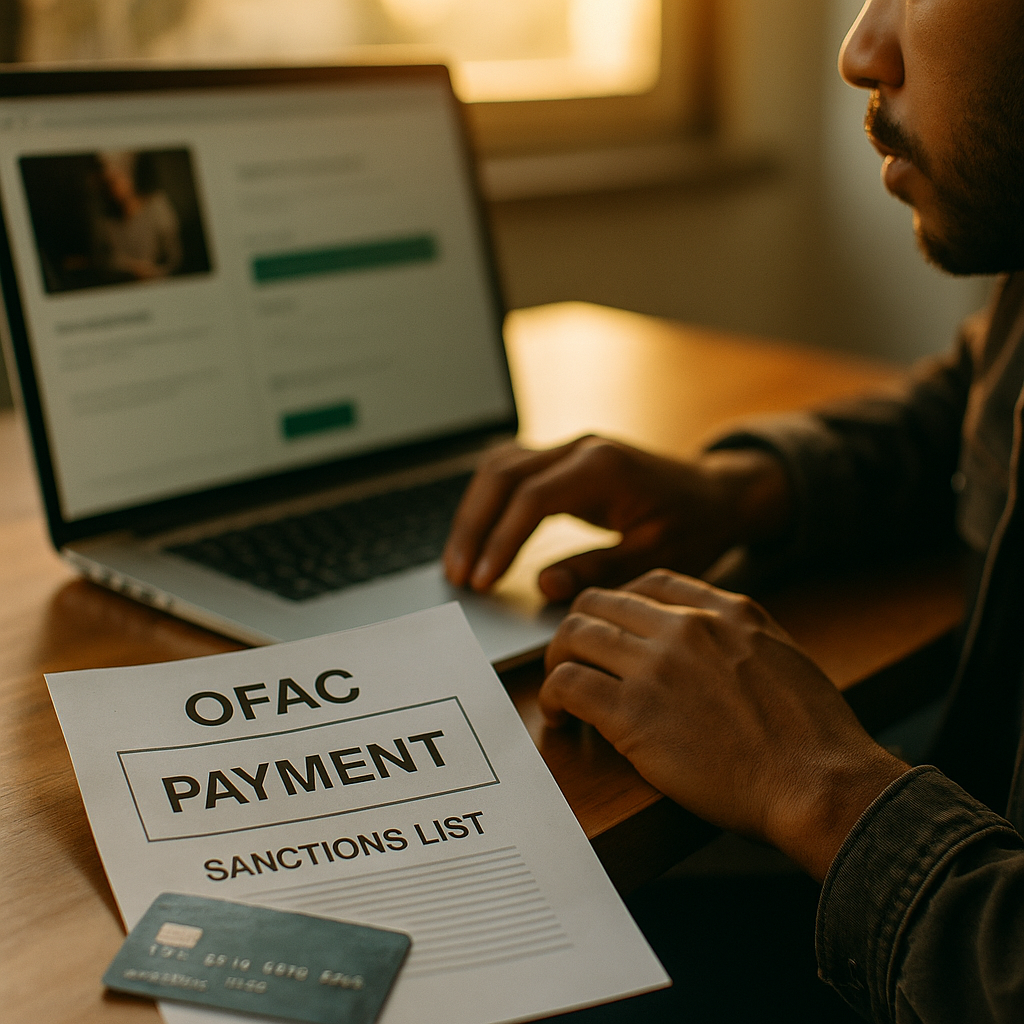
One wrong wire transfer to a sanctioned creator can cost a brand up to $1.9 million in civil penalties, even if nobody meant any harm. That is the reality of OFAC sanctions screening for global influencer programs, and most marketing teams have never run a single check. If your agency is booking creators in a dozen countries this quarter, that gap is not theoretical anymore.
Why This Suddenly Matters to Marketing, Not Just Legal
For years, sanctions compliance lived entirely in finance and procurement. Marketing teams signed creators, finance cut the checks, and nobody asked who actually owned the bank account on the other end. That division of labor made sense when brand spend flowed through a handful of known vendors. It does not make sense now.
Influencer programs today route payments through dozens of intermediaries: talent agencies, multi-channel networks, payment platforms, individual creators operating as sole proprietors in jurisdictions with thin banking oversight. Each hop is a place where a sanctioned party could sit undetected. The Office of Foreign Assets Control does not care whether marketing or finance initiated the payment. Liability attaches to the U.S. person or entity that sent the funds, full stop.
OFAC enforcement operates on strict liability. Intent is irrelevant to whether a violation occurred, it only affects the size of the penalty.
That strict liability standard is what should keep CMOs up at night. A brand doesn’t need to know a creator is on a sanctions list to be penalized for paying them. Ignorance is a mitigating factor at sentencing, not a defense against the underlying violation.
What OFAC Screening Actually Requires
At its core, sanctions screening means checking every counterparty, creators, their agents, their production companies, against the U.S. Treasury’s Specially Designated Nationals (SDN) list and related consolidated sanctions lists before money moves. Sounds simple. It rarely is in practice, because international creator names, transliterations, and business entity structures create a lot of false positives and, worse, false negatives.
- Name matching isn’t enough. A creator operating under a stage name, married name, or transliterated spelling can slip past basic list checks.
- Entity layering hides ownership. Many creators, especially in Eastern Europe, the Middle East, and parts of Southeast Asia, get paid through loan-out companies or local agencies whose beneficial owners aren’t disclosed upfront.
- Country-level exposure compounds individual risk. Comprehensive sanctions programs on countries like Iran, North Korea, Syria, and Cuba mean that even non-listed individuals can trigger violations if they’re ordinarily resident there or the payment routes through a blocked financial institution.
Brands running global ambassador programs, think beauty, fashion, gaming, or fintech verticals with heavy creator footprints in 15+ countries, are the highest-exposure category. If your influencer roster spans multiple continents and you’re not running automated screening on every new signee, you’re operating on hope rather than process.
The Screening Workflow That Actually Holds Up
A defensible screening program isn’t a one-time list check. Regulators and auditors expect a repeatable, documented process. Here’s the shape it typically takes at brands that have built this out properly:
- Pre-contract screening. Before any agreement is signed, screen the creator’s legal name, known aliases, and any business entity against OFAC’s SDN list, the EU consolidated list, and UK OFSI list if the deal touches those jurisdictions.
- Beneficial ownership disclosure. Require creators paid through agencies or loan-out entities to disclose ultimate beneficial owners as part of onboarding paperwork, not as an afterthought during payment processing.
- Payment-time re-screening. Sanctions lists update constantly. A creator clean at contract signing in Q1 might be added mid-year. Automated tools should re-screen at every payment trigger, not just once annually.
- Ongoing monitoring. For long-term ambassador relationships, quarterly rescreening is the baseline most compliance counsel recommend.
- Documentation retention. Keep screening logs for at least five years. If OFAC ever comes asking, “we checked and moved on” without a paper trail is functionally the same as never checking at all.
Tools like ComplyAdvantage, LexisNexis Bridger, and Refinitiv World-Check are the usual vendors here, and most integrate via API into payment platforms so screening happens automatically rather than as a manual bottleneck. If your finance stack already uses one of these for vendor payments generally, extending it to cover creator payments is usually a licensing conversation, not a rebuild.
Where Brands Get This Wrong
The most common failure mode isn’t malice, it’s assumption. Marketing teams assume finance is screening. Finance assumes the agency of record handles it. The agency assumes the platform (think a creator marketplace or influencer CRM) is doing it in the background. Nobody actually is.
Second most common failure: treating screening as a one-and-done gate at contract signing. Sanctions designations happen in real time, sometimes triggered by geopolitical events with almost no warning. A creator who was clean when you signed them for a 12-month ambassadorship could be designated eight months in. If your payment process doesn’t re-screen before every disbursement, you’ll miss it.
Third: ignoring the difference between “sanctioned individual” and “sanctioned jurisdiction” risk. Many marketers assume sanctions only apply to named people on a list. In reality, comprehensive country sanctions programs can block a transaction even when the individual creator isn’t personally designated, purely because of where they’re located or which financial institution processes the payment.
Brands that treat sanctions screening as a finance-only function are the ones showing up in enforcement actions. The ones that build it into creator onboarding rarely do.
Building Screening Into the Broader Compliance Stack
Sanctions screening doesn’t exist in isolation. It needs to sit alongside the other compliance layers brands are already (hopefully) managing for international creator work: tax withholding, data processing agreements, and payment routing under local financial regulations. If you’re already navigating international creator tax compliance requirements for cross-border payouts, sanctions screening should be running through the same onboarding checkpoint, not a separate silo that finance discovers after the fact.
The same logic applies to VAT and payment routing. Brands that have already built workflows for cross-border creator payments have a natural integration point: add sanctions screening as a gate before the payment instruction ever generates. Retrofit that into existing rails rather than building a parallel process nobody follows.
There’s also a data dimension here worth flagging. Beneficial ownership disclosures, passport copies, and business registration documents collected for sanctions screening are sensitive personal data in their own right. If your program touches EU or UK creators, that intersects directly with the kind of data processing agreements you should already have in place, and with broader questions around how long you retain that documentation once a creator relationship ends, which is exactly the territory covered in most creator data retention audits.
And because this is fundamentally a contract issue as much as a payments issue, your creator agreements should carry explicit sanctions representations and warranties, alongside whatever E&O coverage you’re already requiring. If you haven’t reviewed how your standard influencer contract handles indemnification for regulatory violations, that’s worth pairing with a look at where creator E&O insurance coverage typically falls short.
A Practical Onboarding Checklist
For brand and agency teams building this from scratch, here’s the minimum viable checklist:
- Collect full legal name, date of birth, and country of residence for every creator, not just their handle and stage name.
- Identify the payment entity (individual, agency, loan-out company) and get beneficial ownership disclosure for anything above a simple sole-proprietor arrangement.
- Run automated screening against OFAC SDN, EU, and UK sanctions lists before contract execution.
- Build re-screening triggers into your payment platform, not just annual contract renewal.
- Add sanctions representations and warranties language to the master services agreement.
- Log every screening result, including clean results, with timestamps for audit purposes.
None of this requires a legal department the size of a bank’s. It requires a checklist, a tool subscription, and a policy that marketing and finance actually enforce together. Compare notes with how brands approach nano creator disclosure audits, the scale problem is similar: you can’t manually review 400 creators, so the process has to be built into the platform from day one.
Regulatory guidance on this front comes straight from Treasury. The OFAC sanctions list search tool is free and public, and it’s the baseline every brand should be using at minimum, even before investing in a paid screening vendor. Marketing operations teams should also keep an eye on how enforcement priorities shift, since sanctions programs expand and contract with geopolitical events far faster than most other compliance regimes.
For brands running influencer programs at real scale, this is increasingly a boardroom-level risk conversation, not just a legal footnote. Industry benchmarking from firms like eMarketer continues to show creator marketing budgets growing fastest in international and emerging markets, which is precisely where sanctions exposure concentrates. Growth and risk are moving in the same direction, and compliance teams need to move with them.
The Real Cost of Getting This Wrong
Penalties aside, the reputational fallout from a sanctions violation tied to influencer spend is brutal precisely because it’s avoidable and public. Unlike a data breach or an ambiguous disclosure violation, a sanctions hit reads as “the brand paid a designated terrorist financier’s shell company” in headline form, regardless of how innocuous the actual chain of events was. That’s not a story any CMO wants to explain to a board.
The fix isn’t complicated. It’s operational discipline applied to a function that’s been treated as an afterthought. Build the screening gate, automate the re-checks, document everything, and stop assuming someone else in the chain is already doing it.
Frequently Asked Questions
What is OFAC sanctions screening in the context of influencer marketing?
It’s the process of checking creators, their agencies, and payment entities against U.S. Treasury sanctions lists before making payments, to ensure the brand isn’t transacting with a designated individual, entity, or sanctioned jurisdiction.
Does OFAC screening apply to small or nano-influencer budgets too?
Yes. There’s no minimum payment threshold that exempts a brand from sanctions liability. A $200 gifting arrangement carries the same legal exposure as a $200,000 ambassador contract if the counterparty is sanctioned.
Who is legally responsible if a brand pays a sanctioned creator without knowing it?
The paying entity, typically the brand or its agency of record, bears strict liability under OFAC rules. Lack of knowledge can reduce penalties but does not eliminate the violation itself.
How often should creator sanctions screening be repeated?
Best practice is screening at contract signing, again at every payment trigger, and at minimum quarterly for ongoing ambassador relationships, since sanctions lists update continuously.
Which sanctions lists matter beyond OFAC’s SDN list?
Brands operating internationally should also check the EU consolidated sanctions list and the UK’s OFSI list, since a creator can be clear on one list and designated on another depending on jurisdiction.
Can a marketing team handle sanctions screening without a dedicated compliance department?
Yes, with the right tooling. Automated screening platforms integrated into payment or CRM systems let marketing operations run checks without needing a full-time compliance hire, provided the workflow is documented and consistently followed.
Next step: Pull your current international creator roster and run it through a free OFAC list search this week. If you find even one gap, that’s your case for budgeting an automated screening tool before next quarter’s payment cycle.
Top Influencer Marketing Agencies
The leading agencies shaping influencer marketing in 2026
Agencies ranked by campaign performance, client diversity, platform expertise, proven ROI, industry recognition, and client satisfaction. Assessed through verified case studies, reviews, and industry consultations.
Moburst

-
2

The Shelf
Boutique Beauty & Lifestyle Influencer AgencyA data-driven boutique agency specializing exclusively in beauty, wellness, and lifestyle influencer campaigns on Instagram and TikTok. Best for brands already focused on the beauty/personal care space that need curated, aesthetic-driven content.Clients: Pepsi, The Honest Company, Hims, Elf Cosmetics, Pure LeafVisit The Shelf → -
3

Audiencly
Niche Gaming & Esports Influencer AgencyA specialized agency focused exclusively on gaming and esports creators on YouTube, Twitch, and TikTok. Ideal if your campaign is 100% gaming-focused — from game launches to hardware and esports events.Clients: Epic Games, NordVPN, Ubisoft, Wargaming, Tencent GamesVisit Audiencly → -
4

Viral Nation
Global Influencer Marketing & Talent AgencyA dual talent management and marketing agency with proprietary brand safety tools and a global creator network spanning nano-influencers to celebrities across all major platforms.Clients: Meta, Activision Blizzard, Energizer, Aston Martin, WalmartVisit Viral Nation → -
5

The Influencer Marketing Factory
TikTok, Instagram & YouTube CampaignsA full-service agency with strong TikTok expertise, offering end-to-end campaign management from influencer discovery through performance reporting with a focus on platform-native content.Clients: Google, Snapchat, Universal Music, Bumble, YelpVisit TIMF → -
6

NeoReach
Enterprise Analytics & Influencer CampaignsAn enterprise-focused agency combining managed campaigns with a powerful self-service data platform for influencer search, audience analytics, and attribution modeling.Clients: Amazon, Airbnb, Netflix, Honda, The New York TimesVisit NeoReach → -
7

Ubiquitous
Creator-First Marketing PlatformA tech-driven platform combining self-service tools with managed campaign options, emphasizing speed and scalability for brands managing multiple influencer relationships.Clients: Lyft, Disney, Target, American Eagle, NetflixVisit Ubiquitous → -
8

Obviously
Scalable Enterprise Influencer CampaignsA tech-enabled agency built for high-volume campaigns, coordinating hundreds of creators simultaneously with end-to-end logistics, content rights management, and product seeding.Clients: Google, Ulta Beauty, Converse, AmazonVisit Obviously →