


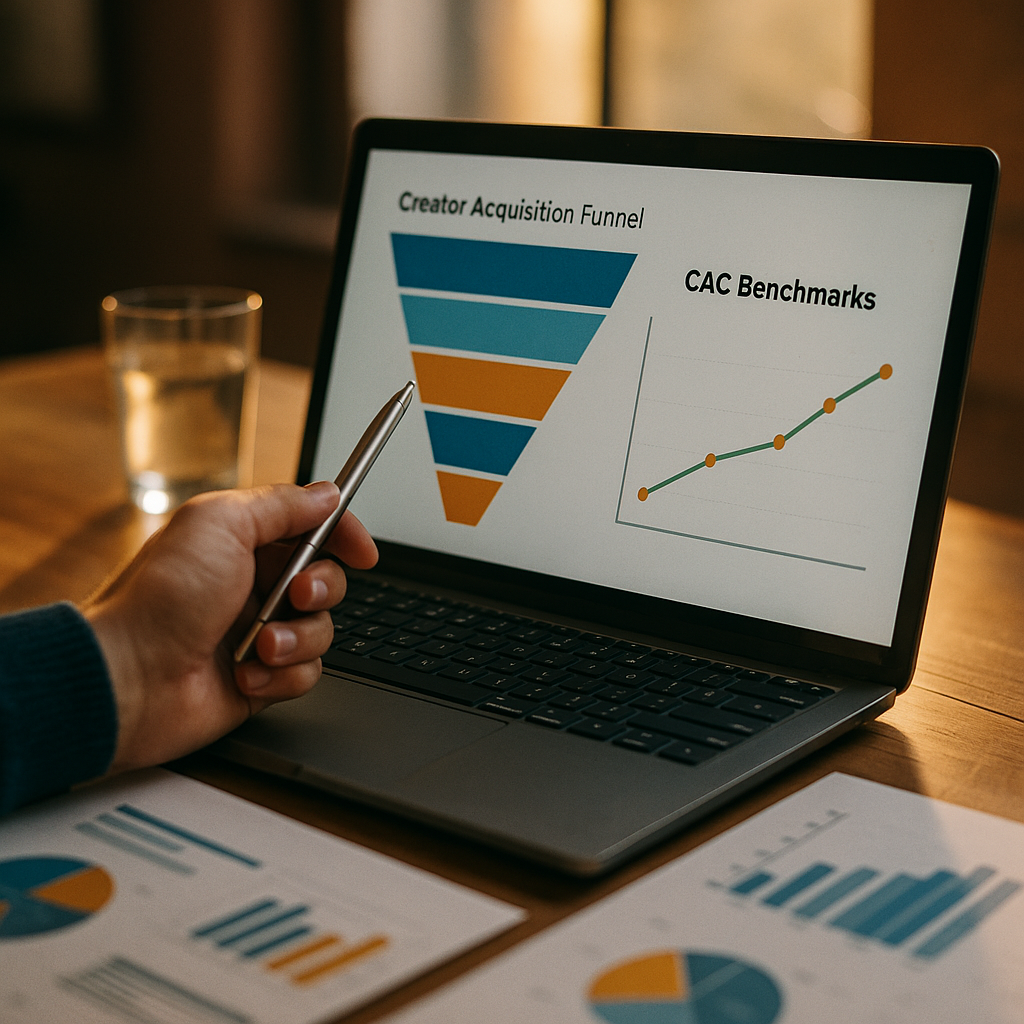
Most brands can tell you their paid search CAC to the penny. Ask the same team what it costs to acquire a customer through creators, and you get a shrug or a vanity metric dressed up as an answer. That gap is costing budgets. A defined creator acquisition funnel with real CAC benchmarks is the difference between influencer marketing treated as a growth channel and influencer marketing treated as a rounding error nobody can defend at renewal time.
What Counts as CAC in a Creator Funnel?
Customer acquisition cost sounds simple until you try to calculate it for influencer programs. Is it just the creator fee? Does it include the agency markup, the affiliate commission stack, the platform ad spend boosting the post, and the internal hours spent vetting and briefing? Most finance teams want a fully loaded number. Most marketing teams report a partial one. That mismatch is where trust erodes.
A workable definition: total creator program spend for a given period (fees, gifting, commissions, whitelisting or boosting spend, and a reasonable allocation of management overhead) divided by net new customers directly attributable to that spend. Attribution is the hard part, and we’ll get to it, but the formula itself isn’t controversial. What’s controversial is that so few brands actually run it consistently.
If your creator CAC calculation excludes agency fees or platform boosting spend, you’re not measuring cost per acquisition. You’re measuring cost per creator fee, and finance will eventually notice the difference.
The Funnel Stages Where CAC Actually Gets Decided
Treat creator acquisition like any performance funnel: awareness, consideration, conversion, retention. CAC isn’t set at the bottom of the funnel. It’s set by decisions made at the top.
- Creator selection: Niche alignment and audience quality predict conversion rate before a single dollar is spent. Brands that skip this step and chase follower count end up with inflated CAC no amount of optimization can fix later.
- Offer and CTA design: A vague “check it out” link converts worse than a coded, time-boxed offer. This single variable can swing CAC by 30 to 50 percent across otherwise identical creator briefs.
- Landing experience: Sending creator traffic to a generic homepage instead of a matched landing page is one of the most common (and cheapest to fix) CAC killers.
- Attribution window: A seven-day window undercounts influencer-driven sales, since creator content often has a longer consideration tail than paid social. A thirty-day window is more realistic for considered purchases.
Get the top of the funnel wrong and no benchmark will save you. This is why teams that rely on a niche alignment scoring model before signing creators consistently report tighter CAC ranges than teams that select on reach alone.
What Benchmark Numbers Actually Look Like
Nobody publishes a universal creator CAC benchmark because it varies wildly by vertical, average order value, and creator tier. But directional ranges exist, and they’re useful for a gut check.
- Beauty and personal care (DTC): Creator-driven CAC often lands 15 to 25 percent below paid social CAC when nano and micro tiers dominate the mix.
- Apparel and accessories: CAC tends to sit close to blended paid social, but with meaningfully better retention and repeat purchase rate.
- SaaS and subscription products: Creator CAC often runs higher upfront but amortizes faster over customer lifetime, since trust-based referrals churn less.
- High-ticket or considered purchases: CAC benchmarks are less reliable here because sales cycles stretch past standard attribution windows, making a hold-out approach more useful than last-click math.
Industry data from eMarketer and Statista consistently shows influencer channels reporting lower blended CAC than paid social in categories with high emotional or trust components, but the variance between individual brands within the same category is enormous. That variance is exactly why internal benchmarking matters more than industry averages. Your own historical CAC, segmented by creator tier, is a far better predictor of next quarter’s performance than a category-wide statistic.
Tier Mix Is Your Biggest CAC Lever
This is where most of the CAC conversation actually lives. Mega and macro creators generate reach efficiently but convert at lower rates per dollar spent, which drags CAC upward. Nano and micro creators convert better per dollar but require more operational overhead to manage at scale, which drags CAC in the opposite direction through hidden labor costs.
The fix isn’t picking a winner. It’s building a deliberate mix and tracking CAC by tier separately rather than blending everything into one misleading average. Brands using a creator tier allocation model to split spend intentionally, rather than defaulting to whoever pitches loudest, report far more predictable CAC quarter over quarter.
Blending CAC across every creator tier into one number hides the story. A macro creator campaign with a 40 dollar CAC and a nano creator campaign with a 12 dollar CAC average out to 26 dollars, and that average tells you nothing useful about where to spend next.
For a deeper breakdown of how nano and micro economics actually stack up against each other on a budget basis, see this nano vs micro creator ROI comparison, which walks through the math most spreadsheets get wrong.
Promo Codes and Affiliate Links: Your Cleanest CAC Signal
If you’re not using unique promo codes or trackable affiliate links per creator, your CAC math is a guess dressed up as a metric. Codes solve two problems at once: they give you clean attribution and they give creators a performance incentive that improves conversion behavior on their end too.
Set expected lift targets before the campaign starts, not after, so you have a real benchmark to measure against rather than reverse-engineering a story from whatever numbers come in. A structured approach to promo code lift targets forecasted before signing gives finance a number to hold you to, which is exactly the kind of accountability that earns bigger budgets later.
For channels where codes aren’t practical (branded content on YouTube, for example, where a hard sell feels out of place), a hold out experiment comparing exposed versus unexposed audiences remains the most statistically honest way to isolate incremental CAC.
Where CAC Benchmarks Break Down in Practice
Three failure modes show up again and again:
- Attribution greed: Crediting every sale within a bloated window to influencer touch, inflating apparent efficiency and setting a benchmark that collapses the moment finance audits it.
- Fee-only accounting: Ignoring platform boosting spend, affiliate commissions, or agency markup, which understates true CAC and sets an unrealistic bar for future campaigns.
- Ignoring payment structure: Flat fee deals and performance-based deals produce structurally different CAC curves. Comparing them on the same benchmark without adjusting for structure is comparing apples to invoices.
Performance-linked compensation, in particular, changes the entire CAC conversation. When a creator is paid partly on outcomes rather than a flat rate, CAC becomes a shared risk rather than a sunk cost. Brands shifting toward revenue based SLAs report cleaner CAC benchmarks precisely because the payment structure forces both sides to agree on what counts as a conversion before the campaign even launches.
Setting a Benchmark That Survives a Finance Review
A CAC benchmark is only useful if it holds up when a CFO asks pointed questions. That means:
- Document your attribution window and defend it with a rationale, not a preference.
- Segment CAC by creator tier, category, and payment structure so the number can’t be gamed by mixing cheap wins with expensive experiments.
- Set a target range, not a single number, since creator performance has natural variance that a rigid figure will misrepresent.
- Reforecast quarterly as rates shift and platform algorithms change reach dynamics.
Tools like HubSpot and Sprout Social can help stitch attribution data together, and platform-native reporting from TikTok Ads Manager is increasingly useful for isolating spark ads and boosted creator content from organic reach. None of these tools replace a clear internal definition of CAC, but they make the data collection far less painful.
This kind of rigor also pays off outside the marketing team. A benchmark built on clean, segmented data is much easier to present in a board level reporting format, and it holds up far better under scrutiny than a single blended number pulled together the week before a budget meeting.
Frequently Asked Questions
FAQs
What is a good CAC for influencer marketing?
There’s no universal good number. A useful benchmark is your creator CAC compared against your own paid social and paid search CAC over the same period, segmented by creator tier. Directionally, nano and micro creator campaigns often land 15 to 25 percent below paid social CAC in categories with strong trust or emotional purchase drivers.
How do you calculate CAC for a creator campaign?
Add total fully loaded spend (creator fees, agency markup, commissions, boosting spend, and a reasonable share of management overhead) and divide by net new customers directly attributable within your defined attribution window.
Should CAC include agency fees and platform boosting spend?
Yes. Excluding these costs produces an artificially low number that won’t survive a finance review and sets unrealistic expectations for future campaigns.
What attribution window should brands use for influencer CAC?
Seven days is common for impulse purchases but often undercounts considered purchases. Thirty days is more realistic for most categories, and hold out experiments are more reliable than any fixed window for high-ticket or long-cycle products.
Why does creator tier affect CAC benchmarks so much?
Different tiers convert at different rates per dollar and carry different management overhead. Blending all tiers into one average CAC hides which segment is actually performing, making it harder to optimize spend allocation going forward.
Next step: Pull your last two quarters of creator spend, segment it by tier and payment structure, and calculate CAC separately for each segment before your next budget conversation. A blended average will not survive the questions you’re about to get asked.
Top Influencer Marketing Agencies
The leading agencies shaping influencer marketing in 2026
Agencies ranked by campaign performance, client diversity, platform expertise, proven ROI, industry recognition, and client satisfaction. Assessed through verified case studies, reviews, and industry consultations.
Moburst

-
2

The Shelf
Boutique Beauty & Lifestyle Influencer AgencyA data-driven boutique agency specializing exclusively in beauty, wellness, and lifestyle influencer campaigns on Instagram and TikTok. Best for brands already focused on the beauty/personal care space that need curated, aesthetic-driven content.Clients: Pepsi, The Honest Company, Hims, Elf Cosmetics, Pure LeafVisit The Shelf → -
3

Audiencly
Niche Gaming & Esports Influencer AgencyA specialized agency focused exclusively on gaming and esports creators on YouTube, Twitch, and TikTok. Ideal if your campaign is 100% gaming-focused — from game launches to hardware and esports events.Clients: Epic Games, NordVPN, Ubisoft, Wargaming, Tencent GamesVisit Audiencly → -
4

Viral Nation
Global Influencer Marketing & Talent AgencyA dual talent management and marketing agency with proprietary brand safety tools and a global creator network spanning nano-influencers to celebrities across all major platforms.Clients: Meta, Activision Blizzard, Energizer, Aston Martin, WalmartVisit Viral Nation → -
5

The Influencer Marketing Factory
TikTok, Instagram & YouTube CampaignsA full-service agency with strong TikTok expertise, offering end-to-end campaign management from influencer discovery through performance reporting with a focus on platform-native content.Clients: Google, Snapchat, Universal Music, Bumble, YelpVisit TIMF → -
6

NeoReach
Enterprise Analytics & Influencer CampaignsAn enterprise-focused agency combining managed campaigns with a powerful self-service data platform for influencer search, audience analytics, and attribution modeling.Clients: Amazon, Airbnb, Netflix, Honda, The New York TimesVisit NeoReach → -
7

Ubiquitous
Creator-First Marketing PlatformA tech-driven platform combining self-service tools with managed campaign options, emphasizing speed and scalability for brands managing multiple influencer relationships.Clients: Lyft, Disney, Target, American Eagle, NetflixVisit Ubiquitous → -
8

Obviously
Scalable Enterprise Influencer CampaignsA tech-enabled agency built for high-volume campaigns, coordinating hundreds of creators simultaneously with end-to-end logistics, content rights management, and product seeding.Clients: Google, Ulta Beauty, Converse, AmazonVisit Obviously →