


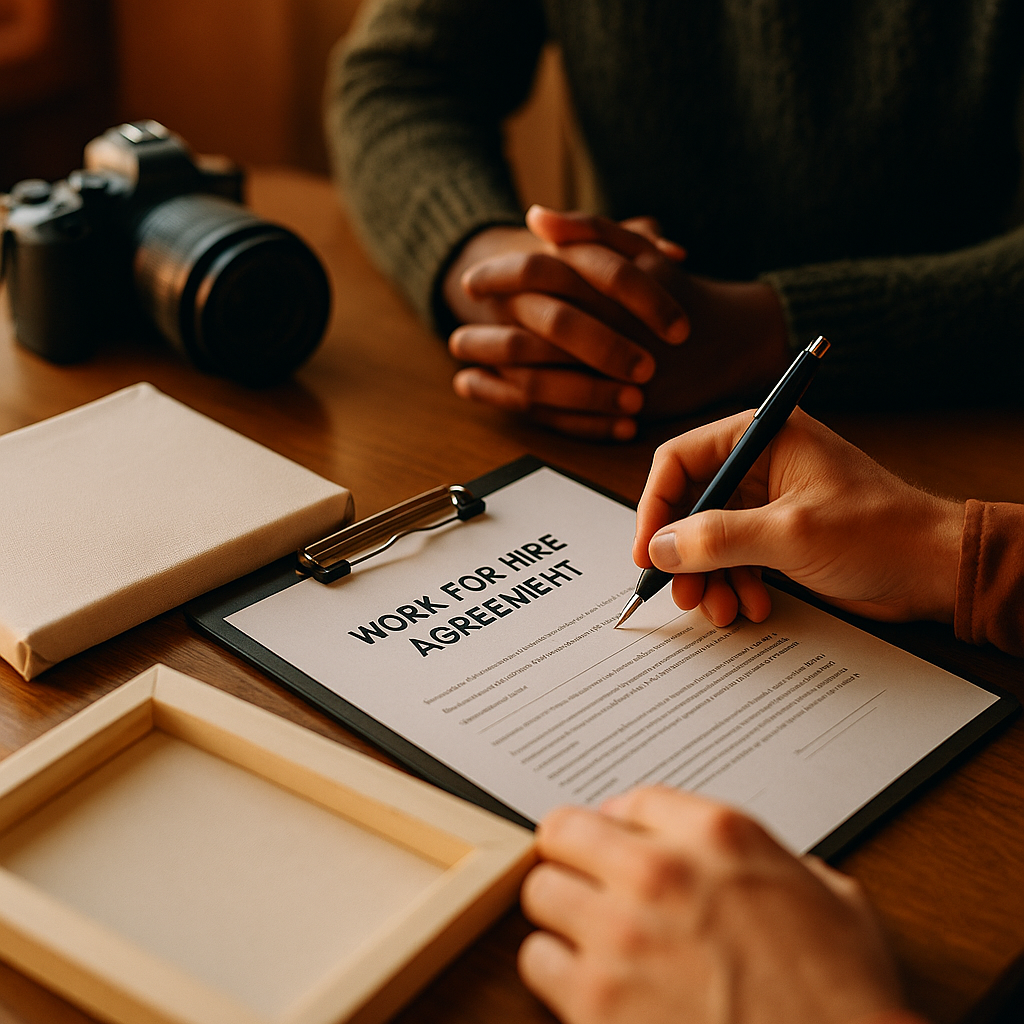
Sixty percent of brands running TikTok Canvas campaigns cannot produce a signed IP assignment for the actor content sitting in their ad libraries right now. That is not a compliance footnote. It is a landmine sitting under every media dollar spent boosting that content. A work for hire agreement is the single document standing between “we own this creative” and “we are licensing someone else’s copyright indefinitely.” Most marketing teams treat it as boilerplate. It is not.
The Ownership Assumption That Is Quietly Wrong
Here is the trap. A brand hires a Canvas UGC actor through a casting platform, gets a polished vertical video, drops it into TikTok’s Smart Creative or Spark Ads, and moves on. Everyone assumes the brand owns the footage because, well, they paid for it. Under U.S. copyright law, that assumption is dead wrong unless specific conditions are met.
Copyright ownership defaults to the creator, not the payer. The “work for hire” doctrine is the narrow legal exception that flips that default, but it only applies in two scenarios: the creator is a bona fide employee acting within scope of employment, or the work fits one of nine statutory categories (audiovisual contributions being one) and both parties sign a written agreement stating explicitly that it is a work made for hire. Miss either condition, and the brand holds, at best, an implied license. Not ownership.
Without a signed work for hire clause and a matching assignment fallback, a brand paying $500 for a Canvas UGC video may have purchased nothing more than a temporary right to run it once.
That distinction matters enormously once the content performs. If a 15-second Canvas clip becomes a top-performing ad and the brand wants to repurpose it across YouTube Shorts, retarget it for eighteen months, or license it to a retail partner, the actor’s original consent (often scoped to a single platform, single use, thirty-day window) does not stretch to cover that. For a deeper look at how licensing scope gaps create liability even when a contract exists, see our breakdown of the contract clauses you need for Canvas licensing.
Why Canvas UGC Actors Are a Special Case
TikTok Canvas connects brands with actors who perform scripted, ad-style content designed to look native but function as paid creative. Unlike a typical creator partnership where the influencer posts organically from their own handle, Canvas actors are hired specifically to produce a deliverable that the brand then owns and distributes as an ad unit. This is functionally closer to a commercial production shoot than an influencer collaboration, yet most brands still use influencer-style contracts (or worse, casting platform default terms) to govern the relationship.
That mismatch is the root of the IP ownership gap. Influencer agreements are built around license grants: the creator retains ownership and grants the brand a usage license. Production agreements are built around assignment: the studio owns the output outright. Canvas UGC actor deals need to function like the latter, but they are frequently drafted, or not drafted at all, like the former.
Casting marketplaces make this worse by design. Many platforms auto-generate a generic release when an actor accepts a brief, and that release rarely survives legal scrutiny. It typically grants “use of the content for marketing purposes” without specifying duration, territory, paid media rights, or derivative works. That is a license, not a transfer of ownership, and it is almost never framed as a proper work for hire agreement under the statutory definition.
What a Compliant Work for Hire Agreement Actually Requires
Getting this right is not complicated, but it does require specificity. A defensible agreement for Canvas UGC actors should include:
- Explicit work for hire language. The contract must state the content is a “work made for hire” under the Copyright Act’s audiovisual works category, and the actor must sign acknowledging that classification.
- A fallback assignment clause. Because courts sometimes reject work for hire classification on technical grounds, every agreement should include a backup clause where the actor assigns all rights, title, and interest to the brand regardless of classification outcome.
- Waiver of moral rights where jurisdiction allows, so the actor cannot later object to edits, recontextualization, or removal of attribution.
- Name, image, and likeness (NIL) release covering all media formats and durations, not just the original platform.
- Compensation tied to the assignment, not just the shoot day. Courts look at whether payment reflects full ownership transfer, not just a service fee.
Skip the fallback assignment clause at your own risk. It is the single most litigated gap in creator content disputes. If a court finds the work for hire designation invalid (which happens more often than brands expect, particularly with independent contractors), the assignment clause is what saves the ownership claim. For guidance on how these clauses interact with paid usage terms, our piece on scripted hook liability covers the adjacent risk of unreviewed script content compounding the ownership problem.
Where This Collides With FTC Disclosure Rules
IP ownership and disclosure compliance are separate legal issues, but they intersect constantly in Canvas campaigns. If a brand owns the content outright and repurposes it as a straightforward paid ad, FTC disclosure obligations shift compared to when the same content runs as if it were organic creator content. Brands that treat owned, paid-media Canvas assets the same way they treat organic UGC often stumble into disclosure gaps the FTC has flagged repeatedly in enforcement guidance. We covered the disclosure side of this in detail in closing the FTC disclosure gap, and the script-level compliance angle in drafting disclosures that hold up.
The practical takeaway: fixing ownership does not fix disclosure, and fixing disclosure does not fix ownership. Legal and brand teams need both agreements reviewed together, ideally by the same counsel, so the work for hire language and the disclosure language do not contradict each other.
The Repurposing Problem Nobody Budgets For
Say the brand did everything right. Signed work for hire agreement, clean assignment, moral rights waived. Six months later, the creative team wants to cut that Canvas video into three shorter variants for a retargeting push on a different platform. Does the original agreement cover derivative edits? If the agreement only grants rights to “the delivered video,” recutting it into new assets may fall outside scope and reopen the ownership question entirely.
This is why the strongest agreements explicitly grant rights to “the content and all derivative works, edits, and excerpts thereof, in any format now known or later developed.” That last phrase matters more than it sounds. Marketing teams in the era of AI-generated ad variants and automated creative testing are already cutting UGC into dozens of micro-versions through tools tied into TikTok’s ad platform and similar systems. An agreement drafted five years ago that did not anticipate AI-assisted editing could leave every one of those derivative cuts unlicensed.
If your work for hire agreement does not mention derivative works and future formats, assume it does not cover the AI-edited variants your creative team is already running.
Related to this is the indemnification question: who is liable if a repurposed clip triggers a claim from the actor later? That risk allocation deserves its own review, and we go deeper on it in closing the coverage gap on repurposed UGC indemnification.
Auditing What You Already Have
Before drafting new agreements, most legal and marketing teams need to audit existing Canvas content sitting in ad libraries. This is tedious but necessary. Pull every actor agreement tied to currently running or recently paused Canvas ads and check for three things: does it explicitly say “work made for hire,” does it include a fallback assignment clause, and does it cover the platforms and formats where the content is actually running today versus where it was originally scoped to run.
Content marketing platforms like HubSpot and social analytics tools such as Sprout Social can help teams inventory where UGC assets are actually deployed across channels, which is often the first step in discovering scope mismatches. Data from eMarketer continues to show accelerating creator ad spend, which means the volume of unaudited agreements is growing faster than most legal teams can review them.
Building a repeatable audit process rather than a one-time cleanup is the only sustainable answer. Our framework for scaling this kind of review is laid out in building a framework that scales legal, which walks through prioritizing high-spend assets first.
Fixing the Gap Going Forward
For new Canvas engagements, the fix is procedural, not just legal. Route every Canvas actor agreement through a standardized template that includes work for hire language, assignment fallback, and derivative rights before any brief goes out. Do not rely on casting platform defaults. Treat the actor relationship as a production hire, not an influencer collaboration, because that is functionally what it is.
Brands running high volumes of Canvas content should also build a lightweight approval gate: no video enters paid media rotation until legal confirms the underlying agreement includes proper ownership language. This adds a day or two to launch timelines. It is far cheaper than a takedown demand or a licensing dispute six months into a campaign flight.
Next step: pull your three highest-spend Canvas ads today, check the underlying actor agreements for explicit work for hire and assignment language, and flag anything missing before your next budget cycle locks in media spend against unowned creative.
FAQs
What is the difference between a work for hire agreement and a licensing agreement for UGC actors?
A work for hire agreement transfers copyright ownership of the content to the brand outright. A licensing agreement lets the actor retain ownership while granting the brand permission to use the content under specific, limited terms. Brands that only have a license cannot claim full ownership even if they paid for production.
Does paying a Canvas UGC actor automatically give the brand ownership of the video?
No. Payment alone does not transfer copyright. Ownership only transfers if the agreement explicitly states the work is made for hire under the statutory definition, or includes a separate assignment clause transferring rights regardless of that classification.
What happens if a brand repurposes Canvas UGC without proper rights?
The brand risks a claim from the actor for unauthorized use, which can result in takedown demands, retroactive licensing fees, or litigation. This is especially likely when content originally scoped for one platform or a limited window gets reused across other channels or extended media flights.
Are casting platform default contracts sufficient for Canvas UGC deals?
Usually not. Most default templates grant a broad but vague usage license rather than a proper work for hire designation with a fallback assignment clause. Brands running significant paid media against this content should replace default terms with a reviewed, brand-specific agreement.
Do work for hire agreements need to address AI-edited or derivative versions of the content?
Yes. Agreements should explicitly cover derivative works, edits, and future formats. Without that language, AI-generated ad variants or recut versions of the original video may fall outside the scope of what the actor originally agreed to.
Top Influencer Marketing Agencies
The leading agencies shaping influencer marketing in 2026
Agencies ranked by campaign performance, client diversity, platform expertise, proven ROI, industry recognition, and client satisfaction. Assessed through verified case studies, reviews, and industry consultations.
Moburst

-
2

The Shelf
Boutique Beauty & Lifestyle Influencer AgencyA data-driven boutique agency specializing exclusively in beauty, wellness, and lifestyle influencer campaigns on Instagram and TikTok. Best for brands already focused on the beauty/personal care space that need curated, aesthetic-driven content.Clients: Pepsi, The Honest Company, Hims, Elf Cosmetics, Pure LeafVisit The Shelf → -
3

Audiencly
Niche Gaming & Esports Influencer AgencyA specialized agency focused exclusively on gaming and esports creators on YouTube, Twitch, and TikTok. Ideal if your campaign is 100% gaming-focused — from game launches to hardware and esports events.Clients: Epic Games, NordVPN, Ubisoft, Wargaming, Tencent GamesVisit Audiencly → -
4

Viral Nation
Global Influencer Marketing & Talent AgencyA dual talent management and marketing agency with proprietary brand safety tools and a global creator network spanning nano-influencers to celebrities across all major platforms.Clients: Meta, Activision Blizzard, Energizer, Aston Martin, WalmartVisit Viral Nation → -
5

The Influencer Marketing Factory
TikTok, Instagram & YouTube CampaignsA full-service agency with strong TikTok expertise, offering end-to-end campaign management from influencer discovery through performance reporting with a focus on platform-native content.Clients: Google, Snapchat, Universal Music, Bumble, YelpVisit TIMF → -
6

NeoReach
Enterprise Analytics & Influencer CampaignsAn enterprise-focused agency combining managed campaigns with a powerful self-service data platform for influencer search, audience analytics, and attribution modeling.Clients: Amazon, Airbnb, Netflix, Honda, The New York TimesVisit NeoReach → -
7

Ubiquitous
Creator-First Marketing PlatformA tech-driven platform combining self-service tools with managed campaign options, emphasizing speed and scalability for brands managing multiple influencer relationships.Clients: Lyft, Disney, Target, American Eagle, NetflixVisit Ubiquitous → -
8

Obviously
Scalable Enterprise Influencer CampaignsA tech-enabled agency built for high-volume campaigns, coordinating hundreds of creators simultaneously with end-to-end logistics, content rights management, and product seeding.Clients: Google, Ulta Beauty, Converse, AmazonVisit Obviously →