


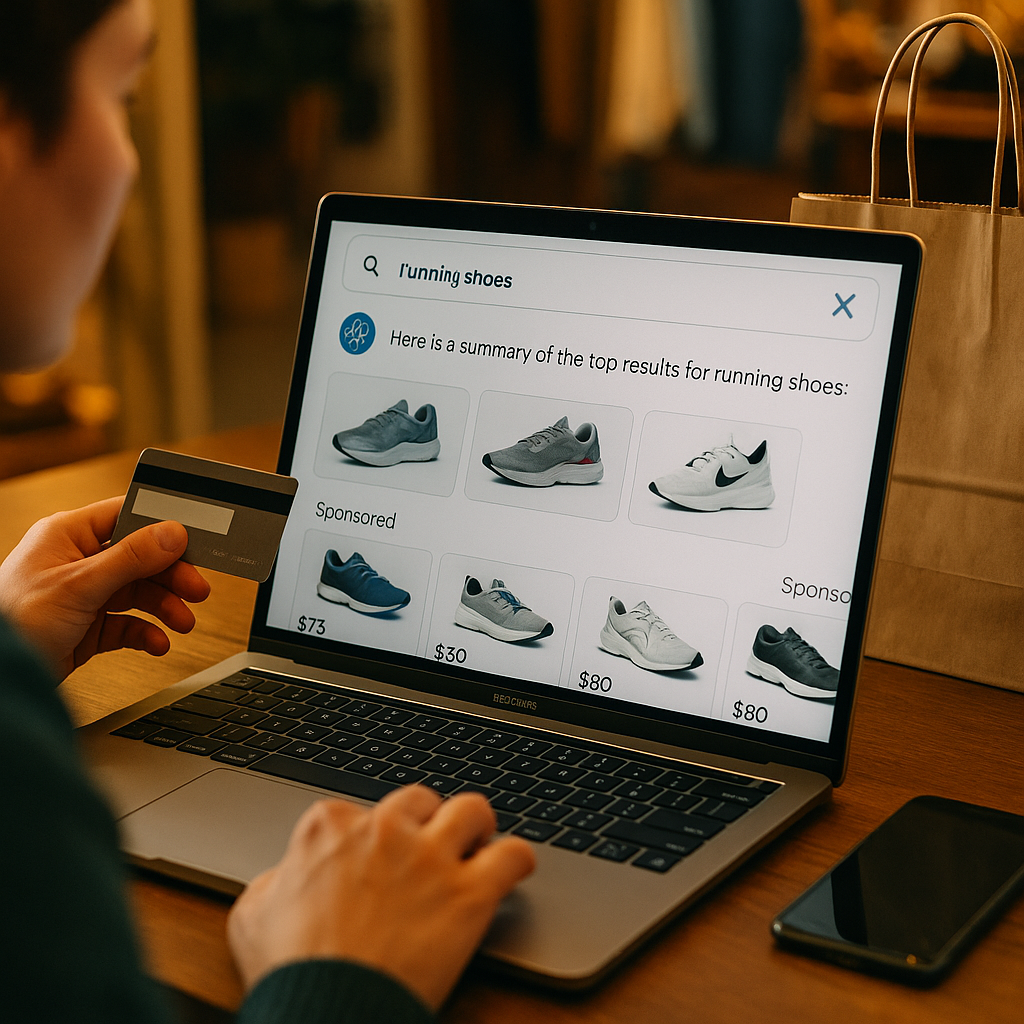
Nearly 60% of product searches now trigger an AI-generated summary before a single sponsored listing loads, according to recent tracking from eMarketer. If your retail media plan still treats Amazon DSP and Walmart Connect as the whole game, you’re already behind. GEO, generative engine optimization, is forcing brands to rethink where every retail media dollar goes.
This isn’t a future problem. It’s a budget line item right now, and finance teams are asking marketers to justify it.
What GEO Actually Means for Retail Media Spend
Generative engine optimization is the practice of shaping product content, reviews, and structured data so AI systems like Google AI Overviews, Perplexity, and ChatGPT shopping surface your brand in a generated answer instead of a competitor’s. Think of it as SEO’s successor, except the “search engine results page” has been replaced by a single synthesized paragraph with maybe three product mentions.
That shift matters enormously for retail media, because retail media was built on the logic of auction based placement. You bid on a keyword or a shelf position, you win impressions, you measure clicks. AI search collapses that funnel. There’s no auction for a spot inside an AI Overview. There’s no guaranteed placement inside a Perplexity shopping answer. Influence there is earned through content quality, structured data, and trust signals, not bid price.
Retail media dollars spent on winning an auction are worthless if the shopper never sees the auction because an AI assistant already answered the question.
Brands are responding by splitting budgets into two buckets: traditional retail media (still necessary, still driving bottom funnel conversion) and GEO investment (content, schema, review generation, and AI readable product feeds). The second bucket barely existed eighteen months ago. Now it’s eating 10 to 15% of some retail media budgets at enterprise CPG and electronics brands, based on conversations with agency buyers tracking the shift.
Why the Old Playbook Is Breaking
Sponsored product listings assume a human is scrolling and clicking. AI search assumes the assistant has already done the scrolling for them. Perplexity, Copilot, and Google’s AI Overviews are increasingly answering “best budget blender” or “which running shoe for flat feet” queries directly, pulling from aggregated reviews, spec sheets, and third party comparison content rather than paid placements.
That means the brands winning in AI search are the ones with the cleanest, most structured, most frequently cited product information, not necessarily the ones with the biggest media budgets. It’s a leveling event, and it’s uncomfortable for teams whose entire retail media strategy has been “outspend the competitor on the same keywords.”
The Attribution Problem Gets Worse, Not Better
Marketers already struggle to prove ROI on influencer and content spend. 61% of CMOs say they can’t measure ROI even as budgets climb. Now layer in AI search, where a shopper might read an AI generated summary, never click through, and still walk into a store three days later. That’s a dark funnel inside a dark funnel.
Last click attribution was already failing creator driven journeys, as covered in our piece on last click attribution failures. AI search compounds the issue because there’s frequently no click at all to attribute. Google itself has acknowledged the measurement gap around AI Overviews in its Search support documentation, pointing advertisers toward broader conversion modeling rather than single touch tracking.
Practical fix: pair GEO content investment with incrementality testing rather than channel level attribution. Run geographic or audience holdouts to see if markets with heavier GEO investment show lift in branded search volume and in store foot traffic, even without a clean click path. It’s imperfect, but it’s more honest than pretending a last click model still works.
Where the Budget Is Actually Moving
Three reallocations are showing up consistently in client conversations and agency RFPs this year:
- From sponsored search to structured content. Brands are funding product feed optimization, schema markup, and detailed spec sheets built specifically to be machine readable, not just human skimmable.
- From broad influencer seeding to review depth. AI engines weight verified, detailed reviews heavily. Brands are paying creators for long form, specific product reviews rather than quick unboxing content, because that’s what gets cited in AI answers.
- From platform specific media buys to omnichannel presence. AI assistants pull from Reddit threads, YouTube comments, and third party comparison sites as much as retailer product pages. A single retailer media buy no longer covers the surfaces that matter.
This mirrors a broader pattern already playing out in influencer marketing, where creator content shifts have forced a paid media rebuild. GEO is simply the retail media version of the same reckoning: the content layer is now doing work the media layer used to do alone.
Is Retail Media Dying? No, But It’s Getting Narrower
Let’s be clear: retail media isn’t disappearing. Amazon’s ad business alone pulled in tens of billions last year, and that number isn’t shrinking. What’s shrinking is retail media’s share of the total discovery journey. Shoppers increasingly start with an AI assistant and only land on a retailer’s paid placement near the end, if at all.
That means retail media budgets are getting more defensive and more bottom funnel. Brands are pulling back on broad awareness buys and concentrating spend on retargeting shoppers who’ve already shown intent, often through search or an AI referred visit. It’s a tighter, more expensive funnel, and it rewards brands that have already won the AI search conversation upstream.
The brands winning retail media budgets this year aren’t the ones spending more. They’re the ones who’ve already earned a mention before the shopper ever opens the retailer’s app.
Compliance and Trust Are Now a GEO Problem Too
AI engines are notoriously bad at distinguishing paid content from organic content when the source material is thin or synthetic. That creates a real risk: brands flooding the web with low quality, AI generated product copy to game GEO rankings are instead getting flagged as unreliable sources, which erodes brand trust at exactly the moment they need credibility most.
The FTC has already signaled it’s watching how brands disclose sponsored content and influencer relationships, and that scrutiny extends naturally to AI generated reviews and content farms built purely to influence AI search rankings. Brands should treat GEO content the same way they treat influencer disclosure: transparent, verifiable, and defensible under review. See the FTC’s endorsement guidelines for the baseline compliance standard, then build GEO content practices on top of it, not around it.
This is also why platform consolidation matters. Brands managing GEO, retail media, and influencer compliance across a dozen disconnected tools are exposed to more risk, not less. The argument for choosing integrated platforms over point solutions gets stronger every time a new discovery surface, like AI search, gets added to the mix.
Building the GEO Line Item Into Next Year’s Plan
Finance teams want a clean justification before they approve a new budget category, and “AI search is a thing now” won’t survive a budget review. Here’s what does:
- Tie GEO investment to a measurable proxy, like branded search volume lift or share of voice in AI generated answers (tools like Profound and Scrunch AI are starting to track this).
- Reallocate a fixed percentage of existing retail media spend, don’t just ask for incremental budget. Treat it as a channel shift, not new money.
- Require GMV or revenue impact reporting on GEO content pilots the same way you’d require it on any creator campaign. The industry has already moved past engagement as a standalone KPI; GMV has become the core metric for a reason, and GEO spend should answer to the same bar.
- Audit existing product content for AI readability before spending a dollar on new placements. Half the battle is fixing broken schema and thin spec sheets you already have.
Marketers who treat GEO as a side project will find their retail media budgets quietly losing effectiveness without an obvious cause. The ones who build it into the core plan now will own the AI generated answer before a competitor’s media buy ever gets a chance to compete for it.
Frequently Asked Questions
What is GEO in the context of retail media?
GEO, or generative engine optimization, is the practice of structuring product content, reviews, and data so AI search tools like Google AI Overviews, Perplexity, and ChatGPT surface a brand’s products in generated answers, independent of paid retail media placements.
Does GEO replace retail media spend entirely?
No. Retail media still drives bottom funnel conversion on retailer platforms like Amazon and Walmart. GEO addresses the earlier discovery stage, where AI assistants are increasingly answering product questions before a shopper ever reaches a retailer’s paid placements.
How do brands measure ROI on GEO investment?
Most brands use proxy metrics like branded search volume lift, share of voice in AI generated answers, and incrementality testing through geographic or audience holdouts, since direct click attribution is often unavailable in AI search interactions.
What risks come with investing heavily in GEO content?
Low quality or synthetic content built purely to game AI rankings can backfire, getting flagged as unreliable and damaging brand trust. Compliance with disclosure standards, similar to FTC endorsement guidelines, is increasingly relevant to GEO content as well.
Which retail media budgets are shifting fastest toward GEO?
Enterprise CPG and electronics brands are moving fastest, often reallocating 10 to 15% of existing retail media budgets toward structured content, review depth, and AI readable product feeds rather than requesting incremental spend.
Next step: Audit your product content’s AI readability this quarter, reallocate a fixed slice of existing retail media budget toward GEO rather than waiting on new funding, and start tracking share of voice in AI generated answers alongside your usual retail media KPIs.
Frequently Asked Questions
What is GEO in the context of retail media?
GEO, or generative engine optimization, is the practice of structuring product content, reviews, and data so AI search tools like Google AI Overviews, Perplexity, and ChatGPT surface a brand’s products in generated answers, independent of paid retail media placements.
Does GEO replace retail media spend entirely?
No. Retail media still drives bottom funnel conversion on retailer platforms like Amazon and Walmart. GEO addresses the earlier discovery stage, where AI assistants are increasingly answering product questions before a shopper ever reaches a retailer’s paid placements.
How do brands measure ROI on GEO investment?
Most brands use proxy metrics like branded search volume lift, share of voice in AI generated answers, and incrementality testing through geographic or audience holdouts, since direct click attribution is often unavailable in AI search interactions.
What risks come with investing heavily in GEO content?
Low quality or synthetic content built purely to game AI rankings can backfire, getting flagged as unreliable and damaging brand trust. Compliance with disclosure standards, similar to FTC endorsement guidelines, is increasingly relevant to GEO content as well.
Which retail media budgets are shifting fastest toward GEO?
Enterprise CPG and electronics brands are moving fastest, often reallocating 10 to 15% of existing retail media budgets toward structured content, review depth, and AI readable product feeds rather than requesting incremental spend.
Top Influencer Marketing Agencies
The leading agencies shaping influencer marketing in 2026
Agencies ranked by campaign performance, client diversity, platform expertise, proven ROI, industry recognition, and client satisfaction. Assessed through verified case studies, reviews, and industry consultations.
Moburst

-
2

The Shelf
Boutique Beauty & Lifestyle Influencer AgencyA data-driven boutique agency specializing exclusively in beauty, wellness, and lifestyle influencer campaigns on Instagram and TikTok. Best for brands already focused on the beauty/personal care space that need curated, aesthetic-driven content.Clients: Pepsi, The Honest Company, Hims, Elf Cosmetics, Pure LeafVisit The Shelf → -
3

Audiencly
Niche Gaming & Esports Influencer AgencyA specialized agency focused exclusively on gaming and esports creators on YouTube, Twitch, and TikTok. Ideal if your campaign is 100% gaming-focused — from game launches to hardware and esports events.Clients: Epic Games, NordVPN, Ubisoft, Wargaming, Tencent GamesVisit Audiencly → -
4

Viral Nation
Global Influencer Marketing & Talent AgencyA dual talent management and marketing agency with proprietary brand safety tools and a global creator network spanning nano-influencers to celebrities across all major platforms.Clients: Meta, Activision Blizzard, Energizer, Aston Martin, WalmartVisit Viral Nation → -
5

The Influencer Marketing Factory
TikTok, Instagram & YouTube CampaignsA full-service agency with strong TikTok expertise, offering end-to-end campaign management from influencer discovery through performance reporting with a focus on platform-native content.Clients: Google, Snapchat, Universal Music, Bumble, YelpVisit TIMF → -
6

NeoReach
Enterprise Analytics & Influencer CampaignsAn enterprise-focused agency combining managed campaigns with a powerful self-service data platform for influencer search, audience analytics, and attribution modeling.Clients: Amazon, Airbnb, Netflix, Honda, The New York TimesVisit NeoReach → -
7

Ubiquitous
Creator-First Marketing PlatformA tech-driven platform combining self-service tools with managed campaign options, emphasizing speed and scalability for brands managing multiple influencer relationships.Clients: Lyft, Disney, Target, American Eagle, NetflixVisit Ubiquitous → -
8

Obviously
Scalable Enterprise Influencer CampaignsA tech-enabled agency built for high-volume campaigns, coordinating hundreds of creators simultaneously with end-to-end logistics, content rights management, and product seeding.Clients: Google, Ulta Beauty, Converse, AmazonVisit Obviously →