


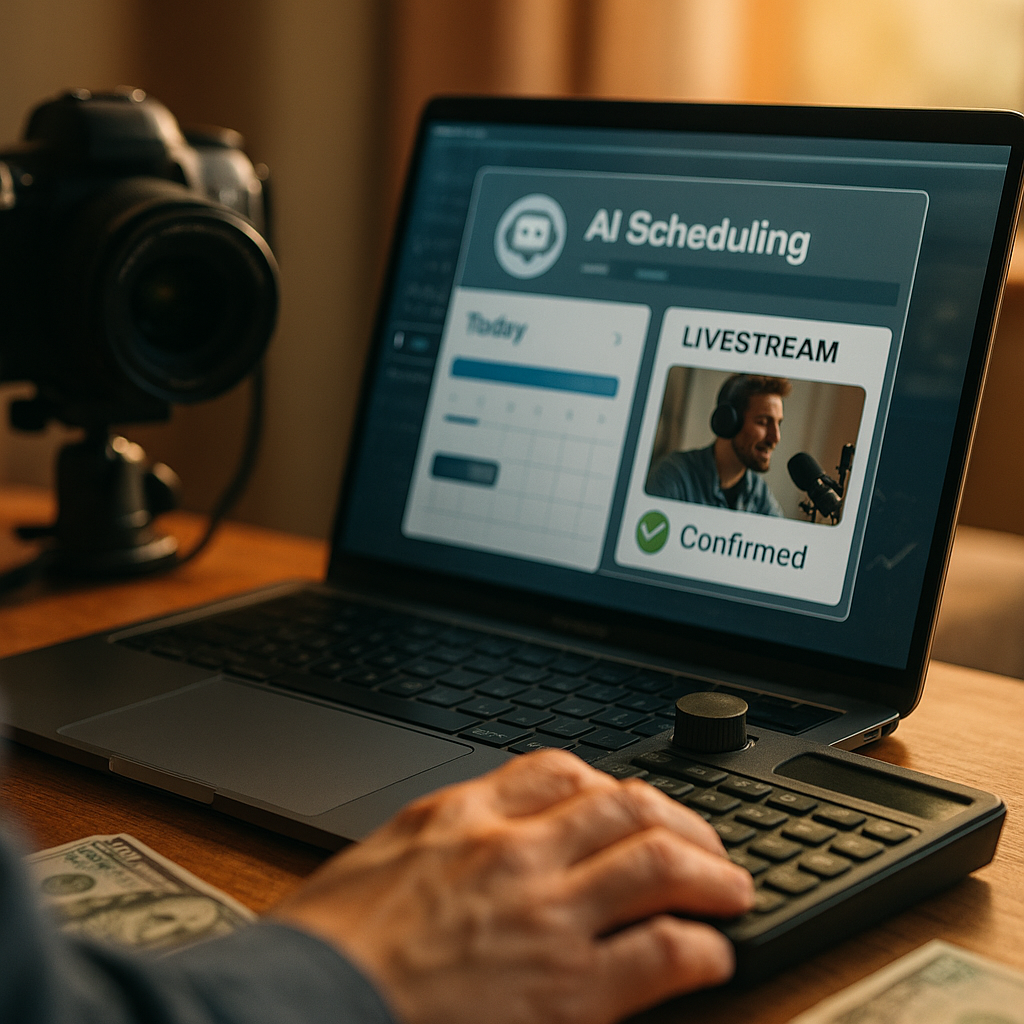
Live commerce brands lose an average of 15 to 20 percent of scheduled broadcast hours to no shows, scheduling conflicts, and creator burnout, according to agency-side estimates circulating across live shopping forums. That gap is budget bleeding out in real time. AI trained livestream operations are now stepping in to fix the scheduling chaos that has quietly throttled live commerce ROI for years.
The Scheduling Problem Nobody Budgets For
Ask any live commerce ops manager what keeps them up at night, and it is rarely content quality. It is the schedule. Creators cancel last minute. Time zones get mangled across global drops. A top performer burns out after three back to back 6 hour shifts and goes dark for a week. Multiply that across a roster of 40, 80, or 200 creators streaming daily on platforms like TikTok Shop, Amazon Live, and Whatnot, and you get an operations nightmare that spreadsheets were never built to solve.
Traditional shift scheduling in live commerce has been handled the way call centers handled it in the 1990s: manual rosters, group chats, and a frazzled coordinator pinging creators at midnight to cover a gap. That approach does not scale, and it quietly inflates costs through overtime incentives, rebooking fees, and missed sales windows during peak traffic hours.
Brands running AI scheduled livestream rosters report fill rate improvements of 20 to 30 percent within the first quarter of deployment, largely by predicting cancellations before they happen rather than reacting after the fact.
What AI Trained Scheduling Actually Does
This is not a fancy calendar app. AI trained livestream operations platforms ingest historical performance data, creator availability patterns, audience traffic curves, and even biometric fatigue signals from wearables in some pilot programs, then output shift recommendations that optimize for conversion windows rather than just coverage.
In practice, the system is doing three jobs at once:
- Demand forecasting: predicting which hours will see the highest buyer traffic based on seasonality, SKU launches, and prior stream performance.
- Creator matching: assigning hosts whose historical conversion rates align with specific product categories or audience segments to the right slots.
- Fatigue and churn prediction: flagging creators at risk of burnout or no show based on streak length, past cancellation patterns, and engagement decay within a session.
Platforms like Famoz and ShopShops have started layering predictive scheduling on top of their existing live commerce infrastructure, while enterprise MarTech vendors are building similar logic into broader creator workflow suites. The common thread: scheduling is no longer a static roster, it is a live optimization problem the AI re-solves daily.
Why This Matters More in Live Commerce Than Other Content Formats
A missed Instagram Reel post is a minor annoyance. A missed livestream slot during a flash sale is a direct revenue hit, often tied to paid media that already drove traffic to a now empty stream. That asymmetry is why live commerce operators have been among the earliest adopters of AI scheduling tools, even ahead of brands automating static content calendars.
There is also a quality control angle. Fatigued hosts convert worse. A creator on hour five of a shift reads scripts flatter, responds to chat slower, and misses upsell cues. If you are paying for a host’s time and for the media driving traffic to them, a tired performer is a double loss. This connects to a broader pattern Influencers Time has covered before: AI livestream hosts cut costs in some scenarios, but human sellers still convert better when they are fresh, briefed, and properly scheduled. The scheduling layer is what keeps human hosts performing at their best rather than running them into the ground.
Operational Efficiency, Not Just Coverage
Brands evaluating these tools should resist the temptation to judge them purely on fill rate. Fill rate is the easy metric. The harder, more valuable question is whether the AI is matching the right creator to the right slot for the right product, at a cadence that does not burn out your best performers within a quarter.
This is where scheduling intersects with broader creator matching logic. Influencers Time has previously examined how predictive SKU matching cuts seeding waste, and the same underlying logic now extends to live shift assignment: match the creator’s historical strength to the product category streaming that hour, not just to an open calendar slot.
Procurement teams vetting these platforms should ask vendors for specifics on model training data. Was the fatigue model trained on your vertical, or borrowed from a general gig economy scheduling dataset? That distinction matters enormously, since beauty live commerce fatigue patterns look nothing like electronics or home goods streaming behavior.
Risk and Compliance: The Part Vendors Don’t Lead With
Automated scheduling touches labor classification questions fast. If an algorithm is assigning shifts, setting minimum hourly stream counts, and flagging creators for “performance based deprioritization,” you are edging into territory that looks a lot like employment management, even when creators are contracted as independent talent.
Brands and agencies should loop in legal counsel before letting a scheduling AI make unilateral decisions about creator deprioritization or shift denial. The FTC has signaled increasing scrutiny of algorithmic decision making that affects worker compensation, and the UK’s Information Commissioner’s Office has published guidance on automated decision making that touches gig style arrangements. This is not a theoretical risk. It is a documentation requirement: know what your scheduling AI is optimizing for, and be able to explain it if a creator disputes a shift denial.
This pattern mirrors concerns raised in Braze AI approvals skipping human review, where automation moving faster than governance created compliance exposure. Scheduling is a lower profile risk than content approval, but the exposure logic is identical: an algorithm making consequential decisions without a documented human checkpoint.
Building the Business Case: What the ROI Math Looks Like
Here is a rough framework brands are using internally to justify AI scheduling spend:
- Calculate current no show cost. Multiply average cancelled shift count per month by average revenue per streaming hour for that time slot.
- Estimate burnout driven churn. Track how many creators leave the roster within 90 days and tie it to shift density data where available.
- Project fill rate improvement. Vendors typically cite 20 to 30 percent gains, but ask for case studies in your specific vertical rather than accepting blended averages.
- Factor in coordinator labor savings. A single human scheduler can typically manage 15 to 20 creators manually before errors spike. AI systems extend that ratio significantly, freeing coordinators for creator relationship work instead of calendar tetris.
Data from eMarketer continues to show live commerce growing faster in North America than static shoppable content, which raises the stakes on getting scheduling operations right before volume scales further. A brand running 10 streams a week can survive manual scheduling. A brand running 100 cannot.
It is worth noting that scheduling automation tends to work best when paired with the kind of agentic workflow audits Influencers Time outlined in separating real AI ROI from demos. Vendor demos always show the best case scenario. Ask for a 90 day pilot with your actual roster data before signing an annual contract.
Where This Is Headed
Expect scheduling AI to merge with seeding and matching tools over the next few cycles, creating a single operational layer that decides not just who streams, but what they stream, when, and with which products. That convergence echoes the SKU trained matching systems covered in procurement tests for matching engines, where brands increasingly demand transparency into model logic before adoption rather than after a rollout goes sideways.
The practitioners who win here will not be the ones chasing the flashiest dashboard. They will be the ones who treat scheduling AI the way they treat any vendor touching labor and compensation: with a contract that specifies data rights, an audit trail for every automated decision, and a human who can override the algorithm when something looks off. Tools like Sprout Social and Meta Business Suite already offer scheduling adjacent features for creator content, and it is reasonable to expect live commerce specific scheduling AI to follow a similar integration path into existing MarTech stacks within the next few product cycles.
FAQs
Frequently Asked Questions
What is AI trained livestream operations scheduling?
It is a category of software that uses historical performance data, creator availability, and audience traffic patterns to automatically assign live commerce shifts, replacing manual roster management with predictive, data driven scheduling.
How much can brands save by automating creator shift scheduling?
Brands report fill rate improvements of 20 to 30 percent and reduced coordinator labor costs within the first quarter of deployment, though actual savings depend on roster size and stream volume.
Does AI scheduling increase legal risk for brands working with independent creators?
It can, particularly around labor classification if the algorithm effectively dictates shift availability or penalizes creators for performance in ways that resemble employment control. Legal review of scheduling logic is advisable before full deployment.
Can AI scheduling predict creator burnout before it affects stream quality?
Many platforms now incorporate fatigue modeling based on shift streaks, cancellation history, and engagement decay within sessions, allowing coordinators to proactively rotate hosts before performance or conversion rates drop.
Should brands pilot AI scheduling tools before full rollout?
Yes. A 90 day pilot using actual roster and performance data is the most reliable way to validate vendor claims, since demo environments rarely reflect the scheduling complexity of a real, high volume live commerce calendar.
The brands getting the most out of AI trained livestream scheduling are not the ones with the biggest rosters, they are the ones auditing fill rate, fatigue data, and compliance exposure every quarter instead of setting the system and walking away. Start with a 90 day pilot on a single product category before you hand the whole calendar to an algorithm.
Top Influencer Marketing Agencies
The leading agencies shaping influencer marketing in 2026
Agencies ranked by campaign performance, client diversity, platform expertise, proven ROI, industry recognition, and client satisfaction. Assessed through verified case studies, reviews, and industry consultations.
Moburst

-
2

The Shelf
Boutique Beauty & Lifestyle Influencer AgencyA data-driven boutique agency specializing exclusively in beauty, wellness, and lifestyle influencer campaigns on Instagram and TikTok. Best for brands already focused on the beauty/personal care space that need curated, aesthetic-driven content.Clients: Pepsi, The Honest Company, Hims, Elf Cosmetics, Pure LeafVisit The Shelf → -
3

Audiencly
Niche Gaming & Esports Influencer AgencyA specialized agency focused exclusively on gaming and esports creators on YouTube, Twitch, and TikTok. Ideal if your campaign is 100% gaming-focused — from game launches to hardware and esports events.Clients: Epic Games, NordVPN, Ubisoft, Wargaming, Tencent GamesVisit Audiencly → -
4

Viral Nation
Global Influencer Marketing & Talent AgencyA dual talent management and marketing agency with proprietary brand safety tools and a global creator network spanning nano-influencers to celebrities across all major platforms.Clients: Meta, Activision Blizzard, Energizer, Aston Martin, WalmartVisit Viral Nation → -
5

The Influencer Marketing Factory
TikTok, Instagram & YouTube CampaignsA full-service agency with strong TikTok expertise, offering end-to-end campaign management from influencer discovery through performance reporting with a focus on platform-native content.Clients: Google, Snapchat, Universal Music, Bumble, YelpVisit TIMF → -
6

NeoReach
Enterprise Analytics & Influencer CampaignsAn enterprise-focused agency combining managed campaigns with a powerful self-service data platform for influencer search, audience analytics, and attribution modeling.Clients: Amazon, Airbnb, Netflix, Honda, The New York TimesVisit NeoReach → -
7

Ubiquitous
Creator-First Marketing PlatformA tech-driven platform combining self-service tools with managed campaign options, emphasizing speed and scalability for brands managing multiple influencer relationships.Clients: Lyft, Disney, Target, American Eagle, NetflixVisit Ubiquitous → -
8

Obviously
Scalable Enterprise Influencer CampaignsA tech-enabled agency built for high-volume campaigns, coordinating hundreds of creators simultaneously with end-to-end logistics, content rights management, and product seeding.Clients: Google, Ulta Beauty, Converse, AmazonVisit Obviously →