


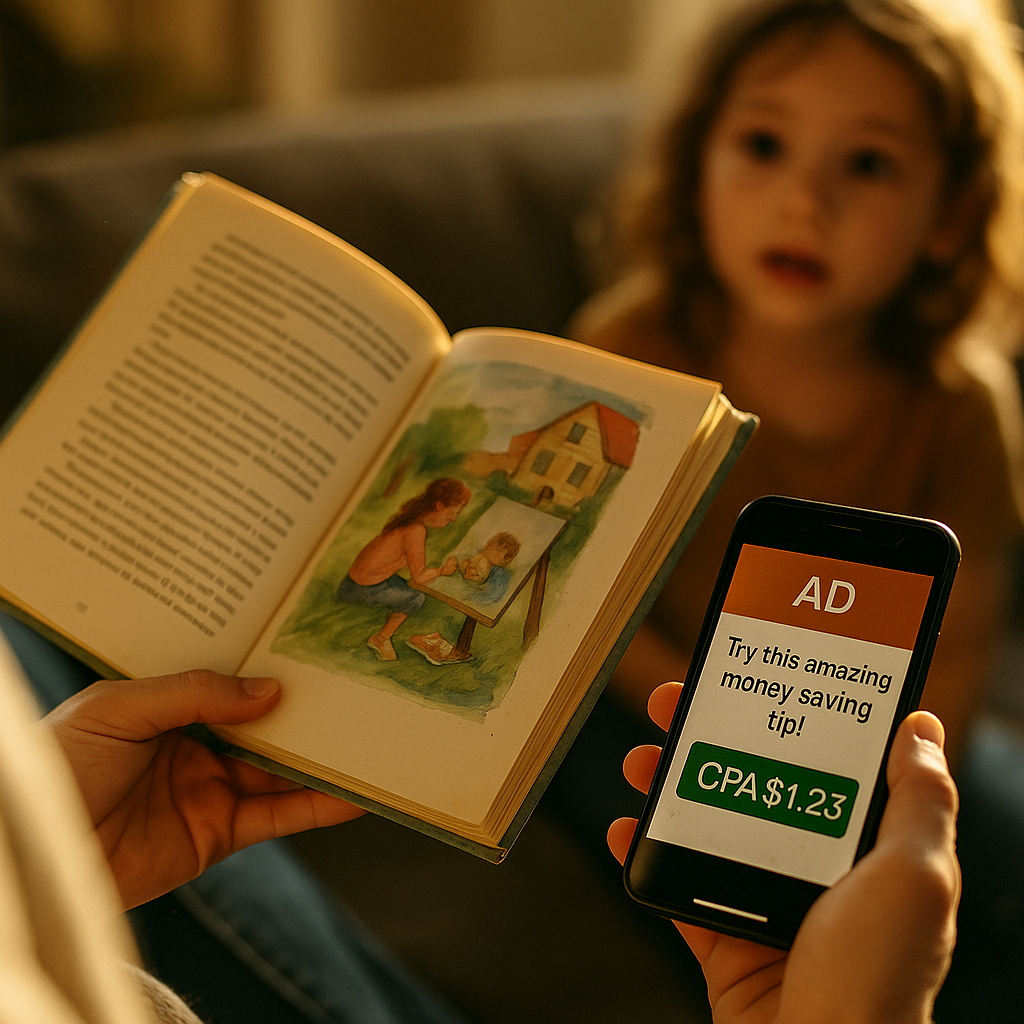
Ads get three seconds. Stories get three minutes, sometimes more. That gap is why the storytime format keeps outperforming straight product pitches on TikTok and Reels: viewers forget they’re being sold to because they’re busy finding out what happens next. One creator’s “the day I almost got fired for this product” video can pull a 40%+ completion rate when a standard demo caps out at 15%. That’s not luck. It’s structure.
Why Narrative Beats the Direct Pitch
Here’s the uncomfortable truth most brand marketers avoid: audiences have built an immune system against ads. Skip rates on obviously branded content have climbed for years, and eMarketer has repeatedly flagged ad avoidance as a top consumer behavior across short-form video. Storytime content sidesteps that immune response because it doesn’t look like an ad. It looks like a confession, a cautionary tale, or a plot twist.
The mechanism is simple. A story creates an open loop (will she get her money back? did he actually get fired?) and the brain hates unresolved loops. Viewers stay to close the loop, and the product gets folded into the resolution instead of announced at the start. Compare that to the short form demo hook approach, which front-loads the product and relies purely on visual payoff in the first three seconds. Both have a place, but storytime wins when the goal is trust-building rather than immediate feature comparison.
A story doesn’t sell the product. It sells the outcome of a decision, and the product just happens to be the decision.
The Anatomy of a Storytime Hook That Converts
Every high-performing storytime video follows a loose but consistent beat structure. Skip a beat and the whole thing collapses into either a boring anecdote or an obvious ad.
- The cold open: a single sentence that implies stakes. “I almost returned this three times” works. “Let me tell you about this great product” does not.
- The complication: something went wrong, got awkward, or didn’t match expectations. This is where credibility gets built, because perfection reads as scripted.
- The turn: the moment the product (or decision) changes the outcome. Keep this understated. Overselling here kills the illusion.
- The resolution with receipts: a specific, verifiable detail (price, time saved, a screenshot) that makes the story feel real rather than performed.
Notice none of those beats are “and that’s why you should buy it.” The CTA lives in the caption or a soft verbal nudge at the very end, not baked into the narrative. This is the same instinct behind myth busting explainers, which name the doubt before addressing it instead of pretending the doubt doesn’t exist.
Scripting Without Sounding Scripted
Ironically, storytime formats require more pre-production discipline than straight ads, not less. The dialogue has to sound improvised while hitting every narrative beat on time, usually inside a 60 to 90 second window. Brands that hand creators a rigid script get stilted delivery; brands that hand creators zero guidance get rambling stories with no product moment at all.
The fix most mature creator programs land on is a beat sheet, not a script. You give the creator the four beats above, a few mandatory claims for compliance, and let them fill in the voice. This is the same operational logic covered in hook taxonomy systems, where structure scales without flattening creator authenticity.
Where Storytime Format Fits in the Funnel
Storytime isn’t a top-of-funnel-only play, though that’s where it’s used most. It also performs well in retargeting, especially for considered purchases where the first touch generated interest but not conviction. A viewer who saw a demo ad and didn’t convert might respond better to a storytime piece that addresses the hesitation directly: “I almost didn’t buy this because of X, here’s what changed my mind.”
That sequencing mirrors what works in expectation vs reality skits, where the gap between what a shopper feared and what actually happened becomes the entire selling point. Storytime just stretches that gap across a longer narrative arc instead of a quick before/after cut.
For brands running always-on creator programs, storytime also pairs well with recurring shoppable episodes. A serialized “storytime” account builds a returning audience the way a podcast does, and each episode becomes a soft-sell opportunity instead of a one-off ad unit.
The Compliance Question Nobody Wants to Ask
Here’s where marketing teams get nervous, and rightly so. If a video doesn’t look like an ad, does it still need to be disclosed as one? Yes, always. The FTC’s endorsement guidance applies regardless of format or how organic the content feels. A storytime video with a paid partnership is still a paid partnership, and the disclosure has to be clear and conspicuous, not buried in a hashtag string at the end of a caption.
This matters more for storytime than almost any other format, because the entire appeal is that it doesn’t feel like an ad. That’s exactly the scenario regulators and platforms are watching closely. Brands operating in the UK should also check guidance from the ICO around data use in testimonial-style content, particularly if the story references purchase history or personal data.
The better a storytime ad hides its selling intent, the more important upfront disclosure becomes, not less.
Measuring Something That Doesn’t Look Like an Ad
Standard ad metrics undersell storytime content if you’re only looking at click-through rate. The real signal is completion rate, average watch time, and comment sentiment, because storytime’s job is to build trust that shows up later in the funnel, not necessarily an immediate click. Brands that judge these videos purely on CTR often kill a format that’s quietly lowering overall CPA across the account.
A better measurement approach borrows from what’s outlined in product explainer KPIs: track comprehension and sentiment alongside conversion, and give the format at least two weeks of spend before judging it against a direct-response benchmark it was never built to beat on day one.
- Watch time past the 15-second mark (this is where most ad-fatigued viewers would normally drop off)
- Comment ratio mentioning the product unprompted (a proxy for how natural the integration feels)
- Save and share rate, which story formats tend to outperform on because people share narratives, not specs
- Assisted conversions in a multi-touch model, since storytime rarely wins last-click attribution
Platforms are also leaning into this behavior shift. TikTok’s advertising resources increasingly emphasize native-feeling creative as a performance lever, not just a branding nicety, which tracks with what agencies are seeing in spark ads built from organic storytime posts.
Common Mistakes That Turn Storytime Into an Ad Again
The fastest way to break the format is to over-polish it. A few patterns show up again and again in underperforming briefs:
- Front-loading the brand name. If the product or company shows up in the first five seconds, you’ve rebuilt the ad you were trying to avoid.
- Resolving too neatly. Real stories have loose ends. A story where everything works out perfectly reads as fiction.
- Scripting every line. Word-for-word scripts kill the vocal cadence that makes storytime feel authentic in the first place.
- Skipping the stakes. Without a real complication, there’s no story, just a testimonial wearing a costume. If you want a format built specifically around testimonials, that’s a different lane entirely, covered well in testimonial compilation reels.
Brand safety teams should also watch for creators who lean on exaggerated stakes to juice watch time (claiming a product “saved my marriage” when it’s a phone case, for instance). That’s a compliance risk and a credibility risk rolled into one, and it tends to backfire in the comments faster than any direct-response ad ever would.
Take the Next Step
Pick one underperforming direct-response ad from your current creator roster, rebuild it using the four-beat storytime structure, and run it against the original for two weeks measuring completion rate and assisted conversions instead of CTR alone. The format earns its keep in the data, not in the pitch deck.
FAQs
What makes storytime format different from standard influencer content?
Storytime format uses a narrative arc (setup, complication, turn, resolution) to embed a product inside a story, rather than presenting the product as the subject of the video from the first frame.
Does storytime content still need an FTC disclosure?
Yes. Paid partnerships require clear disclosure regardless of format. The more natural a video feels, the more important it is to disclose it clearly per FTC endorsement guidelines.
How long should a storytime video be?
Most high-performing versions run 60 to 90 seconds, long enough to complete the narrative arc without losing viewers who are used to shorter-form content.
What metrics best measure storytime performance?
Completion rate, watch time past the 15-second mark, comment sentiment, and assisted conversions matter more than first-click CTR, since the format’s value shows up later in the funnel.
Can storytime format work for considered or high-ticket purchases?
Yes, and it often performs better for considered purchases than for impulse buys, since the extended narrative gives the creator room to address hesitation before the resolution.
Top Influencer Marketing Agencies
The leading agencies shaping influencer marketing in 2026
Agencies ranked by campaign performance, client diversity, platform expertise, proven ROI, industry recognition, and client satisfaction. Assessed through verified case studies, reviews, and industry consultations.
Moburst

-
2

The Shelf
Boutique Beauty & Lifestyle Influencer AgencyA data-driven boutique agency specializing exclusively in beauty, wellness, and lifestyle influencer campaigns on Instagram and TikTok. Best for brands already focused on the beauty/personal care space that need curated, aesthetic-driven content.Clients: Pepsi, The Honest Company, Hims, Elf Cosmetics, Pure LeafVisit The Shelf → -
3

Audiencly
Niche Gaming & Esports Influencer AgencyA specialized agency focused exclusively on gaming and esports creators on YouTube, Twitch, and TikTok. Ideal if your campaign is 100% gaming-focused — from game launches to hardware and esports events.Clients: Epic Games, NordVPN, Ubisoft, Wargaming, Tencent GamesVisit Audiencly → -
4

Viral Nation
Global Influencer Marketing & Talent AgencyA dual talent management and marketing agency with proprietary brand safety tools and a global creator network spanning nano-influencers to celebrities across all major platforms.Clients: Meta, Activision Blizzard, Energizer, Aston Martin, WalmartVisit Viral Nation → -
5

The Influencer Marketing Factory
TikTok, Instagram & YouTube CampaignsA full-service agency with strong TikTok expertise, offering end-to-end campaign management from influencer discovery through performance reporting with a focus on platform-native content.Clients: Google, Snapchat, Universal Music, Bumble, YelpVisit TIMF → -
6

NeoReach
Enterprise Analytics & Influencer CampaignsAn enterprise-focused agency combining managed campaigns with a powerful self-service data platform for influencer search, audience analytics, and attribution modeling.Clients: Amazon, Airbnb, Netflix, Honda, The New York TimesVisit NeoReach → -
7

Ubiquitous
Creator-First Marketing PlatformA tech-driven platform combining self-service tools with managed campaign options, emphasizing speed and scalability for brands managing multiple influencer relationships.Clients: Lyft, Disney, Target, American Eagle, NetflixVisit Ubiquitous → -
8

Obviously
Scalable Enterprise Influencer CampaignsA tech-enabled agency built for high-volume campaigns, coordinating hundreds of creators simultaneously with end-to-end logistics, content rights management, and product seeding.Clients: Google, Ulta Beauty, Converse, AmazonVisit Obviously →