


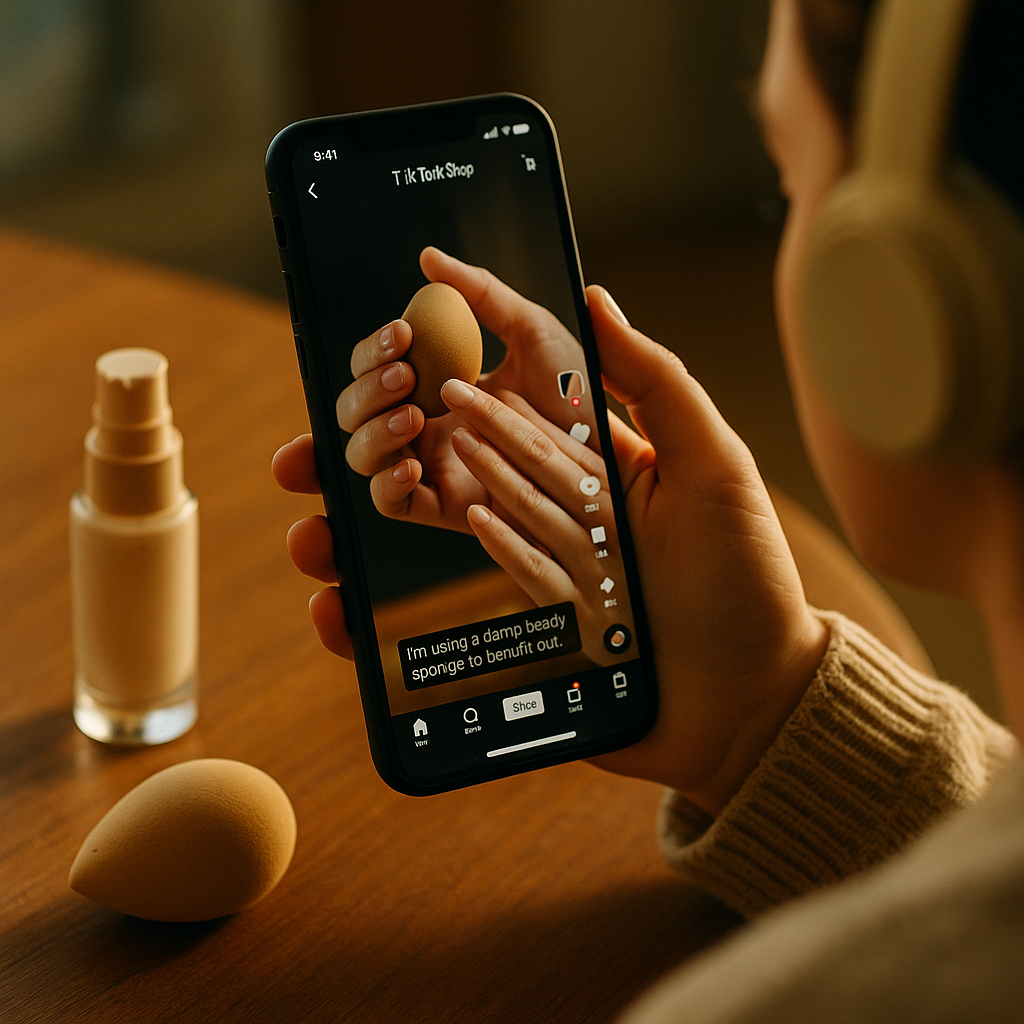
Up to 85% of TikTok sessions in public spaces happen with the sound off, yet most brands still script demos like every viewer is wearing headphones. That mismatch is exactly why the silent captioned demo has quietly become the highest-converting format in TikTok Shop’s product video feed. No voiceover. No trending audio carrying the pitch. Just tight on-screen text doing the selling while the product does the demonstrating.
Why Sound-Off Viewing Broke the Old Demo Playbook
Think about where people actually scroll TikTok Shop: on the train, in a waiting room, half-watching during a work call. Sound isn’t an afterthought in those moments, it’s a liability. If your demo’s value proposition lives entirely in a voiceover, you’ve lost that viewer in the first second.
This isn’t a niche behavior anymore. It’s the baseline. Platforms have known this for years, which is why auto-captioning became a default feature rather than an accessibility add-on. TikTok’s own ad guidance has pushed creators toward text-forward creative precisely because the algorithm rewards watch time, and watch time dies the moment a sound-dependent video gets scrolled past.
Brands that built their entire demo library around talking-head voiceovers are now retrofitting captions as an afterthought, dumping auto-generated text over footage that was never paced for reading. It shows. Viewers can tell the difference between captions that were designed into the edit and captions that were bolted on after the fact.
What Exactly Is a Silent Captioned Demo?
It’s not just “a video with subtitles.” A true silent captioned demo is built from the storyboard stage to work with zero audio dependency. Every beat, the hook, the problem statement, the product reveal, the proof point, the CTA, gets carried by on-screen text timed to visual action rather than speech cadence.
- Text appears in short bursts (3 to 6 words) synced to a visual cue, not a sentence read aloud.
- Captions use motion or emphasis (bold, color pop, size change) to mimic vocal tone, since there’s no voice to convey urgency or surprise.
- Background music still plays for pacing and algorithmic signal, but it’s optional texture, not a carrier of meaning.
- CTAs appear as persistent or repeated on-screen text rather than a single spoken line that’s easy to miss.
This is closer to editing a silent film than captioning a podcast. The text has to do narrative work, and that requires a different kind of brief than handing a creator a script to read aloud.
A demo that only works with sound on isn’t a demo, it’s a radio ad with video attached. Silent captioned formats force you to prove the product visually first, which is the muscle most brands never built.
The Data Behind the Format’s Rise
Sound-off consumption isn’t a TikTok quirk, it’s a broader social video pattern that shows up across platforms. Research compiled by Statista and advertising analysts at eMarketer has repeatedly flagged majority sound-off viewing in mobile feeds, particularly during commute hours and workplace browsing windows, which happen to overlap with peak TikTok Shop purchase intent sessions.
For TikTok Shop specifically, the implication is blunt: if your video’s conversion hinges on audio, you’re optimizing for a minority of your actual audience. Silent captioned demos remove that ceiling entirely. They convert the same whether the viewer has sound on, sound off, or is watching with one earbud in on a crowded bus.
There’s also a secondary benefit most brands miss: caption-heavy demos tend to hold watch time longer because reading paces viewers in a way passive listening doesn’t. A viewer has to stay engaged to finish the text, which nudges completion rate upward, and completion rate is one of the stronger signals in TikTok’s distribution model.
Scripting Captions That Actually Carry the Sale
Writing for silent captioned demos is a different skill than writing voiceover scripts, and treating it like a transcription exercise is the fastest way to tank performance. The caption isn’t a record of what’s being said, because nothing is being said. It’s the entire message.
Start with the same discipline you’d apply to any high-performing hook. The opening caption needs to stop the scroll in the exact same window that matters for every other format, which is why the thinking in first three seconds scripting still applies here. The difference is that the hook has to land as text paired with a visual, not a spoken line.
From there, structure matters more than cleverness:
- Problem beat. One short caption naming the pain point, synced to a visual of the problem (the stain, the tangled cord, the bad fit).
- Demo beat. Captions describe what’s happening on screen in real time, almost like stage directions, so a viewer scrubbing through with sound off still follows the logic.
- Proof beat. A number, a comparison, or a visible result. Text should quantify what the viewer is seeing, not just describe it.
- CTA beat. Repeated at least twice, once mid-video and once at the close, since viewers drop off at different points and you can’t rely on a single spoken mention landing.
This beat structure overlaps heavily with the systems used in hook taxonomy planning, where creative teams pre-build modular openers and swap them in based on product category. Silent captioned demos just add a layer: every module needs a caption variant that stands entirely on its own.
Common Mistakes Killing Silent Demo Performance
Most brands don’t fail at silent captioned demos because the format is hard. They fail because they treat captions as decoration instead of as the script itself. A few patterns show up constantly in underperforming TikTok Shop content:
- Auto-caption dumps. Running a voiceover-based video through auto-caption tools and calling it a silent demo. The pacing is wrong because it was timed for speech, not reading.
- Too much text per frame. If a caption requires more than a second and a half to read, you’ve lost the viewer who’s trying to watch the product at the same time.
- No visual hierarchy. Flat white text with no emphasis treatment makes every beat feel the same weight, so the proof point doesn’t land any harder than the intro line.
- Burying the CTA. A single CTA caption that appears once, for two seconds, near the end. Viewers who dropped off before that point never see it.
- Ignoring comprehension testing. Teams ship captioned demos without checking whether a cold viewer, sound off, actually understands the product in one watch. This is the same gap covered in comprehension KPIs thinking for explainer content, and it applies just as directly here.
Fixing these is mostly a production discipline problem, not a creative talent problem. Brief creators to storyboard captions alongside footage, not after it, and you eliminate most of this list before a single edit happens.
Where This Format Fits in Your TikTok Shop Funnel
Silent captioned demos aren’t a replacement for every format in your rotation, they’re a specific tool for a specific job: top-of-funnel discovery content where you can’t assume sound, context, or prior brand familiarity. Pair them with formats that do different work further down the funnel.
For affiliate-driven campaigns, keeping caption-based CTAs consistent across creator variants also simplifies commission tracking, since you’re not relying on spoken promo codes that get mumbled or cut in editing. The CTA caption becomes the single source of truth for the offer, which cuts down on attribution disputes with creator partners.
It’s also worth running silent captioned demos alongside heavier social proof formats. A product can be demonstrated silently, but trust often still needs a human voice somewhere in the funnel, whether that’s through testimonial compilation content or reaction-style videos that lean into audio precisely because the viewer has already opted into sound by that stage. Think of silent demos as the net that catches viewers who’d otherwise scroll past, and louder formats as the close once you’ve got their attention.
Teams tracking performance across formats should benchmark against engagement reporting standards like those outlined by Sprout Social, and cross-reference completion rate alongside click-through to avoid over-indexing on one metric. A silent demo can post a strong completion rate and still underperform on clicks if the CTA caption isn’t doing enough work, so don’t declare victory on watch time alone.
FAQs
Frequently Asked Questions
What is a silent captioned demo?
It’s a product demo video built to work with zero audio, using on-screen text timed to visual beats (problem, demonstration, proof, CTA) instead of a spoken voiceover carrying the message.
Why are sound-off viewers such a big deal on TikTok Shop?
A large share of mobile social video is watched without sound, especially during commutes and workplace browsing, which overlaps with peak TikTok Shop shopping windows. Demos that rely on voiceover lose that entire audience segment.
How is this different from just adding auto-generated captions to an existing video?
Auto-captions are timed to speech cadence and often miss key beats. A silent captioned demo is storyboarded from the start with caption pacing matched to visual action, so it reads naturally even though nothing was ever meant to be heard.
Does background music still matter if the format is designed for silence?
Yes, but as optional texture rather than a message carrier. Music supports pacing and can help with algorithmic distribution, but the sale still needs to happen entirely through text and visuals.
How do I measure whether a silent captioned demo is working?
Track completion rate alongside click-through rate, not in isolation. A high completion rate with weak clicks usually points to a CTA caption that isn’t repeated or emphasized enough.
Should every TikTok Shop video be a silent captioned demo?
No. It’s best used for top-of-funnel discovery content where you can’t assume the viewer has sound on or prior context. Pair it with voice-driven formats like testimonials further down the funnel to build trust once attention is secured.
If your TikTok Shop library still leans on voiceover-first demos, pick your three best-performing videos and rebuild the captions from scratch as a standalone script, then test them against the originals with sound muted in your own review. The gap in comprehension will tell you everything you need to know about where your next production budget should go.
Top Influencer Marketing Agencies
The leading agencies shaping influencer marketing in 2026
Agencies ranked by campaign performance, client diversity, platform expertise, proven ROI, industry recognition, and client satisfaction. Assessed through verified case studies, reviews, and industry consultations.
Moburst

-
2

The Shelf
Boutique Beauty & Lifestyle Influencer AgencyA data-driven boutique agency specializing exclusively in beauty, wellness, and lifestyle influencer campaigns on Instagram and TikTok. Best for brands already focused on the beauty/personal care space that need curated, aesthetic-driven content.Clients: Pepsi, The Honest Company, Hims, Elf Cosmetics, Pure LeafVisit The Shelf → -
3

Audiencly
Niche Gaming & Esports Influencer AgencyA specialized agency focused exclusively on gaming and esports creators on YouTube, Twitch, and TikTok. Ideal if your campaign is 100% gaming-focused — from game launches to hardware and esports events.Clients: Epic Games, NordVPN, Ubisoft, Wargaming, Tencent GamesVisit Audiencly → -
4

Viral Nation
Global Influencer Marketing & Talent AgencyA dual talent management and marketing agency with proprietary brand safety tools and a global creator network spanning nano-influencers to celebrities across all major platforms.Clients: Meta, Activision Blizzard, Energizer, Aston Martin, WalmartVisit Viral Nation → -
5

The Influencer Marketing Factory
TikTok, Instagram & YouTube CampaignsA full-service agency with strong TikTok expertise, offering end-to-end campaign management from influencer discovery through performance reporting with a focus on platform-native content.Clients: Google, Snapchat, Universal Music, Bumble, YelpVisit TIMF → -
6

NeoReach
Enterprise Analytics & Influencer CampaignsAn enterprise-focused agency combining managed campaigns with a powerful self-service data platform for influencer search, audience analytics, and attribution modeling.Clients: Amazon, Airbnb, Netflix, Honda, The New York TimesVisit NeoReach → -
7

Ubiquitous
Creator-First Marketing PlatformA tech-driven platform combining self-service tools with managed campaign options, emphasizing speed and scalability for brands managing multiple influencer relationships.Clients: Lyft, Disney, Target, American Eagle, NetflixVisit Ubiquitous → -
8

Obviously
Scalable Enterprise Influencer CampaignsA tech-enabled agency built for high-volume campaigns, coordinating hundreds of creators simultaneously with end-to-end logistics, content rights management, and product seeding.Clients: Google, Ulta Beauty, Converse, AmazonVisit Obviously →