


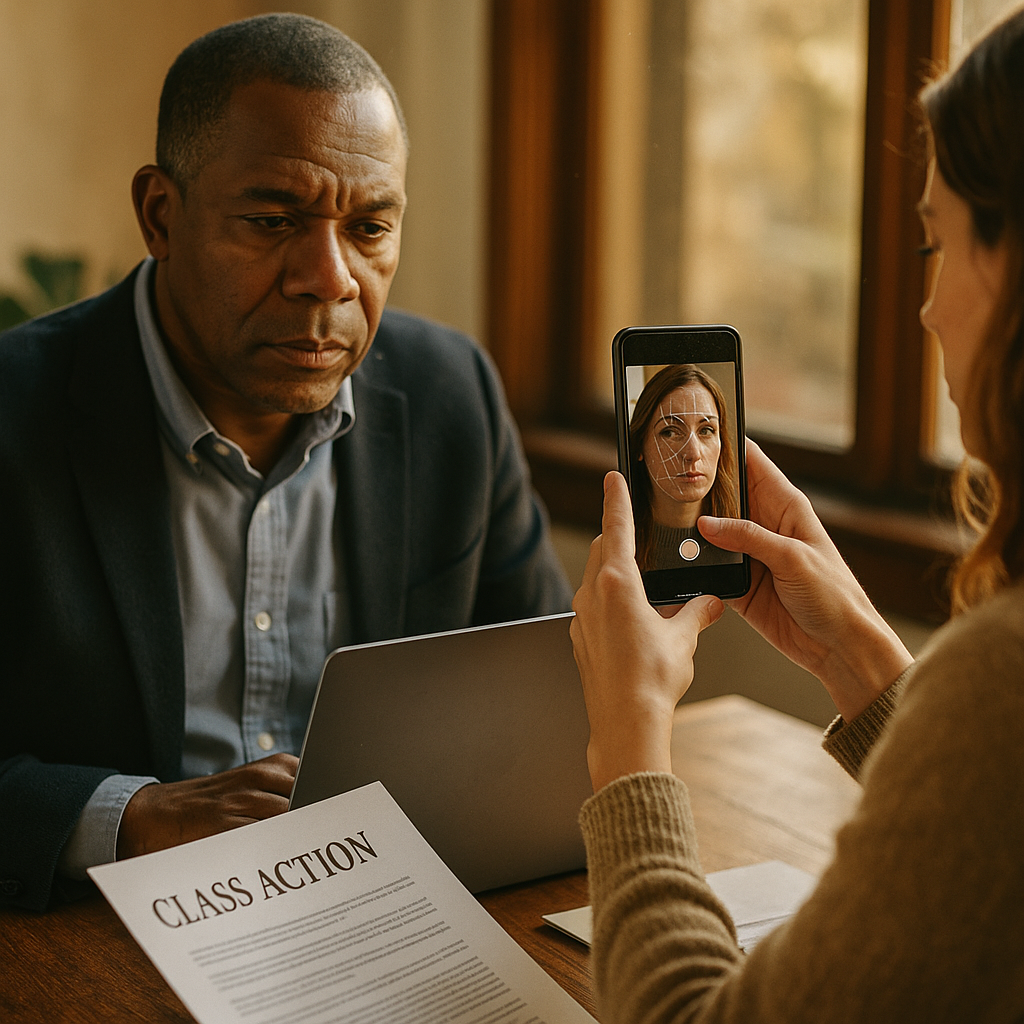
Illinois plaintiffs have collected more than $100 million in biometric privacy settlements since 2024, and most of that money came from companies that never meant to touch biometric data at all. They just used an AI tool that scanned a face. If your creator program touches face swaps, voice clones, or AI avatars, biometric privacy laws are no longer a legal department footnote. They’re a budget line.
UGC Just Got a Faceprint, and Nobody Read the Fine Print
Here’s the uncomfortable truth: most marketing teams still think of biometric data as fingerprints and retina scans, the stuff of spy movies and airport security. That definition is outdated. When a brand runs a creator’s video through an AI tool to generate a synthetic voiceover, swap a background actor’s face, or build a reusable digital avatar, that tool typically has to map facial geometry or vocal patterns to do its job. Under several state statutes, that mapping is a biometric identifier the moment it’s created, whether or not anyone intended to “collect biometric data.”
That’s the gap brands keep falling into. The marketing team sees a cool AI editing feature. The law sees a biometric scan performed without the written, informed consent that statutes like Illinois’s Biometric Information Privacy Act (BIPA) require. And unlike a typical FTC disclosure violation, BIPA creates a private right of action. Translation: individual creators and consumers can sue directly, no regulator required.
A single AI altered UGC campaign running in Illinois without proper consent can generate per-violation damages of $1,000 to $5,000, multiplied across every creator and every piece of content processed. That math turns a clever campaign into a class action fast.
The State by State Risk Map
There is no federal biometric privacy law in the United States, which means your exposure changes depending on where your creators live, where your audience sits, and sometimes where your vendor’s servers process the data. That patchwork is exactly why a national creator campaign needs a state-aware legal review before launch, not after a demand letter arrives.
- Illinois: BIPA remains the gold standard for plaintiff-friendly biometric law. It requires written consent before collecting a biometric identifier, mandates a public retention and destruction policy, and allows private lawsuits with statutory damages. Any brand using AI face or voice tools on Illinois-based creators or consumers is in the highest risk tier.
- Texas: The Capture or Use of Biometric Identifier Act (CUBI) looks similar to BIPA on paper but enforcement runs through the state attorney general, not private plaintiffs. That lowers class action exposure but Texas AG enforcement has become notably more aggressive, which tracks with the broader pattern of state AG enforcement surges outpacing federal action.
- Washington: Its biometric privacy law covers data used for commercial purposes, with a narrower definition than BIPA but still requires consent before enrollment in a biometric system. AI avatar and voice clone tools used in Washington campaigns need explicit opt-in language.
- California: The CCPA and CPRA classify biometric information as sensitive personal information, triggering opt-out rights and stricter processing limits rather than a pure consent requirement. It’s a lower litigation risk than BIPA but a higher regulatory scrutiny environment, especially with the state’s active privacy enforcement unit.
- New York City: A local biometric ordinance covers commercial establishments collecting biometric data from customers, which matters for brands running in-store AI try-on or AI mirror activations tied to influencer campaigns.
- Emerging states: Several additional states have biometric provisions folded into broader comprehensive privacy laws (Colorado, Connecticut, Virginia among them), generally requiring consent for sensitive data processing without BIPA’s private right of action. Expect more states to add biometric specific language as AI altered content becomes mainstream.
Notice the pattern? Illinois is the outlier that creates real financial risk. Everywhere else, you’re managing regulatory and reputational exposure rather than courtroom exposure, which is serious but different. Smart legal teams build campaign geofencing around this distinction rather than applying a single blanket policy that either over-restricts creative or under-protects the brand.
Why AI Altered UGC Multiplies the Exposure
Traditional UGC campaigns carry disclosure risk. AI altered UGC carries disclosure risk plus biometric risk plus a third layer most teams miss entirely: downstream reuse. A face swap tool or AI avatar generator often stores the biometric template to make future edits faster. That stored template is exactly what biometric statutes are built to regulate, and “we didn’t realize the vendor kept it” is not a defense that holds up in discovery.
This is compounded by the fact that many AI content platforms are built by teams focused on creative output, not privacy compliance. They optimize for realistic face mapping and natural voice synthesis, not retention schedules and consent logging. That’s a vendor problem that becomes a brand problem the moment your name is on the campaign.
It also intersects with transparency rules that already exist on the disclosure side. If you’re relying on AI detectability requirements or managing voice clone disclosure obligations, you’re already tracking which assets are AI generated. Extend that same tracking system to capture biometric consent status, and you’ve closed two compliance gaps with one workflow instead of building separate systems that inevitably drift out of sync.
Vendor Contracts Are Where This Usually Breaks
Ask your AI UGC vendor a simple question: does your tool create a biometric template during processing, and if so, where is it stored and for how long? If the sales rep hesitates, that’s your answer. Most brand side teams never ask this question because biometric liability doesn’t show up in a standard MSA template built for software licensing.
The same indemnification gaps showing up in other AI marketing tools apply here, arguably with sharper teeth because of statutory damages. Brands evaluating AI shopping assistants have already run into this with agentic AI liability questions, and the fact pattern repeats: a vendor’s technical capability outpaces its legal documentation, and the brand absorbs the risk by default unless the contract explicitly assigns it elsewhere.
Push for three contract terms specifically: a warranty that the vendor obtains and documents biometric consent before processing, a data retention schedule tied to your campaign timeline rather than the vendor’s default settings, and an indemnification clause that covers biometric privacy claims by name, not just generic “data privacy” language that plaintiffs’ attorneys have learned to argue around.
Building the Consent Trail That Actually Protects You
A verbal “sure, go ahead” from a creator does not satisfy BIPA’s written consent requirement, and it won’t satisfy a judge either. The documentation standard that’s emerging across AI marketing compliance generally includes: a written disclosure explaining exactly what biometric data will be captured, a defined purpose statement (not a vague “for marketing use”), an explicit retention and deletion timeline, and a signed acknowledgment stored separately from the content itself so it survives even if the asset is taken down.
This mirrors the consent architecture brands are already building for other AI decisioning systems, including the audit trails discussed in coverage of AI decisioning consent trails and the breach notification timelines covered in creator CRM breach rules. If a biometric template lives in the same CRM that got breached, your 72 hour notification clock starts the moment a template is exposed, not just when a creator’s name or email leaks.
For a broader view of how disclosure obligations are shifting state by state across AI generated content generally, the analysis in state AI disclosure law mapping is a useful companion read, since biometric exposure and AI labeling exposure increasingly travel together in the same campaign asset.
What Regulators Are Watching Next
Expect biometric definitions to expand, not narrow. Lawmakers are increasingly aware that AI tools generate biometric-adjacent data (voiceprints, gait patterns, even typing cadence in some proposed frameworks) that didn’t exist as a category when older statutes were written. Industry groups tracking this trend, including coverage from eMarketer, point to biometric and AI disclosure rules converging into a single compliance category over the next few budget cycles rather than remaining separate legal silos.
On the enforcement side, state attorneys general have shown they’ll move faster than federal regulators, a trend well documented in reporting from the FTC itself as it acknowledges gaps that states are filling. If you’re building a compliance calendar for next year, assume at least two or three more states add biometric specific amendments to existing comprehensive privacy laws.
The Bottom Line
Audit every AI altered UGC tool in your stack this quarter for biometric data handling, update creator consent forms to explicitly cover faceprint and voiceprint capture, and get your legal team to flag Illinois and Texas as priority review zones before your next campaign goes live. The brands that treat this as a procurement checklist item now will spend a lot less time explaining themselves to a judge later.
Frequently Asked Questions
Do biometric privacy laws apply to AI face filters used in influencer content?
Often yes. If the filter or editing tool maps facial geometry to apply the effect and that mapping is stored even temporarily, it can qualify as biometric data collection under statutes like Illinois’s BIPA, triggering consent requirements regardless of how the brand intended to use the content.
Which state has the highest legal risk for AI altered UGC campaigns?
Illinois carries the highest risk because BIPA allows private lawsuits with statutory damages per violation. Texas and Washington have biometric statutes too, but enforcement generally runs through state agencies rather than individual plaintiffs, which lowers class action exposure.
Is voice cloning covered under biometric privacy laws?
Several state statutes explicitly include voiceprints alongside faceprints and fingerprints as protected biometric identifiers. Any AI tool generating a synthetic voice based on a creator’s actual voice pattern should be treated as biometric processing requiring documented consent.
Who is liable if an AI vendor fails to get proper biometric consent?
Typically both the brand and the vendor can face liability, but brands usually absorb reputational and legal risk first since their name is attached to the published campaign. Strong indemnification language in vendor contracts is the main tool for shifting that liability back to the vendor.
How long should brands retain biometric consent records?
At minimum, for the duration required by the relevant state statute, which can extend well beyond the campaign’s active flight dates. Many compliance teams retain consent documentation for several years after last use as a defensive practice against delayed claims.
Top Influencer Marketing Agencies
The leading agencies shaping influencer marketing in 2026
Agencies ranked by campaign performance, client diversity, platform expertise, proven ROI, industry recognition, and client satisfaction. Assessed through verified case studies, reviews, and industry consultations.
Moburst

-
2

The Shelf
Boutique Beauty & Lifestyle Influencer AgencyA data-driven boutique agency specializing exclusively in beauty, wellness, and lifestyle influencer campaigns on Instagram and TikTok. Best for brands already focused on the beauty/personal care space that need curated, aesthetic-driven content.Clients: Pepsi, The Honest Company, Hims, Elf Cosmetics, Pure LeafVisit The Shelf → -
3

Audiencly
Niche Gaming & Esports Influencer AgencyA specialized agency focused exclusively on gaming and esports creators on YouTube, Twitch, and TikTok. Ideal if your campaign is 100% gaming-focused — from game launches to hardware and esports events.Clients: Epic Games, NordVPN, Ubisoft, Wargaming, Tencent GamesVisit Audiencly → -
4

Viral Nation
Global Influencer Marketing & Talent AgencyA dual talent management and marketing agency with proprietary brand safety tools and a global creator network spanning nano-influencers to celebrities across all major platforms.Clients: Meta, Activision Blizzard, Energizer, Aston Martin, WalmartVisit Viral Nation → -
5

The Influencer Marketing Factory
TikTok, Instagram & YouTube CampaignsA full-service agency with strong TikTok expertise, offering end-to-end campaign management from influencer discovery through performance reporting with a focus on platform-native content.Clients: Google, Snapchat, Universal Music, Bumble, YelpVisit TIMF → -
6

NeoReach
Enterprise Analytics & Influencer CampaignsAn enterprise-focused agency combining managed campaigns with a powerful self-service data platform for influencer search, audience analytics, and attribution modeling.Clients: Amazon, Airbnb, Netflix, Honda, The New York TimesVisit NeoReach → -
7

Ubiquitous
Creator-First Marketing PlatformA tech-driven platform combining self-service tools with managed campaign options, emphasizing speed and scalability for brands managing multiple influencer relationships.Clients: Lyft, Disney, Target, American Eagle, NetflixVisit Ubiquitous → -
8

Obviously
Scalable Enterprise Influencer CampaignsA tech-enabled agency built for high-volume campaigns, coordinating hundreds of creators simultaneously with end-to-end logistics, content rights management, and product seeding.Clients: Google, Ulta Beauty, Converse, AmazonVisit Obviously →