


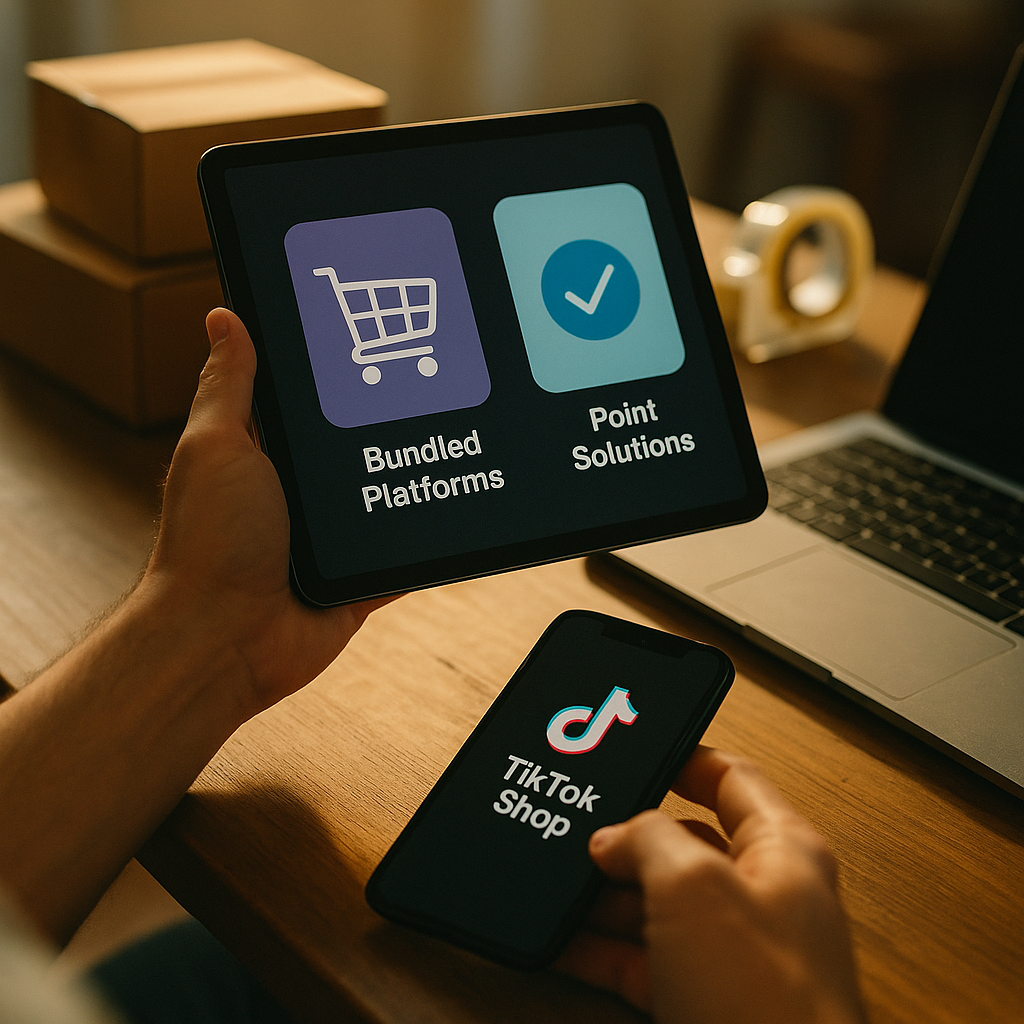
By 2026, the average TikTok Shop seller is running content creation, affiliate recruitment, logistics, and compliance across four or more disconnected tools. Meanwhile, a growing wave of “all in one” bundled platforms promise to collapse that stack into a single dashboard. Which bet actually protects your margin? The TikTok Shop bundled platforms vs point solutions decision is no longer academic. It is one of the biggest line items on next year’s martech budget.
The Stack Problem Nobody Budgeted For
Most brands backed into their TikTok Shop tech stack the way you back into a bad apartment lease: fast, under pressure, and without reading the fine print. A creator sourcing tool here. An affiliate tracking platform there. A separate compliance layer bolted on after the first FTC warning letter arrived. Nobody designed this. It accreted.
Now vendors on both sides are circling. Shopify-adjacent and TikTok-native platforms are pitching “unified commerce suites” that handle sourcing, content, payouts, and reporting in one login. Meanwhile specialist tools keep getting sharper, offering niche capabilities that no generalist platform can match. The pressure to consolidate is real, but consolidation for its own sake is how brands end up locked into a platform that’s mediocre at six things instead of excellent at two.
What “Bundled” Actually Buys You
Bundled platforms sell a simple promise: one vendor, one contract, one login, one invoice. For a lean team running TikTok Shop without a dedicated ops hire, that simplicity is not a nice-to-have. It is survival. A single dashboard that handles creator discovery, sample fulfillment, content approval, and GMV reporting removes the integration tax that smaller teams can’t afford to pay in engineering hours.
The tradeoff is depth. Bundled suites are built to serve the median user, not your specific workflow. If your compliance needs are unusual, say you’re running campaigns across the US, UK, and EU simultaneously, a generalist platform’s disclosure tooling may lag what a dedicated compliance point solution offers. Our multi market compliance framework breaks down exactly where generalist tools tend to fall short once you cross a second regulatory jurisdiction.
Point Solutions: Best of Breed, or Death by a Thousand Logins?
Point solutions win on depth. A dedicated creator vetting tool will out-perform a bundled suite’s creator database every time, because that’s the entire business, not a feature bolted onto a bigger roadmap. Same goes for affiliate payout automation, content rights management, and GMV attribution. Specialists innovate faster in their lane because they have no other lane.
The cost is operational drag. Every additional vendor means another contract to negotiate, another API to maintain, another login for your team to remember, and another data silo that someone has to reconcile manually every Monday. According to HubSpot’s research on marketing operations, teams running five or more disconnected tools report significantly higher time spent on manual reporting than teams on consolidated stacks. That’s not a TikTok Shop specific finding, but it tracks with what creator ops leads describe constantly: the real cost of point solutions isn’t the subscription fee, it’s the headcount required to glue them together.
The real cost of a point solution stack rarely shows up on the vendor invoice. It shows up three months later as a dedicated ops hire whose entire job is reconciling data between tools that were never meant to talk to each other.
A Four Factor Vendor Selection Framework
Instead of debating bundled versus point solution in the abstract, score any vendor decision against four factors: scale, risk exposure, team capacity, and data portability. Weight them honestly and the right answer usually becomes obvious.
- Scale. Brands running under a few hundred thousand dollars a month in TikTok Shop GMV rarely need specialist depth. A bundled platform covers the workflow and frees budget for actual creator fees instead of tooling. Above that threshold, the gaps in a generalist suite start costing real money.
- Risk exposure. Regulated categories (health, finance, beauty claims) carry FTC and platform-policy risk that generic compliance modules often underserve. If your legal team is already flagging disclosure gaps, a dedicated compliance point solution usually pays for itself. Our FTC compliant vetting framework is a useful starting point for scoping what you actually need versus what a bundled vendor claims to cover.
- Team capacity. Who’s actually logging into these tools daily? A three-person creator team cannot maintain five vendor relationships and still ship content on schedule. Capacity constraints often override every other factor, and that’s fine. Pick the stack your team can actually run, not the one that scores best on a feature matrix.
- Data portability. Can you export clean GMV, CPA, and creator performance data without a custom integration project? This matters more than it sounds. Finance teams increasingly want creator spend reported alongside paid media, and a platform that locks data in a proprietary format becomes a reporting liability. See our GMV and CPA dashboard framework for what finance actually expects from this data.
Score each vendor one to five on these four axes before a single sales call. It sounds basic. Almost nobody does it, which is exactly why so many brands end up re-platforming eighteen months into a contract.
When Bundled Platforms Win
Bundled wins when you’re scaling fast but thin on headcount. Early-stage TikTok Shop sellers, DTC brands testing a second or third market, or teams managing creator programs without a dedicated platform owner all benefit from consolidation. The single-vendor model also simplifies procurement: one MSA, one data processing agreement, one renewal date to track instead of six. That’s not nothing when your legal team is already stretched across a dozen vendor reviews a quarter.
There’s also a strategic argument buried in here. Bundled platforms tend to invest heavily in TikTok’s native commerce APIs because the integration is their core product. That often means faster access to new TikTok Shop features (live shopping tools, affiliate marketplace updates) than a point solution built for cross-platform use. If your program lives almost entirely inside TikTok Shop, that native-first advantage is worth real money. Check TikTok’s own commerce resources to see which capabilities platforms are racing to support first.
When Point Solutions Win
Point solutions win once your program is mature enough that a 10 percent efficiency gain in one workflow is worth real money. A dedicated creator vetting tool that reduces fraud and bad-fit partnerships by even a few percentage points pays for its subscription many times over at scale. Same logic applies to specialized compliance tooling, content rights management, and reporting dashboards built specifically for finance stakeholders.
The other scenario where point solutions win: you’ve outgrown the bundled platform’s roadmap. Generalist vendors prioritize features that serve their largest customer segment, not your edge case. If you’re waiting on a feature request that’s been “coming soon” for two quarters, that’s a signal. Our comparison of agencies vs point solutions digs into the cost modeling behind this exact tradeoff, and the math holds up well for platform vendor decisions too.
The Hidden Costs Nobody Puts in the RFP
Vendor comparisons almost never account for switching costs, and that’s where most brands get burned. Migrating creator relationships, historical GMV data, and content libraries off a platform is expensive and slow, regardless of which model you chose. Before signing anything, ask every vendor, bundled or specialist, for a written data export policy and a sample migration timeline. If they can’t answer in writing, treat that as a risk flag, not an oversight.
Compliance overhead is the other line item brands consistently underbudget. Whichever stack you choose, someone has to own disclosure review, creator contract tracking, and audit trails. That work doesn’t disappear because your platform is “all in one.” Our compliance overhead budgeting benchmark gives finance teams a realistic baseline for what this actually costs as a percentage of total creator spend, regardless of vendor architecture.
A platform that saves you three logins but costs you a clean data export is not actually simpler. It’s just deferred complexity with better marketing.
Team structure matters here too. Who owns the vendor relationship once the honeymoon period ends? If you haven’t mapped that, start with our TikTok Shop org chart guide before you sign anything, because the wrong ownership structure will sink even the best-fit platform choice.
Industry data backs up the caution here. eMarketer has repeatedly flagged tool sprawl as a top operational drag for retail and commerce marketing teams, and Statista’s martech surveys show consolidation intent rising year over year even as actual switching remains slow, largely because of the migration friction described above. Brands aren’t wrong to want fewer tools. They’re just underestimating how hard getting there actually is.
One more factor worth weighing: how AI-ready is the vendor’s roadmap? If you’re planning to layer in AI-driven creator matchmaking or automated vetting within the next year, check whether your prospective platform (bundled or point) has the data infrastructure to support it. Our AI creator matchmaking readiness checklist is a useful pre-RFP filter for this exact question.
Next Step
Run the four-factor score before your next renewal conversation, not after. If scale, risk, team capacity, and data portability don’t all point the same direction, default to the bundled platform for simplicity and budget a specialist tool for your single highest-risk workflow only.
FAQs
What’s the main difference between bundled platforms and point solutions for TikTok Shop?
Bundled platforms consolidate creator sourcing, content management, and reporting into one vendor and one login, trading depth for simplicity. Point solutions specialize in a single workflow, like compliance or affiliate payouts, and typically outperform generalist tools in that specific function but require more integration work.
How do I know if my brand has outgrown a bundled TikTok Shop platform?
Common signals include waiting on roadmap features for multiple quarters, hitting reporting gaps that finance can’t work with, or operating in regulated categories where generic compliance tooling isn’t sufficient. If any of these recur, it’s time to evaluate specialist alternatives for that specific gap rather than replatforming entirely.
Are point solutions always more expensive than bundled platforms?
Not necessarily on a line-item basis, but total cost of ownership often runs higher once you factor in integration work, additional headcount to manage multiple vendors, and data reconciliation time. The subscription fee is rarely the full cost.
Can brands mix bundled platforms and point solutions?
Yes, and many mature programs do exactly this: a bundled platform for day-to-day creator and content workflows, paired with a dedicated point solution for the single highest-risk function, usually compliance or payment reconciliation.
What should be in a vendor RFP for TikTok Shop tools?
At minimum, a written data export policy, sample migration timeline, compliance and disclosure capabilities, integration options with existing finance and reporting tools, and clear pricing for scale beyond the current contract tier.
Top Influencer Marketing Agencies
The leading agencies shaping influencer marketing in 2026
Agencies ranked by campaign performance, client diversity, platform expertise, proven ROI, industry recognition, and client satisfaction. Assessed through verified case studies, reviews, and industry consultations.
Moburst

-
2

The Shelf
Boutique Beauty & Lifestyle Influencer AgencyA data-driven boutique agency specializing exclusively in beauty, wellness, and lifestyle influencer campaigns on Instagram and TikTok. Best for brands already focused on the beauty/personal care space that need curated, aesthetic-driven content.Clients: Pepsi, The Honest Company, Hims, Elf Cosmetics, Pure LeafVisit The Shelf → -
3

Audiencly
Niche Gaming & Esports Influencer AgencyA specialized agency focused exclusively on gaming and esports creators on YouTube, Twitch, and TikTok. Ideal if your campaign is 100% gaming-focused — from game launches to hardware and esports events.Clients: Epic Games, NordVPN, Ubisoft, Wargaming, Tencent GamesVisit Audiencly → -
4

Viral Nation
Global Influencer Marketing & Talent AgencyA dual talent management and marketing agency with proprietary brand safety tools and a global creator network spanning nano-influencers to celebrities across all major platforms.Clients: Meta, Activision Blizzard, Energizer, Aston Martin, WalmartVisit Viral Nation → -
5

The Influencer Marketing Factory
TikTok, Instagram & YouTube CampaignsA full-service agency with strong TikTok expertise, offering end-to-end campaign management from influencer discovery through performance reporting with a focus on platform-native content.Clients: Google, Snapchat, Universal Music, Bumble, YelpVisit TIMF → -
6

NeoReach
Enterprise Analytics & Influencer CampaignsAn enterprise-focused agency combining managed campaigns with a powerful self-service data platform for influencer search, audience analytics, and attribution modeling.Clients: Amazon, Airbnb, Netflix, Honda, The New York TimesVisit NeoReach → -
7

Ubiquitous
Creator-First Marketing PlatformA tech-driven platform combining self-service tools with managed campaign options, emphasizing speed and scalability for brands managing multiple influencer relationships.Clients: Lyft, Disney, Target, American Eagle, NetflixVisit Ubiquitous → -
8

Obviously
Scalable Enterprise Influencer CampaignsA tech-enabled agency built for high-volume campaigns, coordinating hundreds of creators simultaneously with end-to-end logistics, content rights management, and product seeding.Clients: Google, Ulta Beauty, Converse, AmazonVisit Obviously →