


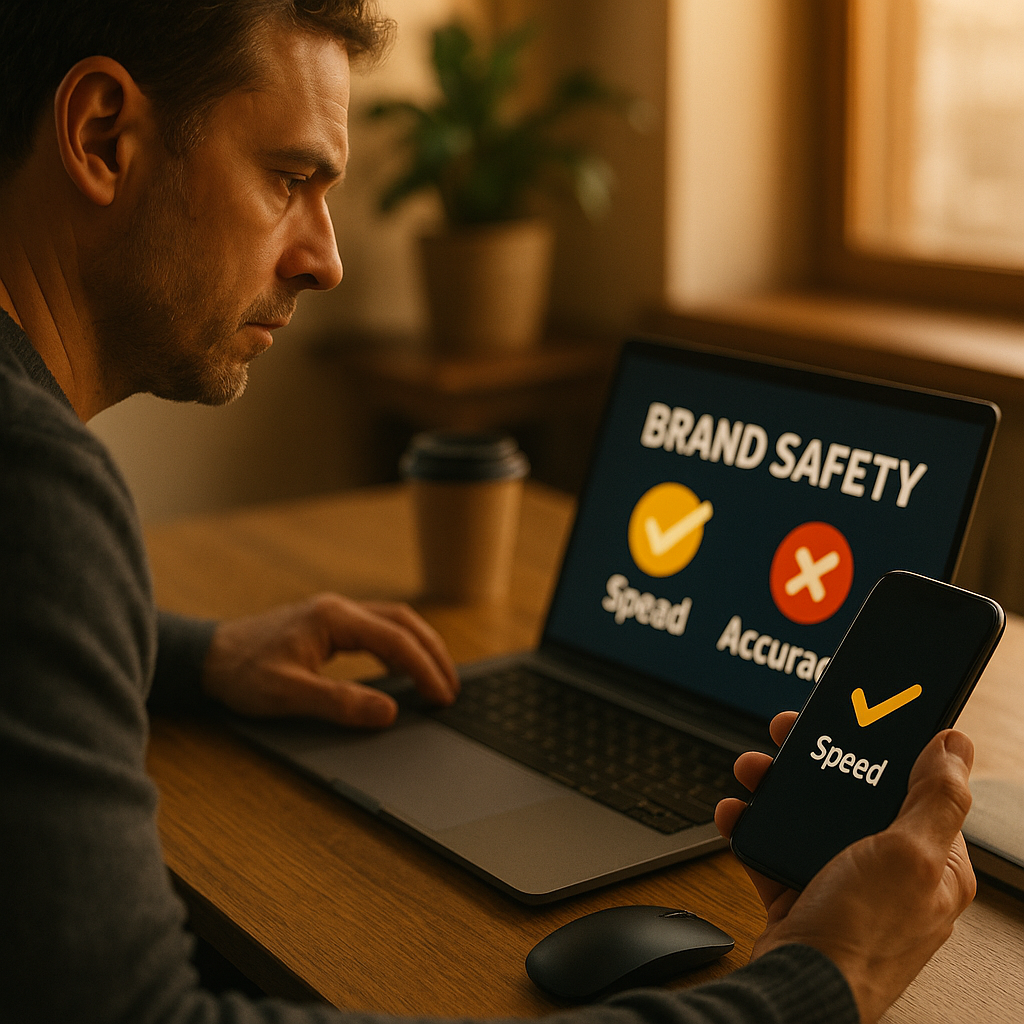
Forty-three seconds. That’s roughly how long the fastest brand safety automation tools claim to take when flagging a creator post containing a risk signal, from publish to alert. The slower ones take hours. Some, depending on the content type, never catch it at all. If your influencer program is still relying on manual spot checks or a quarterly scroll through a creator’s feed, you’re operating on a timeline that no longer matches the risk. Brand safety automation has become table stakes, but the benchmarks behind “real time” detection vary wildly, and the gap between marketing copy and actual performance is where brands get burned.
Why Speed Became the Metric That Matters
Five years ago, brand safety meant screening a creator before signing them. Today it means monitoring them continuously, because the risk doesn’t disappear after contract signature. A creator can post something brand-damaging an hour after your campaign goes live, and the clip can be screenshotted, re-uploaded, and context-stripped before your team even sees the original. Speed isn’t a nice-to-have anymore. It’s the difference between a quiet correction and a crisis comms meeting.
Platforms like Sprout Social and dedicated influencer safety vendors have leaned hard into this framing, selling detection windows measured in minutes rather than days. But “minutes” is doing a lot of marketing work in that sentence. Detection speed depends on content type, platform API access, and how the tool defines a “flaggable” event in the first place.
A tool that flags text captions in under a minute but takes six hours to process video audio isn’t fast. It’s fast at the easy stuff and slow where the actual risk usually lives.
What Actually Gets Benchmarked
Vendors rarely publish apples-to-apples numbers, which makes comparison shopping harder than it should be. Still, a few consistent categories show up across the tools we’ve reviewed for Influencers Time, including the detailed breakdown in Traackr’s brand safety scoring approach.
- Text and caption analysis: Fastest category by far. Natural language processing models can scan a caption against banned-term lists and sentiment thresholds in seconds, sometimes under 60.
- Image recognition: Slower, typically 1 to 5 minutes, because the model needs to parse visual context, not just metadata.
- Video and audio: The laggard. Full transcription plus visual frame sampling can take anywhere from 10 minutes to several hours depending on clip length and whether the tool processes in near real time or batch.
- Cross-platform aggregation: Even if one platform flags fast, syncing that flag across your dashboard, your agency’s dashboard, and your legal team’s alert system introduces lag that vendors rarely disclose in their speed claims.
Here’s the uncomfortable truth: most “real time” claims apply only to the text category. Video, which is where the bulk of influencer content now lives thanks to TikTok and Reels, is still the slowest and least reliable detection surface. If a vendor doesn’t break out speed by content type, ask. If they can’t answer, that’s your answer.
The False Positive Problem Nobody Wants to Talk About
Fast detection is worthless if it’s wrong half the time. Several tools we’ve tested flag creators for benign content, like a sarcastic caption or a satirical meme, because the model lacks context. This creates alert fatigue. Marketing teams start ignoring flags, which defeats the entire purpose of automation.
A reasonable benchmark isn’t just “how fast,” it’s “how fast and how accurate together.” A tool that flags in 90 seconds with an 85 percent false positive rate is slower, in practical terms, than one that flags in 5 minutes with 95 percent precision, because someone still has to manually review every single alert from the faster tool. Our earlier coverage on why human review still wins makes this point directly: automation narrows the haystack, but it rarely finds the needle alone.
Benchmarking Framework for Buyers
If you’re evaluating brand safety tools for an RFP or renewal, don’t take a vendor’s headline speed stat at face value. Build your own benchmark using these four questions.
- What’s the median time to flag, broken out by content type? Ask specifically for text, image, and video separately. A blended average hides the weak spots.
- What’s the false positive and false negative rate at that speed? Speed without an accuracy baseline is marketing fluff.
- Does the tool monitor historical content or only new posts? A creator’s five-year-old tweet can resurface and become today’s crisis. If the tool only watches forward, you’ve got a blind spot.
- How does the alert reach your team? Email digest, Slack integration, dashboard-only? A flag that sits unread in an inbox for six hours isn’t actually a fast detection, it’s a fast detection with a slow human bottleneck attached.
This is also where governance documentation earns its keep. If you haven’t formalized how flags get escalated, reviewed, and resolved, the speed of detection barely matters. Our creator data governance checklist walks through the audit trail structure that regulators and internal compliance teams increasingly expect, and it pairs directly with brand safety workflows.
Platform Differences Change the Math
Detection speed isn’t just a vendor variable, it’s a platform variable too. TikTok’s API access for third-party safety tools has historically lagged behind Meta’s, which means flags on TikTok content can take longer regardless of how good your chosen tool is. Reddit, a newer frontier for brand partnerships, has its own quirks around anonymity and thread context that slow automated review, a gap covered in our piece on brand safety readiness on Reddit.
Meanwhile, tools built primarily for paid media brand safety, like DoubleVerify and IAS, weren’t originally designed for organic creator monitoring. They’re retrofitting ad verification infrastructure to cover influencer content, and the benchmarks reflect that. Ad placement verification happens in milliseconds because it’s a pre-bid decision. Creator content monitoring happens after the fact, scanning posts that already went live, which is a fundamentally different and slower problem.
Don’t assume a brand safety tool that’s excellent for paid media verification will perform at the same speed for organic creator monitoring. The architectures solve different problems.
What “Good Enough” Actually Looks Like in Practice
Realistically, aim for these benchmarks when evaluating vendors in the current market:
- Text flags within 2 minutes
- Image flags within 5 to 10 minutes
- Video flags within 30 minutes for short-form content under 60 seconds
- Cross-platform alert sync within 15 minutes of initial detection
- False positive rate under 15 percent on initial flag, refined further by human review
Anything dramatically faster than this should raise questions, not confidence. According to eMarketer, brands increased influencer marketing spend significantly over the past year, and with that spend comes more creator volume per program, which means more content to monitor and proportionally more edge cases your automation hasn’t seen before. A tool that hasn’t been stress-tested against your specific creator roster’s content style is going to miss things, no matter what the sales deck says.
It’s also worth tying this back to roster management broadly. If you’re running quarterly roster reviews past a certain creator count, brand safety flag history should be one of your scored criteria, not a separate compliance silo. A creator who triggers repeated minor flags, even if each one is individually resolved, is a pattern worth weighing in renewal decisions.
The Compliance Angle: Why Speed Also Means Documentation
Regulators care less about how fast you caught a problem and more about whether you can prove you had a process. The FTC has made clear that brands bear responsibility for creator disclosure compliance, and a documented, timestamped flagging system is your best defense if a creator’s content ever triggers an investigation. The speed benchmark isn’t just operational efficiency, it’s also a legal hedge. A tool with a clean audit log showing detection at the 4-minute mark, followed by human review at the 20-minute mark, and resolution by the 2-hour mark, tells a very different story to a regulator than “we found out when it went viral.”
This is also where integrating safety data into your broader martech operating system pays off. Siloed brand safety tools that don’t feed into your central creator database create reporting gaps exactly when you need clean records most.
Takeaway
Don’t buy brand safety automation based on a single “detection speed” number on a sales slide. Ask for content-type-specific benchmarks, demand false positive data alongside speed claims, and build an internal escalation workflow that treats the fastest possible flag as the start of a process, not the end of one.
Frequently Asked Questions
How fast should a brand safety tool flag risky creator content?
Text-based content should be flagged within about 2 minutes, images within 5 to 10 minutes, and short-form video within 30 minutes. Anything significantly faster, especially for video, warrants scrutiny of the accuracy trade-off.
Why is video content so much slower to flag than text?
Video requires transcription, frame-by-frame visual analysis, and audio processing, all of which demand more computing time than scanning a caption against a keyword or sentiment model. Most “real time” vendor claims apply primarily to text.
What’s a reasonable false positive rate for brand safety automation?
Under 15 percent on the initial automated flag is a reasonable benchmark, with human review refining that further. A lower speed with higher precision is often more operationally efficient than blazing speed with high false positives.
Do brand safety tools monitor a creator’s historical content, or just new posts?
This varies significantly by vendor. Some tools only monitor content published after onboarding, leaving older posts as a blind spot. Always confirm whether historical scanning is included or sold as an add-on.
Can brand safety automation fully replace human review?
No. Automation narrows down what humans need to look at, but context, sarcasm, cultural nuance, and satire still require human judgment. Treat automated flags as a triage layer, not a final verdict.
How does brand safety detection speed affect regulatory compliance?
A documented, timestamped detection and resolution workflow demonstrates due diligence to regulators like the FTC. Speed matters less for compliance purposes than having a clear, auditable process from flag to resolution.
Frequently Asked Questions
Top Influencer Marketing Agencies
The leading agencies shaping influencer marketing in 2026
Agencies ranked by campaign performance, client diversity, platform expertise, proven ROI, industry recognition, and client satisfaction. Assessed through verified case studies, reviews, and industry consultations.
Moburst

-
2

The Shelf
Boutique Beauty & Lifestyle Influencer AgencyA data-driven boutique agency specializing exclusively in beauty, wellness, and lifestyle influencer campaigns on Instagram and TikTok. Best for brands already focused on the beauty/personal care space that need curated, aesthetic-driven content.Clients: Pepsi, The Honest Company, Hims, Elf Cosmetics, Pure LeafVisit The Shelf → -
3

Audiencly
Niche Gaming & Esports Influencer AgencyA specialized agency focused exclusively on gaming and esports creators on YouTube, Twitch, and TikTok. Ideal if your campaign is 100% gaming-focused — from game launches to hardware and esports events.Clients: Epic Games, NordVPN, Ubisoft, Wargaming, Tencent GamesVisit Audiencly → -
4

Viral Nation
Global Influencer Marketing & Talent AgencyA dual talent management and marketing agency with proprietary brand safety tools and a global creator network spanning nano-influencers to celebrities across all major platforms.Clients: Meta, Activision Blizzard, Energizer, Aston Martin, WalmartVisit Viral Nation → -
5

The Influencer Marketing Factory
TikTok, Instagram & YouTube CampaignsA full-service agency with strong TikTok expertise, offering end-to-end campaign management from influencer discovery through performance reporting with a focus on platform-native content.Clients: Google, Snapchat, Universal Music, Bumble, YelpVisit TIMF → -
6

NeoReach
Enterprise Analytics & Influencer CampaignsAn enterprise-focused agency combining managed campaigns with a powerful self-service data platform for influencer search, audience analytics, and attribution modeling.Clients: Amazon, Airbnb, Netflix, Honda, The New York TimesVisit NeoReach → -
7

Ubiquitous
Creator-First Marketing PlatformA tech-driven platform combining self-service tools with managed campaign options, emphasizing speed and scalability for brands managing multiple influencer relationships.Clients: Lyft, Disney, Target, American Eagle, NetflixVisit Ubiquitous → -
8

Obviously
Scalable Enterprise Influencer CampaignsA tech-enabled agency built for high-volume campaigns, coordinating hundreds of creators simultaneously with end-to-end logistics, content rights management, and product seeding.Clients: Google, Ulta Beauty, Converse, AmazonVisit Obviously →