


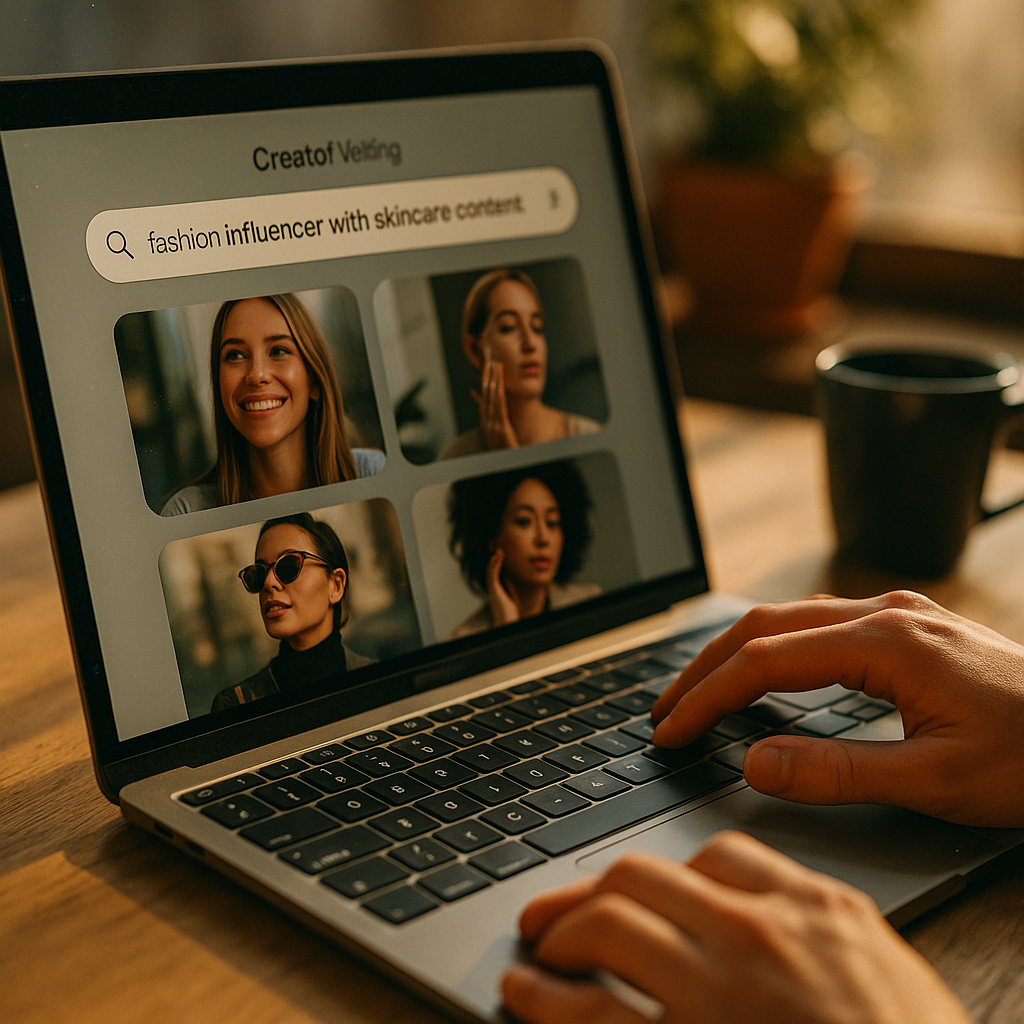
Type “micro-creators who make skincare feel funny, not preachy” into a vetting tool today, and you get a ranked shortlist in seconds. No keyword string. No Boolean operators. No scrolling through 40,000 bio-matched accounts praying for relevance. Prompt-based creator discovery is quietly dismantling the keyword-filter model that influencer platforms have run on for a decade, and brands still relying on tag-and-filter search are leaving matches, and budget, on the table.
Why Keyword Filters Stopped Working
Keyword search was never built for nuance. You’d filter by niche (“beauty”), follower count, engagement rate, and maybe location, then manually scroll through results hoping the algorithm understood what you actually meant. It rarely did. A creator tagged “fitness” might be a bodybuilder, a yoga instructor, or a running mom blogger, three completely different audiences lumped under one label.
The deeper problem is that keyword tags describe what a creator posts about, not how they communicate, who trusts them, or whether their tone fits a brand’s voice. Marketers ended up compensating with spreadsheets, manual vetting calls, and a lot of gut-feel judgment calls that don’t scale past a handful of campaigns a quarter.
Keyword filters answer “what niche is this creator in.” Prompt-based search answers “will this creator’s audience actually buy from us,” which is the question brands were trying to ask all along.
What Prompt-Based Discovery Actually Does Differently
Instead of tags, prompt-based tools use large language models trained on creator content, comment sentiment, transcript data, and performance history to interpret intent. A query like “find creators who’ve grown an audience discussing financial literacy for Gen Z without sounding like a finfluencer grifter” returns results ranked by semantic fit, not keyword overlap.
This works because the underlying models evaluate entities and context rather than string matches. It’s the same shift we’ve covered in how entity salience shapes AI creator briefs: the system understands that a creator talking about “budgeting,” “emergency funds,” and “compound interest” is relevant to a finance brief even if they never use the word “finance” in their bio.
Platforms like Modash, Upfluence, and CreatorIQ have all shipped natural-language search layers over the past year, and newer entrants are building prompt-first from day one. The practical effect: a brand strategist can run a discovery session in the time it used to take to write a single filter query.
The Vetting Layer Gets Smarter Too
Discovery is only half the job. Vetting, checking for brand safety, audience authenticity, and past controversy, has historically meant pulling a report and reading it manually. Prompt-based tools let vetting teams ask direct questions: “Has this creator posted anything politically polarizing in the last 12 months?” or “Does this creator’s audience overlap with our existing roster by more than 20 percent?”
That second question matters more than most marketers realize. Running the same 15 creators across every campaign creates audience fatigue fast, something we’ve flagged before in coverage of how AI forecasting spots creator fatigue before renewal. Prompt-based discovery tools can now flag overlap risk automatically instead of waiting for engagement rates to quietly decline.
Is This Actually More Accurate, or Just Faster?
Fair question. Speed without accuracy is just a faster way to make bad decisions. Early data suggests it’s genuinely more precise, not just quicker. According to eMarketer, brands using AI-assisted creator matching report shortlist-to-signed-deal conversion rates roughly 30 percent higher than teams using manual filter search, largely because the initial shortlist already filters out tonal and audience mismatches that keyword search can’t detect.
The accuracy gain comes from training data depth. Modern discovery tools ingest transcript-level content, not just captions and hashtags. A creator’s actual spoken word choices, pacing, humor style, and even how they handle brand mentions in past sponsored content all feed the model. That’s a richer signal than a self-selected bio tag ever was.
It’s not flawless. Models can still misjudge sarcasm, regional slang, or niche subcultures they weren’t trained on heavily. Human review remains necessary, especially for sensitive categories like finance, health, or anything touching children’s content, which is exactly the argument made in coverage of mandated human review in AI-assisted workflows.
Where This Changes Budget Allocation
Here’s the part that should interest anyone holding a P&L. Faster, more accurate discovery compresses the time agencies and in-house teams spend on sourcing, which has historically eaten 20 to 30 percent of campaign setup hours. Reallocate that time toward negotiation, creative briefing, and attribution setup, and the ROI math shifts meaningfully.
- Lower cost-per-shortlist. Teams report cutting sourcing time by half or more when prompts replace manual filtering across multiple platforms.
- Fewer wasted outreach emails. Better semantic matching means fewer “not a fit” replies from creators who were never aligned to begin with.
- Tighter brand safety nets. Prompt-based vetting catches contextual risk that keyword blocklists miss entirely, like a creator who never says a banned word but consistently posts borderline content.
This operational efficiency compounds when paired with other AI-driven shifts in the stack, like group-based personalization replacing one-off creator targeting. Discovery and targeting are converging into a single AI-assisted pipeline instead of two disconnected manual steps.
What Brands Should Actually Ask These Tools
Not every “AI-powered search” claim holds up under scrutiny. Procurement and marketing ops teams evaluating a new discovery platform should push vendors on specifics rather than taking the pitch deck at face value.
- What content does the model actually ingest? Captions only, or full video transcripts and audio tone?
- How often is the training data refreshed? A model trained on year-old content will miss a creator’s recent pivot or controversy.
- Can the tool explain why it ranked a creator highly? Black-box scoring without rationale makes compliance review harder, not easier.
- How does it handle false positives on brand safety flags? Over-flagging wastes time just as much as under-flagging creates risk.
- Does it integrate with existing attribution and payout systems, or create another data silo?
That last point matters more than vendors like to admit. A brilliant discovery tool that doesn’t talk to your attribution stack or payout workflow just creates another manual export-import cycle, which defeats the efficiency gain you were chasing in the first place.
The Compliance Angle Nobody’s Talking About Enough
Natural-language vetting queries generate a paper trail, which is actually a feature, not a bug, for compliance teams. When regulators or internal legal ask “how did you vet this creator before the partnership,” a logged prompt history (“exclude creators with FTC disclosure violations in the past two years”) is more defensible than a verbal claim that “someone checked.”
This matters increasingly given FTC enforcement attention on influencer disclosure practices. Brands building prompt libraries for vetting should treat them like compliance documentation, not throwaway search queries. Save them. Version them. Review them quarterly as policy and regulatory guidance shifts.
There’s a parallel here to how legal teams are adapting to AI-assisted workflows elsewhere in the creator stack, as covered in our piece on AI agents drafting creator contracts while lawyers catch the risk. The pattern repeats: AI handles volume and speed, humans own final accountability.
Getting Started Without Ripping Out Your Current Stack
You don’t need to abandon your existing platform subscription to test this shift. Most major vetting tools, including HubSpot’s creator marketplace integrations and Sprout Social‘s influencer modules, have added natural-language query layers on top of existing filter systems. Run a parallel test: source the same brief using keyword filters and a prompt query, compare the shortlists, and measure which one converts better over your next two campaigns.
Small sample sizes won’t prove much after one campaign. Give it a quarter, track signed-deal rate and audience overlap, and let the data decide rather than vendor marketing copy.
Frequently Asked Questions
What is prompt-based creator discovery?
Prompt-based creator discovery uses natural-language queries, processed by AI models, to find and rank creators based on semantic fit, audience behavior, and content tone rather than matching keyword tags or hashtags.
How is this different from keyword filtering in influencer platforms?
Keyword filtering matches literal tags and bio text, often missing context or nuance. Prompt-based search interprets intent and content meaning, so a query can describe audience fit, tone, or risk factors in plain language and return more relevant results.
Does prompt-based search replace human vetting entirely?
No. It speeds up shortlisting and flags risk patterns faster, but human review is still recommended for sensitive categories like finance, health, and youth-targeted content, and for final brand safety sign-off.
Which platforms currently offer prompt-based creator search?
Several major influencer marketing platforms have added natural-language search layers over the past year, alongside newer AI-native tools built specifically around prompt-driven discovery and vetting workflows.
Does this change how brands document compliance?
Yes. Saved prompt queries create a searchable audit trail of vetting criteria, which can support compliance documentation around disclosure rules and brand safety reviews more effectively than informal manual checks.
If your team is still filtering by hashtag and follower count, run one prompt-based search this week against your current brief and compare the shortlist quality directly. The gap will tell you whether it’s time to budget for a new tool or renegotiate your current one.
Top Influencer Marketing Agencies
The leading agencies shaping influencer marketing in 2026
Agencies ranked by campaign performance, client diversity, platform expertise, proven ROI, industry recognition, and client satisfaction. Assessed through verified case studies, reviews, and industry consultations.
Moburst

-
2

The Shelf
Boutique Beauty & Lifestyle Influencer AgencyA data-driven boutique agency specializing exclusively in beauty, wellness, and lifestyle influencer campaigns on Instagram and TikTok. Best for brands already focused on the beauty/personal care space that need curated, aesthetic-driven content.Clients: Pepsi, The Honest Company, Hims, Elf Cosmetics, Pure LeafVisit The Shelf → -
3

Audiencly
Niche Gaming & Esports Influencer AgencyA specialized agency focused exclusively on gaming and esports creators on YouTube, Twitch, and TikTok. Ideal if your campaign is 100% gaming-focused — from game launches to hardware and esports events.Clients: Epic Games, NordVPN, Ubisoft, Wargaming, Tencent GamesVisit Audiencly → -
4

Viral Nation
Global Influencer Marketing & Talent AgencyA dual talent management and marketing agency with proprietary brand safety tools and a global creator network spanning nano-influencers to celebrities across all major platforms.Clients: Meta, Activision Blizzard, Energizer, Aston Martin, WalmartVisit Viral Nation → -
5

The Influencer Marketing Factory
TikTok, Instagram & YouTube CampaignsA full-service agency with strong TikTok expertise, offering end-to-end campaign management from influencer discovery through performance reporting with a focus on platform-native content.Clients: Google, Snapchat, Universal Music, Bumble, YelpVisit TIMF → -
6

NeoReach
Enterprise Analytics & Influencer CampaignsAn enterprise-focused agency combining managed campaigns with a powerful self-service data platform for influencer search, audience analytics, and attribution modeling.Clients: Amazon, Airbnb, Netflix, Honda, The New York TimesVisit NeoReach → -
7

Ubiquitous
Creator-First Marketing PlatformA tech-driven platform combining self-service tools with managed campaign options, emphasizing speed and scalability for brands managing multiple influencer relationships.Clients: Lyft, Disney, Target, American Eagle, NetflixVisit Ubiquitous → -
8

Obviously
Scalable Enterprise Influencer CampaignsA tech-enabled agency built for high-volume campaigns, coordinating hundreds of creators simultaneously with end-to-end logistics, content rights management, and product seeding.Clients: Google, Ulta Beauty, Converse, AmazonVisit Obviously →