


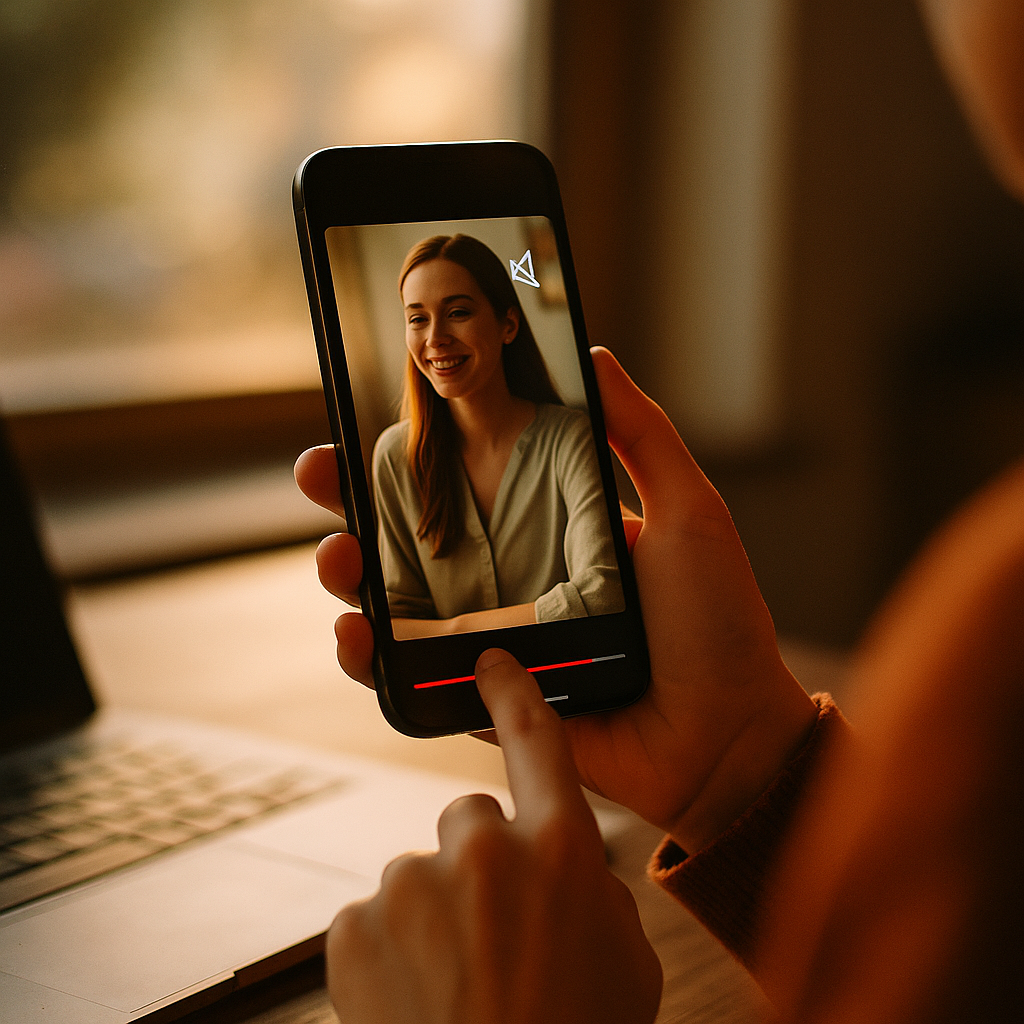
85% of Facebook video and roughly the same share of Instagram Reels get watched with the sound off, according to data platforms like Sprout Social have cited for years, and nothing about autoplay feeds in 2026 has changed that math. Silent product demos aren’t a creative experiment anymore. They’re the default format for any brand running paid or organic creator content on a feed that autoplays muted. If your script still leans on a voiceover to carry the sale, you’re losing the first three seconds, and the first three seconds are the whole game.
Why Autoplay Feeds Killed the Audio-First Script
Every major platform, from TikTok’s For You Page to Instagram Reels to YouTube Shorts, autoplays video without sound by default. Users have to actively tap to unmute. Most won’t. They’re scrolling on a train, in a meeting, next to a sleeping kid. The feed assumes silence, and your script needs to assume it too.
This isn’t a minor UX quirk. It’s a structural shift in how creative gets built. A script written for sound tells a story in sequence: hook, context, reveal, CTA, all paced by a voiceover or dialogue track. A script written for silence has to do the same job using only visual beats, on-screen text, and motion. Miss that distinction and you end up with a video that looks fine with sound on and falls apart the second someone scrolls past it muted, which is to say, almost always.
If your product demo only makes sense with audio, you’ve built it for the 10 to 15 percent of viewers who bother to unmute, not the 85 percent who won’t.
The Anatomy of a Sound-Off Script
A silent-first script isn’t just a regular script with captions slapped on top. It’s structured differently from the first frame. Here’s the framework we recommend brands brief creators on:
- Visual hook in frame one. No build-up. Show the product doing the thing it does best, immediately. Text overlay states the benefit or the problem in under six words.
- On-screen captions that carry narrative weight, not just transcribe speech. Think of captions as the script itself, written to be read, not heard.
- Motion as punctuation. Zooms, cuts, and whip pans replace the vocal emphasis a voiceover would normally provide. A hard cut does what a raised voice used to do.
- Demonstrated proof over narrated claims. “This holds 500ml” works better as a liquid pour shot with a number overlay than as a spoken line.
- A CTA that’s legible in half a second. Big text, high contrast, placed where thumbs won’t cover it.
This approach pairs naturally with what we’ve covered in silent captioned demos for TikTok Shop, where the entire conversion path has to survive without a single spoken word. The principle scales across platforms: if the visual and text track can’t sell the product alone, the audio track is doing work it shouldn’t have to do.
Captions Aren’t Enough. Visual Sequencing Does the Talking
Here’s where a lot of brands get it wrong. They assume auto-generated captions solve the mute problem. They don’t. Captions transcribe what’s said, they don’t restructure how a story unfolds visually. A creator mumbling through a feature list with captions running underneath is still a bad silent experience, just a readable one.
What actually works is sequencing the visual beats so the video tells a complete story even if you stripped every caption away. Picture a skincare creator: jar opens, texture close-up, swipe on skin, before and after split screen, product shot with price tag overlay. That sequence sells the product in total silence. Add captions and you’ve reinforced it. Remove the captions and the sale still happens. That’s the test every silent product demo script should pass.
This is also why multi-angle coverage matters more in sound-off formats than in traditional ones. A single static shot can’t carry the narrative load that a voiceover used to. You need the camera doing more work. We’ve written before about how multi angle product demos borrow coverage techniques from film production, and that approach becomes almost mandatory once you accept that most viewers will never hear a word of your script.
Where Sound Still Matters
Not every format should go fully silent, and pretending otherwise wastes budget. ASMR-style content, satisfying product sounds (the click of a case closing, the hiss of a can opening), and reaction-based reviews genuinely benefit from audio, and a meaningful slice of viewers do unmute for that content specifically. The ASMR product sound briefs approach works precisely because sound is the hook, not an afterthought layered on top of a visual script.
The smarter move is deciding upfront which format you’re making. Is this a silent-first demo designed to convert on mute, or a sound-forward piece designed to earn the tap to unmute? Briefing creators without making that call explicit is how you end up with content that’s mediocre in both modes, too quiet to be ASMR, too reliant on narration to work muted.
Building the Brief: What to Tell Creators
Creator briefs for sound-off content need more visual specificity than traditional scripts, not less. Here’s what should be in every brief:
- A shot list describing the visual sequence, not just talking points.
- Required text overlays with exact wording and placement notes (avoid the bottom third where platform UI sits).
- Pacing cues: how many seconds per shot, when to cut, when to hold.
- A note on whether audio is optional, supplementary, or essential (for ASMR-adjacent content).
- A backup caption pass instruction, so captions are written as narrative support, not a transcription afterthought.
Creators who’ve only ever scripted for voiceover-driven content sometimes resist this. It feels like you’re asking them to work harder for less creative freedom. Reframe it: you’re asking them to be better editors, not better narrators. That’s a skill most experienced UGC creators already have, you just need to name it explicitly in the brief rather than assuming it happens by default.
This same discipline shows up in adjacent formats. The tutorial haul hybrids trend works on mute because the tutorial steps are inherently visual, step one, step two, result. And product explainer hooks that lean on demonstrated proof rather than spoken claims translate almost perfectly into silent formats, because proof is visual by nature.
Measuring What Mute Viewers Actually Do
Standard video metrics can mislead you here. Watch time and completion rate matter, but they don’t tell you whether the video worked without sound specifically. A few things worth tracking:
- Unmute rate. Most platforms expose this in ad reporting. A low unmute rate isn’t a failure if your silent version is converting, it just tells you the audio track isn’t pulling weight.
- Caption-off engagement vs caption-on. Running a split test, where legally and technically possible, shows whether your visual sequencing alone is doing the selling.
- Drop-off timestamp. If viewers bail in the first two seconds, your visual hook isn’t landing before anyone decides to tap for sound.
A video that performs identically whether sound is on or off isn’t a weaker creative, it’s one that’s been built correctly for the feed it’s running in.
Meta’s ad platform and TikTok’s ads manager both surface enough data to run this kind of comparison without extra tooling. Pair that with first-party conversion data and you’ll quickly see which creative decisions were cosmetic and which actually moved the needle on mute. For broader benchmarks on video consumption habits, eMarketer and Statista both publish regular updates worth checking against your own numbers.
Compliance and Clarity Still Apply
Silent doesn’t mean exempt. On-screen disclosure (#ad, #partner) still needs to be legible and unmissable, regardless of audio. The FTC’s endorsement guidance applies to visual disclosures just as strictly as spoken ones, and platforms increasingly flag content where disclosure is present but functionally invisible, buried in a caption wall or flashed for half a second. If your creator brief is detailed enough to specify shot pacing and text placement, it should be detailed enough to specify where disclosure sits and how long it stays on screen.
Next Step
Audit your last ten creator videos with the sound muted. If the story and the CTA don’t land without audio, rewrite the brief before you shoot the next batch, not after the spend is already out the door.
FAQs
What is a silent product demo?
A silent product demo is a creator video scripted so the product’s value, the narrative, and the call to action are all understandable without sound, relying on visual sequencing and on-screen text instead of voiceover or dialogue.
Why do autoplay feeds favor sound-off content?
Platforms like TikTok, Instagram, and YouTube Shorts autoplay video muted by default, and most users never tap to unmute. Content built around audio narration loses its core message for the majority of viewers before they ever hear it.
Do captions solve the muted viewing problem?
Not on their own. Captions that simply transcribe speech still rely on a script structured for audio. Effective silent demos restructure the visual sequence itself so the story works even without any captions at all.
Should every creator video be scripted for silence?
No. Formats built around satisfying sound, like ASMR unboxings or texture reveals, genuinely benefit from audio and should be scripted to encourage unmuting rather than forced into a silent format.
How do you measure whether a silent script is working?
Track unmute rate, compare caption-on versus caption-off engagement where possible, and watch drop-off timestamps to see if your visual hook lands before viewers decide whether to engage further.
Top Influencer Marketing Agencies
The leading agencies shaping influencer marketing in 2026
Agencies ranked by campaign performance, client diversity, platform expertise, proven ROI, industry recognition, and client satisfaction. Assessed through verified case studies, reviews, and industry consultations.
Moburst

-
2

The Shelf
Boutique Beauty & Lifestyle Influencer AgencyA data-driven boutique agency specializing exclusively in beauty, wellness, and lifestyle influencer campaigns on Instagram and TikTok. Best for brands already focused on the beauty/personal care space that need curated, aesthetic-driven content.Clients: Pepsi, The Honest Company, Hims, Elf Cosmetics, Pure LeafVisit The Shelf → -
3

Audiencly
Niche Gaming & Esports Influencer AgencyA specialized agency focused exclusively on gaming and esports creators on YouTube, Twitch, and TikTok. Ideal if your campaign is 100% gaming-focused — from game launches to hardware and esports events.Clients: Epic Games, NordVPN, Ubisoft, Wargaming, Tencent GamesVisit Audiencly → -
4

Viral Nation
Global Influencer Marketing & Talent AgencyA dual talent management and marketing agency with proprietary brand safety tools and a global creator network spanning nano-influencers to celebrities across all major platforms.Clients: Meta, Activision Blizzard, Energizer, Aston Martin, WalmartVisit Viral Nation → -
5

The Influencer Marketing Factory
TikTok, Instagram & YouTube CampaignsA full-service agency with strong TikTok expertise, offering end-to-end campaign management from influencer discovery through performance reporting with a focus on platform-native content.Clients: Google, Snapchat, Universal Music, Bumble, YelpVisit TIMF → -
6

NeoReach
Enterprise Analytics & Influencer CampaignsAn enterprise-focused agency combining managed campaigns with a powerful self-service data platform for influencer search, audience analytics, and attribution modeling.Clients: Amazon, Airbnb, Netflix, Honda, The New York TimesVisit NeoReach → -
7

Ubiquitous
Creator-First Marketing PlatformA tech-driven platform combining self-service tools with managed campaign options, emphasizing speed and scalability for brands managing multiple influencer relationships.Clients: Lyft, Disney, Target, American Eagle, NetflixVisit Ubiquitous → -
8

Obviously
Scalable Enterprise Influencer CampaignsA tech-enabled agency built for high-volume campaigns, coordinating hundreds of creators simultaneously with end-to-end logistics, content rights management, and product seeding.Clients: Google, Ulta Beauty, Converse, AmazonVisit Obviously →