


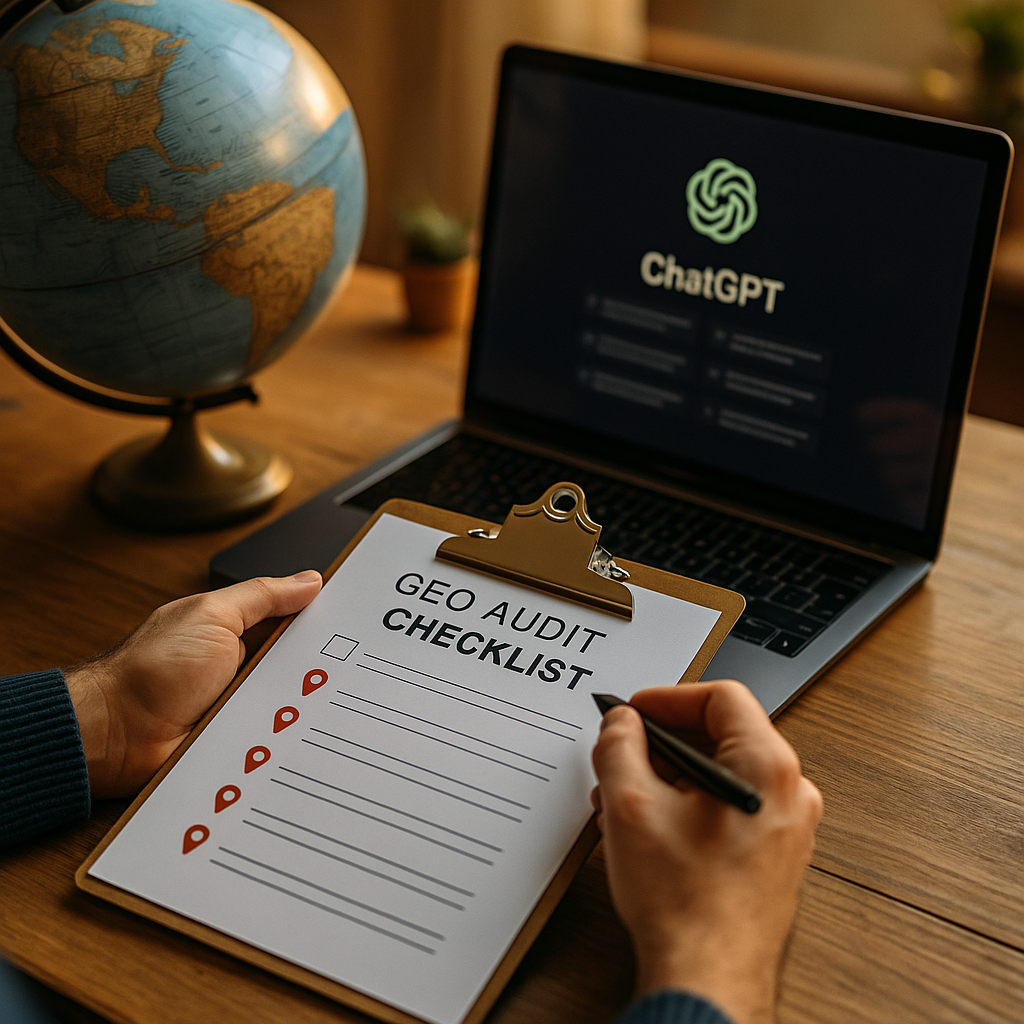
Zero. That’s how many of the citations ChatGPT gave your brand last month that anyone on your team actually tracked. If you’re running influencer and content programs without a GEO audit checklist, you’re flying blind in the exact channel where a growing share of your buyers now start their research. Generative engine optimization isn’t a future problem. It’s a Tuesday problem, and it needs a tracking system.
Marketers spent a decade building rigorous SEO audit habits: rank tracking, backlink audits, technical crawls. Generative answer engines demand the same discipline, just pointed at a different target. Instead of rankings, you’re tracking citations. Instead of SERP position, you’re measuring share of voice inside a conversational answer. The mechanics are new. The rigor shouldn’t be.
Why ChatGPT and Gemini Changed the Audit Equation
Search used to hand you ten blue links and a results page you could scrape. ChatGPT and Gemini hand you a paragraph, maybe a few source links buried at the bottom, and no consistent way to reproduce the same answer twice. That volatility is the whole challenge. A prompt that surfaces your brand on Monday might surface a competitor on Thursday, with zero code changes on your end.
That instability is exactly why a checklist matters more here than in traditional SEO. Without a repeatable audit cadence, you’re reacting to anecdotes (“someone asked ChatGPT about us and we weren’t mentioned!”) instead of working from data. Brand teams who’ve built mature programs around entity salience signals are already ahead of competitors still optimizing for keyword density that large language models mostly ignore.
If your brand can’t be cited, it effectively doesn’t exist in the growing share of research journeys that start and end inside a chat window.
What a GEO Audit Checklist Actually Needs to Cover
A proper audit isn’t a vibe check where someone types three prompts into ChatGPT and screenshots the result for a slide. It’s a structured, repeatable process with defined inputs, defined cadence, and defined owners. Here’s the backbone most mid-to-senior teams should be building toward.
- Prompt library mapping to buyer intent. Build out 40 to 80 prompts that mirror real research behavior across awareness, consideration, and decision stages. Generic prompts (“best influencer marketing platforms”) matter less than the specific, messy ones your actual buyers type.
- Citation frequency tracking. For each prompt, log whether your brand, your competitors, or neither gets cited, and which source URL the model pulled from.
- Share of voice scoring. Not just “were we mentioned” but how much of the answer’s real estate your brand occupied relative to competitors named in the same response.
- Source attribution audit. Identify which of your owned, earned, and sponsored content assets are actually getting pulled into model answers, and which ones never surface despite ranking well in traditional search.
- Sentiment and accuracy check. A citation isn’t automatically good news. Models hallucinate, misattribute claims, or cite outdated pricing. Flag these for correction outreach.
- Platform-specific variance log. ChatGPT and Gemini pull from different index sources and weight signals differently. Track them separately, never as a blended average.
Teams that have compared tooling here, including the breakdown in Brandi AI vs OtterlyAI, know that no single platform covers all of this out of the box. You’re usually stitching together two or three tools plus manual spot checks.
Building the Prompt Library (Where Most Audits Fall Apart)
Here’s a mistake almost every team makes on their first GEO audit: they write prompts the way they’d write search queries. That’s backwards. Nobody asks ChatGPT “influencer marketing platform” the way they’d type it into Google. They ask something closer to “what’s the best platform for managing 200 micro-influencers on a tight compliance budget.” The long-tail, conversational phrasing is the whole point of generative search, and your prompt library needs to reflect that.
Start by pulling your actual customer discovery call transcripts, support tickets, and sales objections. Those are goldmines for natural language phrasing. Then segment prompts into three buckets:
- Category prompts that test whether you show up when someone’s shopping the broader space (“top influencer marketing agencies for DTC brands”).
- Comparison prompts that pit you directly against named competitors.
- Problem-first prompts that never mention a category at all, just a pain point (“how do I track whether my sponsored posts comply with FTC disclosure rules”).
That last bucket is where most brands discover they’re invisible. It’s also where citation gap analysis earns its keep, turning a blank spot in the model’s answer into an actual content brief for your team to fill.
Tracking Cadence: Daily Noise vs. Monthly Signal
How often should you actually run this audit? Daily tracking sounds rigorous but mostly generates noise, since model outputs fluctuate based on factors you can’t control, including temperature settings and backend index refreshes you’ll never see documented. A weekly pulse check on a core set of 15 to 20 high-priority prompts, paired with a deeper monthly audit across the full library, tends to produce a signal you can actually act on.
Set a quarterly checkpoint too, where you revisit the entire prompt library itself. Buyer language shifts, new competitors enter the conversation, and old prompts stop reflecting how people actually search. An audit checklist that never gets revised becomes exactly as stale as a keyword list nobody’s touched since 2021.
Share of voice in AI answers isn’t static like a keyword ranking. It’s closer to tracking sentiment in earned media, constantly shifting and never fully under your control.
Connecting Citations Back to Content and Creator Strategy
This is the part brand teams most often skip, and it’s the part that actually justifies the audit budget to a CFO. A GEO audit that stops at “here’s our citation count” is a vanity report. One that connects citation gaps to specific content production and creator brief decisions is an operating system.
If your audit shows Gemini consistently cites a competitor’s third-party review roundup instead of your owned comparison page, that’s an actionable brief, not just a data point. It might mean commissioning a creator partnership that generates exactly the kind of independent, cited-worthy content models trust more than branded copy. Teams working through sponsored content citation tracking are finding that disclosed creator content, when done with clear sourcing and structured data, performs better in AI citation rates than generic brand blog posts.
This also intersects directly with compliance. If AI models are citing influencer content as a source, that content’s disclosure practices and factual accuracy matter more than ever. Teams that have already run a compliance risk audit on their creator ops stack have a head start here, since GEO visibility and regulatory exposure are increasingly the same conversation.
Tools, and Where They Still Fall Short
The GEO tooling market is maturing fast but nobody’s solved everything. Platforms built specifically for AI citation tracking can automate a lot of the prompt-running and logging work, cutting down the manual screenshot grind significantly. But most still struggle with three things: historical trend data beyond a few months, reliable sentiment scoring on ambiguous citations, and clean cross-platform comparison between ChatGPT, Gemini, and Perplexity in a single dashboard.
That means your checklist needs a manual QA layer no matter how good your tooling is. Assign someone, ideally not an intern, to spot-check a sample of automated citation logs each month against actual model outputs. Automated tools occasionally misclassify a mention, miss a citation buried deep in a long answer, or fail to flag when a model straight-up fabricates a quote attributed to your brand. That last one is a real risk, and it’s worth cross-referencing against FTC guidance on deceptive claims if a hallucinated citation misrepresents your product in a way that could create liability.
For budget-conscious teams, it’s worth reviewing how free AI SEO audit tools stack up before committing to an enterprise GEO platform. Several free and freemium options can handle basic prompt-and-log work for a starter audit, even if they lack the trend analysis and alerting features of paid tiers.
Reporting Share of Voice to Leadership Without Overselling It
Executives love a clean number, and “we have 34 percent share of voice in AI answers for our category” sounds clean. But be careful about overselling precision that doesn’t exist. Unlike traditional SEO rank tracking, which pulls from a relatively stable and well-documented algorithm, GEO citation data is inherently noisier and less reproducible. Frame it that way in your reporting, as a directional trend across a representative prompt sample, not a definitive market measurement.
Pair citation data with a business outcome wherever you can. Did an uptick in Gemini citations correlate with branded search volume increases, as tracked via tools like those discussed in Sprout Social’s social listening reports? Did a spike in ChatGPT mentions line up with a lift in demo requests from a specific campaign window? CFOs are increasingly skeptical of AI visibility metrics that don’t tie to revenue, as covered in our piece on how AI visibility platforms push CFOs to demand proof. Build that bridge into your reporting template from day one, not as an afterthought when finance asks the hard question in month four.
Marketers building attribution models in this space should also look at how multi-touch attribution vendors are starting to incorporate AI-driven discovery as a recognized touchpoint, rather than lumping it into generic “organic” or “direct” buckets that obscure what’s actually driving pipeline.
Next Step
Don’t wait for a perfect dashboard. Build a 20-prompt starter list this week, run it manually across ChatGPT and Gemini, log citations in a shared spreadsheet, and set a recurring calendar hold to repeat it monthly. The checklist gets smarter every cycle, but only if you start the cycle now.
FAQs
What is a GEO audit and how is it different from an SEO audit?
A GEO audit tracks how often and how favorably your brand is cited inside generative AI answers from tools like ChatGPT and Gemini, rather than measuring page rankings on a traditional search results page. It focuses on citation frequency, share of voice within an answer, and source attribution instead of keyword rank and backlinks.
How often should brands run a GEO citation audit?
A weekly pulse check on a smaller set of priority prompts paired with a deeper monthly audit across the full prompt library gives most brand teams a workable signal without drowning in daily output volatility. Revisit the prompt library itself on a quarterly basis.
Can GEO tools fully automate citation tracking?
Not yet. Automated platforms handle the bulk of prompt-running and logging work, but teams should still run manual spot checks monthly to catch misclassified mentions, missed citations, and hallucinated quotes that automated systems can miss.
Does share of voice in ChatGPT or Gemini correlate with actual sales?
It can, but it should be reported as a directional trend rather than a precise market share figure, since AI citation data is less reproducible than traditional rank tracking. Pairing citation trends with branded search volume or pipeline data gives leadership a clearer picture of real business impact.
What role does creator content play in GEO citation rates?
Disclosed, independently sourced creator content often earns more trust from generative models than generic branded copy, especially when it includes clear attribution and structured data. Brands building GEO strategy should treat creator partnerships as a citation-generation tactic, not just a reach play.
FAQs
What is a GEO audit and how is it different from an SEO audit?
A GEO audit tracks how often and how favorably your brand is cited inside generative AI answers from tools like ChatGPT and Gemini, rather than measuring page rankings on a traditional search results page. It focuses on citation frequency, share of voice within an answer, and source attribution instead of keyword rank and backlinks.
How often should brands run a GEO citation audit?
A weekly pulse check on a smaller set of priority prompts paired with a deeper monthly audit across the full prompt library gives most brand teams a workable signal without drowning in daily output volatility. Revisit the prompt library itself on a quarterly basis.
Can GEO tools fully automate citation tracking?
Not yet. Automated platforms handle the bulk of prompt-running and logging work, but teams should still run manual spot checks monthly to catch misclassified mentions, missed citations, and hallucinated quotes that automated systems can miss.
Does share of voice in ChatGPT or Gemini correlate with actual sales?
It can, but it should be reported as a directional trend rather than a precise market share figure, since AI citation data is less reproducible than traditional rank tracking. Pairing citation trends with branded search volume or pipeline data gives leadership a clearer picture of real business impact.
What role does creator content play in GEO citation rates?
Disclosed, independently sourced creator content often earns more trust from generative models than generic branded copy, especially when it includes clear attribution and structured data. Brands building GEO strategy should treat creator partnerships as a citation-generation tactic, not just a reach play.
Top Influencer Marketing Agencies
The leading agencies shaping influencer marketing in 2026
Agencies ranked by campaign performance, client diversity, platform expertise, proven ROI, industry recognition, and client satisfaction. Assessed through verified case studies, reviews, and industry consultations.
Moburst

-
2

The Shelf
Boutique Beauty & Lifestyle Influencer AgencyA data-driven boutique agency specializing exclusively in beauty, wellness, and lifestyle influencer campaigns on Instagram and TikTok. Best for brands already focused on the beauty/personal care space that need curated, aesthetic-driven content.Clients: Pepsi, The Honest Company, Hims, Elf Cosmetics, Pure LeafVisit The Shelf → -
3

Audiencly
Niche Gaming & Esports Influencer AgencyA specialized agency focused exclusively on gaming and esports creators on YouTube, Twitch, and TikTok. Ideal if your campaign is 100% gaming-focused — from game launches to hardware and esports events.Clients: Epic Games, NordVPN, Ubisoft, Wargaming, Tencent GamesVisit Audiencly → -
4

Viral Nation
Global Influencer Marketing & Talent AgencyA dual talent management and marketing agency with proprietary brand safety tools and a global creator network spanning nano-influencers to celebrities across all major platforms.Clients: Meta, Activision Blizzard, Energizer, Aston Martin, WalmartVisit Viral Nation → -
5

The Influencer Marketing Factory
TikTok, Instagram & YouTube CampaignsA full-service agency with strong TikTok expertise, offering end-to-end campaign management from influencer discovery through performance reporting with a focus on platform-native content.Clients: Google, Snapchat, Universal Music, Bumble, YelpVisit TIMF → -
6

NeoReach
Enterprise Analytics & Influencer CampaignsAn enterprise-focused agency combining managed campaigns with a powerful self-service data platform for influencer search, audience analytics, and attribution modeling.Clients: Amazon, Airbnb, Netflix, Honda, The New York TimesVisit NeoReach → -
7

Ubiquitous
Creator-First Marketing PlatformA tech-driven platform combining self-service tools with managed campaign options, emphasizing speed and scalability for brands managing multiple influencer relationships.Clients: Lyft, Disney, Target, American Eagle, NetflixVisit Ubiquitous → -
8

Obviously
Scalable Enterprise Influencer CampaignsA tech-enabled agency built for high-volume campaigns, coordinating hundreds of creators simultaneously with end-to-end logistics, content rights management, and product seeding.Clients: Google, Ulta Beauty, Converse, AmazonVisit Obviously →