


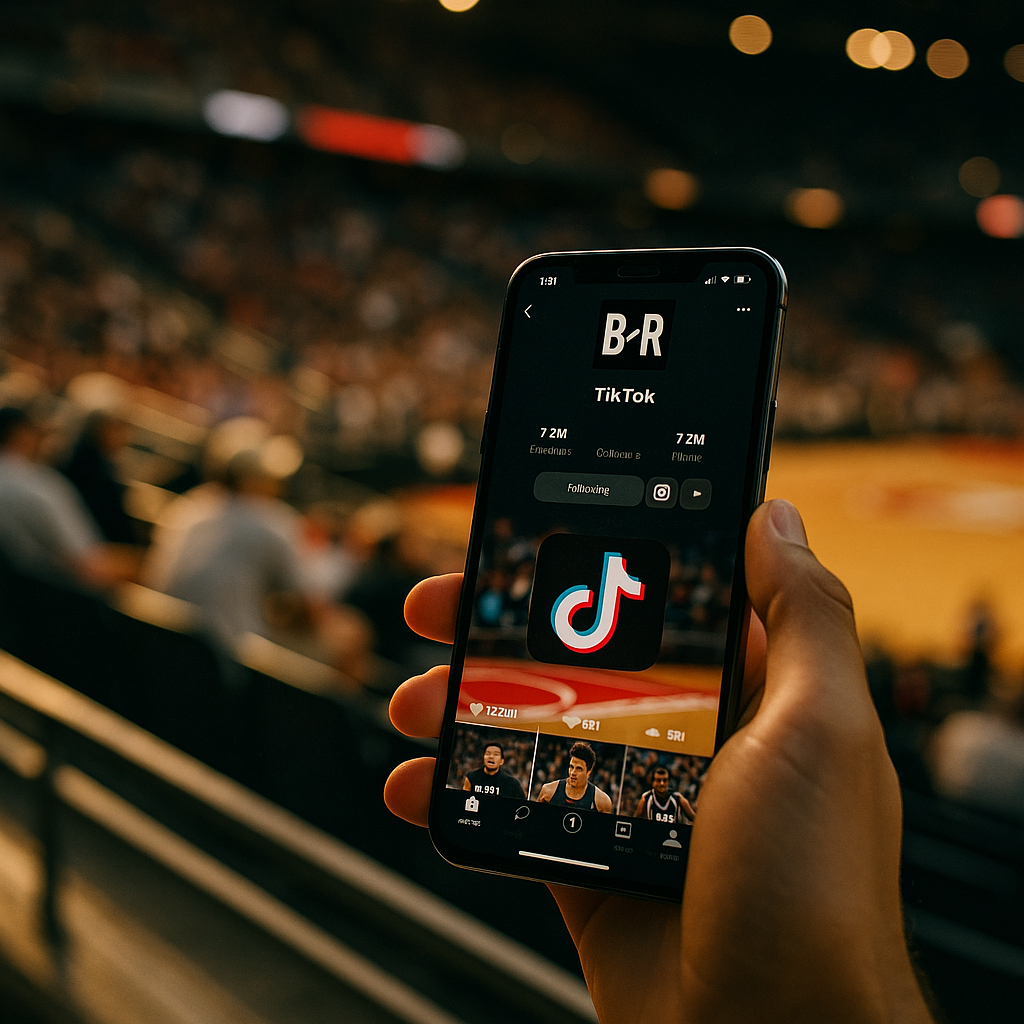
Bleacher Report posts to TikTok more than 15 times a day across a network of handles, not just one. That single operational detail says more about where sports media is headed than any highlight reel ever could. If you run a creator or social team for a sports brand, league, or agency, the Bleacher Report TikTok programming model is the closest thing to a public playbook you’re going to get. Here’s how to reverse engineer it.
Why Bleacher Report’s Approach Matters Beyond Sports Media
Most brands still treat TikTok as one feed, one voice, one content calendar. Bleacher Report treats it like a portfolio. They run a flagship account alongside niche-specific handles (think House of Highlights, B/R Football, B/R Gridiron) each tuned to a distinct audience, posting cadence, and tone. That’s not an accident. It’s a deliberate response to how TikTok’s recommendation engine rewards topical specificity over broad brand messaging.
For marketing leads outside of sports, the lesson translates directly. A single branded account trying to be everything to everyone will underperform a cluster of focused accounts that each nail one audience segment. The Bleacher Report model is essentially a case study in audience segmentation applied to short-form video distribution.
A multi-handle content network isn’t about volume for its own sake. It’s about matching content velocity to the specific behavioral patterns of each audience segment, something a single master account structurally cannot do.
The Multi-Handle Architecture: What’s Actually Happening
Bleacher Report’s network isn’t improvised. Each handle has a defined content remit, posting rhythm, and editorial voice, even though they all draw from the same rights-cleared footage library and the same production team. The efficiency comes from centralizing asset creation while decentralizing distribution and tone.
- Centralized clip library: Game footage, highlights, and licensed content get pulled once, tagged, and distributed to whichever handle fits the audience.
- Handle-specific editorial voice: Football content reads differently than general highlight content, even when covering the same game.
- Independent posting cadence: Each handle posts based on its own audience’s peak engagement windows, not a shared master schedule.
- Cross-promotion discipline: Handles tag and reference each other selectively, building a network effect without diluting individual account identity.
This is the part most brand social teams skip. They build one account, throw everything at it, and wonder why engagement plateaus. Bleacher Report’s structure forces discipline: if content doesn’t fit a handle’s remit, it doesn’t get posted there, full stop.
Rights Clearance Is the Real Bottleneck, Not Creativity
Here’s the uncomfortable truth sports media teams deal with daily: licensing rights, not creative ideas, determine what gets posted. Bleacher Report operates under league and broadcast partnerships that dictate exactly what clips can run, for how long, and in what format. This isn’t unique to sports. Any brand working with licensed IP, sponsored athletes, or co-branded content faces the same constraint.
The operational fix is a rights clearance workflow that runs parallel to content ideation, not after it. Teams that treat legal review as a final checkpoint instead of a parallel track lose speed, and on TikTok, speed is the entire game. A clip posted six hours after a game-winning shot gets exponentially more reach than the same clip posted the next morning.
If your brand works with creator-shot content involving licensed music, branded handles, or paid partnerships, the compliance logic is nearly identical to what’s covered in our creator handle ads compliance guide, which breaks down how to keep legal review from becoming a content bottleneck.
Posting Velocity: How Much Is Actually Enough?
Fifteen-plus posts a day sounds excessive until you consider the math. TikTok’s algorithm rewards accounts that consistently test content against a responsive audience, and sports content has a short shelf life. A highlight from last night’s game is stale by tomorrow afternoon. Sprout Social’s benchmarking research has repeatedly shown that posting frequency correlates with reach on TikTok more strongly than on any other major platform, precisely because the For You Page prioritizes recency and engagement velocity over follower count.
That said, volume without a content taxonomy is just noise. Bleacher Report’s handles aren’t posting 15 times a day each. The network posts that volume in aggregate, distributed intelligently across handles so no single audience gets overwhelmed with repetitive content. Most brand teams misread the headline number and try to replicate raw volume on one account, which just annoys followers and tanks completion rates.
What a Realistic Cadence Looks Like for a Mid-Size Brand
You don’t need a 15-handle network to apply this logic. A realistic adaptation for a mid-size sports or lifestyle brand looks like:
- One flagship handle posting 2 to 4 times daily with broad-appeal content.
- One or two niche handles (product category, regional audience, or event-specific) posting 1 to 2 times daily.
- A shared asset pipeline so creative doesn’t get duplicated across teams.
- A weekly cadence review comparing completion rate and shares per handle, not just views.
This mirrors the segmentation thinking we’ve covered in our TikTok creator brief structure guide, where audience specificity in the brief directly predicts content performance downstream.
Creator Partnerships Inside a Media Brand’s Owned Network
Bleacher Report doesn’t rely solely on in-house editorial talent. The network regularly brings in creators, former athletes, and niche commentators to post content under B/R-adjacent handles or as featured collaborators. This hybrid model, owned editorial plus creator voice, is becoming standard across sports and entertainment media, and it solves a real problem: in-house teams can produce clips fast, but they can’t replicate the authenticity of a creator who’s spent years building trust with a specific fan base.
Brands evaluating this hybrid structure should look closely at how collaboration tagging and attribution work on TikTok and Instagram. The mechanics around shared posting credit, covered in our collab post attribution guide, apply almost directly when deciding whether a creator post should run as a standalone or as a co-authored piece under a brand handle.
There’s also a paid media layer worth considering. Once organic content proves out, media networks and brands alike are increasingly pushing top-performing creator clips into paid distribution using TikTok’s Spark Ads infrastructure, which lets branded or creator content run as an ad unit without losing the native engagement signals (likes, comments, shares) tied to the original post. Our Spark Ads authorization guide walks through the approval workflow brands need to get right before scaling this.
The highest-performing sports and entertainment TikTok networks no longer separate “organic” and “paid” strategy. They treat every post as a candidate for paid amplification the moment it shows early engagement velocity.
Measurement: What Metrics Actually Predict Program Health?
Vanity metrics don’t cut it in a multi-handle structure. View count alone tells you almost nothing about whether the segmentation strategy is working. The metrics that actually matter:
- Completion rate by handle: Shows whether content matches audience expectation for that specific channel.
- Share rate relative to follower count: A stronger predictor of organic reach expansion than raw views.
- Cross-handle follow conversion: Are viewers of one handle converting into followers of adjacent handles in the network?
- Time-to-post latency: How fast content moves from live event to published clip, especially critical in sports and breaking news content.
According to eMarketer’s social video research, short-form video engagement windows are shrinking year over year, which makes latency metrics increasingly tied to revenue outcomes, not just vanity reporting. If your reporting dashboard still leads with total views, it’s time for a rebuild.
Where This Model Breaks for Smaller Teams
It would be dishonest to present this as a universal blueprint. Bleacher Report has production infrastructure, licensing relationships, and headcount that most brand social teams simply don’t have. Running a five-handle network with distinct editorial voices requires real staffing, not just a content calendar template.
Smaller teams should resist the urge to copy the structure wholesale. Instead, borrow the principles: segment by audience, centralize asset production, decentralize distribution timing, and measure engagement depth over volume. A two-handle structure applied thoughtfully will outperform a five-handle structure applied sloppily every time.
Teams running live or shoppable content alongside editorial posting should also look at how cross-platform scheduling affects reach, something we cover in depth in our cross-platform live commerce budget guide, which is directly relevant if your sports or entertainment content eventually ladders into commerce.
Next Step
Don’t try to build a five-handle network overnight. Start with one flagship account and one tightly scoped niche handle, run them for a full quarter, and let completion rate and share velocity (not raw views) tell you whether segmentation is earning its keep before you scale further.
FAQs
How many TikTok accounts should a sports brand realistically run?
Most mid-size brands do best starting with one flagship handle and one niche handle, scaling only after both show healthy completion and share rates for at least a full quarter.
Does posting frequency actually improve TikTok reach?
Yes, but only when paired with audience-specific content. High volume on a poorly segmented account tends to suppress completion rate and hurt overall reach rather than help it.
What’s the biggest operational bottleneck in sports media content networks?
Rights clearance and licensing approval, not creative production, is typically the slowest part of the pipeline and the one most teams underestimate when planning posting speed.
Should creator content and in-house editorial content be separated into different handles?
Not necessarily. Many successful networks blend creator and editorial voice within the same handle, as long as attribution and disclosure are handled correctly.
What metrics matter more than view count for a multi-handle content strategy?
Completion rate, share-to-follower ratio, and cross-handle follow conversion are stronger indicators of program health than total views.
Top Influencer Marketing Agencies
The leading agencies shaping influencer marketing in 2026
Agencies ranked by campaign performance, client diversity, platform expertise, proven ROI, industry recognition, and client satisfaction. Assessed through verified case studies, reviews, and industry consultations.
Moburst

-
2

The Shelf
Boutique Beauty & Lifestyle Influencer AgencyA data-driven boutique agency specializing exclusively in beauty, wellness, and lifestyle influencer campaigns on Instagram and TikTok. Best for brands already focused on the beauty/personal care space that need curated, aesthetic-driven content.Clients: Pepsi, The Honest Company, Hims, Elf Cosmetics, Pure LeafVisit The Shelf → -
3

Audiencly
Niche Gaming & Esports Influencer AgencyA specialized agency focused exclusively on gaming and esports creators on YouTube, Twitch, and TikTok. Ideal if your campaign is 100% gaming-focused — from game launches to hardware and esports events.Clients: Epic Games, NordVPN, Ubisoft, Wargaming, Tencent GamesVisit Audiencly → -
4

Viral Nation
Global Influencer Marketing & Talent AgencyA dual talent management and marketing agency with proprietary brand safety tools and a global creator network spanning nano-influencers to celebrities across all major platforms.Clients: Meta, Activision Blizzard, Energizer, Aston Martin, WalmartVisit Viral Nation → -
5

The Influencer Marketing Factory
TikTok, Instagram & YouTube CampaignsA full-service agency with strong TikTok expertise, offering end-to-end campaign management from influencer discovery through performance reporting with a focus on platform-native content.Clients: Google, Snapchat, Universal Music, Bumble, YelpVisit TIMF → -
6

NeoReach
Enterprise Analytics & Influencer CampaignsAn enterprise-focused agency combining managed campaigns with a powerful self-service data platform for influencer search, audience analytics, and attribution modeling.Clients: Amazon, Airbnb, Netflix, Honda, The New York TimesVisit NeoReach → -
7

Ubiquitous
Creator-First Marketing PlatformA tech-driven platform combining self-service tools with managed campaign options, emphasizing speed and scalability for brands managing multiple influencer relationships.Clients: Lyft, Disney, Target, American Eagle, NetflixVisit Ubiquitous → -
8

Obviously
Scalable Enterprise Influencer CampaignsA tech-enabled agency built for high-volume campaigns, coordinating hundreds of creators simultaneously with end-to-end logistics, content rights management, and product seeding.Clients: Google, Ulta Beauty, Converse, AmazonVisit Obviously →