


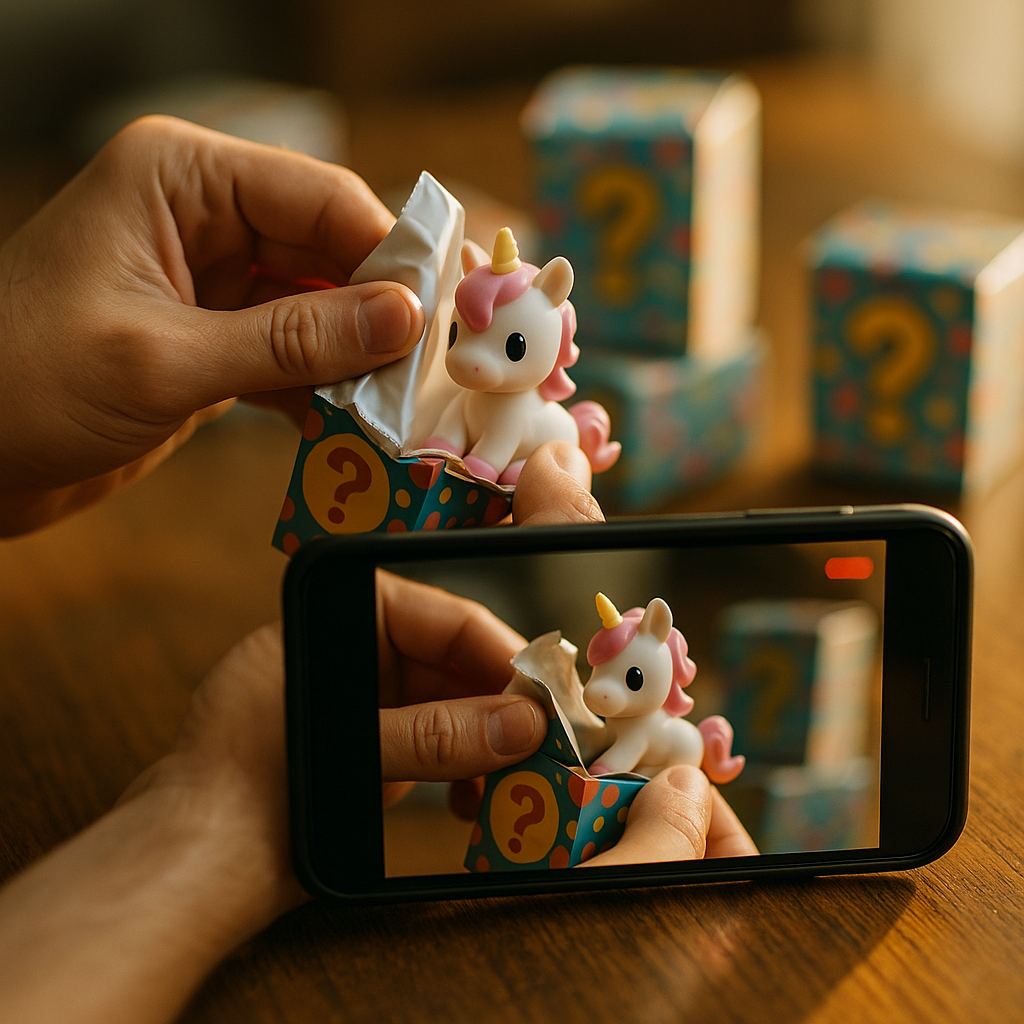
A single blind box unboxing creator on TikTok can move more inventory in a weekend than a month of paid search. Pop Mart’s Labubu line sold out globally in hours, largely on the back of blind box reveal videos that turned product discovery into a dopamine loop. If your brand sells anything with variability, limited runs, or chase items, this format isn’t optional anymore. It’s the distribution channel.
Why Suspense Sells Better Than Specs
Traditional product content tells you what something does. Blind box content makes you feel the wait for what it might be. That distinction matters more than marketers want to admit. Humans are wired for variable reward, the same mechanism that makes slot machines sticky. When a creator shakes a sealed box, debates the weight distribution, and slowly peels back packaging, viewers aren’t watching a product demo. They’re watching a small gamble play out in real time.
This is why collectible categories (trading cards, designer toys, cosmetics capsules, even sneaker drops) have adopted the format faster than commodity goods. The uncertainty is the product benefit, not a packaging quirk.
Blind box content converts because it monetizes anticipation, not information. Specs tell. Suspense sells.
The Anatomy of a Scroll-Stopping Reveal
Good blind box scripts follow a fairly rigid beat structure, even when the delivery feels spontaneous. Here’s the skeleton most high-performing reveal videos share:
- The setup (0 to 3 seconds): Establish stakes immediately. “I bought six of these hoping for the chase figure” works because it frames a goal before the box opens. This mirrors the logic behind three second hook formulas used across other high-retention formats.
- The friction beat: Fumbling with packaging, shaking the box, reading odds printed on the outside. This isn’t filler. It’s pacing control that extends watch time.
- The delay: A cut away, a reaction shot, a pause before the final reveal. Editors who skip this step lose the payoff entirely.
- The reveal: Fast, unambiguous, often paired with a genuine (or well-performed) reaction.
- The reframe: Was it a hit or a miss? Creators who explain rarity context here drive repeat purchase intent, because viewers now understand the odds they’re buying into.
Brands that skip the friction beat and cut straight to the reveal consistently underperform. Platforms reward watch time, and watch time comes from the wait, not the win.
Scripting for Authenticity Without Losing Structure
There’s a tension every brand manager faces with this format: you need a repeatable script for consistency and compliance, but over-scripting kills the authenticity that makes blind box content work. The fix is scripting the structure, not the dialogue. Give creators the five beats above as a checklist, then let their natural reactions fill the gaps. This is the same principle behind POV purchase decision scripts, where the emotional arc is fixed but the voice stays creator-owned.
One packaging agency I spoke with for context on this format noted that brands who hand creators a rigid word-for-word script see engagement drop by roughly a third compared to beat-sheet guidance. Audiences can smell a read-aloud ad from three seconds out.
Sourcing and Sponsorship: What Brands Actually Pay For
Blind box campaigns typically run through one of three sponsorship models, and choosing the wrong one creates downstream compliance headaches.
- Gifted product, organic reveal: Lowest cost, lowest control. You send cases, creators post what they want. Works for awareness, weak for attribution.
- Paid partnership with disclosure: Standard influencer agreement, FTC-compliant tagging, agreed posting window. This is the model most mid-size brands should default to.
- Exclusive drop seeding: Creator gets early access to a limited SKU before public release. Highest conversion because scarcity is real, not simulated, but requires tight inventory coordination with the creator’s posting schedule.
Whichever model you choose, disclosure isn’t optional. The FTC’s endorsement guidance applies fully to gifted blind box product, even when the “review” is just a reaction video. Brands that treat unboxings as exempt from disclosure rules are taking on regulatory risk for a short-term engagement bump that isn’t worth it.
Measuring ROI Beyond Views
View counts on reveal videos are vanity metrics unless tied to something downstream. The brands getting this right track three things:
- Completion rate on the reveal moment, not just overall video completion. If viewers drop off right before the box opens, your pacing is off.
- Click-through on linked product pages within 48 hours of posting, since blind box purchase intent spikes and fades fast.
- Repeat purchase signals from the same audience segment, which tells you whether the “chase” mechanic is actually driving collecting behavior or just one-time curiosity buys.
Platforms like Sprout Social and native TikTok Shop analytics can surface most of this, but you’ll need to build a custom dashboard if you’re running sponsorship across multiple creators simultaneously. Don’t rely on creator-reported screenshots as your only data source. Pull it yourself.
A reveal video with 2 million views and no purchase attribution window is a vanity asset, not a performance channel.
What Category Fits This Format (and What Doesn’t)
Not every product benefits from manufactured mystery. Blind box reveal content performs best when there’s genuine variability (different colorways, rarity tiers, randomized bundle contents) and a collecting culture already forming around the brand. Forcing suspense onto a commodity item, like randomizing the color of a phone charger, reads as gimmicky rather than exciting.
Categories where this format is proving durable in recent creator economy data include designer toys, trading card resealed packs, beauty mystery bundles, and limited sneaker releases. If your product doesn’t have a natural rarity mechanic, consider a related format instead, like the gradual reveal pacing used in swipe to reveal carousels, which borrows the suspense beat without requiring randomized inventory.
Avoiding the Format’s Biggest Risk: Perceived Manipulation
There’s a reputational line between “satisfying surprise” and “engineered gambling mechanic,” and brands have crossed it before. Regulators in several markets have scrutinized loot box and blind box mechanics for resembling gambling, particularly when marketed to younger audiences. The ICO and similar bodies have flagged concerns around dark patterns in randomized purchase mechanics aimed at minors.
Practical guardrails: publish odds transparently where regulations require it, avoid scripting language that implies guaranteed rare pulls, and never target blind box ad creative at users you know are under 18. This isn’t just legal hygiene. It’s also what keeps the format sustainable instead of inviting a platform crackdown that kills the whole category for everyone.
For brands building a broader creator content calendar around collectibles, pairing blind box reveals with format diversity helps. Mixing in puzzle style creator content or interactive riddles and visual gags keeps the collecting community engaged between drops, rather than relying solely on the reveal moment to carry retention.
Building a Repeatable Production Workflow
The brands scaling this format well treat it like a content system, not a one-off stunt. That means a documented brief covering the five-beat structure, a rotating roster of five to ten creators so audiences don’t fatigue on the same face, and a tagging system in your CRM or marketing platform that ties each video back to a specific SKU drop.
It also means briefing creators on what not to script. Forced enthusiasm on a “miss” pull reads as fake and erodes trust faster than almost any other misstep in this category. Let the disappointment show. Audiences trust the format precisely because the losses look real.
Run this as a repeatable quarterly system tied to product drops, not a reactive one-off campaign.
FAQs
Common questions brand teams ask before greenlighting a blind box reveal campaign.
Frequently Asked Questions
What makes a blind box reveal video different from a standard unboxing video?
A standard unboxing shows a known product arriving. A blind box reveal centers on uncertainty: the creator and viewer both don’t know the exact contents until the reveal moment, which creates the suspense mechanic driving engagement.
Do blind box reveal videos require FTC disclosure?
Yes. If a brand gifted or paid for the product shown, standard endorsement disclosure rules apply regardless of whether the content frames itself as a “reaction” rather than a traditional review.
What length performs best for blind box reveal content?
Most high-performing reveals run between 30 and 75 seconds on short-form platforms. Long enough to build the friction beat, short enough to avoid drop-off before the payoff.
Can this format work for non-collectible products?
It can, but only if there’s genuine variability in what the customer receives. Manufacturing fake randomness on a product with no real variation tends to come across as a gimmick rather than an engaging mechanic.
How do brands measure ROI on blind box campaigns beyond views?
Track completion rate specifically at the reveal moment, click-through to product pages within a 48 hour window, and repeat purchase behavior from the same audience segment to confirm the mechanic is driving real collecting behavior.
Start with one SKU, one beat-sheet brief, and three creators running the same five-beat structure. Measure reveal-moment completion and 48 hour click-through before you scale spend, and let the data, not the view count, tell you whether the suspense is actually converting.
Top Influencer Marketing Agencies
The leading agencies shaping influencer marketing in 2026
Agencies ranked by campaign performance, client diversity, platform expertise, proven ROI, industry recognition, and client satisfaction. Assessed through verified case studies, reviews, and industry consultations.
Moburst

-
2

The Shelf
Boutique Beauty & Lifestyle Influencer AgencyA data-driven boutique agency specializing exclusively in beauty, wellness, and lifestyle influencer campaigns on Instagram and TikTok. Best for brands already focused on the beauty/personal care space that need curated, aesthetic-driven content.Clients: Pepsi, The Honest Company, Hims, Elf Cosmetics, Pure LeafVisit The Shelf → -
3

Audiencly
Niche Gaming & Esports Influencer AgencyA specialized agency focused exclusively on gaming and esports creators on YouTube, Twitch, and TikTok. Ideal if your campaign is 100% gaming-focused — from game launches to hardware and esports events.Clients: Epic Games, NordVPN, Ubisoft, Wargaming, Tencent GamesVisit Audiencly → -
4

Viral Nation
Global Influencer Marketing & Talent AgencyA dual talent management and marketing agency with proprietary brand safety tools and a global creator network spanning nano-influencers to celebrities across all major platforms.Clients: Meta, Activision Blizzard, Energizer, Aston Martin, WalmartVisit Viral Nation → -
5

The Influencer Marketing Factory
TikTok, Instagram & YouTube CampaignsA full-service agency with strong TikTok expertise, offering end-to-end campaign management from influencer discovery through performance reporting with a focus on platform-native content.Clients: Google, Snapchat, Universal Music, Bumble, YelpVisit TIMF → -
6

NeoReach
Enterprise Analytics & Influencer CampaignsAn enterprise-focused agency combining managed campaigns with a powerful self-service data platform for influencer search, audience analytics, and attribution modeling.Clients: Amazon, Airbnb, Netflix, Honda, The New York TimesVisit NeoReach → -
7

Ubiquitous
Creator-First Marketing PlatformA tech-driven platform combining self-service tools with managed campaign options, emphasizing speed and scalability for brands managing multiple influencer relationships.Clients: Lyft, Disney, Target, American Eagle, NetflixVisit Ubiquitous → -
8

Obviously
Scalable Enterprise Influencer CampaignsA tech-enabled agency built for high-volume campaigns, coordinating hundreds of creators simultaneously with end-to-end logistics, content rights management, and product seeding.Clients: Google, Ulta Beauty, Converse, AmazonVisit Obviously →