


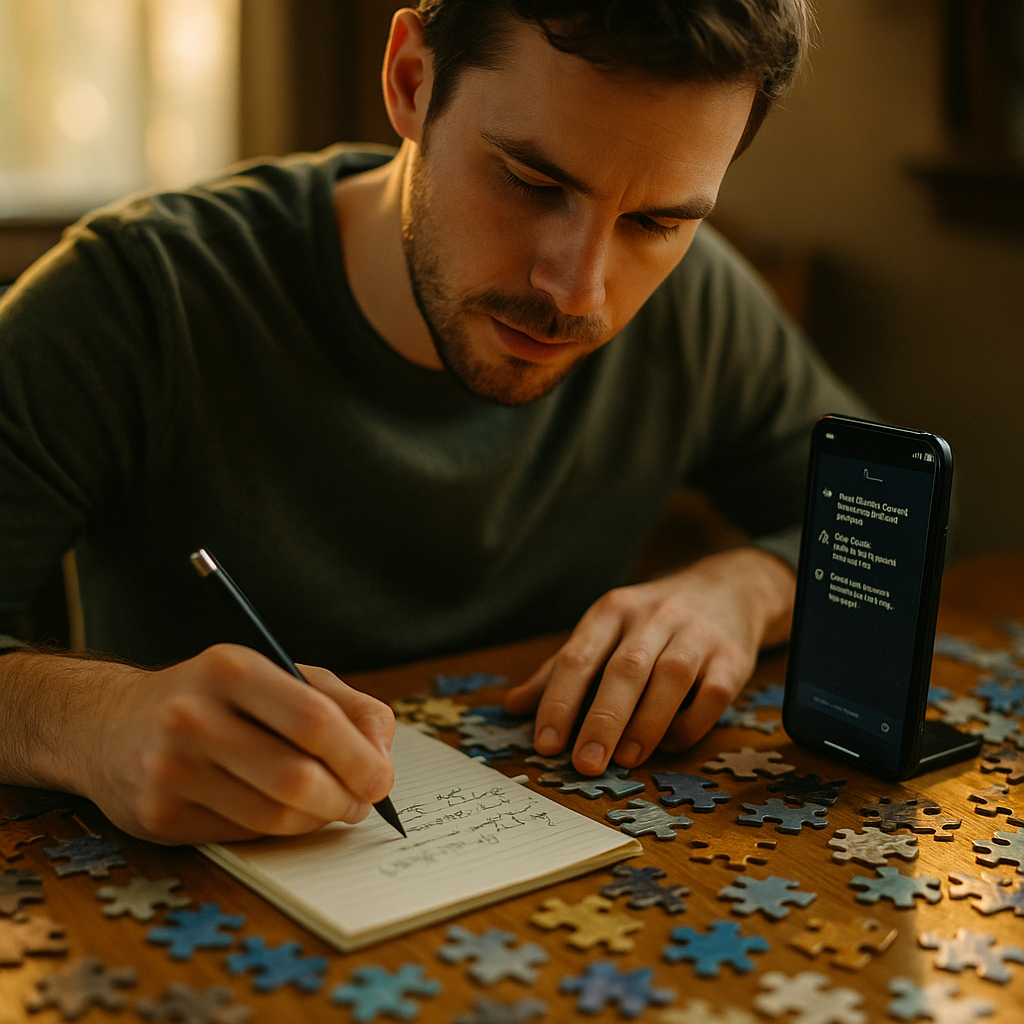
Videos that ask viewers to solve something before they can scroll away are outperforming straight product demos by wide margins on watch time. Creators have figured out what casino game designers and crossword editors have known for decades: an unresolved question is harder to abandon than a finished one. That psychological hook is why puzzle style creator content, riddles, visual gags, spot the difference edits, is spreading across TikTok, Instagram, and YouTube Shorts feeds right now, and why brands are starting to brief for it on purpose.
What Counts as Puzzle Style Content?
The category is broader than it sounds. It includes literal riddles delivered straight to camera, optical illusion product reveals, “spot the hidden item” carousels, math or logic brain teasers tied to a brand mechanic, and visual gags where the punchline only lands once you notice a detail you initially missed. Some creators build entire series around it. Others drop a single puzzle post between regular content to reset engagement after a slump.
What ties these formats together is a deliberate withholding of information. The hook isn’t “here’s something cool.” It’s “here’s something you can’t fully process yet.” That gap between presentation and resolution is the entire mechanism.
Why the Format Travels So Well Right Now
Three things are converging. First, platform algorithms reward completion rate and rewatch behavior, and puzzles naturally generate both because viewers rewind to check their answer or re-read a caption. Second, comment sections have become a core engagement surface, and puzzles give people an obvious reason to comment (“wait, I see it now”) rather than leaving a generic reaction. Third, audiences are fatigued by overt selling. A riddle feels like play, not pitch, which lowers the guard that usually goes up around branded content.
Puzzle content converts passive scrollers into active participants, and active participants are the ones platforms choose to show to more people.
There’s also a simpler explanation: puzzles are cheap to produce and easy to template. A creator doesn’t need a studio to film a “find the odd one out” grid or record a riddle voiceover over a product shot. That low production bar means the format scales across creator tiers, from six figure follower accounts down to nano creators doing brand deals for the first time.
The ROI Case Brands Actually Care About
Marketing leads evaluating this format should look past the novelty and at the metrics that matter for budget conversations: average watch time, saves, comment depth, and secondary shares. Puzzle formats consistently outperform on the first three because resolution requires attention, and attention requires time on screen. A viewer skimming a demo video can absorb the gist in two seconds and swipe. A viewer facing an unsolved riddle has to stay to get the payoff, or they feel like they lost.
That loss aversion dynamic is well documented in behavioral marketing research, and it’s one reason gamified formats outperform static ones across digital advertising generally, a pattern eMarketer’s engagement research has tracked across multiple content categories. For brands running always-on influencer programs, that translates into lower cost per engaged view even when the base CPM is identical to a standard post.
There’s a secondary benefit agencies underweight: puzzle content is unusually well suited to repurposing. A riddle video performs on TikTok, gets clipped into an Instagram carousel with the answer revealed on the last slide, and becomes a quiz sticker on Stories. One creative concept, three distribution formats, minimal incremental cost. That’s the kind of efficiency finance teams actually notice.
Visual Gags Do Different Work Than Riddles
It’s worth separating riddles from visual gags because they solve different briefs. Riddles are built for comment engagement and dwell time, they work best when the brand has a product with a genuine “aha” feature worth highlighting. Visual gags, think optical illusions, perspective tricks, or a sight gag that reframes the product mid video, are built for shareability and rewatches. They don’t need a correct answer to land, just a moment of surprise.
Brands selling anything with a visual transformation angle, beauty, home goods, fashion, food, lean naturally into visual gags. Brands selling something more abstract, software, finance, B2B services, tend to get more mileage out of structured riddles because they can encode a real product truth into the puzzle logic rather than relying purely on a visual twist.
Where Compliance and Brand Safety Teams Need to Pay Attention
Puzzle formats carry a specific risk that straightforward reviews don’t: the joke or riddle can obscure required disclosures. If a sponsored post is built around a visual gag, the #ad disclosure has to remain unambiguous even when the creative is deliberately misdirecting attention elsewhere. The FTC’s endorsement guidance doesn’t carve out an exception for comedic or puzzle formats, disclosure still needs to be clear and conspicuous, not buried in a caption the viewer has to pause and zoom in to read.
There’s also a subtler risk: some riddle formats depend on withholding information the FTC would classify as a material claim, like implying a product does something it doesn’t until the “reveal” corrects it. Legal review should treat the full video, setup and payoff, as a single claim, not just the final frame. Agencies that build approval workflows for trend-jacking content already have a process for this kind of rapid-turnaround review, and the same logic applies here. Our trend jacking frameworks piece covers how teams compress review timelines without skipping the compliance checklist, and it’s a useful template for puzzle briefs that also need fast turnaround.
Treat the setup and the punchline as one claim during legal review. A misleading gag that gets “corrected” in the last three seconds is still a misleading gag for the first seven.
Briefing Creators for Puzzle Content Without Killing the Format
This is where most brand briefs go wrong. Marketers see the engagement numbers and ask creators to “make a riddle about our product,” without understanding that a bad riddle (too easy, too obscure, or too obviously an ad setup) kills the exact mechanism that made the format work. A few operating principles help:
- Let the creator own the puzzle logic. They know what their specific audience finds satisfying to solve. A brand dictating the exact riddle wording usually produces something that reads like copy, not play.
- Build in a visible solve rate. Comment prompts like “comment your guess before you scroll” give you a usable engagement metric and give the algorithm a reason to extend reach.
- Keep the product integration native to the solution, not the setup. The product should be the answer, not an interruption before the real content starts.
- Plan for a follow-up reveal post. The highest performing puzzle series post the answer or explanation as a second piece of content a day later, which doubles the touchpoints without doubling production cost.
Creators who already run POV or reaction-style formats tend to adapt puzzle mechanics quickly because the core skill, holding attention through delayed payoff, overlaps heavily. Teams building scripts for this kind of delayed-reveal pacing can borrow structure from our POV format scripts guide, which breaks down how to sequence reveal moments for maximum retention. The same pacing logic that makes a product reveal feel earned instead of abrupt is exactly what makes a riddle’s resolution satisfying instead of flat.
Measuring What Actually Matters
Standard influencer reporting templates weren’t built with puzzle content in mind, and that’s a gap worth fixing before a campaign launches, not after. Track completion rate and average watch percentage alongside comment sentiment, not just comment volume, since a flood of wrong guesses is a different signal than a flood of correct ones. Saves are a particularly strong indicator here because viewers save puzzle content to revisit or share with a friend who’ll also try to solve it, which is a second-order distribution effect most dashboards undercount. Platforms like Sprout Social’s analytics tools and native platform insights through Meta Business Suite both surface save and share data that standard engagement rate calculations tend to flatten out.
Agencies running low-budget UGC pipelines can apply the same logic to puzzle briefs that they apply to other high-output, low-cost formats. The structure in our low cost UGC briefs article, templated prompts, fast turnaround, minimal production, maps cleanly onto riddle and visual gag content, since both depend on volume testing more than single-asset polish.
Is This a Passing Trend or a Durable Format?
Puzzle mechanics aren’t new, game shows and print riddles have used the same psychology for a century. What’s new is the distribution speed and the measurability. A format that used to take a week to circulate through a newspaper now gets tested, iterated, and scaled across a creator roster in a single afternoon. That durability argument matters for budget planning: this isn’t a meme trend that dies in a news cycle, it’s a content mechanic rooted in attention psychology, which means it’ll keep resurfacing in new visual wrappers even after the current aesthetic (optical illusion edits, spot-the-difference grids) ages out.
Brands should budget for puzzle content the way they budget for comparison or review formats: as a recurring content type in the mix, not a one-off experiment. The creative wrapper will change. The underlying mechanic, delayed resolution driving attention, won’t.
Quick Takeaway
Start with one low-stakes riddle or visual gag post per creator per month, measure completion rate and saves against your current best-performing format, and scale the briefs that beat your baseline rather than guessing which puzzle style will land.
Frequently Asked Questions
What makes puzzle style creator content perform better than standard posts?
The unresolved question forces viewers to stay on screen longer to get the payoff, which boosts watch time and completion rate, both signals platform algorithms use to extend organic reach.
Do riddles and visual gags need FTC disclosures like any other sponsored post?
Yes. Disclosure requirements apply to the entire video regardless of format, and the clear and conspicuous standard from the FTC still applies even when the creative misdirects attention toward a joke or puzzle.
Which brand categories benefit most from puzzle style content?
Visual-transformation categories like beauty, fashion, food, and home goods tend to do well with visual gags, while brands with less visual products, like software or finance, often get more traction from structured riddles that encode a real product benefit into the puzzle logic.
How should brands measure success for this content type?
Prioritize completion rate, average watch percentage, saves, and comment sentiment over raw comment volume or like count, since puzzle content tends to under-index on likes but over-index on saves and shares.
Is puzzle style content a short-term trend?
The visual wrapper will evolve, but the underlying mechanic, delayed resolution holding attention, is based on durable behavioral psychology, so brands should treat it as a recurring content category rather than a one-off trend to chase.
Top Influencer Marketing Agencies
The leading agencies shaping influencer marketing in 2026
Agencies ranked by campaign performance, client diversity, platform expertise, proven ROI, industry recognition, and client satisfaction. Assessed through verified case studies, reviews, and industry consultations.
Moburst

-
2

The Shelf
Boutique Beauty & Lifestyle Influencer AgencyA data-driven boutique agency specializing exclusively in beauty, wellness, and lifestyle influencer campaigns on Instagram and TikTok. Best for brands already focused on the beauty/personal care space that need curated, aesthetic-driven content.Clients: Pepsi, The Honest Company, Hims, Elf Cosmetics, Pure LeafVisit The Shelf → -
3

Audiencly
Niche Gaming & Esports Influencer AgencyA specialized agency focused exclusively on gaming and esports creators on YouTube, Twitch, and TikTok. Ideal if your campaign is 100% gaming-focused — from game launches to hardware and esports events.Clients: Epic Games, NordVPN, Ubisoft, Wargaming, Tencent GamesVisit Audiencly → -
4

Viral Nation
Global Influencer Marketing & Talent AgencyA dual talent management and marketing agency with proprietary brand safety tools and a global creator network spanning nano-influencers to celebrities across all major platforms.Clients: Meta, Activision Blizzard, Energizer, Aston Martin, WalmartVisit Viral Nation → -
5

The Influencer Marketing Factory
TikTok, Instagram & YouTube CampaignsA full-service agency with strong TikTok expertise, offering end-to-end campaign management from influencer discovery through performance reporting with a focus on platform-native content.Clients: Google, Snapchat, Universal Music, Bumble, YelpVisit TIMF → -
6

NeoReach
Enterprise Analytics & Influencer CampaignsAn enterprise-focused agency combining managed campaigns with a powerful self-service data platform for influencer search, audience analytics, and attribution modeling.Clients: Amazon, Airbnb, Netflix, Honda, The New York TimesVisit NeoReach → -
7

Ubiquitous
Creator-First Marketing PlatformA tech-driven platform combining self-service tools with managed campaign options, emphasizing speed and scalability for brands managing multiple influencer relationships.Clients: Lyft, Disney, Target, American Eagle, NetflixVisit Ubiquitous → -
8

Obviously
Scalable Enterprise Influencer CampaignsA tech-enabled agency built for high-volume campaigns, coordinating hundreds of creators simultaneously with end-to-end logistics, content rights management, and product seeding.Clients: Google, Ulta Beauty, Converse, AmazonVisit Obviously →