


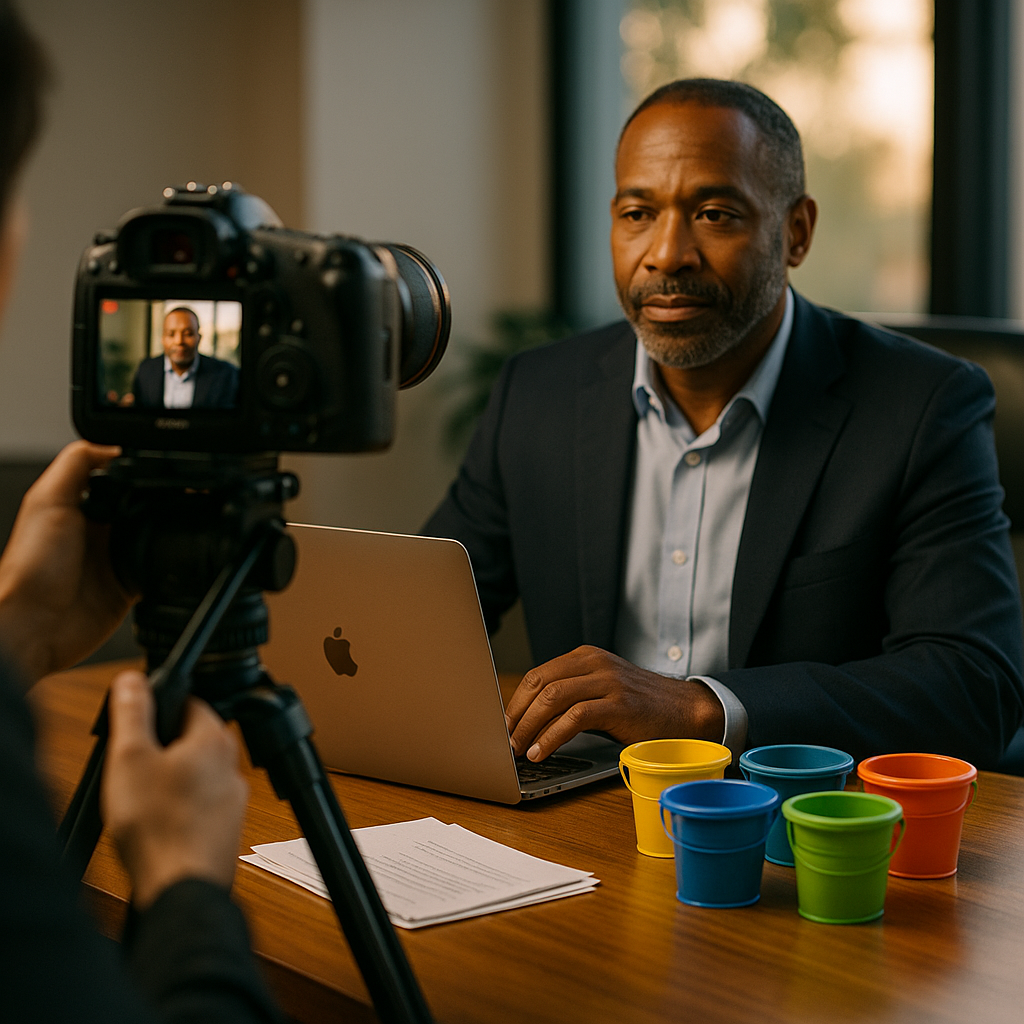
LinkedIn’s own data shows video posts get five times more engagement than text updates, yet most CXO video series die within two quarters. Not because the founder loses interest, but because nobody budgeted for the editor, the strategist, or the distribution spend that makes long-form founder content actually work. Planning long-form founder content means treating it like a media product with a P&L, not a vanity project squeezed into someone’s Friday afternoon.
Why Founder Video Became a Budget Line Item, Not a Favor
Three years ago, founder video was a nice-to-have: a few iPhone clips, maybe a podcast guest spot. Now it’s a demand-gen channel with its own forecasting cycle. B2B buyers trust people over logos, and a CEO who shows up weekly with a sharp point of view builds pipeline faster than another gated whitepaper ever will.
But here’s the catch nobody says out loud in the planning meeting: a credible CXO video series costs more than most brands budget for in year one. You’re not paying for a camera. You’re paying for strategy, pre-production, editing, repurposing, and paid amplification, stacked on top of the most expensive calendar in the building (your executive’s time).
A weekly CXO video series that actually moves pipeline rarely costs less than 8,000 to 15,000 euros a month once you account for production, editing, and distribution, not the 500 euro “just hire a videographer” estimate most teams start with.
Breaking Down the Real Budget
Most planning docs list one line: “video production.” That’s where the surprises start. A realistic CXO series budget splits into five buckets:
- Pre-production and strategy: topic ideation, scripting, research briefs. Usually 10 to 15 percent of total spend, and the bucket teams cut first (mistake).
- Production: filming days, crew, lighting, studio or location costs. This scales fastest if you’re filming in multiple cities or need broadcast-quality output.
- Post-production: editing, captions, motion graphics, platform-specific cuts (a 20-minute LinkedIn interview becomes six 60-second verticals for TikTok and Instagram).
- Distribution and paid amplification: boosting on LinkedIn, running clips as paid social, syndicating to YouTube and podcast platforms.
- Governance and measurement: someone has to track what’s working, report to finance, and justify renewal. This is the bucket almost nobody budgets for, and it’s the one that determines whether the series survives budget season.
If you’re still building your core rate card for creator and production spend, the logic in rebuilding influencer rate cards applies just as well to internal production vendors. Know your baseline before fees creep up on renewal.
Who Actually Runs This Thing?
Here’s a question that derails more CXO video programs than budget ever does: who owns it day to day? Marketing wants editorial control. Comms wants message discipline. The founder wants creative freedom. Without a clear owner, you end up with a series that limps along on goodwill until someone’s calendar gets too full.
The teams that make this work assign a single producer, often a senior content manager or an external agency lead, who owns the calendar, chases the founder for filming slots, and manages the edit queue. This person reports into a RACI that spans marketing, comms, and legal (yes, legal, especially if the founder talks about pricing, competitors, or forward-looking statements). If you haven’t mapped that structure yet, the framework in cross functional creator governance is a solid starting point, even though it was written for external creators rather than internal executives.
A fair number of companies also face the build-versus-buy question here: hire an in-house video producer, or retain an agency that specializes in executive content? The headcount math in in house vs agency creator managers is worth running before you post a job req, because a full-time in-house hire only pencils out once you’re producing weekly, not monthly.
Cadence Is a Budget Decision, Not a Creative One
Weekly, biweekly, or monthly? This feels like a creative call but it’s really a resourcing call wearing a creative costume. Weekly cadence demands a dedicated producer, a standing filming slot on the executive’s calendar, and an edit pipeline that doesn’t bottleneck. Monthly cadence is more forgiving but risks losing algorithmic momentum, since platforms like LinkedIn and YouTube reward consistency.
Most mid-market B2B brands land on biweekly as the sustainable middle ground: enough frequency to build an audience habit, light enough to survive a founder’s travel schedule. Whatever cadence you pick, build in a buffer. Founders cancel. Flights get delayed. If your entire pipeline depends on one filming day a month with zero slack, one missed session blows up your quarter.
This is the same discipline that governs always-on creator spend generally. The governance principles in always on creator spend governance translate directly: build a cadence the system can sustain under stress, not just under ideal conditions.
What Does Success Actually Look Like?
Here’s where a lot of CXO series get judged unfairly. Marketing leadership expects pipeline attribution within a quarter, but long-form founder content behaves more like brand building than performance marketing. View counts and watch time are early signals; pipeline influence shows up on a longer curve, usually two to three quarters in.
Set OKRs that reflect that reality. Early milestones: subscriber growth on the series, average watch time, share of comments from target-account employees. Later milestones: self-reported attribution in sales calls, inbound demo requests referencing specific episodes, sales cycle acceleration for accounts exposed to the series. The framework in creator program OKRs is built for external creator spend but the staged-measurement logic maps cleanly onto founder content too.
Don’t skip the finance conversation either. A CXO series without a documented ROI story gets cut at the first budget review, no matter how good the content is. If you need language that lands with a CFO, the scorecard approach in creator tier ROI scorecards gives you a template for framing soft metrics in hard financial terms.
The Mistakes That Sink These Programs
A few patterns show up again and again in failed founder video series:
- Underfunding distribution. Teams spend 90 percent of budget on production and nothing on amplification, so a brilliant episode reaches 400 organic views and dies.
- No repurposing plan. One long-form interview should generate a podcast episode, five to eight short clips, a blog recap, and a newsletter feature. Shooting once and posting once wastes most of the production cost.
- Treating the founder as talent, not a stakeholder. The best series involve the executive in topic selection early, so they show up energized instead of reading a script cold.
- No reforecasting trigger. If three months of data show weak engagement, teams keep the series running on autopilot because nobody defined what “pivot” looks like in advance. The reforecasting logic in creator budget reforecasting triggers is worth adapting for exactly this scenario.
The single biggest predictor of a CXO video series surviving past its first renewal cycle isn’t production quality. It’s whether someone budgeted for distribution and repurposing from day one.
Industry benchmarks back this up. According to eMarketer, video now accounts for the majority of time spent on B2B social platforms, and LinkedIn’s own guidance recommends native video uploads over external links to maximize reach, which has direct implications for how you allocate your distribution budget. Meanwhile, HubSpot’s research on content marketing consistently shows that repurposed long-form content outperforms single-use assets on cost per engagement, which is exactly why the repurposing line item deserves real budget rather than an afterthought.
Building the Pitch for Leadership
If you’re building the business case for next quarter, frame it in three numbers: total program cost across all five buckets, expected reach and engagement range based on comparable B2B executive series, and the staged measurement plan showing when pipeline attribution becomes visible. Leadership rarely rejects a well-scoped CXO video series. They reject vague ones with no cost discipline and no defined checkpoint for cutting losses.
Also build a contingency line for talent risk. Executives change jobs, get promoted, or simply burn out on being on camera weekly. A series anchored entirely on one personality has a shelf life tied to that person’s tenure and patience, so document the format and process well enough that a new executive could step in without rebuilding the whole operation from scratch.
Next Step
Before you greenlight a CXO video series, price out all five budget buckets, not just production, and name one accountable owner who controls the calendar end to end. Everything else, cadence, measurement, repurposing, follows from getting those two decisions right.
Frequently Asked Questions
How much should a brand budget for a monthly CXO video series?
A realistic monthly budget for a professionally produced CXO video series typically ranges from 3,000 to 8,000 euros depending on production quality, editing volume, and paid distribution spend. Weekly cadence programs with heavier repurposing and amplification can run considerably higher.
Who should own a CXO video series internally?
A single producer or senior content manager should own the calendar, filming logistics, and edit pipeline, reporting into a cross-functional structure that includes marketing, communications, and legal review for executive statements.
How long before a founder video series shows pipeline impact?
Most programs show early engagement signals within the first quarter but meaningful pipeline attribution usually takes two to three quarters, since long-form founder content functions more like brand building than direct response marketing.
Should we hire an in-house video producer or use an agency?
Weekly cadence programs often justify an in-house hire, while monthly or biweekly series are usually more cost-effective with a specialized agency retainer. Run the headcount math against your actual production volume before deciding.
What’s the biggest budget mistake teams make with founder video?
Overspending on production and underfunding distribution and repurposing, which leaves strong content with minimal reach because there’s no budget left to amplify or repackage it across platforms.
Top Influencer Marketing Agencies
The leading agencies shaping influencer marketing in 2026
Agencies ranked by campaign performance, client diversity, platform expertise, proven ROI, industry recognition, and client satisfaction. Assessed through verified case studies, reviews, and industry consultations.
Moburst

-
2

The Shelf
Boutique Beauty & Lifestyle Influencer AgencyA data-driven boutique agency specializing exclusively in beauty, wellness, and lifestyle influencer campaigns on Instagram and TikTok. Best for brands already focused on the beauty/personal care space that need curated, aesthetic-driven content.Clients: Pepsi, The Honest Company, Hims, Elf Cosmetics, Pure LeafVisit The Shelf → -
3

Audiencly
Niche Gaming & Esports Influencer AgencyA specialized agency focused exclusively on gaming and esports creators on YouTube, Twitch, and TikTok. Ideal if your campaign is 100% gaming-focused — from game launches to hardware and esports events.Clients: Epic Games, NordVPN, Ubisoft, Wargaming, Tencent GamesVisit Audiencly → -
4

Viral Nation
Global Influencer Marketing & Talent AgencyA dual talent management and marketing agency with proprietary brand safety tools and a global creator network spanning nano-influencers to celebrities across all major platforms.Clients: Meta, Activision Blizzard, Energizer, Aston Martin, WalmartVisit Viral Nation → -
5

The Influencer Marketing Factory
TikTok, Instagram & YouTube CampaignsA full-service agency with strong TikTok expertise, offering end-to-end campaign management from influencer discovery through performance reporting with a focus on platform-native content.Clients: Google, Snapchat, Universal Music, Bumble, YelpVisit TIMF → -
6

NeoReach
Enterprise Analytics & Influencer CampaignsAn enterprise-focused agency combining managed campaigns with a powerful self-service data platform for influencer search, audience analytics, and attribution modeling.Clients: Amazon, Airbnb, Netflix, Honda, The New York TimesVisit NeoReach → -
7

Ubiquitous
Creator-First Marketing PlatformA tech-driven platform combining self-service tools with managed campaign options, emphasizing speed and scalability for brands managing multiple influencer relationships.Clients: Lyft, Disney, Target, American Eagle, NetflixVisit Ubiquitous → -
8

Obviously
Scalable Enterprise Influencer CampaignsA tech-enabled agency built for high-volume campaigns, coordinating hundreds of creators simultaneously with end-to-end logistics, content rights management, and product seeding.Clients: Google, Ulta Beauty, Converse, AmazonVisit Obviously →