


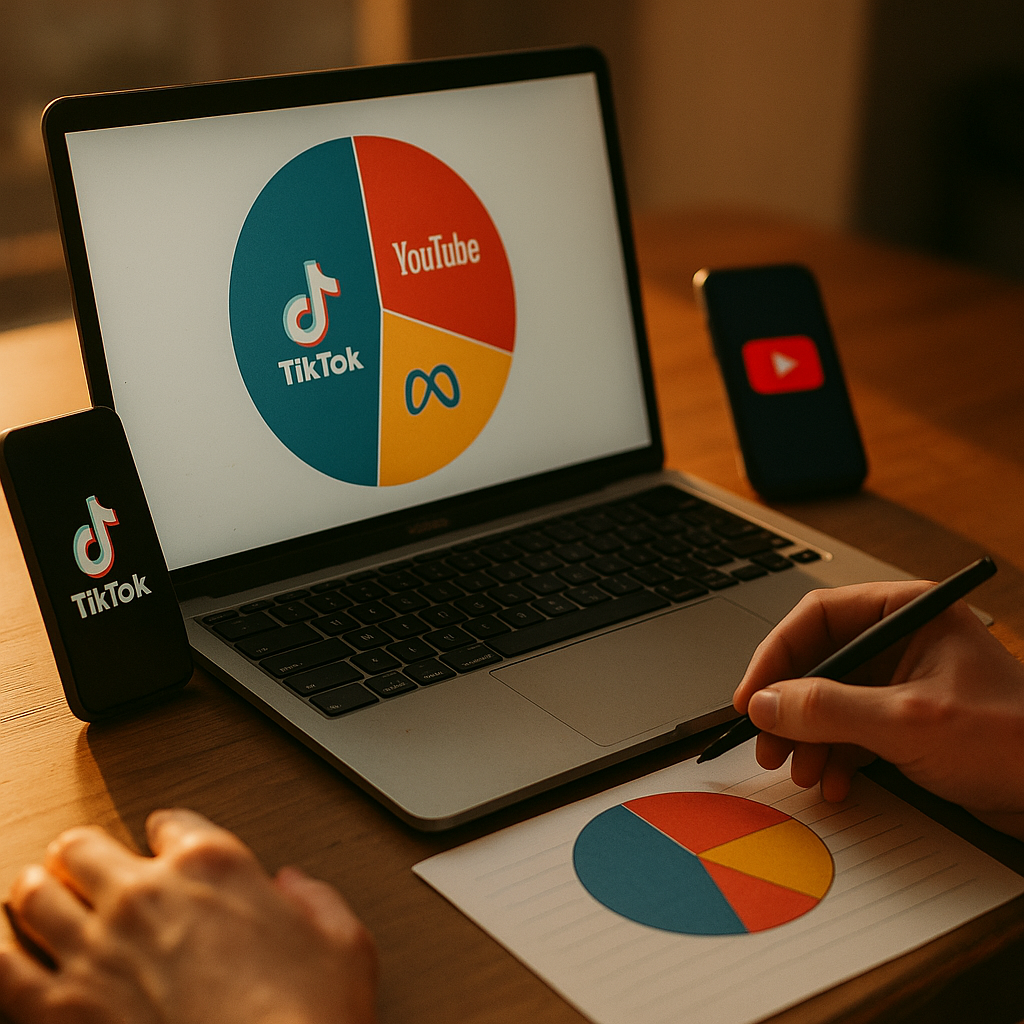
Here’s an uncomfortable truth heading into 2027: most brands still allocate paid amplification budgets the way they did three years ago, splitting dollars by gut feel instead of performance data. Paid amplification budget splits by platform now determine whether a six-figure creator program actually moves revenue or just inflates vanity metrics. Get the mix wrong and you’re funding reach on a platform your buyers already ignored.
The Platform Mix Is Shifting Faster Than Your Spreadsheet
Three years ago, a typical paid amplification split looked predictable: Meta took the lion’s share, YouTube got a supporting role, and everything else was an afterthought. That math no longer holds. TikTok’s ad infrastructure has matured into a genuine performance channel, not just a brand-awareness play, and Spark Ads whitelisting now rivals Meta’s partnership ads in sophistication.
Meanwhile, YouTube Shorts has quietly absorbed budget that used to live in Instagram Reels boosting, and LinkedIn’s organic-to-paid creator amplification is no longer a niche B2B tactic. If your 2024 media plan still treats these as fixed percentages, you’re planning for a market that doesn’t exist anymore.
The brands winning in 2027 aren’t the ones spending the most on paid amplification. They’re the ones rebalancing the split every quarter based on where conversion actually happens, not where impressions are cheapest.
How Much of the Total Creator Budget Should Even Go to Amplification?
Before you split by platform, settle the bigger question: what percentage of total creator spend goes to paid amplification versus organic-only partnerships? Most mature programs now land somewhere between 25% and 40% of total influencer budget going toward boosting or whitelisting top-performing content. Below that range, you’re likely under-amplifying winners. Above it, you risk propping up mediocre creative with media dollars instead of fixing the content.
This isn’t a universal rule. A DTC brand running always-on TikTok Shop campaigns might push amplification spend toward 50%, because the platform’s algorithm rewards paid boosting of organic winners so heavily. A B2B brand running quarterly thought-leadership pushes on LinkedIn might sit closer to 15%, since reach matters less than targeting precision. For a deeper look at how total creator spend breaks down by tier and content type, our piece on allocating amplification by tier walks through the math in more detail.
A Workable Core Split for the Year Ahead
Strip away the platform-specific nuance and most enterprise and mid-market brands planning for the year ahead are converging on a rough baseline. Treat this as a starting point, not gospel:
- Meta (Instagram and Facebook): 30-38% of paid amplification budget. Still the default for retargeting and lookalike scaling, even as organic reach declines.
- TikTok: 25-35%. Growing fastest, especially for brands with TikTok Shop integration or younger audience skew.
- YouTube (including Shorts): 15-20%. The go-to for longer-form consideration content and brand lift campaigns.
- LinkedIn: 5-10% for B2B brands, often 0% for consumer brands.
- Emerging/experimental (Pinterest, Reddit, Snapchat, niche platforms): 5-10%, reserved for testing budget.
Notice what’s missing from that list: a fixed number for “always-on” versus campaign-based spend. That’s intentional. Always-on creator spend requires different governance than campaign bursts, and lumping them into one percentage hides where the actual waste lives.
Why TikTok’s Share Keeps Climbing
TikTok’s advertising platform has closed much of the gap with Meta on targeting sophistication, and TikTok’s own ads resources now push Spark Ads as the default for brand-creator amplification rather than a bolt-on feature. The practical implication: if your team still treats TikTok boosting as an experimental line item, you’re underfunding the one platform where organic-to-paid conversion is often fastest.
That said, TikTok Shop budgets deserve their own line item entirely, separate from general TikTok amplification. Our breakdown on modeling TikTok Shop creator budgets covers how to scenario-plan that spend across base, accelerated, and shock cases, which matters more now that commission structures keep shifting.
Platform Selection Isn’t Just About Reach, It’s About Risk
Every platform carries a different compliance and brand-safety profile, and that should factor into your split just as much as CPMs do. Meta’s ad library and disclosure tools are relatively mature, which the FTC’s endorsement guidance has effectively normalized across the industry. TikTok and newer platforms are still catching up on consistent disclosure enforcement, which means your legal and compliance review needs to scale alongside your spend there, not after it.
This is where a lot of mid-size brands get caught flat-footed. They shift 15 points of budget toward TikTok because performance data says to, but their contract templates and usage rights language were written for a Meta-first world. If you haven’t revisited your paperwork recently, it’s worth pairing this budget exercise with a review of standardized creator contracts covering usage rights across platforms, so the legal foundation doesn’t lag behind the media plan.
Boosted Posts, Whitelisting, and Spark Ads: Know Which Lever You’re Pulling
Not all paid amplification is the same, and lumping it together in a budget spreadsheet creates false precision. Three distinct mechanics dominate the space right now:
- Boosted posts: The cheapest and least precise option. Good for quick reach extension, weak on targeting control.
- Whitelisting/partnership ads: Running paid media through the creator’s handle with advertiser-level targeting. Higher setup cost, significantly better performance data.
- Spark Ads (TikTok-specific) and similar native formats: Blend organic social proof with paid targeting, often outperforming both boosted posts and traditional ad units on engagement rate.
Your platform split should actually be two splits layered together: platform allocation, then mechanic allocation within each platform. A brand spending 30% of amplification budget on Meta but putting all of it into simple boosted posts is leaving performance on the table compared to one running whitelisting through its top-tier creators.
Build the Split to Move, Not Sit Still
The biggest mistake in paid amplification planning isn’t picking the wrong starting percentages. It’s treating those percentages as fixed for the full year. Platform algorithms change, CPMs spike, and a creator’s audience can shift demographics in a single viral moment. A static annual split guarantees you’ll be over-invested somewhere by Q3.
Instead, build quarterly checkpoints tied to actual performance data, not calendar convenience. If TikTok CPMs jump 20% in a quarter while Meta’s targeting improves, the split should move with it. Our framework on quarterly portfolio rebalancing offers a tiered model for exactly this kind of mid-year adjustment, and pairing it with defined reforecasting triggers keeps the shift from becoming a political negotiation every time it happens.
Platforms like Sprout Social and HubSpot publish benchmark data regularly that’s useful for sanity-checking your internal numbers against broader industry trends, particularly on engagement rate decay and platform-specific CPM movement. Don’t treat any single benchmark report as gospel, but use three or four in combination to spot directional shifts before they show up in your own reporting dashboard.
Who Should Own This Decision?
Budget splits by platform shouldn’t live solely with the media buying team or solely with the creator partnerships team. The platforms where creators perform best organically aren’t always the platforms where paid media converts most efficiently, and that tension needs a shared owner. If your organization hasn’t formalized who signs off on quarterly reallocation, that gap will show up as slow decision-making right when speed matters most. A clear cross-functional governance structure solves this before it becomes a Q4 fire drill.
FAQs
Frequently Asked Questions
What percentage of total influencer budget should go to paid amplification?
Most mature programs allocate between 25% and 40% of total creator budget to paid amplification. The exact figure depends on platform mix, with TikTok Shop-heavy programs often pushing higher and B2B LinkedIn programs sitting lower.
How often should brands reassess platform budget splits?
Quarterly reviews are the practical minimum given how fast CPMs and algorithm behavior shift across platforms. Some high-spend programs now run monthly checkpoints tied to specific performance thresholds rather than a fixed calendar.
Is Spark Ads better than traditional boosted posts?
Spark Ads and similar native amplification formats generally outperform simple boosted posts on engagement and conversion metrics because they preserve organic social proof while adding advertiser-level targeting. They typically cost more to set up, which is why allocation should account for mechanic, not just platform.
Should every platform get a fixed percentage of the amplification budget?
No. Fixed annual percentages tend to underperform compared to a baseline split adjusted quarterly against real performance data, CPM shifts, and platform algorithm changes.
How does TikTok Shop change the amplification math?
TikTok Shop budgets often need a separate line item from general TikTok amplification spend, since commission structures and conversion paths differ significantly from standard brand awareness campaigns on the platform.
Set your baseline split this week, tie it to one reforecasting trigger (a CPM swing, a conversion drop, or a platform policy change), and revisit it at the next quarterly review, not the next annual planning cycle.
Top Influencer Marketing Agencies
The leading agencies shaping influencer marketing in 2026
Agencies ranked by campaign performance, client diversity, platform expertise, proven ROI, industry recognition, and client satisfaction. Assessed through verified case studies, reviews, and industry consultations.
Moburst

-
2

The Shelf
Boutique Beauty & Lifestyle Influencer AgencyA data-driven boutique agency specializing exclusively in beauty, wellness, and lifestyle influencer campaigns on Instagram and TikTok. Best for brands already focused on the beauty/personal care space that need curated, aesthetic-driven content.Clients: Pepsi, The Honest Company, Hims, Elf Cosmetics, Pure LeafVisit The Shelf → -
3

Audiencly
Niche Gaming & Esports Influencer AgencyA specialized agency focused exclusively on gaming and esports creators on YouTube, Twitch, and TikTok. Ideal if your campaign is 100% gaming-focused — from game launches to hardware and esports events.Clients: Epic Games, NordVPN, Ubisoft, Wargaming, Tencent GamesVisit Audiencly → -
4

Viral Nation
Global Influencer Marketing & Talent AgencyA dual talent management and marketing agency with proprietary brand safety tools and a global creator network spanning nano-influencers to celebrities across all major platforms.Clients: Meta, Activision Blizzard, Energizer, Aston Martin, WalmartVisit Viral Nation → -
5

The Influencer Marketing Factory
TikTok, Instagram & YouTube CampaignsA full-service agency with strong TikTok expertise, offering end-to-end campaign management from influencer discovery through performance reporting with a focus on platform-native content.Clients: Google, Snapchat, Universal Music, Bumble, YelpVisit TIMF → -
6

NeoReach
Enterprise Analytics & Influencer CampaignsAn enterprise-focused agency combining managed campaigns with a powerful self-service data platform for influencer search, audience analytics, and attribution modeling.Clients: Amazon, Airbnb, Netflix, Honda, The New York TimesVisit NeoReach → -
7

Ubiquitous
Creator-First Marketing PlatformA tech-driven platform combining self-service tools with managed campaign options, emphasizing speed and scalability for brands managing multiple influencer relationships.Clients: Lyft, Disney, Target, American Eagle, NetflixVisit Ubiquitous → -
8

Obviously
Scalable Enterprise Influencer CampaignsA tech-enabled agency built for high-volume campaigns, coordinating hundreds of creators simultaneously with end-to-end logistics, content rights management, and product seeding.Clients: Google, Ulta Beauty, Converse, AmazonVisit Obviously →